DALLAS--(BUSINESS WIRE)--Jun 23, 2026--
Jacobs (NYSE: J) is serving as the Dormitory Authority of the State of New York’s (DASNY) technical advisor for the progressive design-build project delivering the New York State Department of Health’s new Wadsworth Center Public Health Laboratory, an advanced public health laboratory in Albany.
This press release features multimedia. View the full release here: https://www.businesswire.com/news/home/20260623964879/en/
The new 663,000 gross–square foot five-story laboratory will support highly specialized clinical, environmental and research activities. The planned new $1.7 billion Wadsworth Center will consolidate multiple laboratory sites into a single, modern campus, strengthening New York’s long-term public health readiness, research capacity and ability to respond to emerging biological and environmental threats.
Jacobs is providing consulting and technical advisory services across architectural, engineering and construction disciplines, representing DASNY and the New York State Department of Health while working with the design-build joint venture of Gilbane Building Company and Turner Construction Company, in association with HOK.
Jacobs Executive Vice President Imad Feghali said: “Large-scale public health laboratories demand rigorous technical oversight to support safety, reliability and adaptability over decades of operation. Jacobs’ independent technical advice is helping DASNY and the New York State Department of Health make informed decisions that advance regulatory compliance, operational resilience and long-term public health outcomes.”
The Wadsworth Center will fulfill a critical role in disease surveillance, outbreak response, environmental testing and newborn screening programs that protect communities in New York and beyond. The Wadsworth Center is a national reference laboratory recognized by the Centers for Disease Control and Prevention and other federal agencies. Construction is expected to be completed in 2030.
Around the world, Jacobs supports governments, healthcare providers and research institutions in planning and delivering complex health infrastructure and laboratory facilities. Engineering News-Record ranks Jacobs No. 1 in both healthcare and pharmaceuticals facilities. Jacobs has worked on more than 100 healthcare projects including the Johns Hopkins Medicine campus redevelopment in Baltimore, U.S., Christchurch Hospital in New Zealand and the Royal Prince Alfred Hospital redevelopment in Sydney.
At Jacobs, we're challenging today to reinvent tomorrow – delivering outcomes and solutions for the world’s most complex challenges. With approximately $12 billion in annual revenue and a talent force of approximately 47,000, we provide end-to-end services in advanced manufacturing, cities & places, energy, environmental, life sciences, transportation and water. From advisory and consulting, feasibility, planning, design, program and lifecycle management, we’re creating a more connected and sustainable world. See how at jacobs.com and connect with us on LinkedIn, Instagram, X and Facebook.
Certain statements contained in this press release constitute forward-looking statements within the meaning of the Private Securities Litigation Reform Act of 1995. Forward-looking statements are statements that do not directly relate to any historical or current fact. When used herein, words such as "expects," "anticipates," "believes," "seeks," "estimates," "plans," "intends," "future," "will," "would," "could," "can," "may," and similar words are intended to identify forward-looking statements. We base these forward-looking statements on management's current estimates and expectations, as well as currently available competitive, financial and economic data. Forward-looking statements, however, are inherently uncertain. There are a variety of factors that could cause business results to differ materially from our forward-looking statements including, but not limited to, uncertainties as to, the timing of the award of projects and funding and potential changes to the amounts provided for under the Infrastructure Investment and Jobs Act and other legislation and executive orders related to governmental spending, including any directive to federal agencies to reduce federal spending or the size of the federal workforce, and changes in U.S. or foreign tax laws, including the tax legislation enacted in the U.S. in July 2025, statutes, rules, regulations or ordinances, including the impact of, and changes to tariffs and retaliatory tariffs or trade policies, that may adversely impact our future financial positions or results of operations, as well as general economic conditions, including inflation and the actions taken by monetary authorities in response to inflation, changes in interest rates and foreign currency exchange rates, changes in capital markets, the possibility of a recession or economic downturn, and increased uncertainty and risks, including policy risks and potential civil unrest, relating to the outcome of elections across our key markets and elevated geopolitical tension and conflicts, among others. For a description of these and additional factors that may occur that could cause actual results to differ from our forward-looking statements, see our filings with the U.S. Securities and Exchange Commission. The company is not under any duty to update any of the forward-looking statements after the date of this press release to conform to actual results, except as required by applicable law.

The new facility will support highly specialized clinical, environmental and research activities.
PARIS (AP) — Millions of people across Europe were exposed to extreme and exceptional high temperatures on Tuesday, with 40 fatalities from drowning recorded in France in the past week as residents seek relief from the searing heat.
Temperatures will remain high around the clock in France, the European nation the most affected so far by the early summer heat wave. The national weather service, Meteo France, placed 54 departments, about half the country, under a red heat wave alert.
Italy, Spain, and Britain were also hit.
Human-caused climate change is tied to increasingly extreme weather, and U.N. climate agency projections say the next five years should shatter more heat records.
French Prime Minister Sébastien Lecornu said that the 40 people who died by drowning since last Thursday were mainly young people.
In a country without widespread air conditioning, schools, public transportation and sporting events have been impacted. In Paris, the Eiffel Tower adjusted its operations to the scorching weather, closing in the afternoon instead of late at night as it usually does. The Louvre museum said it would close two hours earlier than normal from Wednesday through Saturday.
“Although parts of its historic building are naturally resilient, the museum remains vulnerable and is not sufficiently adapted to climate change,” it said. “Heat buildup is greatest toward the end of the day and is further intensified by high visitor numbers.”
Extreme conditions are expected to last at least until the end of the week, with daytime highs above 40 degrees Celsius (104 degrees Fahrenheit) in many towns.
“Further record-breaking temperatures are expected, including some that could surpass all previous records, regardless of the time of year,” Meteo France said.
The heat wave is exceptionally intense, coming very early in the summer, “but with a still uncertain duration,” the weather service said. It has already been compared to the August 2003 heat wave, when the highest temperatures in over half a century caused an estimated 15,000 deaths, many of them among older people in apartments and retirement homes without air conditioning.
Europe is the world’s fastest-warming continent, with temperatures increasing twice as fast as the global average since the 1980s, according to the European Union’s Copernicus Climate Change Service. Over the last four years, more than 200,000 people across Europe died from heat-related causes, and most of those deaths were preventable, the World Health Organization’s Europe office said this month.
The above-average temperatures can cause heat exhaustion and life-threatening heat stroke.
Across the English Channel from France, many British schools said they were closing for the day and trains were disrupted as the Met Office, the U.K. weather agency, issued a red extreme heat warning for Wednesday and Thursday, with forecasts suggesting June’s all-time daily temperature record could be broken.
Temperatures of around 37 degrees C (98.6 F) are expected in southern England, with up to 35 C (95 F) in southeast Wales. The peak of the heat wave is now forecast for Wednesday and Thursday, when highs could reach at least 39 C (102.2 F). Conditions are expected to ease by Friday, the Met Office said.
On Tuesday multiple train operators across the U.K. said they were canceling train services to “ensure the safe operation of the railway.” National Rail, which operates the railway infrastructure, urged people to “only travel if absolutely necessary” on Wednesday and Thursday.
Further south on the continent, Spain is facing a heat wave across various parts of the Iberian Peninsula.
Spain’s national weather service, Aemet, issued red alerts Tuesday for temperatures of 44 C (111 F) in southern Andalusia as well as warnings of thermometers hitting 40 C (104 F) in the normally temperate Cantabria and the Basque Country regions along its northern Atlantic coast.
Aemet meteorologist Rubén del Campo said Spain, which has experienced increasingly torrid summers of late, is only going to get hotter because of climate change as heatwaves become more frequent, longer and appear outside the traditional window of July and August.
Of the dozen heatwaves Aemet has recorded in the month of June since it started tracking them in 1975, half have occurred since 2015, del Campo said.
Human-driven climate change is heating up the atmosphere, both above Spain and in the surrounding sea waters, he said.
Copernicus, the EU monitoring agency found that in Europe and globally, 2024 was the hottest year on record and the continent experienced its second-highest number of “heat stress” days.
Scientists warn that climate change is exacerbating the frequency and intensity of heat and dryness, especially in southeastern Europe, making the region more vulnerable to health impacts and wildfires.
The name of the body of water between France and the U.K. has been corrected to the “English Channel.”
Associated Press journalists Sylvia Hui in London and Joseph Wilson in Barcelona, Spain, contributed to this report.

People swim in an outdoor swimming pool in London, Tuesday, June 23, 2026 as a heat wave is predicted across Britain.(AP Photo/Alberto Pezzali)

Tourists use umbrellas to shelter from the sun as they visit the historical Spanish steps in Rome, Tuesday, June 23, 2026. (AP Photo/Alessandra Tarantino)

A man drinks on Westminster Bridge in London, as a heat wave is predicted Tuesday, June 23, 2026. (AP Photo/Kirsty Wigglesworth)

A man keeps his legs dry as he cycles through standing water in London, as a heat wave is predicted Tuesday, June 23, 2026. (AP Photo/Kirsty Wigglesworth)

An African penguin cools off in a basin in Kronber zoo, near Frankfurt, Germany, Tuesday, June 23, 2026. (AP Photo/Michael Probst)

A man keeps his legs dry as he cycles through standing water in London, as a heat wave is predicted Tuesday, June 23, 2026. (AP Photo/Kirsty Wigglesworth)

People cool off in a water spray at the Eiffel Tower in Paris, Sunday, June 21, 2026. (AP Photo/Michel Euler)
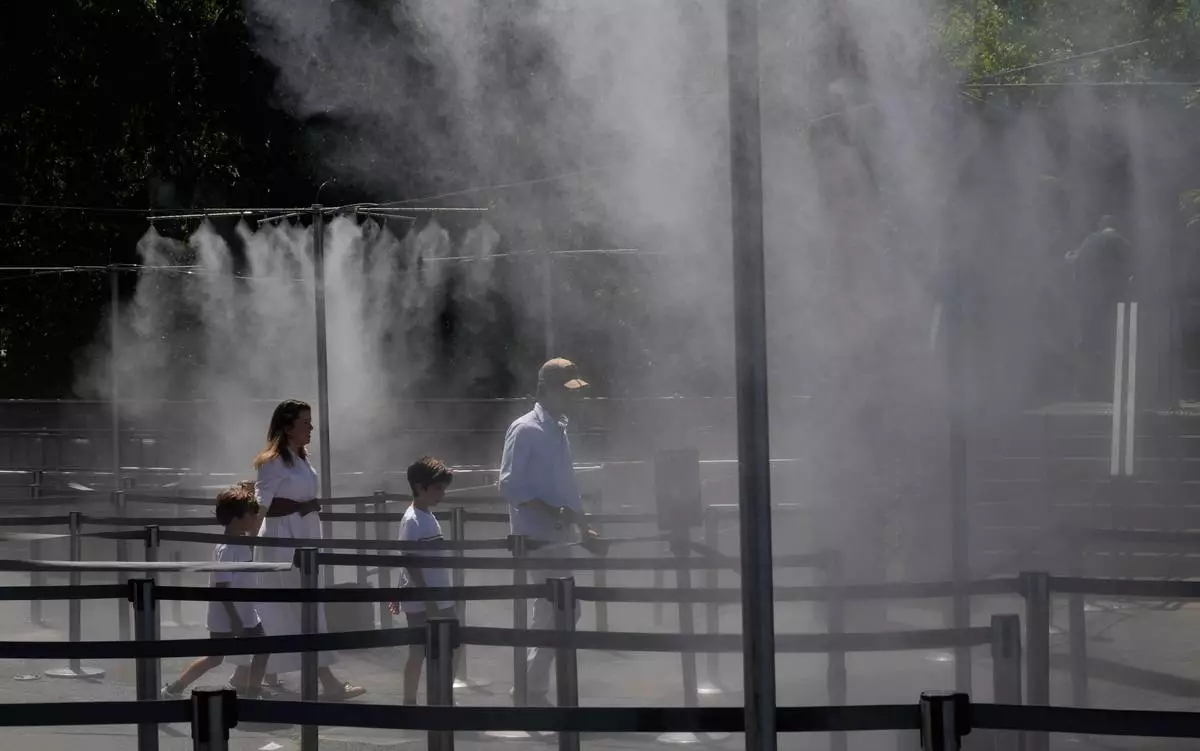
A family walks through a cooling water spray at the Eiffel Tower in Paris, Sunday, June 21, 2026. (AP Photo/Michel Euler)

A man shields himself from the sun with a scarf as he walks in the garden of the Palace of Versailles, outside Paris, during a heat wave with temperatures soaring above 40 degrees Celsius (104 Fahrenheit), Monday, June 22, 2026. (AP Photo/Thibault Camus)

Tourists with an umbrella take a photo in Paris, as France is enduring a grueling heat wave with temperatures soaring above 40 degrees Celsius (104 Fahrenheit), Monday, June 22, 2026. (AP Photo/Christophe Ena )
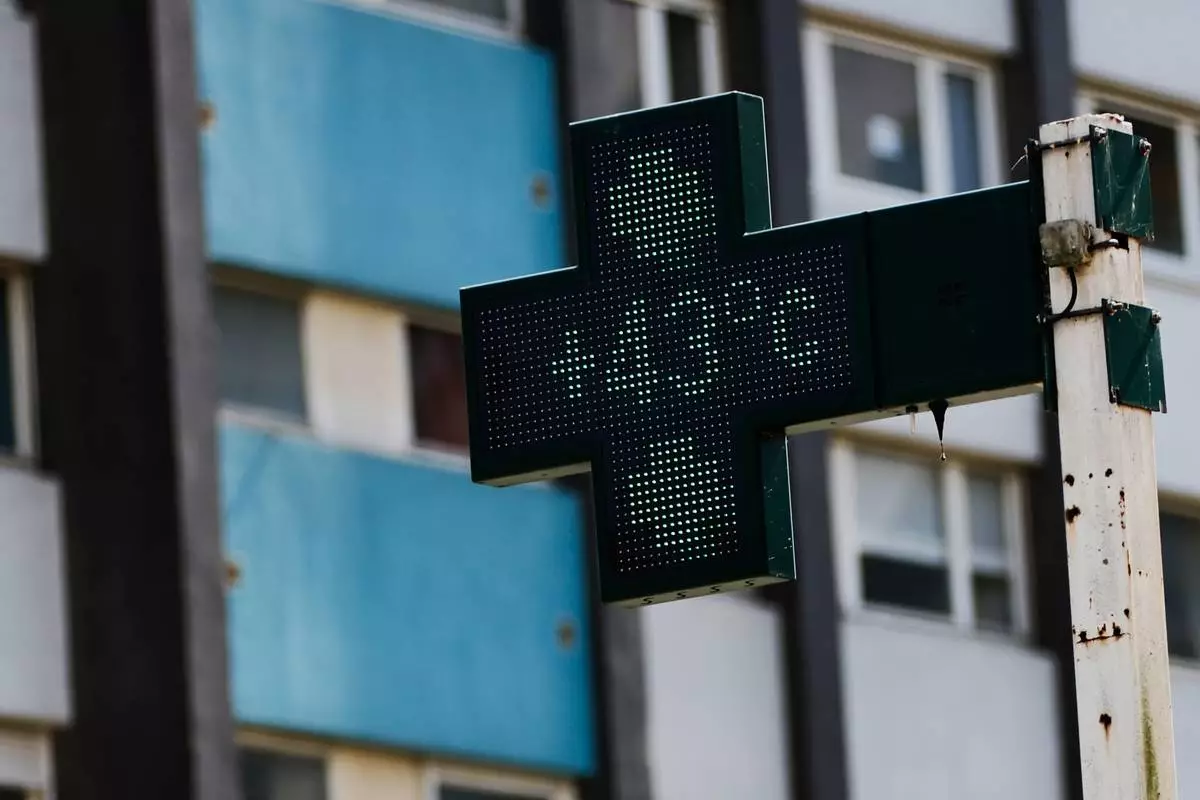
A drugstore sign shows the temperature 43 degrees Celsius (109,4 degrees Fahrenheit) in Rennes, western France, Monday, June 22, 2026. (AP Photo/Jeremias Gonzalez)