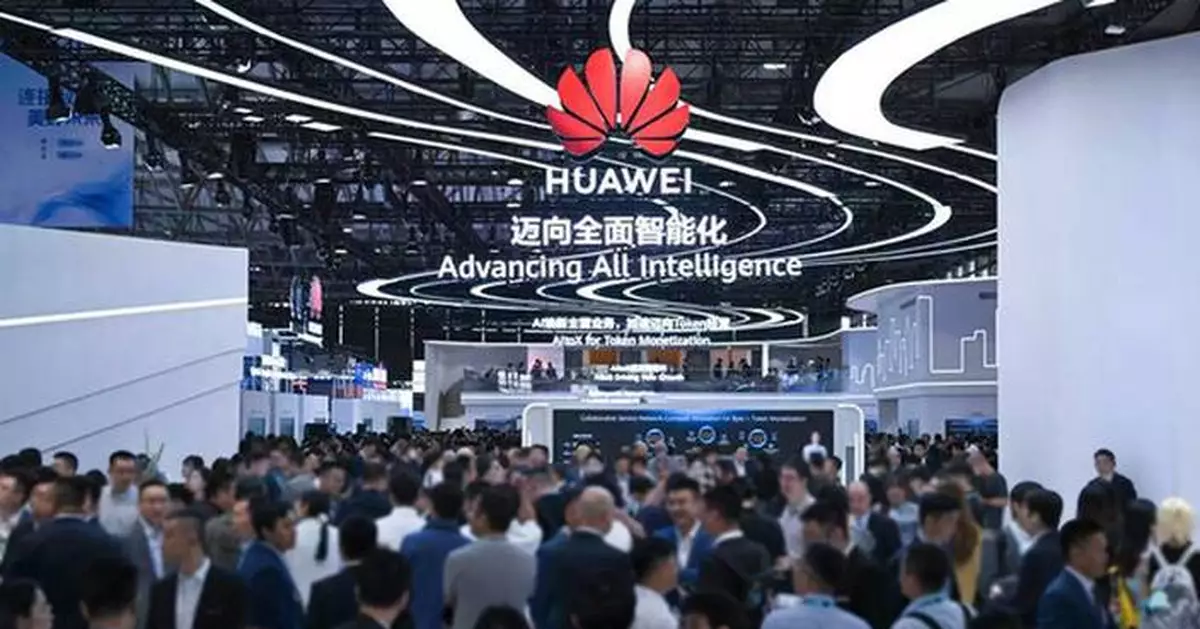
Shanghai, June 25, 2026 /PRNewswire/ -- At this year's MWC Shanghai, Huawei is showcasing its latest innovations which integrate services, networks, and compute to enable growth in terms of both bytes and tokens and help the telecom industry seize the opportunities presented by rapidly evolving AI models and agents. Boasting "Advancing All Intelligence", the company aims to join global carriers, industry partners, and key opinion leaders in exploring enhanced connectivity and compute, 5G-A high uplink and experience monetization, and AI-powered business upgrade.
At MWC Shanghai 2026, David Wang, Huawei's Deputy Chairman of the Board and Rotating Chairman, delivered a keynote speech on how AI is transforming mobile networks, paving the way for the next decade of industry growth.
Over the past 40 years, innovation in mobile technology from each generation to the next has been key to the industry's success. "With each generation, we have pushed the limits of spectral efficiency and performance," said Wang. "Network architecture has gradually flattened, with new application scenarios and services emerging left and right. This has consistently expanded the boundaries of communications, helping carriers translate network capabilities into commercial value."
"As mobile communications enters the age of intelligence, there are six key imperatives that will pave the way for the next decade of industry growth." They include:
- Developing new services and capabilities for future mobile communications systems
- Integrating AI with mobile communications to build three distinct layers of intelligence
- Building network architecture for integrated satellite-ground communications
- Advocating for sustainable and future-oriented spectrum planning and allocation
- Clearly defining the specifications of AI-native core networks
- Exploring new business models and application scenarios for mobile services
Huawei released a wide range of innovations during the event. Regarding services, the company, alongside China's three major carriers, released technological and business innovations in 5G-A high uplink and experience monetization, AI-powered business upgrade, and token monetization. For infrastructure, Huawei launched the AI-centric target network, which helps carriers enhance competitiveness in byte and token monetization. As part of this AI-centric target network, the basic communications network emphasizes a shift from traffic-centric networking to networking for real-time interaction in order to offer users guaranteed connectivity. It also takes advantage of high uplink and downlink, in addition to guaranteed technologies and networks, to deliver high-quality connectivity to users. The computing network emphasizes a shift from traffic transport to network-wide compute scheduling and supply, with the network designed for computing, and connecting to the network being equivalent to accessing compute. The AI computing infrastructure emphasizes high performance and efficiency, as well as support for open-source and open ecosystems.
To date, the number of 5G-A users worldwide has exceeded 100 million. Huawei is now working with global carriers to advance 5G-A experience monetization and make 5G-A an integral part of installed base operations, in a bid to retain mid-range and high-end users, increase average revenue per user (ARPU), and meet user needs for sustainable revenue growth.
High uplink is a key capability of carriers' network infrastructure in the token monetization era. The uplink requirements for mobile AI have grown increasingly prominent: AI glasses can now be used for translation and viewing exhibitions through real-time multimodal interaction, which requires 20 Mbps uplink speeds. This year, leading carriers around the world are moving fast to explore commercial high-uplink services through various capabilities to guarantee peak speeds, latency, and universal speeds in the uplink.
The boom in AI agents is expected to drive rapid growth in token services, which will require ultra-broadband networks that support high uplink, high reliability, and low latency. Upper-6 GHz (U6 GHz) is considered the next-generation golden frequency band for such networks, and the entire industry ecosystem stands ready to adopt it. From the perspective of global collaboration, more than 20 countries and regions have explicitly designated U6 GHz for International Mobile Telecommunications (IMT), covering nearly 80% of the world's population. In 2026, which marks the commercial debut of U6 GHz, the Middle East is expected to deploy the world's first commercial 5G-A network running on U6 GHz. A few carriers in Hong Kong and Macao of China will also initiate commercial U6 GHz deployment.
Huawei has said they will continue collaborating with carriers in Guangdong, Shanghai, Hebei, and other locations in 2026, to reengineer their B2C and B2H services with AI and create compelling offerings. Looking ahead, this will drive token consumption in areas like smart home assistants, personal communication assistants, and integrated consumer and home services. For the B2B market, the company plans to work alongside carriers to deliver AI computing services centered on the integration of compute and networks, unlocking new avenues of business growth.
Huawei hopes to continue leading the innovative application of AI-native technologies to autonomous networks, and has been working to develop domain-specific intelligence to lay the groundwork for level-4 autonomous networks. This year, Huawei will work with carriers to implement domain-specific intelligence across domains, including wireless network and transmission network, in key regions. The resulting synergy that will be achieved across the maintenance, optimization, energy efficiency, and experience aspects of networks will help carriers enhance both network quality and efficiency. It will also enable them to deliver differentiated products for a range of scenarios like high-speed rail, event venues, and campuses, thereby driving new network momentum.
** This press release is distributed by PR Newswire through automated distribution system, for which the client assumes full responsibility. **
Huawei Helps Global Carriers Monetize Tokens with Service-Network-Compute Integration