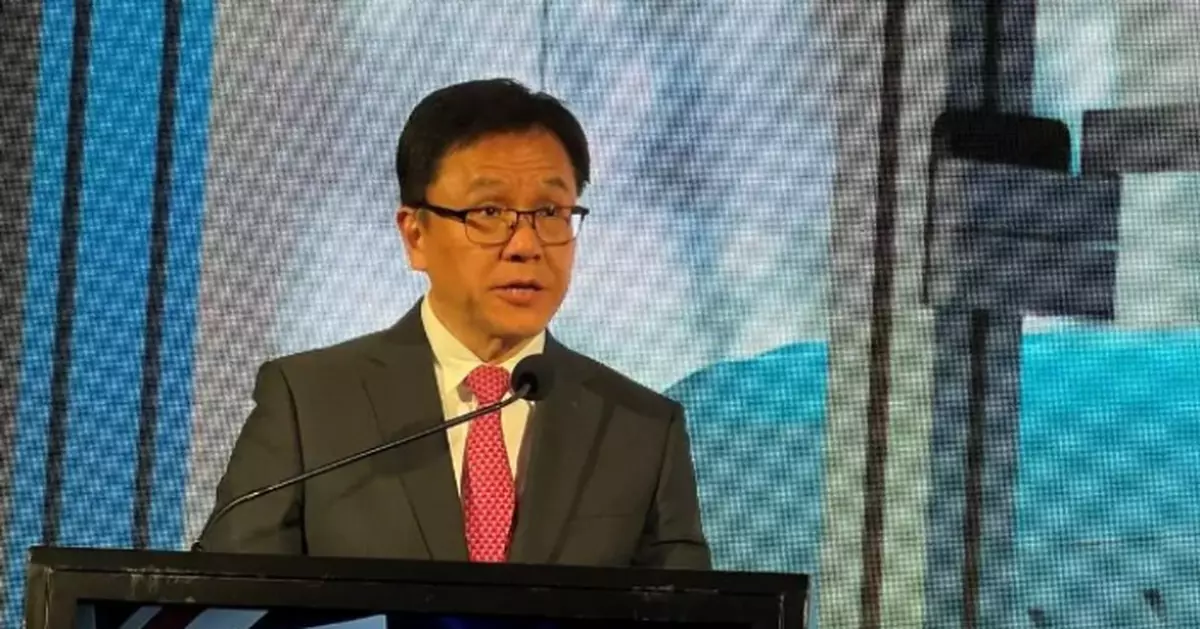
Keynote speech by SITI at China Business Summit 2026 in Auckland
Following is the keynote speech by the Secretary for Innovation, Technology and Industry, Professor Sun Dong, at the China Business Summit 2026 in Auckland, New Zealand, today (June 25, Auckland time):
Distinguished guests, ladies and gentlemen,
Good morning. It is a profound honour to join you today in Auckland for the China Business Summit 2026 during my first stop on my official visit to New Zealand.
We all see the currents reshaping the global landscape - shifting supply chains, diverging technology systems, and rising geopolitical tensions. These forces ripple every economy, large or small. Yet even amid complexities, innovation and technology (I&T) keep surging forward with remarkable momentum. International co-operation remains possible and powerful. This spirit of openness is exactly what Hong Kong seeks to uphold for global innovation, regional co-operation and shared progress.
Hong Kong's transformation: from financial hub to I&T powerhouse
For decades, Hong Kong has been recognised as one of the world's leading financial centres - fast, efficient, and deeply international. That DNA remains at our core. But today, Hong Kong is writing a new chapter to emerge as one of the most dynamic international I&T centres. We are diversifying our economy to create shared prosperity in an era of geopolitical complexities.
Hong Kong and New Zealand have long enjoyed close economic ties, people-to-people links, and a shared commitment to openness. Our Closer Economic Partnership Agreement signed in 2010, Hong Kong's first free-trade agreement with a foreign economy, laid a strong foundation for bilateral trade and exchange. As both economies pursue greener, smarter and more connected futures, the potential for collaboration in I&T has never been greater.
Charting a new chapter: Hong Kong I&T blueprint
I&T is the cornerstone of the current-term Hong Kong SAR (Special Administrative Region) Government. In December 2022, we promulgated the Hong Kong I&T Development Blueprint, setting out a long-term and comprehensive roadmap to build Hong Kong into an international I&T centre. This vision is fully supported by our motherland under the National 15th Five-Year Plan, which states in clear terms the development of Hong Kong into an international I&T centre.
To this end, we anchor our I&T ecosystem around our local universities, three major I&T parks and five key R&D (research and development) institutions, creating a full pipeline from upstream research, to midstream technology transfer, to downstream industrial application and development. We have identified life and health technologies, AI and robotics, advanced manufacturing and new energy as strategic tech industries that will power Hong Kong's future growth.
Talent: engine for a global convergence of R&D excellence
Hong Kong is home to five universities ranked among the world's top 100, backed by internationally acclaimed and award-winning experts, and a growing pool of global tech talent. This concentration of academic excellence gives Hong Kong solid R&D capability to drive scientific breakthroughs.
Our flagship R&D initiative, InnoHK, brings together more than 3 000 international research talents and 30 leading universities and research institutes from 12 economies, including Oxford, Stanford, EPFL (École Polytechnique Fédérale de Lausanne). Alongside the 30 laboratories in health technologies, AI and robotics, we have recently established eight new labs focusing on sustainable development, energy, advanced manufacturing and materials - areas where New Zealand's expertise in agritech, foodtech and greentech can create meaningful synergy. To further attract world-class talent, we also launched the Frontier Technology Research Support Scheme, enabling universities to recruit international top-notch scientific researchers to Hong Kong to spearhead basic research in frontier technologies. We warmly welcome scientists and researchers from New Zealand to join us on this journey and shape the next chapter of global innovation together.
Hetao and San Tin: world-class I&T infrastructure for the future
Hong Kong is also building ambitious I&T infrastructure. The Hetao Hong Kong Park, opened last December, is designed to be a world-class I&T hub connecting the Chinese Mainland and the world. With seamless cross-border access, shared research facilities, joint laboratories, and preferential policies for global talent and enterprises, it is an ideal testing ground for innovation that blends Hong Kong's R&D strength with the manufacturing power of nearby Shenzhen and the wider Greater Bay Area.
As a natural extension of the Hetao, the San Tin Technopole will be Hong Kong's flagship I&T industrial base, enabling prototyping, pilot production and mass production base. Together, Hetao Hong Kong Park and San Tin Technopole form a powerful bridge linking global tech talent and enterprises with the Greater Bay Area’s 88-million-strong market and comprehensive supply chain.
AI as the strategic priority for the future
Like New Zealand, the Hong Kong SAR Government has identified AI as the core industry. We are building an ecosystem that supports "industries forAIandAIfor industries", echoing the national AI+ initiative.
With three universities ranked among the world's top 30 in data science and AI, Hong Kong has a strong foundation in AI research. The newly set up Hong Kong AI Research and Development Institute will spearhead and support Hong Kong's innovative R&D as well as the industry application of AI. Meanwhile, the Sandy Ridge Data Facility Cluster, now under full-speed construction, will provide 180 000 PFLOPS (peta-floating point operations per second) of computing power by 2032, making Hong Kong an advanced data and computing hub in the region.
In a world of rising technological uncertainty, the ability to develop core technologies is increasingly essential. Our Hong Kong Generative AI Research and Development Center, one of our InnoHK centres, had launched a series of generative AI applications built on a locally developed large language model, now upgraded with agentic AI capabilities.
New industrialisation: turning innovation to real economy
Besides AI, Hong Kong is also accelerating the development of new industrialisation to strengthen our innovation-driven economy. The Hong Kong Microelectronics Research and Development Institutewas set up in 2024, focusing on technologies related to the third-generation semiconductor. The pilot lines for R&D will commence operation this year to facilitate trial production and upgrading of industries.
Technology aside, capital is crucial for industry development. To this end, we have deployed substantial policy and financial support, including three HK$10 billion initiatives, namely the Research, Academic and Industry Sectors One-plus Scheme to foster transformation of R&D outcomes; the New Industrialisation Acceleration Scheme to support the setup of smart production lines in Hong Kong; and the I&T Industry-Oriented Fund to encourage market capital to invest in strategic industries. Together, these represent roughly NZ$6.6 billion dedicated to driving Hong Kong's I&T development.
Our commitment to new industrialisation is further reinforced by a recent joint statement with the United Nations Industrial Development Organization to advance industrial development, innovation and digital transformation. We are actively exploring the joint development of a centre of excellence on global advanced manufacturing and AI in Hong Kong. Such collaboration positions Hong Kong as an active player in global industrial transformation.I warmly welcome New Zealand stakeholders to join us.
Hong Kong: A gateway to Asia's innovation frontier
The Asia-Pacific is the world's most dynamic region for technological transformation. For New Zealand, deeper engagement with Asia's innovation networks offers enormous opportunities to diversify markets, accelerate commercialisation, and connect with the world’s fastestgrowing I&T centres. Hong Kong plays a unique role in this process.
As a highly open and free economy with a robust legal framework, simple and low tax regime, strong IP protection, ease of capital raising, and world-class logistics and infrastructure, Hong Kong offers a trusted, stable and predictable platform for international business and collaboration. I would also like to add that Hong Kong has been ranked the freest economy in the world for many years.Through Hong Kong, New Zealand companies can reach not only the Chinese Mainland, but also ASEAN (Association of Southeast Asian Nations) and the broader Asia-Pacific. This is why many overseas partners see Hong Kong as a strategic anchor in such an increasingly complex global landscape.
Global recognition: the proof is in the numbers
Indeed, numbers speak louder than words. I am delighted to share with you all some global recognition of Hong Kong's increasingly vibrant I&T ecosystem. In 2025, Hong Kong ranked fourth globally in the World Digital Competitiveness Ranking. Our start-up ecosystem has grown by 40 per cent in five years, reaching 5 200 start-ups and we have witnessed the birth of 20 unicorns. The Shenzhen-Hong Kong-Guangzhou innovation cluster is now ranked number one in the world by the World Intellectual Property Organisation - a testament to the power of cross-border I&T collaboration. And in the latest World Competitiveness Yearbook 2026 published last week, Hong Kong climbed one place to rank second among 70 economies, reaffirming the city’s enduring strengths as an open, competitive and globally connected economy.
Advancing together in a time of global competition
As the global I&T race intensifies, standing still is not an option. As a Chinese saying reminds us, and also shared by Ambassador Wang (Ambassador of the People's Republic of China to New Zealand, Mr Wang Xiaolong) just now,"" - when rowing against the current, you must keep moving forward, or you will be pushed back. This captures Hong Kong’s determination to advance innovation with purpose and discipline.
Progress in I&T is not a solo journey. The challenges we face - from climate change to health crisis to digital transformation - are shared challenges. Shared challenges require shared effort. Another Chinese proverb expresses this well: "" - when we are in the same boat, we must row together. This is the spirit with which Hong Kong approaches global I&T co-operation. Competition drives excellence, but co-operation creates impact.
A shared future of innovation and opportunity
Hong Kong and New Zealand may be separated by thousands of kilometres, but I am confident that we share a common belief in global I&T partnership. Hong Kong stands ready to be a trusted partner, a platform, and a bridge - between East and West, between research and industry, and between today's challenges and tomorrow's opportunities. Let us move forward together to build a better future for humankind where innovation is open, inclusive, and beneficial to all. Thank you.
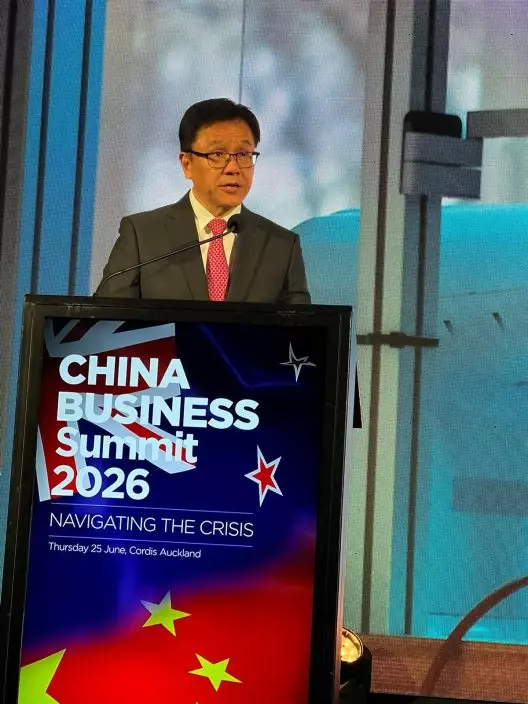
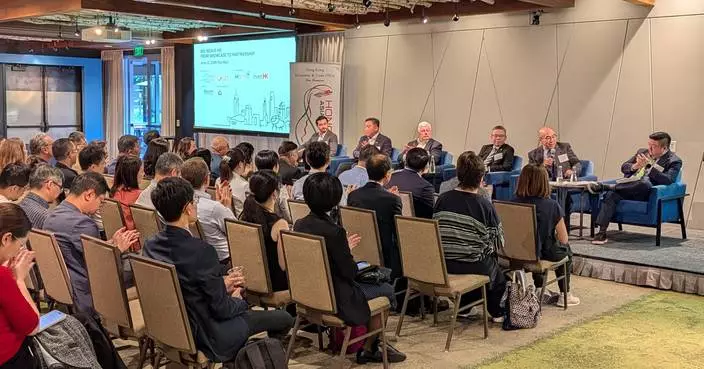
The Secretary for Innovation, Technology and Industry, Professor Sun Dong, attended the China Business Summit 2026 in Auckland, New Zealand, today (June 25, Auckland time). Photo shows Professor Sun delivering a keynote speech at the summit. Source: HKSAR Government Press Releases