Research Grants Council announces funding results of General Research Fund and Early Career Scheme 2026/27
The following is issued on behalf of the University Grants Committee:
The Research Grants Council (RGC) today (June 26) announced the funding results of the General Research Fund (GRF) and the Early Career Scheme (ECS) for 2026/27. Altogether, 1 483 proposals were successfully granted a funding of $1.18 billion in total.
In this round of exercise, the RGC received 4 215 GRF and 617 ECS applications from academic staff of the eight universities funded by the University Grants Committee. This represents an overall increase of around 9 per cent as compared with that of the last round.
After rigorous international peer reviews, 1 277 GRF projects were approved with grants amounting to around $1.04 billion. This represents an increase of about 10 per cent in terms of funded projects as compared to the last round. The overall success rate is maintained at about 30 per cent, which is similar to that of last year. The funded proposals cover all disciplines of business studies, biology and medicine, engineering, humanities and social sciences, and physical sciences.
The RGC also funded 206 ECS projects with a total allocation of roughly $140 million. The overall success rate remains at about 33 per cent, matching the previous year, and slightly exceeding that of the GRF to provide enhanced support for early career researchers.
The RGC Subject Panels commended the continued improvement in the overall quality of GRF and ECS research proposals. They were glad to see a wealth of strong and promising submissions, with a steady rise in application numbers that highlighted the vibrancy of Hong Kong's research ecosystem.
The Chairman of the RGC, Professor Timothy W. Tong said, "The RGC remains steadfast in our commitment to supporting high-quality and impactful research in Hong Kong. These outstanding research projects will play a key leading role in Hong Kong's development into an international education hub and its deepening integration into the Greater Bay Area, laying the foundation for future academic and regional innovation.
"The GRF and ECS support basic research of all disciplines in Hong Kong by catalysing discoveries across a vast spectrum of critical fields. These schemes empower eminent scholars and junior faculty with essential resource allocations while actively fostering a research environment that nurtures original innovation."
The RGC also continues to focus on the development of young talent in Hong Kong. Professor Tong said he welcomed the substantial number of proposals from young researchers that are being supported by the ECS this year, underscoring the scheme's pivotal role in empowering next-generation scholars.
The GRF and the ECS are individual research funding schemes under the RGC. The GRF supplements universities' own research support for researchers who have achieved or have the potential to achieve excellence. The ECS aims to nurture junior academics and prepare them for a career in education and research. Based on academic quality and merit, the RGC follows the international practice of a peer-review mechanism to assess research proposals.
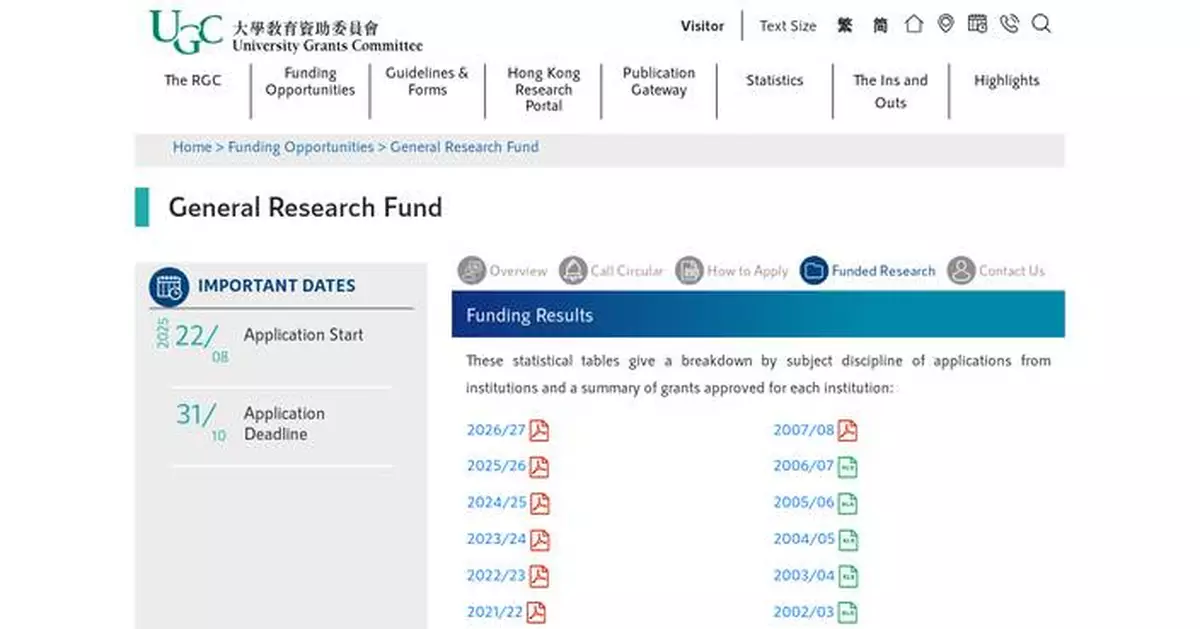
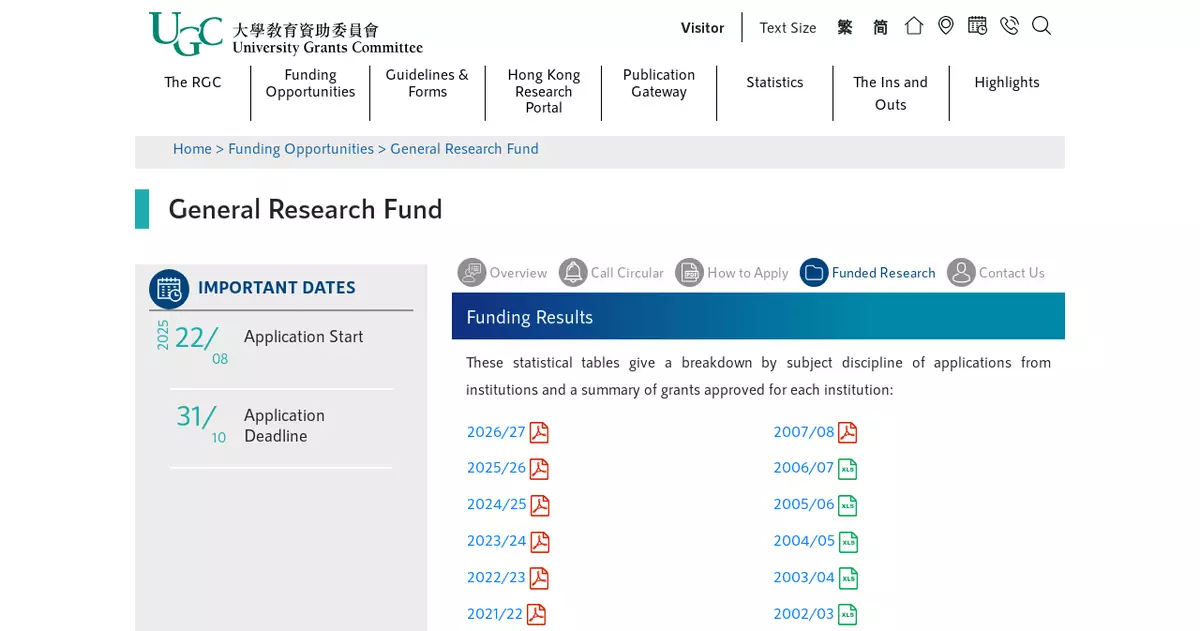
The 2026/27 funding results of the GRF and the ECS are available on the RGC website
(GRF: www.ugc.edu.hk/eng/rgc/funding_opport/grf/funded_research.html;
ECS: www.ugc.edu.hk/eng/rgc/funding_opport/ecs/funded_research.html).
Source: AI-found images