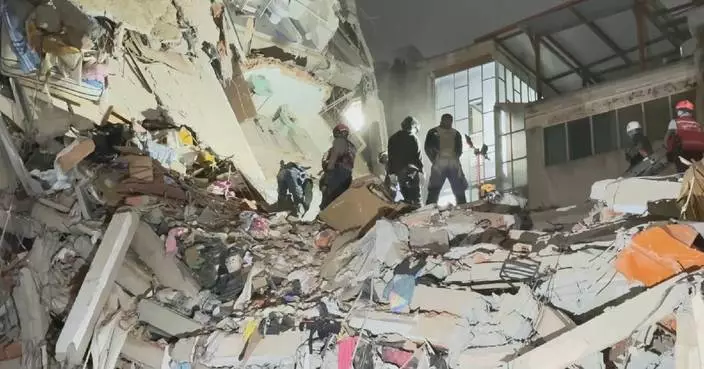
Caracas residents on Thursday described scenes of panic and terror after twin earthquakes devastated Venezuela, killing at least 235 people and trapping hundreds under rubble.
The quakes struck Wednesday less than a minute apart, prompting frantic rescues from collapsed buildings and drawing international support for the disaster‑hit South American country.
The U.S. Geological Survey (USGS) said the tremors measured magnitude 7.2 and 7.5, at depths of 20.3 km and 10 km, injuring at least 4,300 people and leaving 157 missing.
"It all happened so fast. It took us all by surprise. It was very frightening. There were a lot of people in this building, including many elderly people and many children. It's the first time we've experienced an earthquake of this magnitude. Thank God we were able to get downstairs. We live on the first floor, so we could get down quickly. But obviously we were worried about our neighbors upstairs, so we stayed here out on the street. The firefighters did a quick assessment while they were evacuating the elderly residents, and they told us we couldn't stay in the building until a more thorough inspection was conducted to determine if it was actually safe to live in," said Beatriz Chelaner, a local resident.
In addition to organized relief, members of the public are stepping in to support rescue operations.
"I came here to lend a hand as a Venezuelan. It's a call to action after everything that has happened since yesterday. It's been a truly devastating catastrophe, a very severe one. And we came to pitch in as that's what every good Venezuelan should do. Pickaxe and shovel, let's break some rocks," said Claudio Yagnoti, a local.
As of noon local time Thursday, the two quakes had triggered 138 aftershocks, Venezuelan National Assembly President Jorge Rodriguez said in a televised address. The government has declared several areas, including La Guaira state, disaster zones amid continuing aftershocks.
The USGS issued a red alert after the quakes, warning of major casualties, extensive damage and severe economic losses. Early modeling from the USGS estimates that the final death toll could reach between 10,000 and 100,000, while economic losses could amount to between 2 percent and 10 percent of Venezuela's gross domestic product.
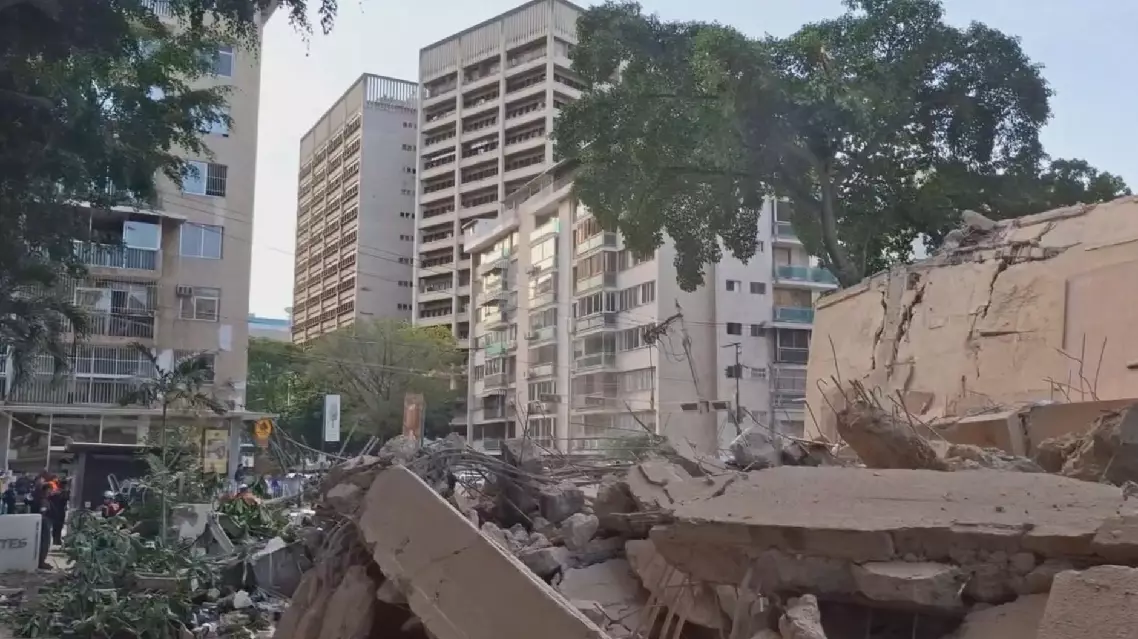
Caracas residents recount terror as quakes devastate Venezuela
The China-proposed Belt and Road Initiative (BRI) helps to set a solid foundation for developing countries without complete infrastructure networks to pursue development independently, said Guinean Prime Minister Amadou Oury Bah in an interview on Wednesday.
Bah visited China and attended the World Economic Forum (WEF)'s 17th Annual Meeting of the New Champions, which concluded on Thursday in the northeastern city of Dalian.
Speaking to the China Global Television Network (CGTN) on the sideline of the meeting, Bah said "The BRI helps Guinea pursue great development. My visit to China aims to further deepen bilateral ties and to fully seize new development opportunities so that Guinea will achieve greater progress and connect more closely with the rest of the world, especially in terms of the construction of logistics and transport corridors, which will help Guinea and some regions in Africa to pursue true economic transformation."
Bah said at a sub-forum of the event held on Tuesday that he was looking forward to closer cooperation with China to help Guinea and other countries in Africa to pursue greater development.
He further explained the point in Wednesday's interview that he believes by working with China within the framework of BRI, some developing countries will pursue independent development by building a complete infrastructure network.
"We are all sovereign states. The BRI offers a solution to a key issue that the international community has been debating extensively over the past two decades -- how to eradicate poverty in some countries, African countries in particular. The solution offered by the BRI is practical and viable, because it meets the real needs of the developing countries. It helps countries without a complete infrastructure network to build logistics hubs, highways, ports and other facilities, thus laying a solid foundation for them to pursue independent development. These infrastructure networks constitute an essential prerequisite for development and only with these facilities can a country fully unleash the potential of its mineral and agricultural resources as well as its capacity to trade with all countries across the world," said Bah.
The prime minister also stressed the urgent need for African countries to foster their internal growth drivers in pursuing greater economic development.
"It has become an urgent task for African countries to achieve deep processing of resources domestically, because we need to foster internal growth drivers, pursue greater development and achieve more equitable distribution of wealth," said Bah.

BRI helps countries without complete infrastructure networks pursue independent development: Guinean PM