Skip to Content Facebook Feature Image

OceanBase Unveils AI Database: A New Product Portfolio Unifying Multimodal Data, Real-Time Analytics, and AI Agent Workloads

Business

OceanBase Unveils AI Database: A New Product Portfolio Unifying Multimodal Data, Real-Time Analytics, and AI Agent Workloads
Business

Business

OceanBase Unveils AI Database: A New Product Portfolio Unifying Multimodal Data, Real-Time Analytics, and AI Agent Workloads

2026-06-29 20:00 Last Updated At:20:15

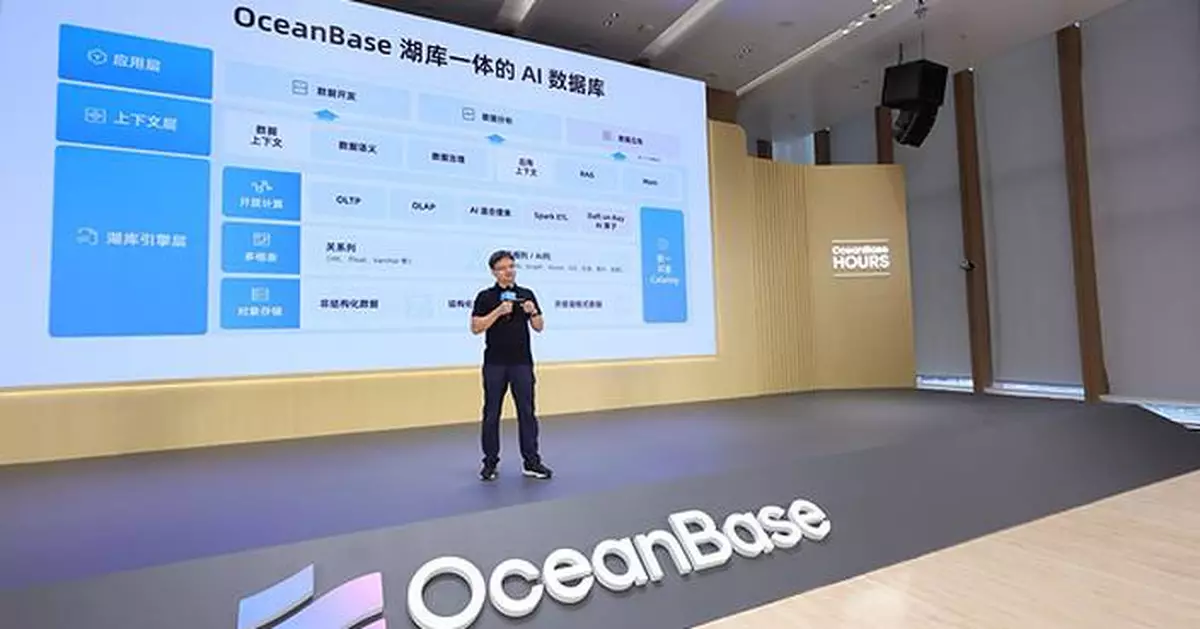
SINGAPORE, June 29, 2026 /PRNewswire/ -- OceanBase today announced the release of OceanBase AI Database, a comprehensive portfolio designed to enable enterprises to manage multimodal data, deliver real-time trusted data context to AI agents, and simplify fragmented data architectures.

Built around a unified LakeBase architecture, the OceanBase AI Database integrates the openness and scale of data lakes, the transaction processing and real-time serving capabilities of databases, and native multimodal data processing capabilities. This enables enterprises to manage structured, unstructured, and vector data within a single, strongly consistent data foundation.

OceanBase AI Database introduces a series of data products tailored for the AI era:

  • OceanBase Lakebase: Serving as the underlying data engine, Lakebase enables structured, unstructured, and vector data to be managed, processed, searched, and served within a unified architecture, enabling enterprises to build a robust data foundation for the AI era.
  • OceanBase DataStudio: Built upon the Lakebase engine, DataStudio is a data production, governance, and services platform, covering the entire lifecycle from data ingestion, processing, and orchestration to semantic modeling and agent collaboration, and turning data silos into callable data services.
  • OceanBase DataPilot: Acting as a business intelligence agent for enterprises, DataPilot can generate analytical reports, data dashboards, and trusted answers through natural language, making data intelligence highly accessible to non-technical users.

Over the past years, large language models have evolved rapidly. However, the deployment of enterprise AI applications has hit a plateau. While AI models have largely solved the reasoning problem, the next challenge for enterprises now lies in whether AI can access, understand, and act on trusted business data.

As AI agents move from chat interfaces into production workflows, they require continuous access to memory, context, state, and enterprise data. At the same time, enterprise data is becoming increasingly multimodal, spanning business records, documents, images, audio, video, logs, and vectors. Traditional multi-system architectures struggle to provide the real-time, consistent, and governed context that AI agents require.

Meanwhile, although AI is fundamentally changing the paradigm of data management, and data forms, flows, and interactions are undergoing significant transformations, four fundamental baselines remain non-negotiable for enterprises: consistency, scalability, reliability, and real-time performance.

To address this, OceanBase proposes the LakeBase architecture, which brings the openness and massive storage capabilities of data lakes together with the consistency, online serving, and reliability of databases. By extending transaction consistency, high availability, and elasticity proven in financial core systems to data lake and multimodal data scenarios, OceanBase AI Database provides a unified data foundation for modern AI applications.

"As AI moves from answering questions to taking actions, databases must evolve from systems of record into trusted context engines for AI," said Charlie Yang, Chief Technology Officer of OceanBase. "OceanBase AI Database is not about stitching together data lake and database. It is about bringing multimodal data, real-time serving, transaction consistency, and open compute into a single architecture."

Compared to traditional solutions, the OceanBase AI Database can reduce the overall Total Cost of Ownership (TCO) by approximately 30% to 50%. This has already been validated in various AI application scenarios, including Ant Group's AQ (Ant A-Fu in Chinese) and Lingguang. Notably, leveraging Lingguang, users have cumulatively generated tens of millions of "flash apps", demonstrating OceanBase's ability to provide isolated, low-cost data environments at massive scale.

Over the past few years, OceanBase has already supported AI application deployment across multiple industries. Leading enterprises, including Lalamove, China Unicom, and Trip.com, have adopted OceanBase to build stable, high-performance RAG, hybrid search, and AI-powered data applications, empowering higher-quality search and question-answering experiences.

About OceanBase

OceanBase is a distributed database launched in 2010. It provides strong data consistency, high availability, high performance, cost efficiency, elastic scalability, and compatibility with mainstream relational databases. It handles transactional, analytical, and AI workloads through a unified data engine, enabling mission-critical applications and real-time analytics.

To learn more, please visit: https://www.oceanbase.com/

** This press release is distributed by PR Newswire through automated distribution system, for which the client assumes full responsibility. **
OceanBase Unveils AI Database: A New Product Portfolio Unifying Multimodal Data, Real-Time Analytics, and AI Agent Workloads

OceanBase Unveils AI Database: A New Product Portfolio Unifying Multimodal Data, Real-Time Analytics, and AI Agent Workloads
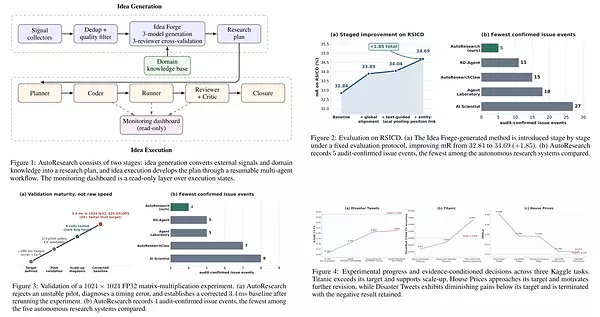
What happens when AI starts investigating its own ideas? AutoResearch is an open-source attempt to bring AI agents one step closer to answering that question through experiments, evidence and iteration.

SAN FRANCISCO, Sept. 2, 2026 /PRNewswire/ -- EvoMap, an open infrastructure project for AI self-evolution, has open-sourced AutoResearch, a system that lets AI agents take research ideas from hypothesis to experiment and use the results to determine what happens next.

The Research Verification Problem

AI models are getting better at proposing ideas, writing code and analyzing results. But does a plausible answer actually hold up when put to the test?

AutoResearch starts from a simple premise: a model's confidence is not evidence of success.

The system uses multiple AI models to independently generate and cross-review research ideas, then converts accepted ideas into executable research plans with defined metrics, success criteria, resource budgets and evaluation procedures. During execution, specialized agents handle planning, implementation, experimentation, analysis and review.

Research state, code, experiment logs, metrics, failures and decisions are preserved in a persistent workspace, allowing the system to continue unfinished research rather than restarting from scratch. Independent and blind review is also used to challenge conclusions before a research direction can be closed.

Evidence Determines What Happens Next

One of the more important design choices in AutoResearch is that failure is not treated as the end of a research path.

A partial result can lead to a revised hypothesis. An external test can expose a problem and trigger another round of experiments. And when repeated experiments stop producing meaningful gains, the system can stop pursuing the idea while retaining what was learned.

The approach was tested on a real Django issue from SWE-bench Lite. AutoResearch initially scored 2/7 and then 4/7 on official new-feature tests. Rather than stopping after the partial improvement, it continued investigating the underlying problem and ultimately reached 7/7, while maintaining 203/203 regression tests.

On the RSICD benchmark, an AutoResearch-generated research idea improved mean Recall from 32.84 to 34.69, demonstrating that the system could turn an AI-generated research hypothesis into a measurable improvement through iterative experimentation.

From AI Research to AI4AI

What happens when AI starts researching AI itself?

AI can already help researchers search the literature, identify promising directions, formulate hypotheses and even design experiments. The harder problem is what comes after that: can AI actually test the ideas it comes up with, and let the results determine whether those ideas are worth pursuing?

In AI research, this could mean agents exploring model architectures, training methods, optimization algorithms, agent designs and evaluation techniques, then running experiments to test their hypotheses and using the results to shape the next round of research. Moving from "this might work" to "let's find out whether it actually works" is a critical step toward more autonomous research.

The same principle could eventually extend beyond AI to areas such as drug discovery, materials science and engineering, where research ideas can be evaluated through simulations or physical experiments. The potential is not simply to have AI assist with more of the research process, but to give it a way to learn from what happens when its ideas meet evidence.

That is the direction AutoResearch is designed to explore: turning research ideas into executable experiments, experiments into evidence, and evidence into the next research decision.

Open-Source Research Infrastructure

AutoResearch is now available as an open-source project for researchers and developers working on AI scientists, autonomous agents and AI4AI systems. The accompanying paper, "AutoResearch: Insight In, Hallucination Out," is available on arXiv.

GitHub: github.com/EvoMap/AutoResearch
Research paper: arXiv: AutoResearch: Insight In, Hallucination Out
Technical research: EvoMap Research: AutoResearch Evidence Loop

About EvoMap

EvoMap is an open infrastructure project for AI self-evolution. The company is building systems that allow AI agents to learn from experience, share validated capabilities and improve across tasks and environments. EvoMap's work spans AI agent infrastructure, reusable AI capabilities and autonomous AI research, with representative projects including the Genome Evolution Protocol (GEP), EvoX Agent and AutoResearch.

Learn more at evomap.ai.


** This press release is distributed by PR Newswire through automated distribution system, for which the client assumes full responsibility. **

EvoMap Open-Sources AutoResearch, Giving AI Agents a Way to Test Their Own Research Ideas

EvoMap Open-Sources AutoResearch, Giving AI Agents a Way to Test Their Own Research Ideas

Recommended Articles