REDWOOD CITY, Calif.--(BUSINESS WIRE)--Jun 29, 2026--
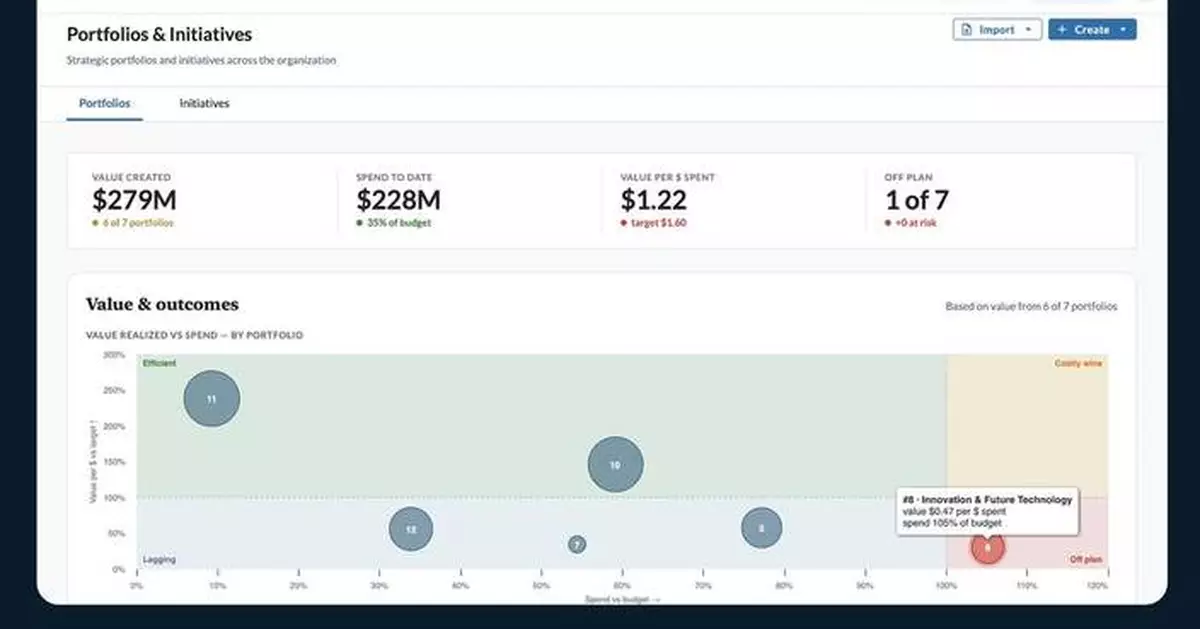
WorkBoard Inc., provider of the leading enterprise strategy execution and OKR platform, WorkBoardAI, today announced the launch of its Strategic Portfolio Management (SPM) solution, the market’s first truly AI-native SPM.
This press release features multimedia. View the full release here: https://www.businesswire.com/news/home/20260629227363/en/
“The world has changed, and strategic portfolio management must as well – it must be outcome-centric, fast, smart, and easy to use or opportunities are lost. Customers have been working around legacy portfolio management systems for years and managing outcomes separately in WorkBoard’s OKR solution,” said Deidre Paknad, CEO and co-founder of WorkBoard, Inc. “Our new SPM solution and its Portfolio Analyst Agent give customers an end-to-end solution with the power, speed, and ease they need to execute brilliantly at the speed of AI.”
Enterprises invest billions each year on long-running initiatives and technology portfolios to achieve their strategic outcomes, but AI changes those potential outcomes, their velocity, and cost structure – and we are at the beginning of this massive change. Now, what took a year takes a month, and what was relevant is quickly made obsolete. Planning, adapting, and choosing tradeoffs all need to be faster and easier to seize the opportunities ahead.
It's hard to operate at future speed on slides or a system tuned for the past. Legacy SPM systems were built in the early 2000s for project tracking, not for adapting to continuous change and delivering strategic outcomes. They are difficult to use by all but the trained experts; their UIs have aged poorly as the world speeds up and AI redefines user expectations.
With the release of WorkBoard’s AI-native SPM system, customers get an outcome-centric, lightning-fast solution to deliver the most strategic outcomes in a fast-changing world. Users have conversations with a Portfolio Analyst Agent, a chat-first experience that eliminates learning curves and complexity so it’s easy for anyone to:
The new SPM solution is seamlessly integrated with WorkBoard’s world-class OKR solution and with Workday, Jira, Azure Dev Ops, Slack and Teams out of the box. The Portfolio Analyst Agent handles onboarding, so customers are live in a day, not weeks or months.
WorkBoard’s new SPM solution and its robust strategy execution and OKR solution share a common Enterprise Knowledge Graph and agentic foundation. The Enterprise Knowledge Graph provides the context, fact base, and data the agents need to deliver reliable, consistent measures of success and status.
The WorkBoard Agentic Foundation ensures agents:
SPM Availability
The WorkBoardAI SPM offering will be available in July. For more information or to request a demo, visit https://www.workboard.com/products/strategic-portfolio-management
About WorkBoard
WorkBoardAI provides the world's leading enterprise OKR solution and the only strategy execution system of record with generative and agentic AI to improve alignment, accountability, and transparency. Trusted by 3M, AstraZeneca, Avery Dennison, Blue Cross Blue Shield, Boeing, Capital One, Davita, Elevance, Ford, Mercedes Benz, State Street, United Healthcare, and others, WorkBoardAI makes it easy for organizations to align, measure, and drive their strategic priorities in a rapidly changing world. Investors include SoftBank, Andreessen Horowitz, M12 Microsoft's Venture Fund, Notable Capital, Workday Ventures, and others. WorkBoard is headquartered in Silicon Valley with offices across the US, Europe, and India.
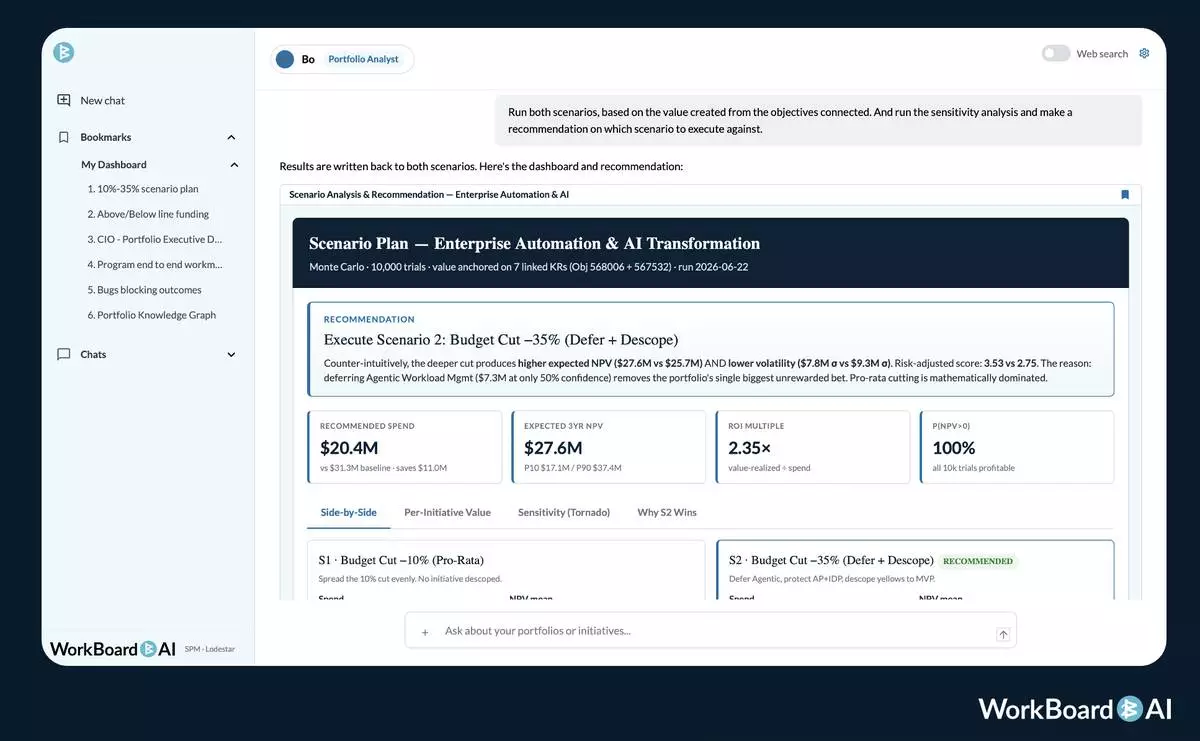
AI-Native Strategic Portfolio Management from WorkBoard - Scenario Planning
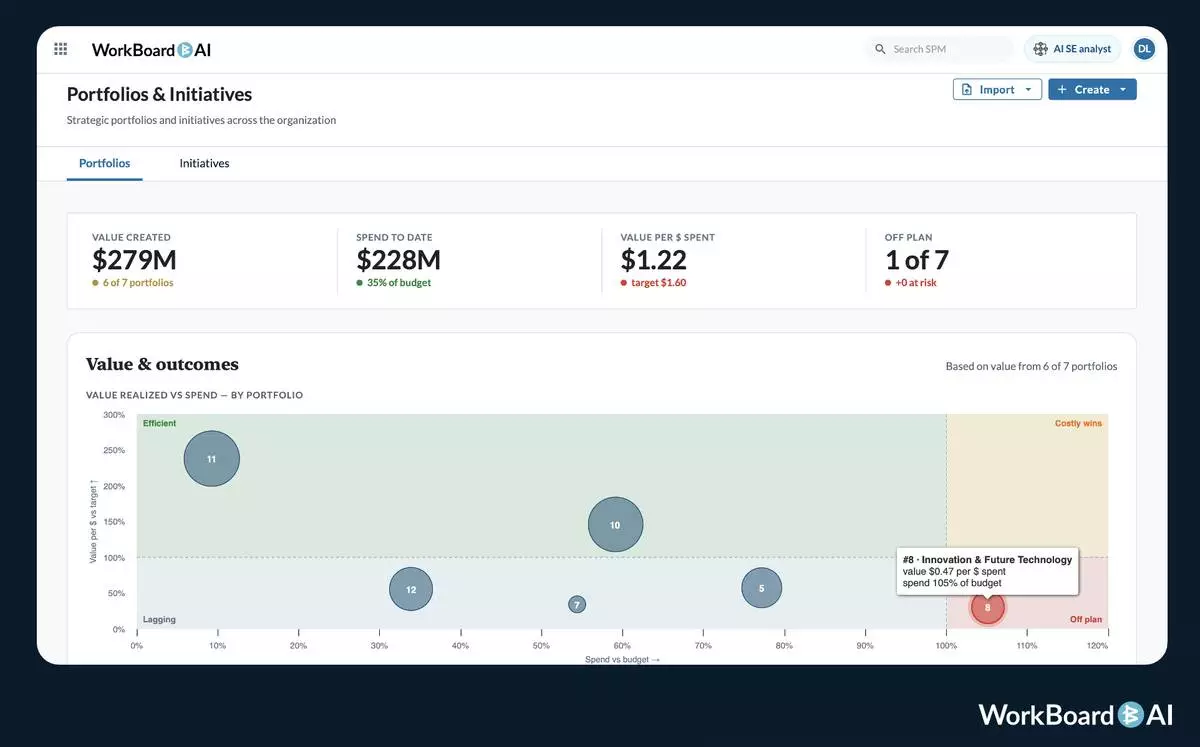
AI-Native Strategic Portfolio Management from WorkBoard
DUBAI, United Arab Emirates (AP) — President Donald Trump said Monday on social media that Iran had requested a meeting with U.S. counterparts, though one of Iran's top negotiators said no further talks had been scheduled after attacks across the Persian Gulf over the weekend challenged negotiations to end the war.
The U.S. president has tried to preserve an increasingly fragile interim deal as hostilities have mounted in recent days in the Strait of Hormuz, through which a fifth of the world's oil had been shipped before war began. Monday marked the first time both sides appeared to pause after four days of trading attacks.
Trump said the meeting with Iran would happen on Tuesday in Doha, Qatar. But Kazem Gharibabadi, a senior negotiator for Iran, denied any talks had been scheduled.
The U.S. and Iran agreed to a deal earlier this month that calls for Tehran to dilute its stockpile of enriched uranium, and waives U.S.-backed sanctions on the country while opening the Strait of Hormuz and giving each side 60 days to hammer out broader agreements.
Oil prices fell sharply after the signing of the interim deal, but if they were to reverse course in a meaningful way it could undermine Trump’s claims to voters ahead of November elections that inflation was easing.
Earlier on Monday, Iran’s president said that $6 billion in frozen Iranian assets would be released by Qatar. Masoud Pezeshkian’s mention of the funds appeared aimed at selling the Iranian public on the interim deal, particularly as its grip on the strait has been tested.
During the war that began Feb. 28, Iran’s attacks and threats stopped cargo ships and tankers from moving through the Strait of Hormuz, creating a global energy crisis.
In recent days, Iran has twice attacked vessels in the strait following efforts to open Oman’s territorial waters to both inbound and outbound traffic from the Persian Gulf.
The attacks drew retaliatory American airstrikes and raised concerns that negotiations to reach a formal end to the war could be disrupted. Iran launched drone and missile attacks targeting Bahrain and Kuwait on Sunday.
Iran and Oman held a meeting about the strait Monday in Oman.
The strait has long been considered an international waterway despite its location in Iran and Oman’s territorial waters.
Pezeshkian offered praise for the interim deal in comments published Monday by the state-run IRNA news agency, calling it “a great victory for the Iranian people.”
“Based on the plans made, $6 billion out of the total $12 billion of Iranian resources in Qatar will be released and returned to the country, and necessary follow-ups are being carried out,” he said. He did not elaborate.
Pezeshkian, a reformist within Iran's theocracy, is the highest-ranking official within Iran to reference the release of the funds held by Qatar, a key mediator along with Pakistan in the negotiations. So far, U.S. officials say no frozen Iranian assets have been released. Qatar as well as has not acknowledged any such transfer and Iran attacked a tanker filled with Qatari crude oil this weekend during the crossfire in the Persian Gulf.
Pakistan, a key mediator, has said talks would resume Tuesday. The Trump administration on Sunday said nothing has been canceled and technical talks are on track for the coming days.
Gharibabadi, the Iranian negotiator, cast doubt on the meeting in comments published by IRNA.
“Although consultations with Qatar, including on following up on the implementation of the other side’s commitments, are continuing as usual, reports by some media about technical talks by the working groups being held in Doha are not confirmed,” he said.
Technical talks involve lower-level diplomats working on the specifics of any deal that would draw top leaders from Iran and the U.S. back to the table.
Trump celebrated on Monday morning that U.S. oil futures were trading at roughly $69 a barrel, a decrease that he credited to the interim deal with Iran.
Even though the president has previously said oil prices and domestic political concerns were not influencing his approach to Iran, Trump has repeatedly focused on lower oil prices with the reopening of the Strait of Hormuz as a key victory.
The president falsely claimed that oil prices at $69 a barrel are lower than they were before the war.
Oil futures in the U.S. were trading at a range of roughly $65 to $66 before the war began in late February.
Brent crude, the international standard was trading at $73.25 a barrel. It sold for about $72 a barrel before the war began, and rose above $126 per barrel in April.
Boak reported from Washington. Associated Press writers Nasser Karimi and Amir Vahdat in Tehran, Iran, contributed to this report.
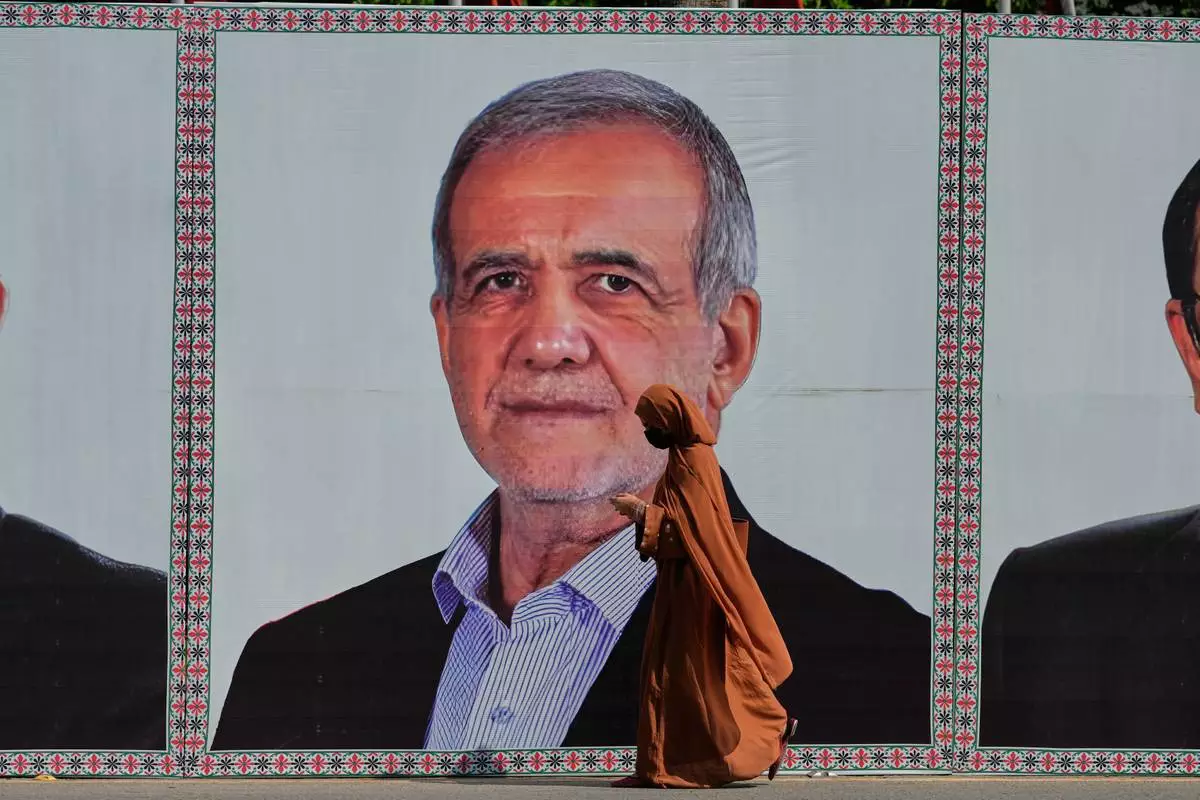
A woman walks past a welcoming billboard featuring Iranian President Masoud Pezeshkian along a roadside in Islamabad, Pakistan, Tuesday, June 23, 2026. (AP Photo/Anjum Naveed)