Lands Department responds to Ombudsman's direct investigation report on unlawful occupation of government land
Regarding the direct investigation report on combating unlawful occupation of government land released by the Office of The Ombudsman today (June 29), the Lands Department (LandsD) appreciates the Ombudsman for reviewing the enforcement actions taken by the LandsD and relevant departments regarding a case of unlawful occupation of government land in Tin Shui Wai, and accepts the Ombudsman's recommendations.
The LandsD is pleased to note the Ombudsman recognised the Department's necessary adoption of a "risk-based" approach to prioritise and handle vast amount of unlawful occupation of government land cases according to their urgency. The Ombudsman also noted that the LandsD has successively introduced a series of measures in recent years, such as the incorporation of multiple data integration and analysis functions into a new database system introduced in September 2025.
The LandsD will continue to leverage the use of technology to enhance its enforcement efficiency and proactively detect irregularities, including making use of the Geographic Information System of its Survey and Mapping Office, aerial photographs taken by unmanned aerial vehicles, and robotic dogs to assist in daily inspections and monitoring, thereby enabling early identification of repeated occupation or larger scale unlawful occupation cases.
The LandsD will actively follow up on the recommendations of the Ombudsman to optimise the handling of unlawful occupation of government land and strengthen enforcement actions. These include continuously reviewing the effectiveness of existing guidelines and the database system, exploring the use of technology to improve enforcement efficiency, enhancing training for frontline staff in investigation and evidence collection, and ensuring that the staff understand and fulfil their leading role when co-ordinating departmental efforts in resolving land issues.
The Lands Department, Photo source: reference image
CFS announces food safety report for May
The Centre for Food Safety (CFS) of the Food and Environmental Hygiene Department today (June 30) released the findings of its food safety report for last month. The results of about 6 000 food samples tested (including food items purchased online) were found to be satisfactory except for 19 unsatisfactory samples that were announced earlier. The overall satisfactory rate was 99.7 per cent.
A CFS spokesman said that about 2 100 food samples were collected for microbiological tests, and about 3 900 samples were taken for chemical and radiation level tests.
The microbiological tests covered pathogens and hygiene indicators; the chemical tests included testing for pesticides, preservatives, metallic contaminants, colouring matters, veterinary drug residues and others; and the radiation-level tests included testing for radioactive caesium and iodine in samples collected from imported food from different regions.
The samples comprised about 1 400 samples of vegetables and fruit and their products; about 500 samples of cereals, grains and their products; about 600 samples of meat and poultry and their products; about 1 100 samples of milk, milk products and frozen confections; about 900 samples of aquatic and related products; and about 1 500 samples of other food commodities (including beverages, bakery products and snacks).
The 19 unsatisfactory samples were a prepackaged dried lily bulb sample and a prepackaged dried porcini sample detected with metallic contaminants exceeding the legal limits; a tomato sample detected with a pesticide residue exceeding the legal limit; a beef congee sample found to contain sulphur dioxide; a beef skewer sample detected with a preservative exceeding the legal limit; a prepackaged pork floss sample detected with an antioxidant exceeding the legal limit; two soft ice-cream samples, a frozen confection sample and two imported frozen confection samples detected with coliform bacteria counts exceeding the legal limits; five imported frozen confection samples detected with coliform bacteria and total bacterial counts exceeding the legal limits; two bottled mineral water samples found to contain a trace amount of Enterococci; and a growing up formula powder sample found with the possible presence of Cereulide produced by Bacillus cereus.
The CFS has taken follow-up actions on the above-mentioned unsatisfactory samples, including informing the vendors concerned of the test results, instructing them to stop selling the affected food items, and tracing the sources of the food items in question.
The spokesman reminded the food trade to ensure that food is fit for human consumption and meets legal requirements. Consumers should patronise reliable shops when buying food and maintain a balanced diet to minimise food risks.
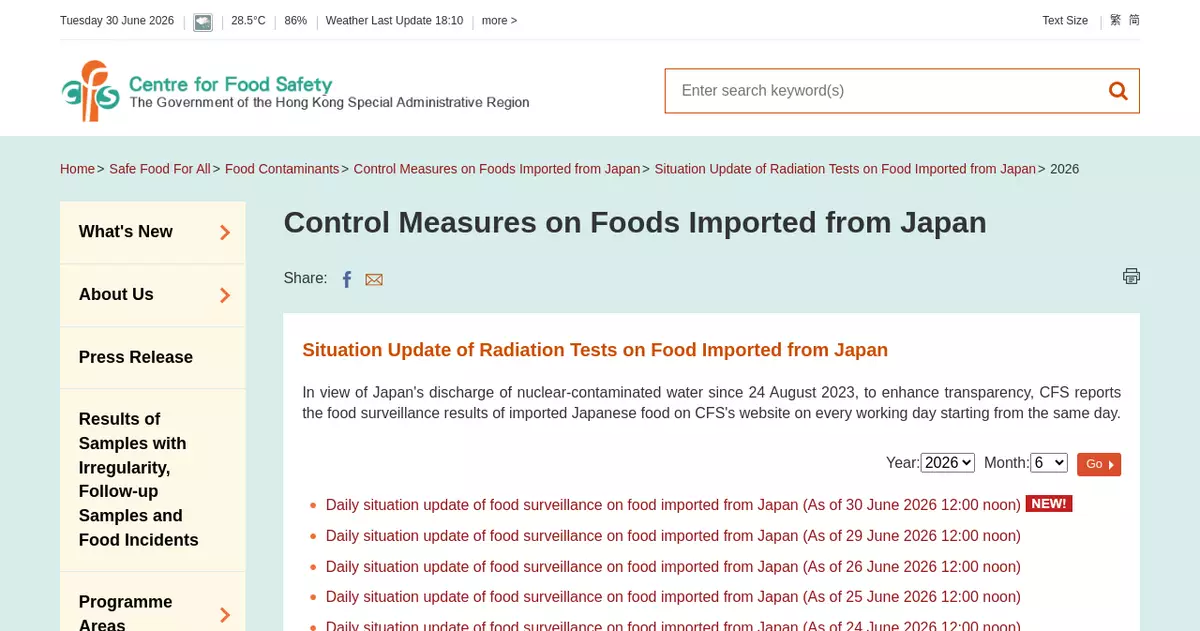
Separately, in response to the Japanese Government's discharge of nuclear-contaminated water at the Fukushima Nuclear Power Station, the CFS will continue enhancing the testing on imported Japanese food, and make reference to the risk assessment results to adjust relevant surveillance work in a timely manner. The CFS will announce every working day on its dedicated webpage (www.cfs.gov.hk/english/programme/programme_rafs/daily_japan_nuclear_incidents.html) the radiological test results of the samples of food imported from Japan, with a view to enabling the trade and members of the public to have a better grasp of the latest safety information.
Source: AI-found images