SEOUL, South Korea--(BUSINESS WIRE)--Jun 29, 2026--
Magnachip Semiconductor Corporation (NYSE: MX, “Magnachip”) announced the appointment of Chae Lee as Chief Executive Officer, effective July 1, 2026. Lee is also expected to join Magnachip’s Board of Directors following the effective date of his appointment. Lee succeeds Camillo Martino, who has served as Interim Chief Executive Officer since August 2025 and will continue to serve as Chairman of the Board of Directors.
This press release features multimedia. View the full release here: https://www.businesswire.com/news/home/20260629698526/en/
Lee brings more than 30 years of global semiconductor industry experience spanning power semiconductors, power management integrated circuits (PMIC), sensors, audio amplifiers with expertise in applications, sales, marketing, operations and executive leadership. Most recently, he served as Chief Executive Officer of Tagore Technology, a provider of Gallium Nitride (GaN) semiconductor solutions for Radio Frequency (RF) and Power applications. Prior to Tagore, Lee held senior leadership positions at semiconductor companies including Insyte Systems, NXP Semiconductors, and Maxim Integrated Products where he was responsible for strong high-margin revenue growth through innovative product development in its mobility group.
“Chae has a strong background ideally suited to guide Magnachip through its next phase of growth,” said Camillo Martino, Chairman of the Board. “Chae brings a unique combination of deep technical expertise, operational leadership and commercial experience across both power ICs and system solutions. His experience aligns perfectly with Magnachip’s strategy to strengthen our product portfolio, accelerate innovation and expand our presence in high-value power semiconductor markets.”
Martino added, “On behalf of the Board, I would also like to thank our employees for their dedication and resilience over the past year. I look forward to continuing to work closely with Chae and the management team as Chairman.”
“I am honored to join Magnachip at this important point in its evolution,” said Lee. “Magnachip has a strong heritage in power semiconductors, a talented team, valuable manufacturing assets and on a path to developing compelling next-generation products. I believe the Company is well positioned to capitalize on long-term opportunities across AI, data center, industrial, automotive, robotics, communications, computing and consumer applications. I look forward to working closely with the Board and the entire Magnachip organization to build on the progress already underway and create outstanding value for customers, employees and shareholders.”
About Magnachip Semiconductor
Magnachip is a designer and manufacturer of analog and mixed-signal power semiconductor platform solutions for various applications, including industrial, automotive, communication, consumer and computing. The Company provides a broad range of standard products to customers worldwide. Magnachip, with about 45 years of operating history, owns a substantial number of registered patents and pending applications, and has extensive engineering, design and manufacturing process expertise. For more information, please visit www.magnachip.com. Information on or accessible through Magnachip’s website is not a part of, and is not incorporated into, this release.

Magnachip appoints Chae Lee as Chief Executive Officer, effective July 1, 2026.
WASHINGTON (AP) — Students pursuing graduate degrees in nursing, physical therapy and several other fields will be eligible to take out higher federal student loan amounts — at least for now — after a federal judge blocked part of a Trump administration rule that held them to lower limits.
The U.S. Education Department issued a revised rule on Monday designed to follow the judge's order from last week, officials told The Associated Press. Agency officials called it a temporary change while they fight in court to keep the original rule, which defined medicine, law and other fields as “professional programs” but excluded fields such as nursing.
“While we disagree with the Court’s analysis regarding the Department’s definition of professional degree programs for purposes of determining eligibility for higher loan limits, the Department is complying with the order,” undersecretary Nicholas Kent said in a statement.
The change represents a short-term win for groups that sued to stop the rule. Eight groups challenged the department's definition in court, representing nurse practitioners, therapists, speech language pathologists and more.
But in strictly applying the judge's order, the department is now striking some degrees from the list of professional programs, meaning those students will face lower loan limits. Theology studies programs are among the biggest to shift from professional to non-professional degrees in the shuffle, subjecting theology students to a lower student loan limit. The master of divinity degree — a common degree for pastors and ministers — remains on the professional list, with a more generous student loan limit.
The new rule, which takes effect Wednesday, comes from a student loan overhaul passed in President Donald Trump's tax bill last year. Programs designated as professional degrees face federal loan caps of $200,000, while other graduate programs are capped at $100,000.
Previously, graduate students had been able to take out federal loans up to the full cost of their degree. Trump officials pushed for new loan caps to rein in student debt and lower tuition prices that they said had grown out of control.
The groups that brought the lawsuit said the rule would require students to forgo their studies or take out riskier private loans. Although many graduate nursing degrees fall within the lower loan limits, some can cost more than $100,000, including in high-demand fields like nurse anesthesia.
In a notification to universities on Monday, the Education Department said it's confident the Trump administration's initial rule will ultimately be upheld in court. The amended rule is expected to remain in effect during the judge's preliminary stay, but the department warned that it “may change as litigation in the case proceeds.”
The original rule included about a dozen programs that were deemed professional, which Trump officials had said was not a judgment on their importance but part of a technical definition dating to the 1960s. Along with law and medicine, that list also included theology, pharmacy, veterinary medicine, clinical psychology and more.
The temporary rule expands that list to 29 specific degree programs, including master of science in nursing, doctor of nursing practice, and doctor of nurse anesthesia practice. Others newly added to the professional list include degrees for physical therapy, athletic training, speech-language pathology, physician associates and anesthesiologist assistants.
The department's communication listed about 25 programs that are now considered non-professional degrees. Along with theology, that list now includes applied psychology, pharmaceutical sciences and others. (The doctor of pharmacy degree remains professional.)
Last week's court ruling blocked parts of the Education Department's definition that were added in a federal rulemaking process. U.S. District Judge Beryl Howell in Washington called it a “misguided” interpretation that strayed from a longstanding definition created by Congress.
The department's definition laid out several criteria used to weigh if degrees count as professional programs. It said those degrees generally take six years to complete and require licenses to begin practicing, among other requirements.
It also said professional degrees cannot lead to employment that must be "be supervised by another professional" with “more education, training, and qualifications.”
A separate lawsuit filed by a coalition of Democratic-led states challenging the loan caps is still pending.
Associated Press Writer Heather Hollingsworth contributed to this report from Kansas City.
The Associated Press’ education coverage receives financial support from multiple private foundations. AP is solely responsible for all content. Find AP’s standards for working with philanthropies, a list of supporters and funded coverage areas at AP.org.
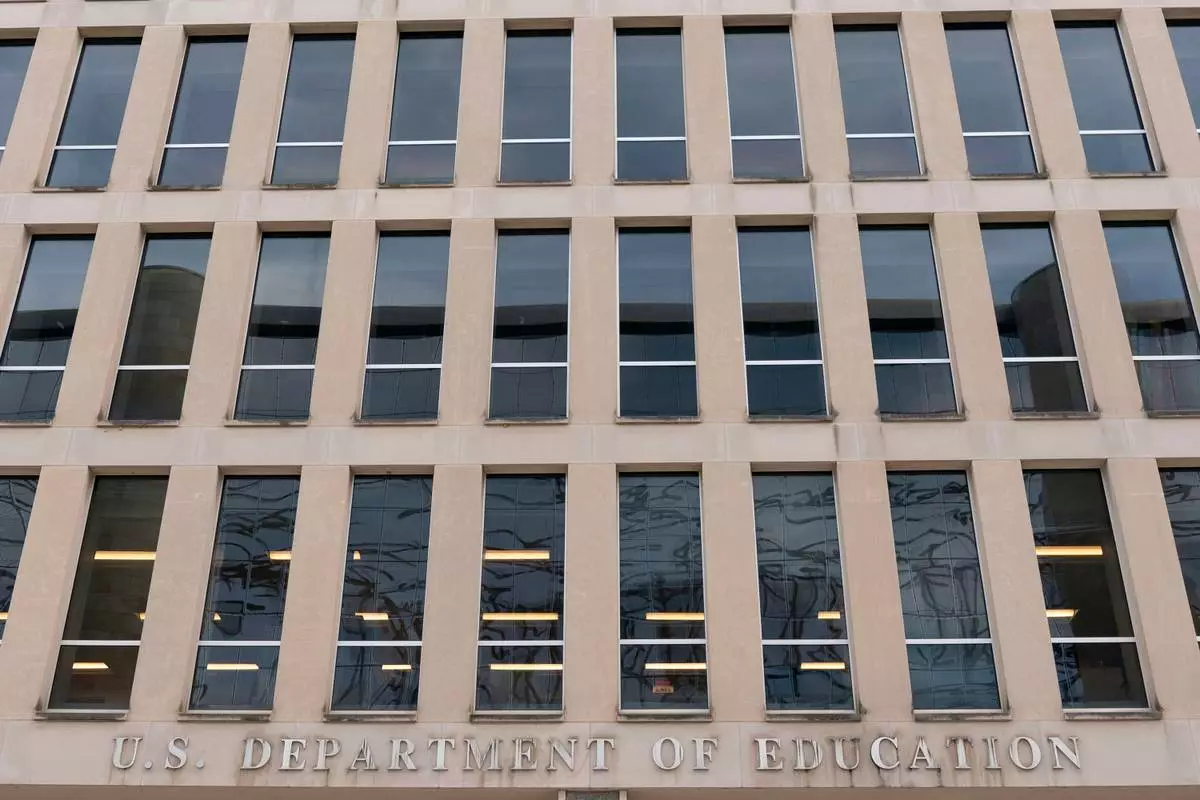
FILE - The U.S. Department of Education building is seen in Washington, Nov. 18, 2024. (AP Photo/Jose Luis Magana, File)