SEOUL, South Korea, June 30, 2026 /PRNewswire/ -- LG Innotek, renowned for its optical solution business and leadership in high-performance camera modules, is quickly establishing itself as a key player in package solutions, including high-value-added semiconductor substrates.
Backed by a combination of structural growth drivers—including the rollout of 5G networks, trend toward higher-performing components in premium smartphones, ongoing recovery of the memory market, and rapid expansion of AI and big data applications—the increase in global demand for high-value-added semiconductor substrate products is accelerating.
To respond to these technology trends, LG Innotek has built a high-value-added semiconductor substrate portfolio that includes RF-SiP (radio frequency system-in-package), FC-CSP (flip chip chip-scale package), and FC-BGA (flip chip ball grid array) products.
Reflecting this dramatic increase in semiconductor substrate demand, LG Innotek's package solution business recorded sales of approximately USD 1.11 billion in 2025, up approximately 18% from approximately USD 0.94 billion in 2024. Over the same period, operating profit increased from approximately USD 46 million to approximately USD 83 million, representing growth of approximately 82%. Securities firms expect LG Innotek's package solution business to sustain its strong growth this year.
Notably, the package solution business is a key profit driver. In 2025, it generated nearly 20% of LG Innotek's total operating profit, despite accounting for only about 10% of the company's total sales. Drawing on over 50 years of unrivaled substrate technology know-how, the company has markedly increased the added value of its semiconductor substrate products.
LG Innotek anticipates that, on the back of its high-value-added semiconductor substrate products that deliver both profitability and growth, the contribution of the package solution business to operating income will rise to a level comparable with that of its optical solution business within the next five years.
Jeffrey Cho, senior vice president of the Package Solution Business Unit, said at a recent Media Tech Day event held at LG Innotek's headquarters in Magok, Seoul, "LG Innotek has established itself as a first mover in the semiconductor substrate market by anticipating market changes ahead of customers, advancing its technologies, and driving paradigm-shifting innovation. Based on our differentiated technologies, we will swiftly expand our market share in the rapidly evolving semiconductor substrate market and nurture our package solution business into a core pillar that generates USD 647 million in operating profit by 2031."
- RF-SiP substrates integrating 50 years of high-density, ultra–precision technology, maintaining the largest market share globally for 10 consecutive years
The RF-SiP substrate is widely viewed as an innovative product, leveraging unequaled substrate technologies that LG Innotek has honed for more than 50 years.
The RF-SiP is a communication semiconductor component that combines key elements required for wireless communication, such as power amplifiers and chipsets, into a single package. LG Innotek develops and produces RF-SiP substrates that connect these integrated wireless communication components to the mainboard.
LG Innotek has built strong capabilities in high-density, ultra-precision substrates, enabling various components and fine circuitry to be tightly mounted within a very small substrate area. The company holds 1,868 patents related to these substrate technologies and also possesses highly optimized technology for realizing RF-SiP substrates that are mounted in space-constrained devices such as smartphones.
In 2011, LG Innotek successfully developed and mass-produced the world's first coreless RF-SiP substrate, which eliminates the core layer and insulation (prepreg) layers. Removing the core layer made the RF-SiP substrate approximately 20% thinner than existing substrates. Moreover, it applies a low-loss resin that minimizes signal delay and a specially treated copper surface that reduces signal loss during transmission and reception by around 70%.
Capitalizing on this advanced technology, LG Innotek rapidly captured the market and has maintained a thoroughly dominant position in the global RF-SiP substrate market since 2016. As of last year, the company commanded an estimated 65% of the global RF-SiP market, based on the top five global RF customers, and it expects this share to expand to around 80% this year.
In addition to solid demand driven by the global spread of smartphones, the trend toward slimmer devices is further boosting RF-SiP substrate demand, making it a steady seller that now represents the largest sales contributor within LG Innotek's package solution business.
- Applying Cu-Post technology to RF-SiP substrates for the first time in the world, enabling to design slimmer smartphones and enhancing the product's added-value in the 6G era
With the shift from LTE to 5G, making 5G smartphones thinner while maintaining performance became a major design challenge for the industry.
As 5G smartphones were designed to support both 5G and legacy LTE communication, the challenge was that 5G and LTE communications operate on different frequency bands, which increased circuit complexity and raised the number of components that needed to be mounted by at least 60%. Nevertheless, to address the pain point of customers who prefer slimmer smartphones, LG Innotek launched solution development in 2021 and discovered the answer by pioneering a paradigm shift in the RF-SiP substrate manufacturing process.
The most basic step in the manufacturing of semiconductor substrates is attaching solder balls to the substrate, thereby providing electrical connections between electronic components and the mainboard. Because solder balls can melt and bridge together during the soldering process, it was considered practically impossible to further narrow the spacing between them.
Rather than directly connecting solder balls to the semiconductor substrate, however, LG Innotek pioneered a new approach by first forming a Cu-Post (copper column) on the substrate and then mounting the solder ball on top, becoming the first company in the world to commercialize this structure. By adopting this column structure, the company was able to narrow the spacing between solder balls, reducing substrate thickness by nearly 20% while enhancing circuit integration. By using copper, which has a high melting point, the column structure remains stable even in high-temperature environments, enabling a tighter solder ball layout.
Using the Cu-Post manufacturing process, LG Innotek has been able to offer customers the world's thinnest 5G RF-SiP substrates. Its 5G RF-SiP substrate is roughly the size of two grains of rice. Despite its compact form factor, however, it accommodates more than 100 components, including high-frequency wireless communication chips, power amplifiers, and filters.
As the Cu-Post manufacturing process applied to RF-SiP substrates emerged as a new paradigm in the industry, LG Innotek was able to further consolidate its technological leadership in the communication semiconductor substrate sector.
Sanghyuck Nam, leader of the Package Solution Lab, said, "We are currently developing next-generation Cu-Post technology that will further shrink the distance between solder balls by about 10%. By doing so, we aim to lead the market with RF-SiP substrates that deliver even higher added value."
- Demand for FC-CSP substrates surging in the agentic AI era, with applications expanding from mobile APs to the memory sector
Another key product in LG Innotek's package solution business is the FC-CSP substrate. As the chip size is similar to the substrate size, FC-CSP substrates are primarily used to connect to the mainboard by mounting LPDDR (low-power double-data-rate) memory and small chip packages—both essential for mobile IT device application processors—on top of the substrate.
The FC-CSP substrate features a "flip" connection between the semiconductor chip and substrate, in which the chip is mounted upside down and connected via solder bumps instead of wire bonding.
LG Innotek has maintained a leading position in the global FC-CSP substrate market, underpinned by its high–density, ultra–precision substrate technology.
Seho Myeong, Head of Package Solution Development Division, explained, "FC-CSP substrates offer superior electrical characteristics and higher integration density compared with conventional memory substrates, helping enhance chip performance. Replacing existing memory substrates with FC-CSP substrates to improve performance and density has become a clear industry trend."
While FC-CSP substrates have been used primarily for mobile application processors, their use is now expanding into the memory sector in the AI era. The AI market has initially been dominated by GPU–centric systems optimized for AI training. However, as the real-time processing and inference of massive datasets gain prominence, the market landscape is undergoing a structural shift.
As the era of inference and agentic AI unfolds, the use of memory semiconductors such as GDDR (graphics double data rate) in AI accelerators and servers has risen sharply. As a result, demand for FC-CSP substrates required for memory semiconductor packaging has increased markedly.
FC-CSP substrates for AI semiconductors represent a new market in which the global supply chain is still taking shape. Building on the capabilities it has established through the mass production of FC-CSP substrates for mobile devices, LG Innotek aims to rapidly capture the emerging AI-driven FC-CSP market.
Jungho Hwang, Head of Package Solution Marketing Division, stated, "LG Innotek has recently secured orders from global semiconductor customers for FC-CSP substrates for GDDR7 memory. With a series of new orders for memory-type FC-CSP substrates, the semiconductor production lines at our Gumi plant are now operating at full capacity." She went on to add, "We plan to meet the demand from domestic and overseas customers by expanding the FC-CSP and RF-SiP production lines at our new plant in Vietnam, which is scheduled to break ground this month."
- Building the industry's most advanced smart factory for the optimized production of high-density, multi-layer, large-body FC-BGA substrates
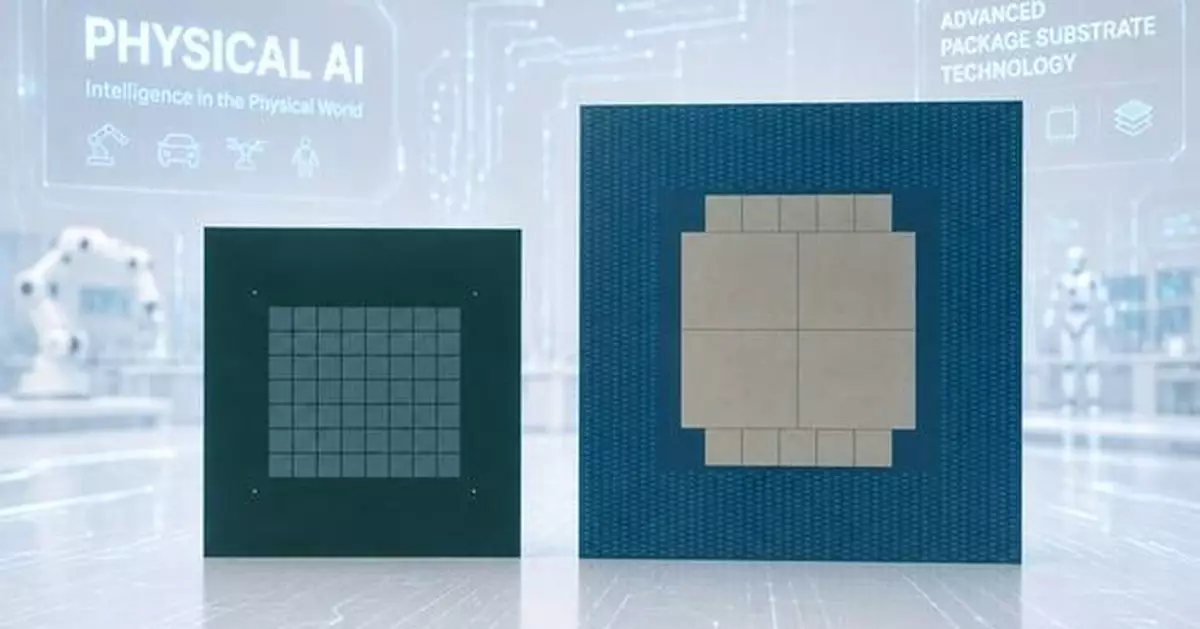
Small devices such as smartphones and tablet PCs can be covered by existing FC-CSP substrates. However, as high-performance, high-spec semiconductor chips are increasingly adopted in larger systems such as desktop PCs, laptops, AI servers, and data centers, additional circuits and components need to be integrated into the package. FC-BGA substrates are semiconductor substrates specialized for these larger systems, performing a role similar to that of FC-CSP substrates in mobile application processors (APs).
FC-BGA substrates are used for chipsets and CPUs in PCs, as well as for CPUs and GPUs deployed in autonomous driving vehicles and AI servers.
FC-BGA substrates have an area approximately 18 times larger than FC-CSP substrates and typically incorporate 16 to 22 layers—around three to four times more than FC-CSP substrates, which usually have 6 to 8 layers. Another key feature of FC-BGA substrates is that they interface with electronic devices via arrays of tiny ball-shaped joints (solder balls) formed on the underside of the substrate.
As substrate size and layer count increase, process complexity rises dramatically. LG Innotek has secured technology to mass-produce large-body FC-BGA substrates measuring 3.35in × 3.35in, and is now developing extra-large FC-BGA substrates larger than 4.72in × 4.72in.
Meanwhile, LG Innotek launched its FC-BGA substrate business in 2022. The company acquired the Gumi 4 Plant from LG Electronics and is building its "Dream Factory," a new approximately 280,000 sq ft (26,000m2) production line dedicated to FC-BGA substrates. The Dream Factory, first unveiled to the press in April 2025, is widely regarded as one of the industry's most advanced smart factories, seamlessly integrating state-of-the-art IT technologies such as AI, deep learning, robotics, and digital twin platforms. In particular, because large-area substrates are more susceptible to defects caused by foreign particles, LG Innotek's Dream Factory has transformed its entire production process through AI and is now recognized as a competitive production infrastructure with the capability to rapidly improve yields of large-body FC-BGA substrates.
LG Innotek successfully produced FC-BGA substrates for networks, modems, and digital TVs in 2022. In December 2024, the company commenced the mass production of FC-BGA substrates for PC chipsets used by a global big tech customer at the Dream Factory. From the third quarter of this year, it will begin producing FC-BGA substrates for PC CPUs for the same customers.
In 2025, the company also secured additional global big tech customers and, by 2028, aims to move in stages into high-end markets for FC-BGA substrates for CPUs and GPUs used in autonomous vehicles and AI accelerators/servers.
Jungho Hwang said, "While the share of GPUs used in AI training was overwhelmingly high, the shares of memory and CPUs in the era of AI inference are expected to increase further. As a result, many global big tech companies have entered the CPU market, creating new business opportunities for latecomers in FC-BGA substrates like us. In fact, various global customers are already approaching us directly to supply FC-BGA substrates for CPUs." To respond to this significant increase in customer demand, LG Innotek is reviewing plans to expand FC-BGA substrate production capacity at its domestic manufacturing sites.
According to Intel Market Research, the global FC-BGA substrate market was valued at USD 5.42 billion in 2025 and is projected to grow at an annual rate of 10.6%, reaching USD 9.548 billion by 2032.
Jeffrey Cho said, "LG Innotek aims to continuously develop FC-BGA substrates needed in diverse sectors, such as edge computing and the defense industry, and grow the FC-BGA business into one of its core business segments by actively engaging with new global big tech customers."
Applications for Three Semiconductor Substrates
| Product | Application area |
| RF-SiP | Smartphones (LTE/5G/6G communication), vehicles, smart glasses, satellites, AI power management |
| FC-CSP | Smartphones (AP), vehicles (ADAS), mobile devices/PCs/general servers (memory), AI servers (memory) |
| FC-BGA | PCs (chipsets, CPU), AI accelerators (ASIC), AI servers (CPU∙GPU), vehicles |
Product
Application area
RF-SiP
Smartphones (LTE/5G/6G communication), vehicles, smart glasses, satellites, AI power management
FC-CSP
Smartphones (AP), vehicles (ADAS), mobile devices/PCs/general servers (memory), AI servers (memory)
FC-BGA
PCs (chipsets, CPU), AI accelerators (ASIC), AI servers (CPU∙GPU), vehicles
** This press release is distributed by PR Newswire through automated distribution system, for which the client assumes full responsibility. **
LG Innotek Targets USD 647 million in Package Solution Operating Profit by 2031