PHOENIX (AP) — San Francisco Giants third baseman Matt Chapman was placed on the 10-day injured list Wednesday due to an abdominal strain.
The Giants announced the move before their game against the Arizona Diamondbacks. They recalled infielder Christian Koss from Triple-A Sacramento in a corresponding move.
Chapman’s abdominal injury caused him to exit the Giants’ 8-2 loss to Arizona in the sixth inning on Tuesday. He had walked back to the dugout in pain after charging a ground ball and throwing out Gabriel Moreno during that sixth inning.
After the game, Chapman said his abdominal area had been bothering him over the last several weeks.
“It’s been hot and cold where I’m trying to figure out what’s going on,” Chapman said. “I made that bare-handed play and that was the first time that one specific play made me cringe and go down a little bit, where I was actually in a lot of pain.”
Chapman is batting .235 this season with seven homers and 42 RBIs.
AP MLB: https://apnews.com/hub/MLB

An injured San Francisco Giants third baseman Matt Chapman walks off the field slowly after throwing out Arizona Diamondbacks' Gabriel Moreno at first base during the sixth inning of a baseball game, Tuesday, June 30, 2026, in Phoenix. (AP Photo/Ross D. Franklin)

San Francisco Giants third baseman Matt Chapman makes a one-handed grab on a grounder hit by Arizona Diamondbacks' Gabriel Moreno (14) before throwing to first base for the out during the sixth inning of a baseball game, Tuesday, June 30, 2026, in Phoenix. (AP Photo/Ross D. Franklin)
WASHINGTON (AP) — Franklin D. Roosevelt toiled over paperwork there during World War II's darkest days. George W. Bush sat behind it to address the nation on 9/11. Beneath it, John F. Kennedy Jr. once crawled and peeked out from behind its front panel while his father worked above, an image so etched into American history that President Joe Biden recreated it with his grandson.
The Resolute Desk is one of the most recognizable pieces of furniture in the White House — and probably in the entire nation. As the president’s desk, it’s been at the center of American history for nearly 150 years.
That famous front panel has its own story. Many accounts claim it was added during FDR’s presidency to conceal his wheelchair and leg braces, but some historians dispute that. They argue Roosevelt used the desk in his private study, away from the public eye, and that the panel itself was not installed until after his death.
The desk’s origins extend far beyond the Oval Office. In fact, it's not American; it’s British.
The desk is crafted of timbers from the HMS Resolute, a British naval vessel that set off for the Arctic in the early 1850s in search of Sir John Franklin, who disappeared while seeking the Northwest Passage. During that mission, the Resolute became trapped in ice and was abandoned by its crew. Years later, it was discovered drifting through Arctic waters by an American whaling vessel.
The United States repaired it and returned it to Queen Victoria. The vessel resumed service for many years before eventually being retired.
Once decommissioned, Queen Victoria expressed her gratitude to the United States by ordering the timbers of Resolute to be transformed into several pieces of furniture. One of them was a large desk that she presented to President Rutherford B. Hayes in 1880.
The desk spent much of its early White House history out of public view until 1961, when first lady Jacqueline Kennedy moved it into the Oval Office.
Every president since Jimmy Carter has used the Resolute desk in the Oval Office, with the exception of President George H.W. Bush, who instead placed it in the Treaty Room. The desk has also become the place where recent presidents leave a letter for their successor on Inauguration Day.
The Resolute Desk stands not only as a symbol of the American presidency, but also as a reminder of the enduring friendship between the United States and Britain.
Part of a recurring series, “American Objects,” marking the 250th anniversary of the United States. For more American objects, click here. For more stories on the anniversary, click here.
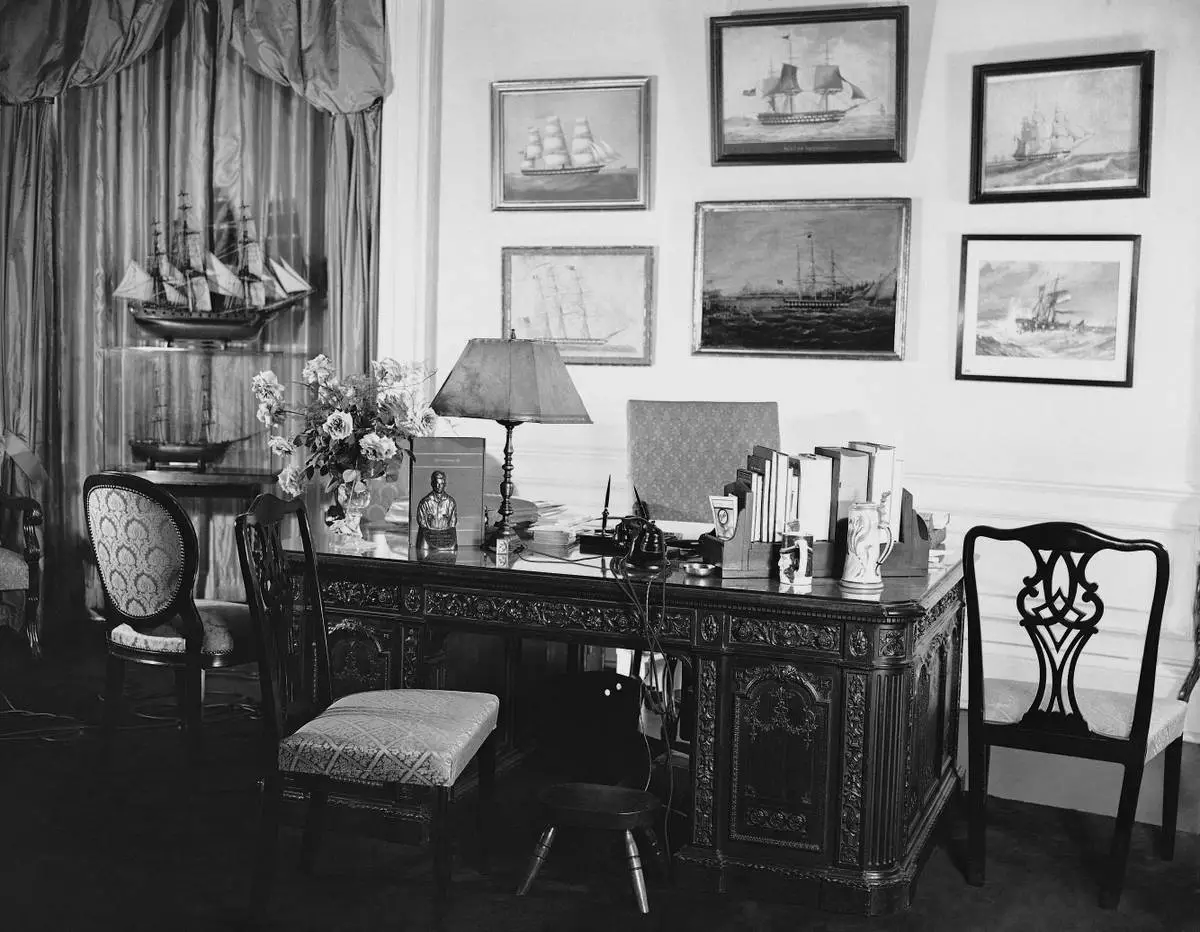
FILE - The private study of President Franklin D. Roosevelt at the White House on the second floor is shown on May 10, 1933. (AP Photo/File)
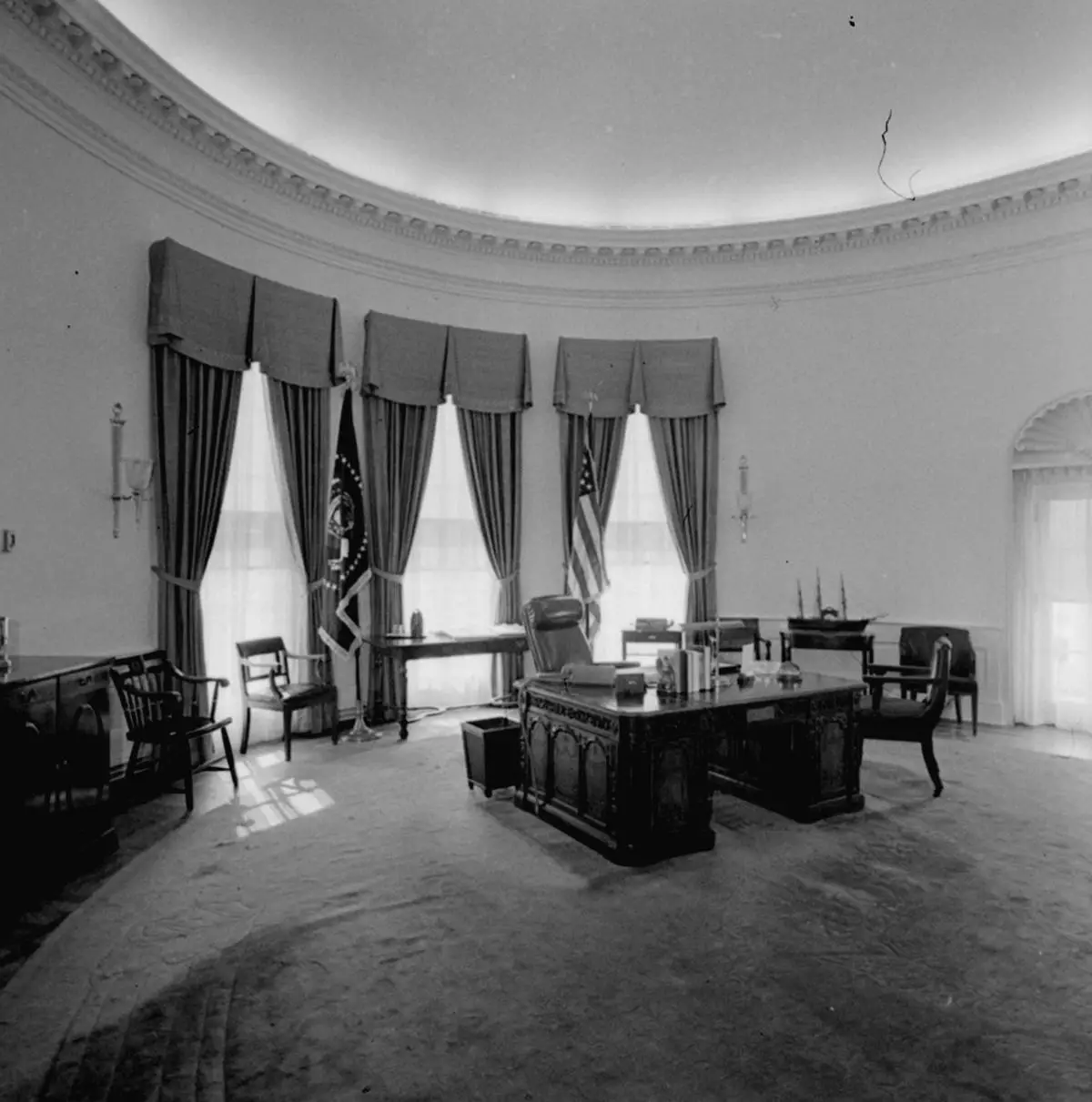
FILE- A view of the Resolute desk in President John F. Kennedy's Oval Office at the White House in Washington, Feb. 5, 1961. (AP Photo/Bob Schutz, File)
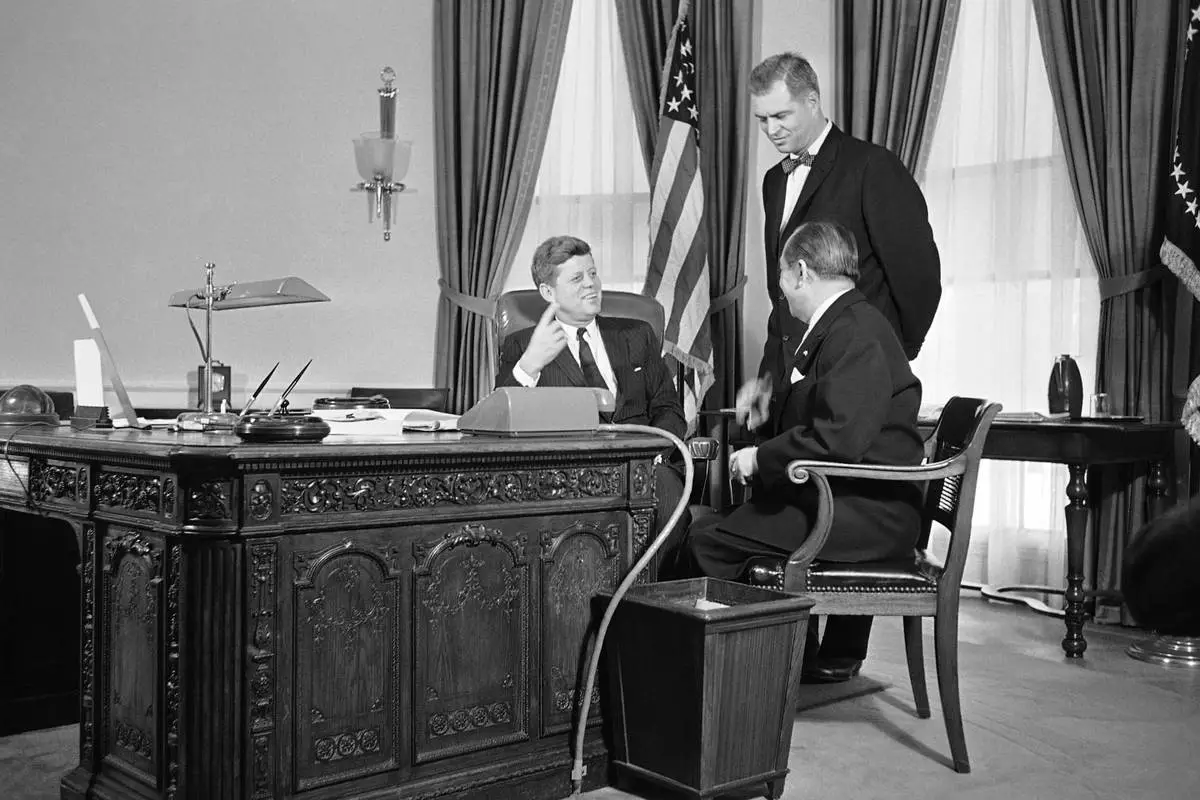
FILE - President John F. Kennedy gestures from behind a richly carved desk, made from the timbers of a British sailing ship, as he talks, Feb. 6, 1961 in his White House office in Washington with Mongi Slim, right, Tunisian Ambassador to the U.S., and G. Mennen Williams, Assistant Secretary of State for African Affairs. (AP Photo/HB, File)