- Thailand's solar market is growing rapidly, driven by the PDP 2026 target to raise the clean energy share to 60% and rising electricity demand from cloud and AI investment.
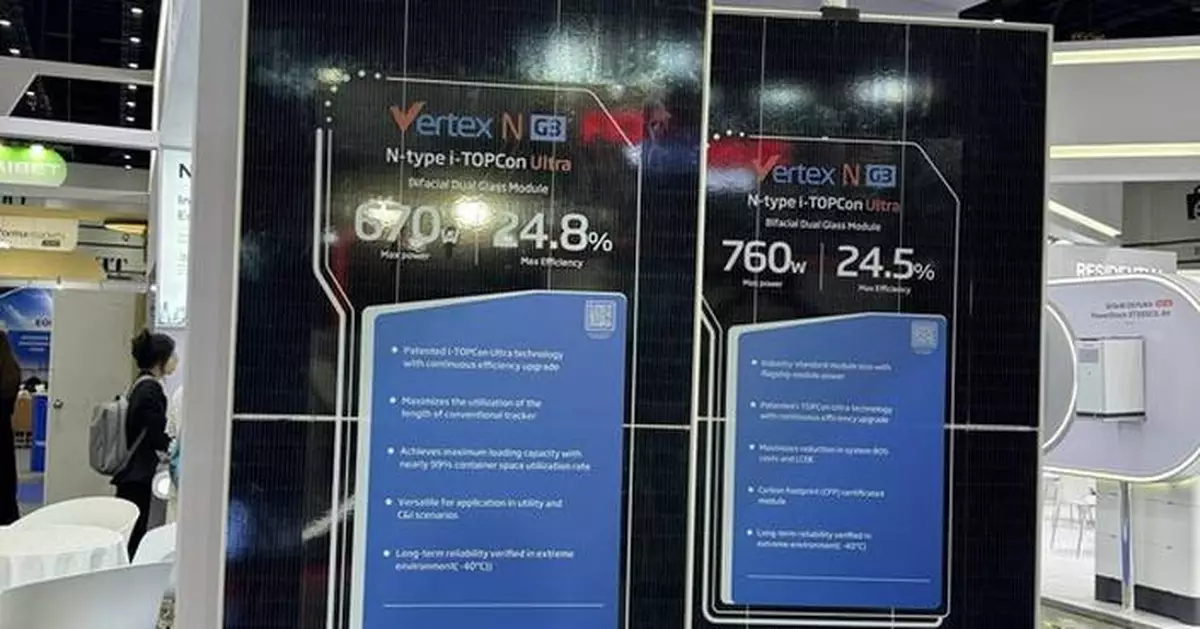
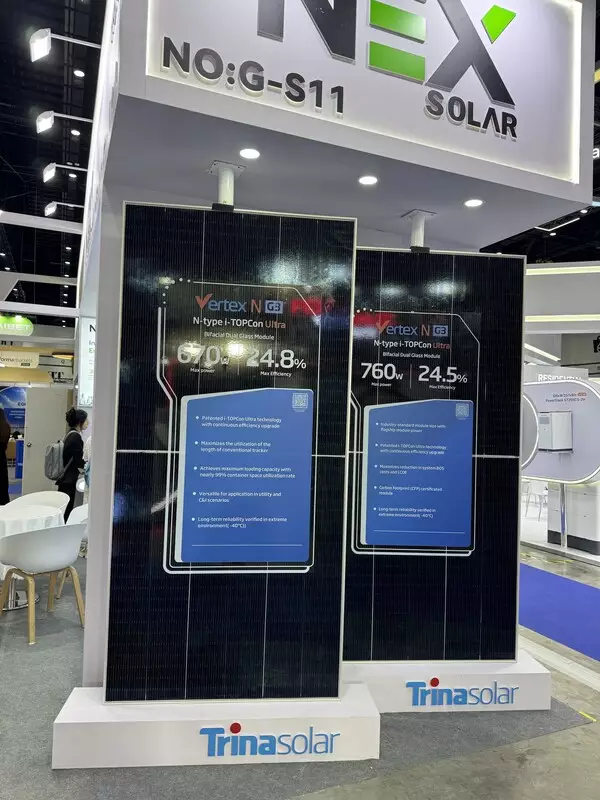
- The Vertex N G3 is designed to address Thailand's installation space constraints, delivering up to 760W output and Bifacial technology that enables 10–20% additional energy generation.
BANGKOK, July 2, 2026 /PRNewswire/ -- Trinasolar, a global leader in smart solar and energy storage solutions, will debut its latest high-power module, the Vertex N G3, at Asia Sustainable Energy Week 2026 (ASEW), taking place from 1 to 3 July 2026 in Bangkok, Thailand. The module will be displayed at the booths of Trinasolar's distributor partners NEX, KLINK and Marvel.
Thailand's solar sector is entering a more demand-driven phase, with the draft Power Development Plan (PDP 2026) targeting renewables to account for 60% of power generation by 2037. Rising investment in cloud and artificial intelligence infrastructure is also increasing demand for cleaner electricity, creating a stronger need for high-yield solar solutions across utility, commercial and industrial (C&I) and emerging artificial intelligence data centre (AIDC) applications.Thailand's data centre sector is projected to grow at 27.71% annually between 2025 and 2031, significantly above the global average of 8.37%, underscoring the scale of clean energy demand that high-efficiency solar solutions will need to support.
The Vertex N G3 (NEG21C.20Q) is positioned to meet these requirements with its high module output of up to 760W and module efficiency of 24.5%. Leveraging Trinasolar's advanced n-type i-TOPCon Ultra technology, its optimized voltage-to-current ratio enables higher string power with fewer modules, supporting more efficient system layouts and helping reduce balance-of-system requirements. The module also features bifaciality of up to 85±5%, enabling 10 to 20% additional rear-side energy generation depending on site conditions and system design. These features are relevant for Thailand, where customers need to improve project output while managing land, rooftop and installation constraints.
The module is also suited to Thailand's hot and humid operating environment. With low linear degradation of 0.35% and stable temperature performance, the Vertex N G3 supports consistent energy output over time.
Trinasolar's showcase of the Vertex N G3 follows its recent 600MW MoU with Ecohope, in which the Vertex N G3 is a flagship module. Ecohope's focus on Thailand as a key Southeast Asia market signals confidence in the module's relevance to local solar demand.
"Thailand is an important market for Trinasolar, and ASEW gives us a strong platform to showcase our latest TOPCon 3.0 technology. The rapid expansion of data centres and AI infrastructure is fundamentally reshaping" said Dave Wang, Subregion Head (Thailand, Cambodia, Laos, and Myanmar), Trinasolar Asia Pacific. "The Vertex N G3is well-positioned to support this shift, delivering higher energy yield and long-term reliability that both industrial and digital infrastructure customers increasingly require. Showcasing it with our local partners demonstrates our commitment to Thailand and our confidence in the market's next phase of solar growth."
** This press release is distributed by PR Newswire through automated distribution system, for which the client assumes full responsibility. **
Trinasolar Showcases Vertex N G3 at ASEW to Support Thailand's Solar Market Amid Rising AI and Data Centre Demand
- Introduces a low-rank-based approach to KV cache compression, one of the key bottlenecks in long-context AI
- Speeds up attention computation by up to 6.9x and overall generation throughput by up to 3.1x, moving beyond memory savings to faster inference
- Selected as a Spotlight paper at ICML 2026, representing about 2.2% of reviewed submissions and about 8.4% of accepted papers
- Following the attention around Google's TurboQuant at ICLR 2026, STAR-KV presents another approach to advancing KV cache compression
- Paper available on arXiv; source code released on GitHub
SEOUL, South Korea, July 2, 2026 /PRNewswire/ -- Dnotitia Inc. (Dnotitia), a company specializing in long-term memory AI and semiconductor-based AI infrastructure technologies, has released the paper and source code for "STAR-KV: Low-Rank KV Cache Compression via Soft Thresholding for Adaptive Rank Control." The technology was developed through a joint research effort involving UC San Diego's VVIP Lab and Dnotitia researchers, and the paper was selected as a Spotlight paper at ICML 2026 (International Conference on Machine Learning 2026), one of the world's leading conferences in machine learning.
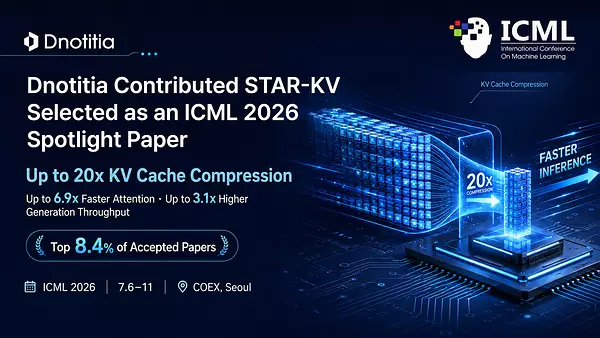
In the experiments reported in the paper, low-rank compression alone reduced the KV cache by up to 75%. Combined with the mixed-precision quantization method proposed in the paper, STAR-KV compressed the full KV cache by up to 20x. The technology also improves computation speed through custom GPU kernels, increasing attention computation speed by up to 6.9x and overall generation throughput by up to 3.1x. STAR-KV also showed higher accuracy than major existing KV cache compression methods.
KV cache compression has become a key technical challenge in AI infrastructure. As research into reducing the memory bottleneck of long-context AI gains momentum, including the attention around Google's TurboQuant at ICLR 2026, STAR-KV presents a new approach that combines low-rank compression with quantization and GPU execution optimization.
The KV cache is temporary memory stored on the GPU so that a large language model (LLM) does not have to recompute context it has already processed. As AI evolves into agentic systems that use multiple documents, conversation history, code, search results, and outputs from external tools, the amount of context a model must process is growing rapidly. In this environment, the KV cache has emerged as a key bottleneck affecting both GPU memory usage and inference cost.
According to the STAR-KV paper, when a LLaMA-3.1-8B model processes a 128K-token context at a batch size of 4, the KV cache accounts for about 81% of total GPU memory. As long-context AI becomes more widely used, KV cache compression is increasingly viewed as a core AI infrastructure technology for processing long context at lower cost.
ICML, where the STAR-KV paper was accepted, is widely regarded as one of the top international conferences in AI and machine learning, alongside NeurIPS and ICLR. ICML 2026 will be held from July 6 to 11 at COEX in Seoul. This year, 23,918 papers entered review, 6,352 were accepted, and 536 were selected as Spotlight papers. Spotlight papers account for about 2.2% of all reviewed submissions and about 8.4% of accepted papers.
Going forward, Dnotitia plans to further advance STAR-KV for use in real-world AI service environments and explore its application to open-source LLM inference frameworks such as vLLM.
"Technologies that help AI process longer context faster and at lower cost are advancing rapidly" said MK Chung, CEO of Dnotitia. "STAR-KV addresses the core bottlenecks in KV cache capacity and attention processing speed, and Dnotitia aims to contribute to the AI inference ecosystem through open sourcing."
SEOUL, South Korea, July 2, 2026 /PRNewswire/ -- Dnotitia Inc. (Dnotitia), a company specializing in long-term memory AI and semiconductor-based AI infrastructure technologies, has released the paper and source code for "STAR-KV: Low-Rank KV Cache Compression via Soft Thresholding for Adaptive Rank Control." The technology was developed through a joint research effort involving UC San Diego's VVIP Lab and Dnotitia researchers, and the paper was selected as a Spotlight paper at ICML 2026 (International Conference on Machine Learning 2026), one of the world's leading conferences in machine learning.
In the experiments reported in the paper, low-rank compression alone reduced the KV cache by up to 75%. Combined with the mixed-precision quantization method proposed in the paper, STAR-KV compressed the full KV cache by up to 20x. The technology also improves computation speed through custom GPU kernels, increasing attention computation speed by up to 6.9x and overall generation throughput by up to 3.1x. STAR-KV also showed higher accuracy than major existing KV cache compression methods.
KV cache compression has become a key technical challenge in AI infrastructure. As research into reducing the memory bottleneck of long-context AI gains momentum, including the attention around Google's TurboQuant at ICLR 2026, STAR-KV presents a new approach that combines low-rank compression with quantization and GPU execution optimization.
The KV cache is temporary memory stored on the GPU so that a large language model (LLM) does not have to recompute context it has already processed. As AI evolves into agentic systems that use multiple documents, conversation history, code, search results, and outputs from external tools, the amount of context a model must process is growing rapidly. In this environment, the KV cache has emerged as a key bottleneck affecting both GPU memory usage and inference cost.
According to the STAR-KV paper, when a LLaMA-3.1-8B model processes a 128K-token context at a batch size of 4, the KV cache accounts for about 81% of total GPU memory. As long-context AI becomes more widely used, KV cache compression is increasingly viewed as a core AI infrastructure technology for processing long context at lower cost.
ICML, where the STAR-KV paper was accepted, is widely regarded as one of the top international conferences in AI and machine learning, alongside NeurIPS and ICLR. ICML 2026 will be held from July 6 to 11 at COEX in Seoul. This year, 23,918 papers entered review, 6,352 were accepted, and 536 were selected as Spotlight papers. Spotlight papers account for about 2.2% of all reviewed submissions and about 8.4% of accepted papers.
Going forward, Dnotitia plans to further advance STAR-KV for use in real-world AI service environments and explore its application to open-source LLM inference frameworks such as vLLM.
"Technologies that help AI process longer context faster and at lower cost are advancing rapidly" said MK Chung, CEO of Dnotitia. "STAR-KV addresses the core bottlenecks in KV cache capacity and attention processing speed, and Dnotitia aims to contribute to the AI inference ecosystem through open sourcing."
** This press release is distributed by PR Newswire through automated distribution system, for which the client assumes full responsibility. **
Dnotitia Unveils STAR-KV, Achieving UP to 20x KV Cache Compression, Selected as an ICML 2026 Spotlight Paper