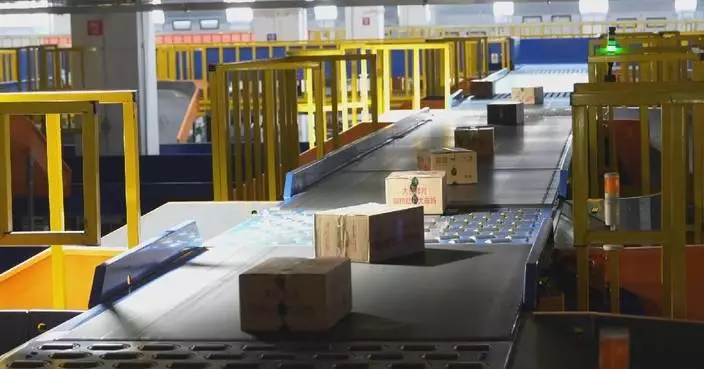
China's postal and express delivery industry is being revolutionized by advanced technologies such as smart warehousing, automated sorting, and unmanned delivery systems.
In Zhenning County, southwest China's Guizhou Province, local honey plums are currently in peak production and sales season. Express delivery companies have partnered with fruit growers, directly entering the orchards for sorting and packaging.
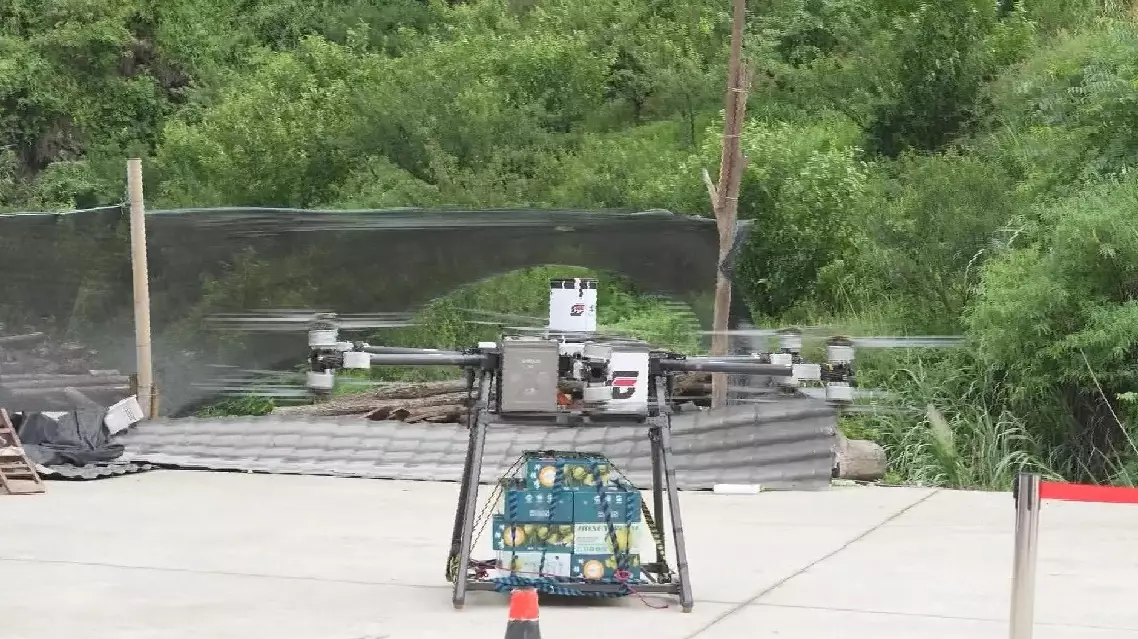
Utilizing drones and shuttles, these companies have created an integrated delivery system that combines picking and sorting with direct dispatch. This innovation addresses previous challenges, such as farmers transporting goods down steep mountains, excessive transfers, and significant product loss.
"Once the fruit is packed by farmers, drones first transport the plums to a collection point at the mountain's base, after which trucks take them to a sorting center for dispatch. This allows Zhenning honey plums picked and packaged the same day to be shipped out by drone, establishing a rapid fresh-fruit transport channel," said Lai Junnan, a drone specialist from a local logistics company.
To tackle inefficiencies like time-consuming sorting and delays from secondary redistribution, express delivery companies have deployed intelligent automated sorting vehicles, established dedicated shipping routes, and enhanced direct links to airports.
"The automated sorting vehicles operate on six shipping routes that send items directly to the corresponding airports for quick distribution. These direct routes have significantly reduced our sorting time compared to previous years -- we've cut it by more than half a day," said Liu Banglei, business director of a local logistics company.
Meanwhile, the introduction of unmanned vehicles has significantly reduced delivery times, especially in rural and remote areas.
"Our area used to be quite remote, and packages often arrived late. However, since we started using unmanned vehicles, delivery times have improved significantly. Now we can pick up our parcels by noon -- it's much faster than before," said Li Hongbao, a resident of Pingchuan Town, Linze County northwest China's Gansu Province.
Unmanned delivery vehicles are now deployed daily in over 200 cities to transport parcels, with drones handling nearly four million items each year. Many large sorting centers have fully automated operations, while smart warehouses utilize flying-ladder and pallet-moving robots for precise picking.
Once packaged, parcels enter an automated system for weighing, scanning, and bagging, completing the process in as little as 15 minutes. Electronic waybills have achieved full coverage, and over 95 percent of trunk-line vehicles are equipped with Beidou satellite navigation systems.
These advancements in information technology are enhancing efficiency, increasing successful delivery rates, and boosting user satisfaction each year.
Technology transforms China's delivery industry