MUNICH--(BUSINESS WIRE)--Jul 6, 2026--
Households around the world are feeling the strain of the rising cost of living, with financial pressure increasingly shaping everyday choices and long-term confidence. Finances and health are now tied as the top global worries, at 48% each, followed by concerns about the future at 35%, according to consumer surveys in 10 countries published in “The Allianz 3am Report 2026.”
This press release features multimedia. View the full release here: https://www.businesswire.com/news/home/20260703907741/en/
Financial worries, which include concerns about “rising cost of living” (71%) and “insufficient income” (51%), increased in seven out of eight countries surveyed year over year, moving up in the ranking of top three worries in Brazil, France, Germany, and the U.K., while remaining stable in Italy. The strongest increases are observed in Australia and Indonesia, where financial concerns have remained the leading worry, as well as in Turkey (from 42% to 49%). In the two countries added to this year's survey, Spain and Switzerland, financial worries also rank among the top two concerns. At the same time, many people lack the financial knowledge needed to save effectively, build wealth and plan for long-term security, a gap Allianz aims to help close with its new financial and risk learning platform, “ Allianz School For Life.”
Health concerns remain a major source of anxiety worldwide. Concerns about personal physical health rank highest globally at 48%, followed by worries about the health of family members (45%) and access to medical treatment (42%). Mental health and stress are emerging as the fastest-growing issues (up 5 and 4 percentage points, respectively, from 2025), potentially reflecting the strain of uncertain times and even financial stress on individuals’ well-being. Allianz helps address these concerns by offering a connected suite of health and preventive care services designed to support people throughout their healthcare journey, guide them to the right care faster, and reduce unnecessary treatment.
“The top worries of finances and health increasingly reflect the search for stability in a changing world. As more household budgets are focused on essentials, many people find it harder to save, plan ahead and feel in control of their future. For Allianz, staying close to customers starts with understanding their everyday realities. It also means helping them make informed financial choices and ensuring they have the right access to health and preventative care. It is how we continue to earn their trust across generations and provide protection and peace of mind through insurance solutions they value and can afford,” said Bernd Heinemann, Head of Group Strategy, Marketing, and Distribution, Allianz SE.
People are coping, but financially fragile
Based on a survey of 10,000 people across Australia, Brazil, France, Germany, Indonesia, Italy, Spain, Switzerland, Turkey and the U.K., the report takes a closer look at how financial pressure is shaping everyday choices. The findings point to growing affordability challenges. They reflect a shift toward a less inclusive economy where wealth gaps are widening.
With only a small global minority (5%) describing themselves as truly financially secure and able to save and invest significantly, a large share report they are “managing,” while nearly one in three are struggling to make ends meet. In uncertain times, the dominant instinct is defensive with 34% of respondents reducing nonessential spending and 22% focusing on saving for essential future needs. Expenses for food (77%) and housing (49%) dominate household budgets globally, followed by transportation (35%) and insurance (34%).
For many households, saving money remains difficult, with nearly one in three people unable to save regularly, which may result in unexpected expenses that can quickly disrupt stability. Across Europe and the U.K., around one-third (34%) are able to save 10% or more of their income. Indonesia shows a different pattern, with 56% of respondents reporting they can save 10% or more of their income, suggesting a greater reliance on personal savings to manage uncertainty, even under pressure.
Curated financial education
As the cost of living rises and people take greater responsibility for their retirement, wealth and financial security, financial literacy is essential. However, significant knowledge gaps remain: Allianz Research finds that only 18% of people have advanced financial knowledge, while 26% have only a basic understanding. Allianz continues to invest in customer-centric solutions that address customers’ evolving needs. One way it is doing so is through the launch of the “Allianz School For Life,” a free, open-access digital learning platform designed to help address gaps in financial literacy and support long-term resilience. The platform provides content about budgeting, investing and risk management, tailored to different life stages, with dedicated learning journeys for children, teenagers and adults, to make financial education engaging, accessible and applicable to everyday life.
About Allianz
The Allianz Group is one of the world’s leading insurers and asset managers, active in almost 70 countries and serving around 97 million private and corporate customers*. Our customers benefit from a broad range of personal and corporate insurance services, including property, life and health insurance, as well as assistance services, credit and global business insurance. Recognized for the seventh consecutive year as the number one global insurance brand in Interbrand’s Best Global Brands 2025 ranking, Allianz’s success is built on technology-enabled customer centricity – providing peace of mind, protection, and prevention for our customers and strengthening the resilience of individuals, communities, and societies. We are one of the world’s largest investors, managing around 770 billion euros** on behalf of our insurance customers. Furthermore, our asset managers PIMCO and Allianz Global Investors manage about 2.0 trillion euros** of third-party assets. Thanks to our systematic integration of environmental and social criteria in our business processes and investment decisions, Allianz received an MSCI ESG Rating of AAA (as of March 2026). In 2025, our 156,000 dedicated employees achieved a total business volume of 186.9 billion euros and an operating profit of 17.4 billion euros for our shareholders.
* As of December 31, 2025. Customer count reflects Allianz customers in consolidated entities that are part of the customer reporting scope only.
** As of March 31, 2026.
Mandatory corporateinformation:Corporate disclosures
These assessments are, as always, subject to the disclaimer provided below.
Cautionary note regarding forward-looking statements
This document includes forward-looking statements, such as prospects or expectations, that are based on management's current views and assumptions and subject to known and unknown risks and uncertainties. Actual results, performance figures, or events may differ significantly from those expressed or implied in such forward-looking statements.
Deviations may arise due to changes in factors including, but not limited to, the following: (i) the general economic and competitive situation in the Allianz’s core business and core markets, (ii) the performance of financial markets (in particular market volatility, liquidity, and credit events), (iii) adverse publicity, regulatory actions or litigation with respect to the Allianz Group, other well-known companies and the financial services industry generally, (iv) the frequency and severity of insured loss events, including those resulting from natural catastrophes, and the development of loss expenses, (v) mortality and morbidity levels and trends, (vi) persistency levels, (vii) the extent of credit defaults, (viii) interest rate levels, (ix) currency exchange rates, most notably the EUR/USD exchange rate, (x) changes in laws and regulations, including tax regulations, (xi) the impact of acquisitions including related integration issues and reorganization measures, and (xii) the general competitive conditions that, in each individual case, apply at a local, regional, national, and/or global level. Many of these changes can be exacerbated by terrorist activities.
No duty to update
Allianz assumes no obligation to update any information or forward-looking statement contained herein, save for any information we are required to disclose by law.
Privacy Note
Allianz SE is committed to protecting your personal data. Find out more in our privacy statement.
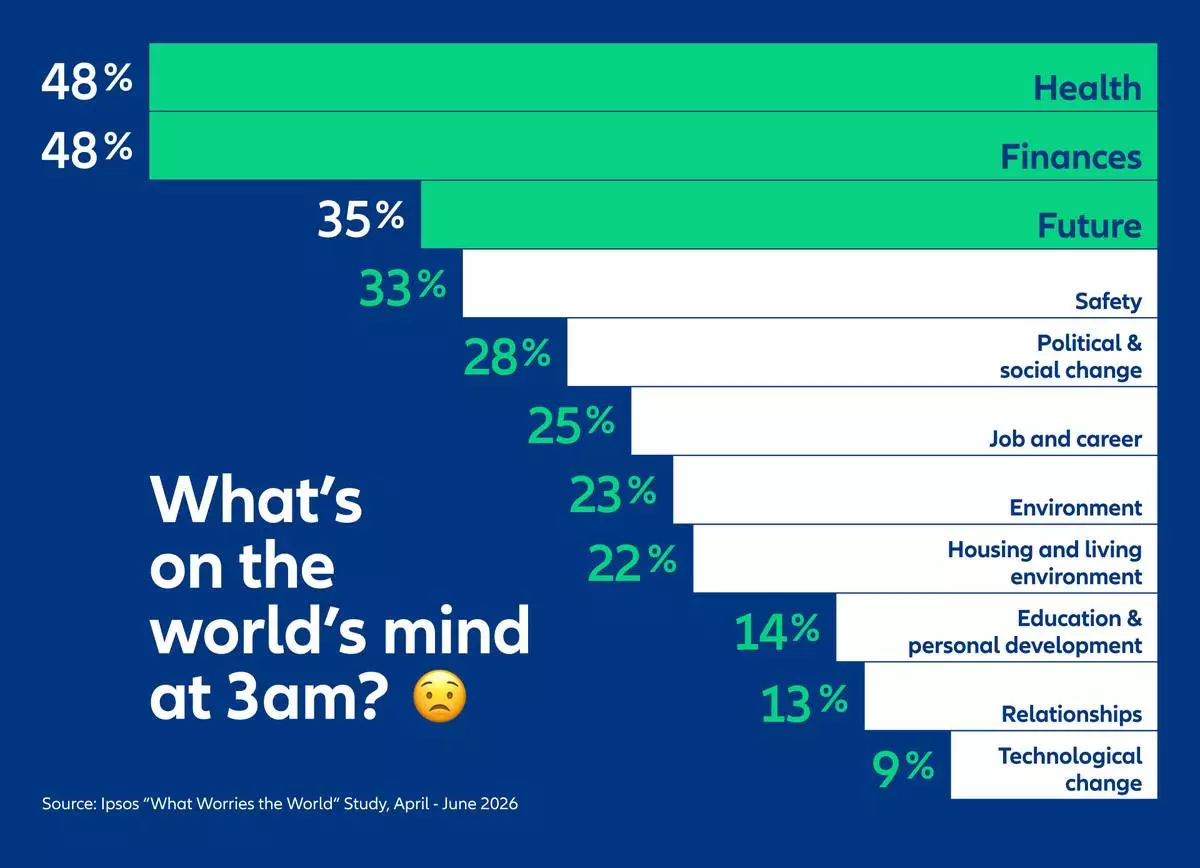
Allianz / IPSOS “What Worries the World” Study, April – June 2026.