BOSTON--(BUSINESS WIRE)--Jul 6, 2026--
Elucid, an innovator in AI-powered coronary CT angiography (CCTA) analysis, today announced its largest and most comprehensive presence to date at the Society of Cardiovascular Computed Tomography Annual Scientific Meeting (SCCT 2026), taking place July 9 - 12, 2026, at the Gaylord Pacific Resort & Convention Center in Chula Vista, Calif. During the meeting, Elucid will unveil its next generation of innovation, including plaque based FFR-CT 2, stenosis quantification 2, and a new comprehensive user interface that enables efficient and transparent clinical insights. Across meeting proceedings, the company will present scientific and clinical cases that demonstrate its leadership in CCTA 3.0, the company’s vision of the future of CCTA-guided, personalized coronary artery disease (CAD) care.
This press release features multimedia. View the full release here: https://www.businesswire.com/news/home/20260706232077/en/
“We are standing at an inflection point in cardiovascular medicine, on the cusp of CCTA 3.0 and moving from population-based guidelines to truly personalized therapy,” said Elucid CEO Kelly Huang, PhD. “Oncology made this shift over the past decade, evolving from a one-size-fits-all approach based on tumor size (anatomy) to highly personalized care driven by detailed biological characteristics and physiology of tumor behavior. Elucid’s vision is to drive a similar evolution in cardiovascular disease. At SCCT, we will demonstrate how we plan to deliver accuracy, reproducibility, and complete transparency in integrating anatomy, biology, and physiology, and how we are investing in the clinical science that will make CCTA 3.0 a reality.”
As vasodilatory function is impacted by plaque amount and composition, Elucid developed deep learning AI models that leverage its histology-based plaque quantification to estimate FFR-CT 2. Elucid’s FFR-CT is validated against invasive FFR, and under review by FDA. This biointegrated approach to FFR-CT uniquely enables continuous estimation of numerical FFR-CT along the entire vessel tree in a manner that is transparent and is always concordant with plaque characterization. Additionally, Elucid offers the only CT-derived plaque analysis validated for use in the carotid arteries.
“The next frontier in coronary CT is not simply detecting disease but also measuring the biological and physiological features that determine how that disease behaves,” said Dr. Amir Ahmadi, MD, FACC, FSCCT, clinical associate professor of Cardiology at the Icahn School of Medicine at Mount Sinai and Elucid’s lead scientific advisor. “New data being presented at SCCT demonstrate that Elucid achieves excellent performance in the accurate, reproducible, and transparent quantification of plaque composition, as well as stenosis 2, and plaque-derived FFR-CT 1. This enables risk assessment at the level where events originate — the individual lesion — while integrating that information with vessel-level plaque burden to define personalized, patient-level risk. The goal is to translate reliable imaging data into more precise therapy and improved patient outcomes, all while improving workflow efficiency for physicians.”
Elucid’s SCCT 2026 sessions and events include:
Thursday, July 9:
12:30 – 5:30 pm | AI & Innovation Symposium “CCTA 3.0: Precise Personalized Guidance, Accelerated by Agentic AI.” Speaker: Ruby Gill, PhD. Elucid’s session will explore how artificial intelligence and machine learning are accelerating the translation of comprehensive plaque data into precise, individualized clinical guidance.
5 – 8 pm | Workshop Dinner “CCTA 3.0: HANDS-ON EXPERIENCE | Integrating Plaque Biology and Plaque-Derived FFR-CT for Lesion-Level Risk Assessment.” Speakers: Amir Ahmadi, MD; Jairo Aldana-Bitar, MD; Farhan Katchi, MD; Adam Jacobi, MD. An immersive, hands-on session in which attendees will work directly with Elucid’s platform to explore the integration of plaque biology and plaque-derived FFR-CT for comprehensive lesion-level risk assessment. Register here:https://scct.org/events/register.aspx?id=2063525
Friday, July 10:
12:50 – 1:10 pm | Product Showcase (Exhibit Hall) “CCTA 3.0: ANALYSIS | From Individual Lesions to Patient Risk: A Comprehensive Assessment.” Speaker: Jairo Aldana-Bitar, MD. Elucid will participate in SCCT’s inaugural Product Showcase with a focused 20-minute demonstration of how the company’s integrated platform bridges individual lesion data and holistic patient risk assessment.
3:30 – 3:45 pm | Non-Sponsored Session: AI-Plaque Wars. Speaker: Amir Ahmadi, MD. Dr. Ahmadi will represent Elucid in this panel on its CCTA 3.0 vision, including the evolution from CCTA 1.0 through 2.0 to 3.0, and the scientific approach and case for deriving both plaque characterization and FFR-CT from the same histology-based data, enabling physiologic assessments that are informed by and directly linked to plaque biology.
5:22 – 5:34 pm | Novel Technology Session | Chula Vista 4 “CCTA 3.0 | Delivering on Next-Level Scientific Innovation and Patient Outcomes.” Speaker: Kelly Huang, PhD. In a 12-minute featured presentation, Elucid CEO Kelly Huang, PhD, will articulate Elucid’s comprehensive CCTA 3.0 platform strategy, from CT-Virtual Histology and plaque-derived FFR-CT to prospective clinical trials and next-generation physician workflows.
Saturday, July 11:
12:50 – 1:40 pm | Lunch Symposium | Chula Vista 2 “CCTA 3.0 | Remove the Blindfold: Integrating Plaque Biology and Plaque-Based Physiology for Smart Clinical Decisions.” Speakers: Amir Ahmadi, MD, Michael Hadley, MD, Anton Camaj, MD. Through clinical evidence, real-world cases, and emerging research, this session explores how plaque biology and plaque-derived physiology can support more informed decisions and better understand risk, guide treatment, and improve patient outcomes.
About Elucid
Elucid is a Boston-based AI medical technology company that develops AI to see invisible features of risk. The company is dedicated to developing a clinical platform to help physicians deliver CCTA-guided personalized care by providing a more precise view of atherosclerosis, the root cause of cardiovascular disease. The company’s FDA-cleared Plaque-IQ™ image analysis software is designed to help physicians prioritize and personalize treatment based on actual disease, rather than population-based risk of disease. Plaque-IQ equips physicians with critical information regarding the type and amount of plaque in arteries that can lead to heart attack and stroke. Elucid is also pursuing an indication for FFR-CT, derived from its plaque algorithm, resulting in concordance between plaque and FFR-CT. FFR-CT helps physicians identify coronary blockages and the extent of a patient’s ischemia non-invasively. For more information, visit elucid.com.
References
1 FFR-CT data being presented at SCCT is based on research product.
2 FFR-CT and stenosis are under FDA review.
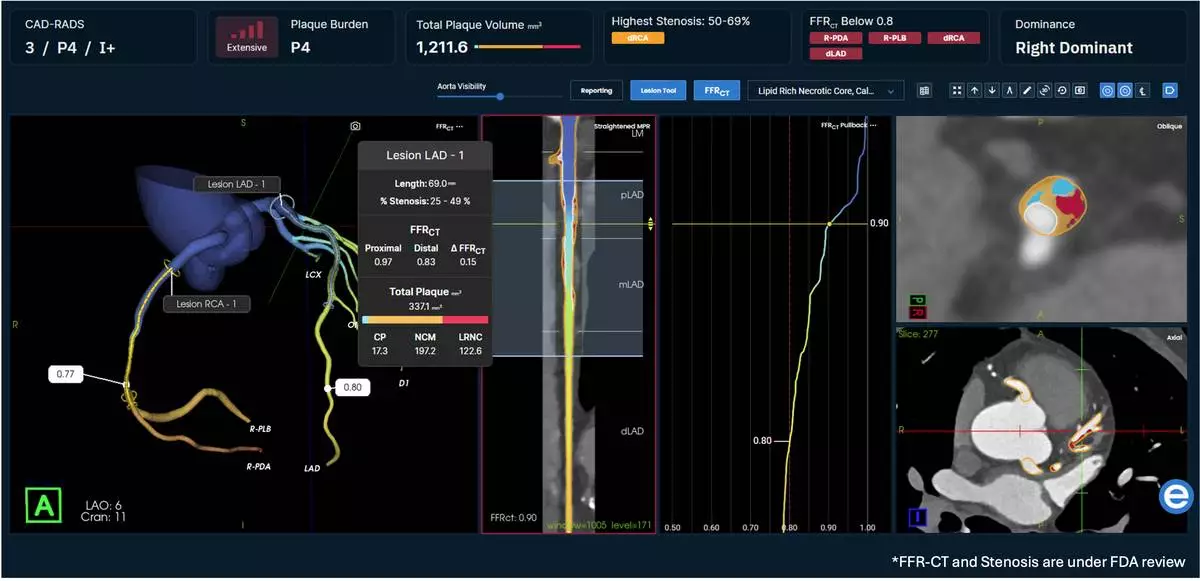
Elucid’s comprehensive clinical platform. FFR-CT and Stenosis under FDA review
KYIV, Ukraine (AP) — Russia unleashed waves of missiles and drones at Ukraine early Monday, killing at least 21 people in attacks that exposed widening gaps in the country’s air defenses more than four years into Moscow's full-scale invasion, authorities said.
All of the ballistic missiles launched by Russia struck their targets, underscoring Kyiv’s need for more U.S.-made Patriot interceptor missiles — a point Ukrainian President Volodymyr Zelenskyy will likely reiterate at a NATO summit in Ankara, Turkey, this week.
Fifteen people were killed in the capital of Kyiv, which was Russia's main target, and 56 were injured, according to administrative head Tymur Tkachenko. Another six people were killed in the wider Kyiv region and 21 were inured, according to Mykola Kalashnyk, the head of the regional administration, and other emergency officials.
Emergency workers searched for survivors in the rubble of residential high-rises in two locations that suffered direct hits.
Moscow has stepped up strikes on Kyiv in retaliation for Ukraine’s recent long-range strikes, according to the Russian Defense Ministry. Those attacks have caused severe fuel shortages and put pressure on President Vladimir Putin.
On Thursday, a Russian strike killed 31 people in Kyiv, the deadliest attack in the capital this year.
Ukraine’s advances in drone technology have given it an edge in recent months, analysts and Western officials say, striking supply routes behind the front line, stripping the Russian army of momentum on the battlefield and slowing its advance.
But Russia is now exploiting a different kind of momentum: vulnerabilities in Ukraine’s air defenses, which remain heavily reliant on the Patriot missile systems to intercept ballistic missiles it can rarely shoot down. The war in the Middle East has strained the global supply of Patriot interceptors — a shortage now felt keenly in Ukraine.
Ukraine’s air force said Russia fired 351 drones and 68 missiles overnight, targeting mainly Kyiv, and all 29 ballistic missiles struck their targets.
“To intercept ballistics, we need the means for interception,” air force spokesman Yurii Ihnat said on national television. “Russians are certainly using the fact that there is a serious deficit of interceptor missiles now, in Ukraine and the world.”
Ahead of the NATO summit in Turkey, Zelenskyy said Ukrainian forces had performed well against drones and cruise missiles but not against ballistic missiles — a shortfall he blamed on insufficient supplies of interceptors. He urged U.S. and European partners at the summit to bolster Ukraine’s air defense and protect civilians.
“As long as Patriot missiles remain in our allies’ stockpiles, Russia is only encouraged to keep ‘vanquishing’ residential buildings. The United States and Europe have enough strength to stop this terror,” he said on X following the attack.
Ukraine’s Defense Minister Mykhailo Fedorov said Russia is deliberately ramping up ballistic missile attacks on a scale unseen before, exploiting the acute shortage of Patriot interceptors. “Fewer such missiles are produced worldwide each month than the enemy fires at Ukraine in that same period,” he said.
Russia’s Defense Ministry said the attack targeted weapons factories in Kyiv, including sites it said produce drones, armored vehicles and missiles, as well as facilities repairing air defense systems and fuel and energy infrastructure in the capital and surrounding region. The claims could not be independently verified.
Russia’s attacks have repeatedly hit civilian areas. More than 16,000 Ukrainian civilians have been killed in the war, according to the United Nations.
“These are residential buildings. Places where people slept and lived their ordinary lives,” Tkachenko said in a post on Telegram.
A residential building in the Podilskyi district partially collapsed, he said. In the Darnytsia district, several multistory buildings were damaged and people were believed to be buried in the rubble.
In Kyiv's suburb of Vyshneve, about 600 residents were evacuated due to the risk of unexploded munitions, Ukraine's Emergency Service said.
Khrystyna Piatetska, 20, a resident of Kyiv’s Darnytskyi district, said she began screaming after the first strike, which was followed by a second blast that blew out the windows in her apartment building.
The lights went out, a burning smell filled the air and the stairwell was thick with smoke, she said.
“When we were leaving the building, bodies were lying there,” Piatetska said. “When we got downstairs, cars started exploding, and we came out from under the rubble straight into the fire.”
Halina Ivanivna, 61, said she was awakened by the first strike about 2 a.m. Moments later, her apartment building began collapsing around her.
“Everything was falling down,” she said. Water poured through the building as smoke filled the air while emergency crews rushed to evacuate residents.
About five minutes after the initial impact, a second strike hit, she said.
Russia’s Defense Ministry said its air defenses downed 519 Ukrainian drones overnight.
Ukraine’s military said its Special Operations Forces struck the Omsk oil refinery in western Siberia, which it described as Russia’s largest, located nearly 2,500 kilometers (1,550 miles) from Ukraine’s border. That added to a long list of Russia’s key refineries struck in recent months.
Regional Gov. Vitaly Khotsenko said several Ukrainian drones hit in Omsk but gave no other details.
An energy provider in Russian-held Crimea reported a blackout across the peninsula following Ukrainian attacks early Monday. The Moscow-appointed head of the city of Sevastopol, Mikhail Razvozhayev, said the attacks cut power that was restored with backup equipment.
Ukraine’s military confirmed it struck several Russian energy and military facilities used to supply Russia’s armed forces with fuel and support its war efforts.
In the Russian city of Yaroslavl, two people were wounded in an attack in which over 70 Ukrainian drones were downed, according to regional Gov. Mikhail Yavrayev. He didn’t say if any facilities were damaged, but the Astra online news outlet said they caused a fire at an oil refinery.
Ukrainian drone attack on the Leningrad region north of Moscow damaged unspecified infrastructure at the Luga training ground, as well as in the areas of Baltic Sea ports of Ust-Luga and Vysotsk, Gov. Alexander Drozdenko said.
Follow the AP’s coverage of the war in Ukraine at https://apnews.com/hub/russia-ukraine

Frightened by explosions, a cat cuddles up to its owner during search and rescue works at the damaged residential building following Russia's missile attack in Kyiv, Ukraine, Monday, July 6, 2026. (AP Photo/Efrem Lukatsky)
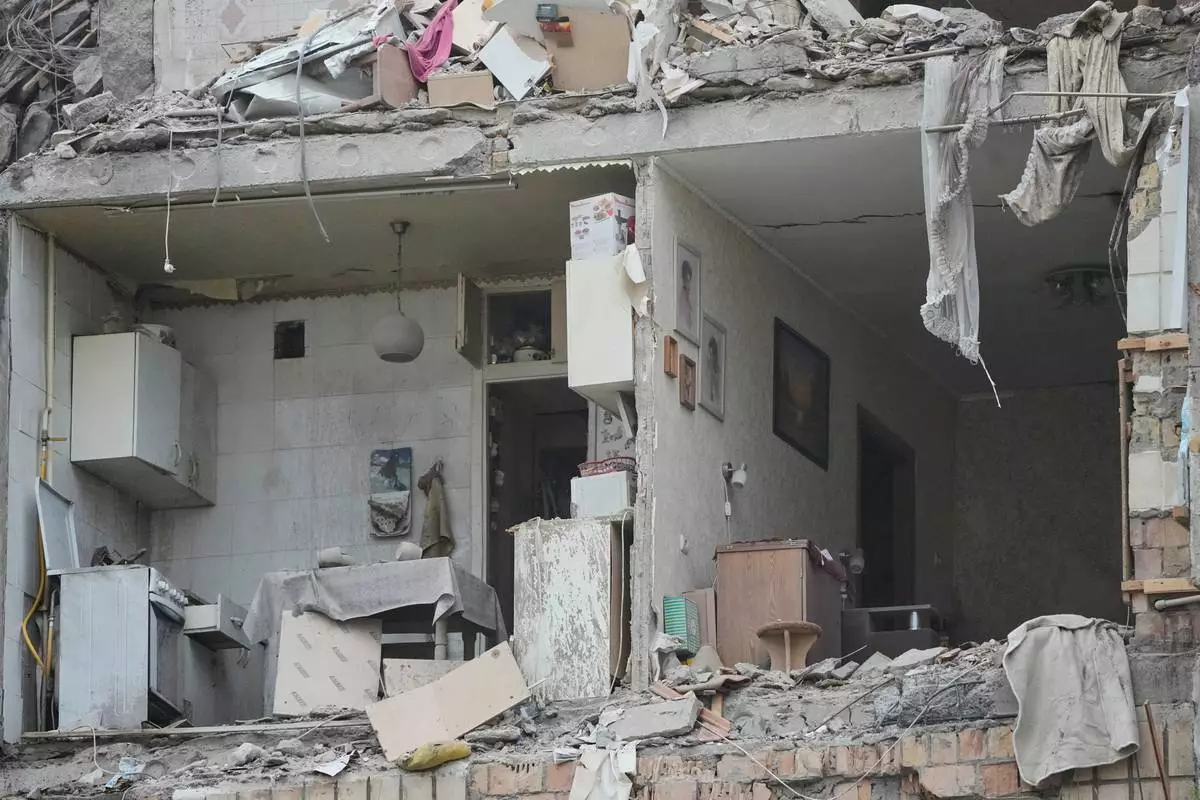
The damaged apartment interior in the ruined apartment building following Russia's missile attack in Kyiv, Ukraine, Monday, July 6, 2026. (AP Photo/Efrem Lukatsky)

A woman carries her cat out of a damaged multistory apartment building following a Russian missile attack in Kyiv, Ukraine, Monday, July 6, 2026. (AP Photo/Efrem Lukatsky)
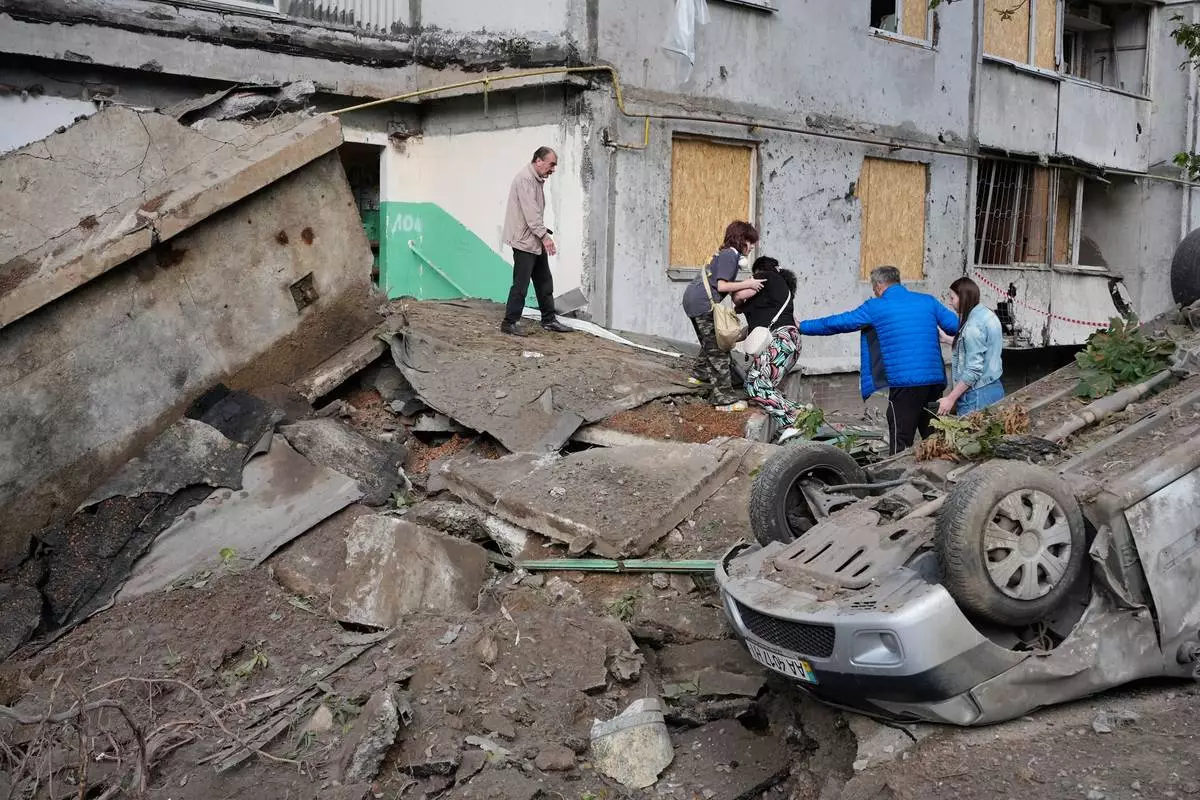
Local residents walk amid debris following a Russian missile attack in Kyiv, Ukraine, Monday, July 6, 2026. (AP Photo/Efrem Lukatsky)

Local residents look out of the balcony at a building damaged by Russian missile attack in Kyiv, Ukraine, Monday, July 6, 2026. (AP Photo/Efrem Lukatsky)

Emergency workers carry an injured person following Russian missile attacks in Kyiv, Ukraine, Monday, July 6, 2026. (AP Photo/Danylo Antoniuk)
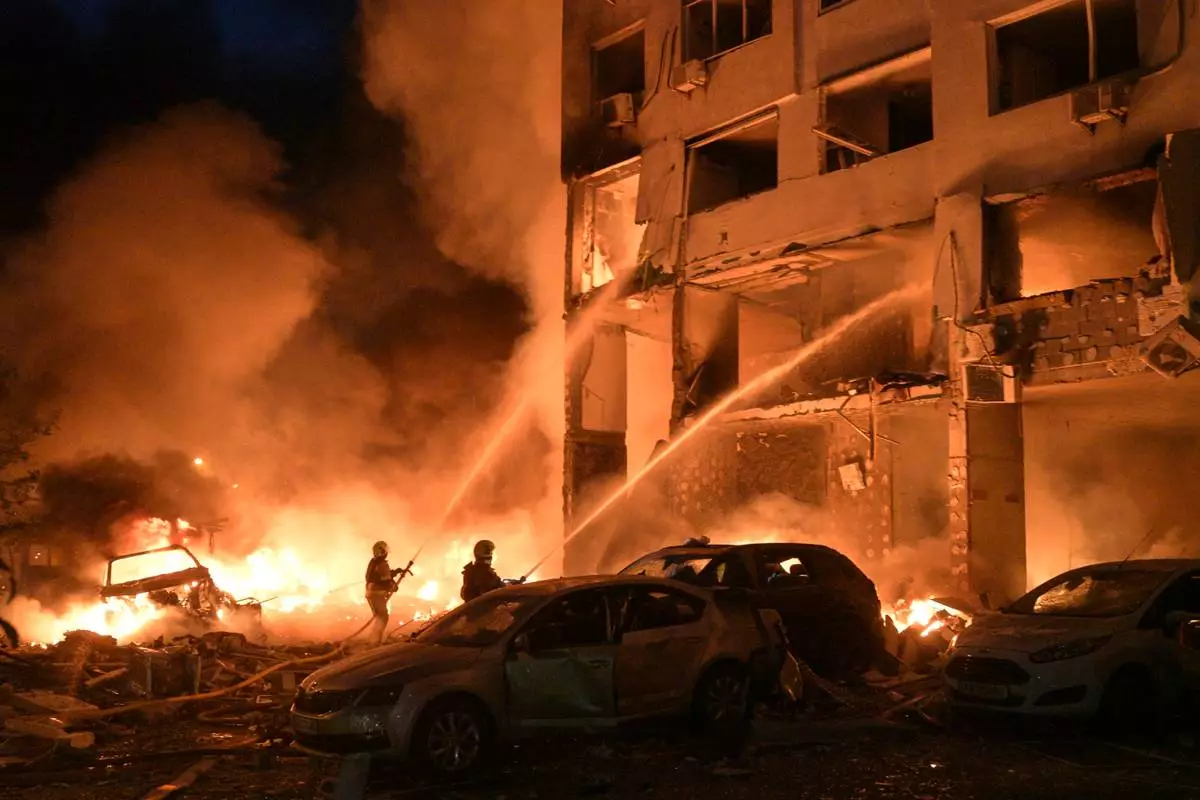
Emergency services personnel work to extinguish a fire following Russian missile attacks in Kyiv, Ukraine, Monday, July 6, 2026. (AP Photo/Danylo Antoniuk)
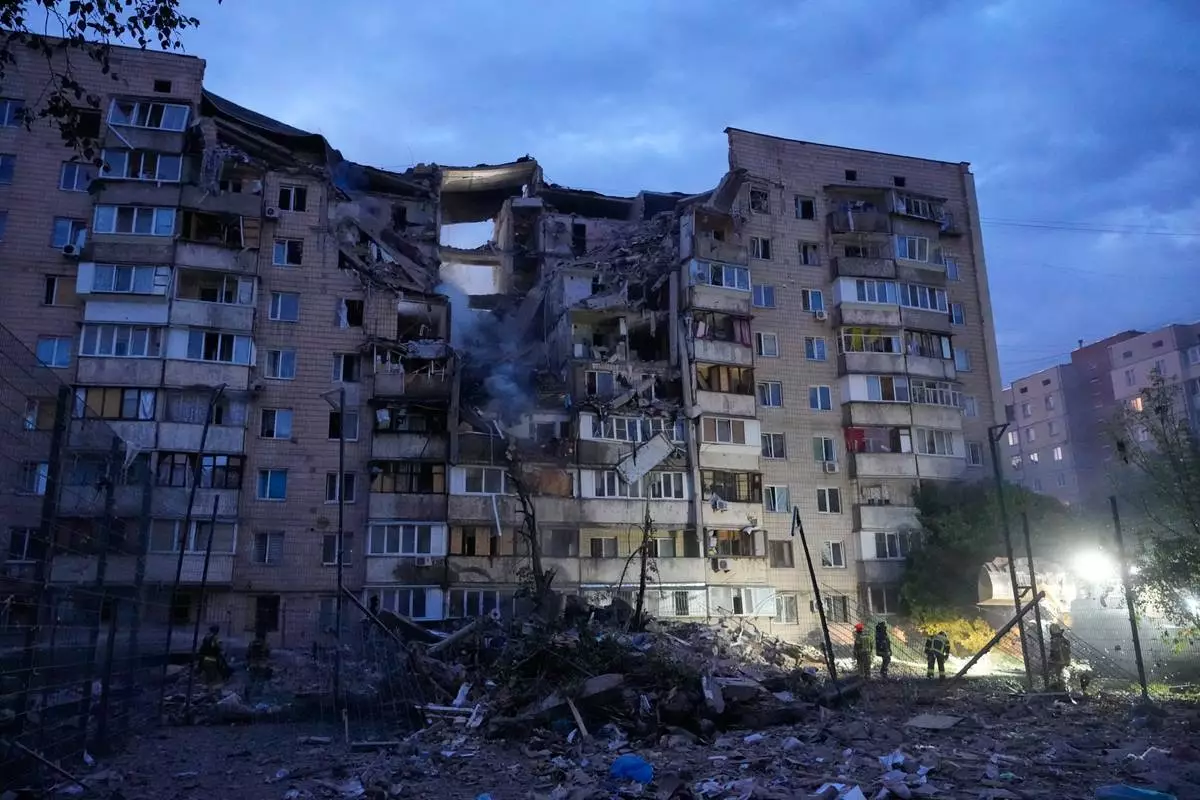
Rescuers work the scene of a building damaged by Russian missile attack in Kyiv, Ukraine, Monday, July 6, 2026. (AP Photo/Efrem Lukatsky)
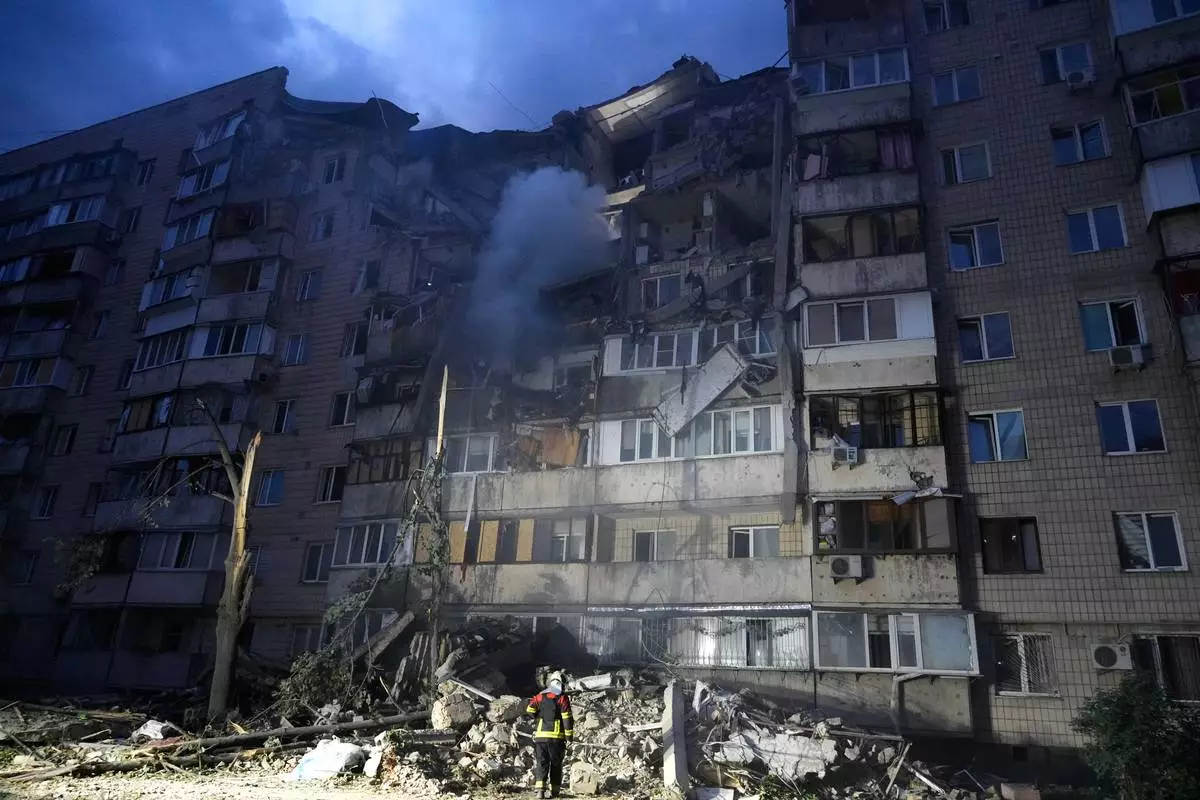
Rescuers work the scene of a building damaged by Russian missile attack in Kyiv, Ukraine, Monday, July 6, 2026. (AP Photo/Efrem Lukatsky)
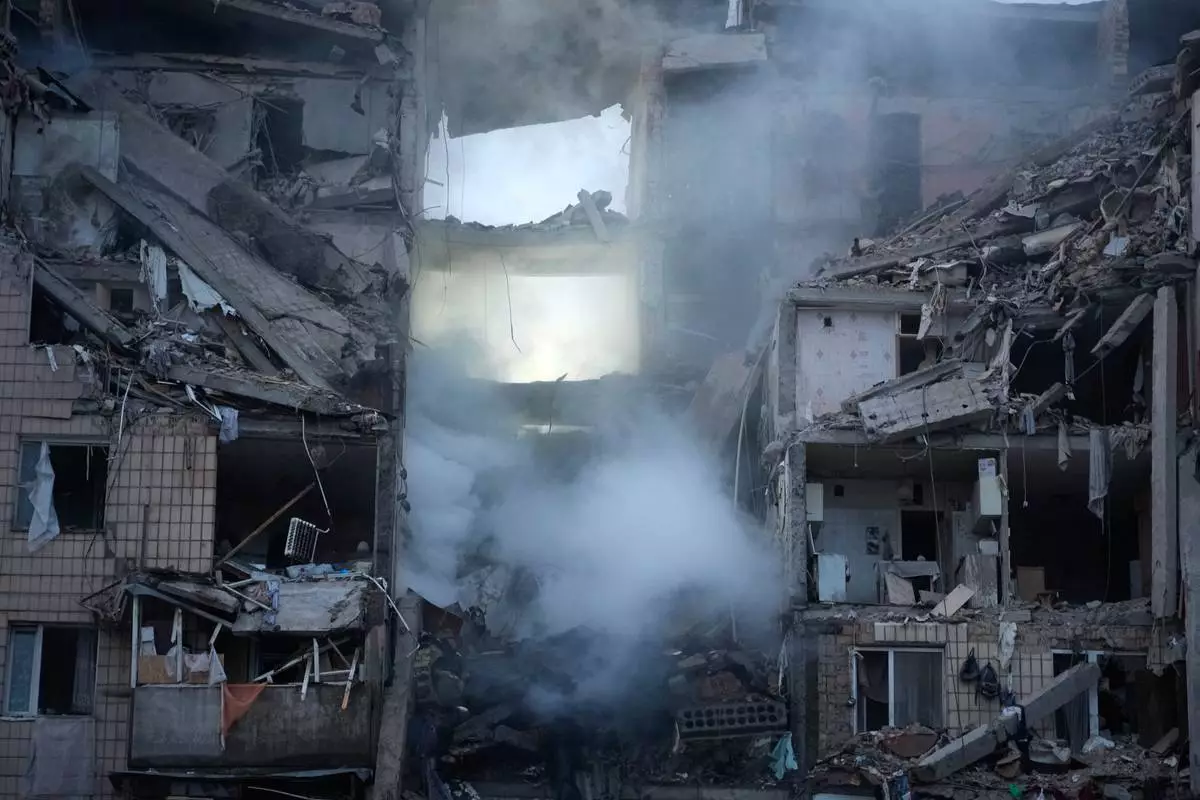
The damaged apartment interior in the ruined building following Russian missile attack in Kyiv, Ukraine, Monday, July 6, 2026. (AP Photo/Efrem Lukatsky)
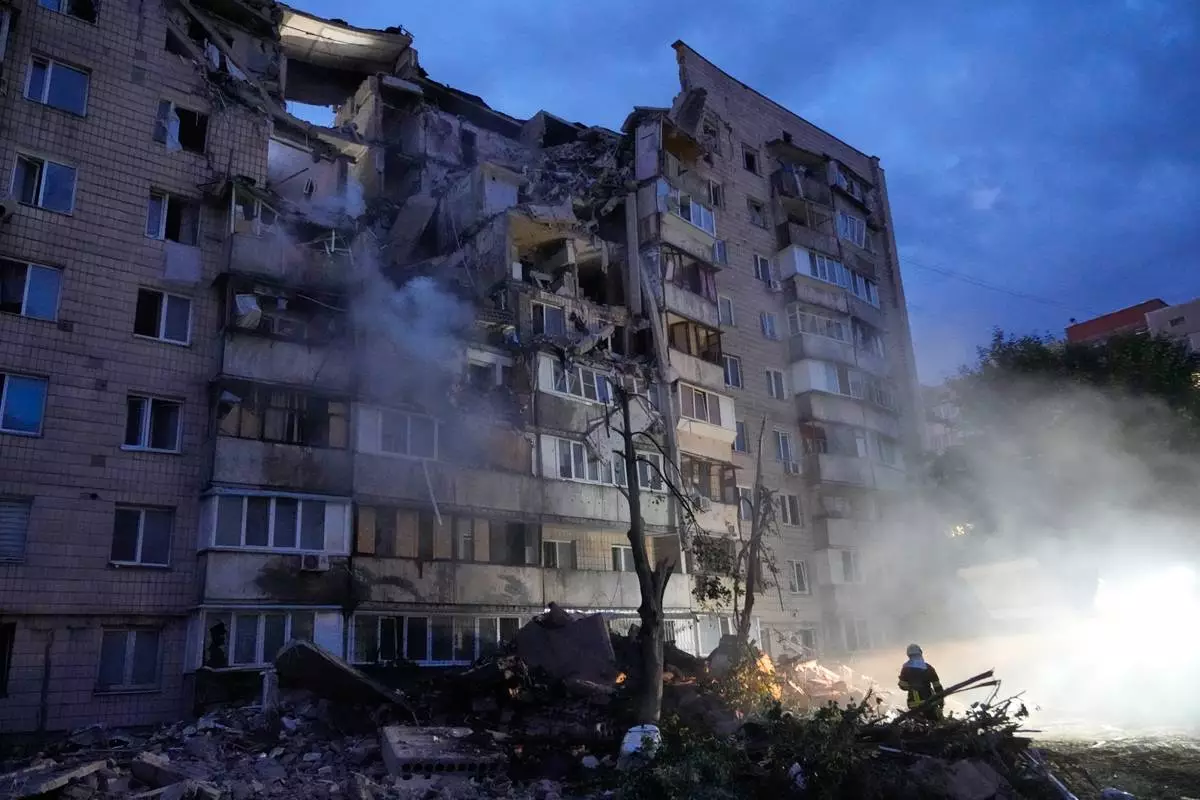
Rescuers work the scene of a building damaged by Russian missile attack in Kyiv, Ukraine, Monday, July 6, 2026. (AP Photo/Efrem Lukatsky)
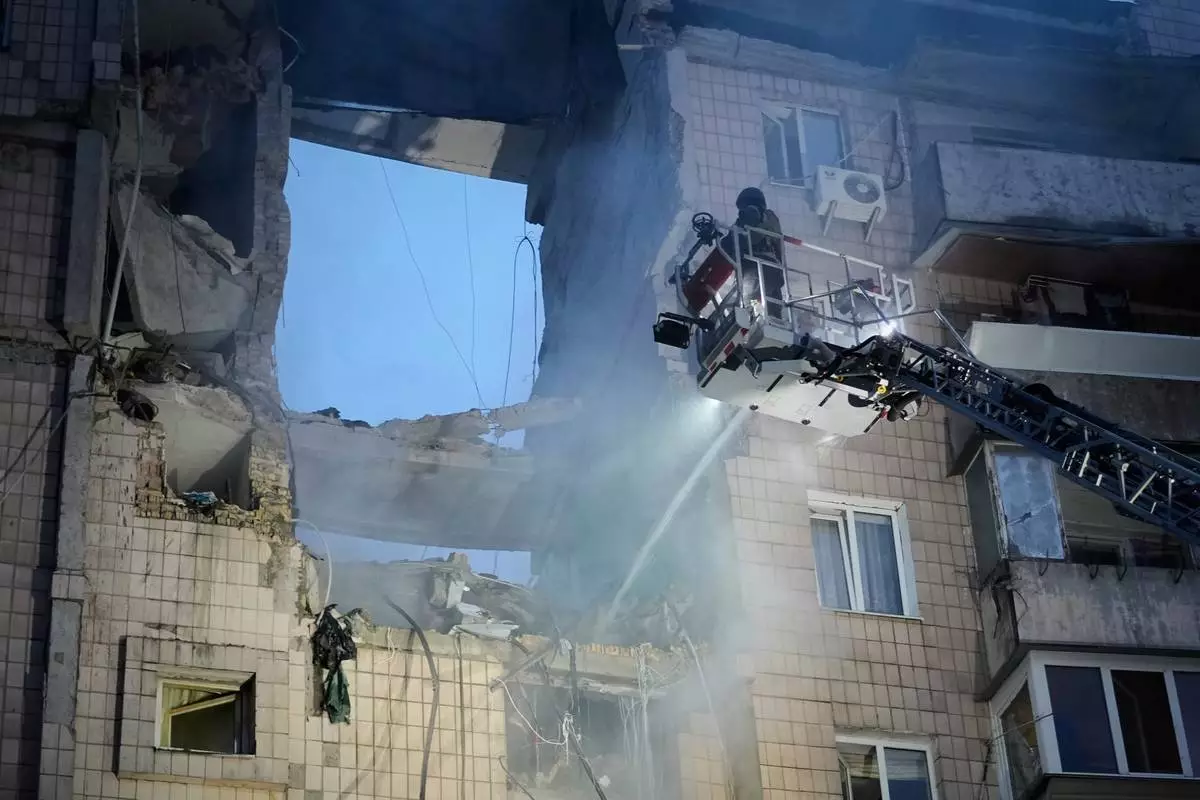
Rescuers work the scene of a building damaged by Russian missile attack in Kyiv, Ukraine, Monday, July 6, 2026. (AP Photo/Efrem Lukatsky)