New Measures to support development of Hong Kong's fixed income and currency market and offshore Renminbi business
The following is issued on behalf of the Hong Kong Monetary Authority:
The Hong Kong Monetary Authority, Photo source: reference image
The Hong Kong Monetary Authority (HKMA), the People's Bank of China (PBoC) and the Securities and Futures Commission (SFC) announced today (July 7) a series of new measures to deepen the financial co-operation between Hong Kong and the Chinese Mainland, support the development of Hong Kong's fixed income and currency (FIC) market and offshore Renminbi (RMB) business, and reinforce Hong Kong's position as an international financial centre. These measures include:
- supporting the collaboration of financial infrastructure institutions in Hong Kong and Chinese Mainland to develop a Hong Kong FIC electronic trading platform;
- further enhancing and expanding the Southbound Bond Connect, including increasing the annual investment quota, developing bond repurchase (repo) business using Southbound Bond Connect bonds as collateral, expanding the product scope to cover products with HKD bonds and RMB bonds as underlying assets, connecting to the Macao bond market, and enhancing the management of Southbound Bond Connect market makers;
- supporting the inclusion of onshore bonds issued by the Ministry of Finance and Mainland policy banks that are held under Northbound Bond Connect as eligible margin collateral at the HKFE Clearing Corporation and the SEHK Options Clearing House;
- enhancing the Northbound Bond Connect operational arrangement to extend the settlement time and improve efficiency;
- further enhancing the Swap Connect to include the interbank Seven-Day Fixing Depository-Institutions Repo Rate (FDR007) as a reference rate; and
- supporting the launch of Hong Kong Exchanges and Clearing Limited Five-Year China Government Bond Futures in Hong Kong on August 3.
The People's Bank of China, Photo source: reference image
Building on this, the HKMA also announced five measures to support the development of the offshore RMB market and strengthen Hong Kong's role as a leading offshore RMB business hub, thereby enabling greater outreach to other regions and enhancing support for the real economy. These measures, underpinned by strong support from the PBoC, address industry suggestions for developing the offshore RMB market. These include:
- increasing the size of the HKMA's RMB Business Facility from RMB200 billion to RMB500 billion and extending tenors to include nine-month, two-year and three-year, effective on July 10;
- exploring to introduce a tendering mechanism of seven-day offshore RMB liquidity;
- exploring the issuance of offshore RMB short-term debt instruments to support the building of the offshore RMB yield curve;
- promoting the development of a bilateral currency transaction framework between Indonesian Rupiah and offshore RMB; and
- issuing good practices to banks to promote RMB adoption.
The Chief Executive of the HKMA, Mr Eddie Yue, said, "We are pleased to announce this series of measures, which will further deepen cross-boundary financial co-operation, strengthen financial market connectivity between Hong Kong and the Chinese Mainland, promote the development of Hong Kong's fixed income and currency market, and reinforce Hong Kong's position as an offshore RMB business hub and international financial centre. These measures are the result of concerted efforts of the HKMA, the PBoC and other relevant financial regulatory authorities in Hong Kong and on the Chinese Mainland. We will continue to work closely with the relevant regulatory authorities, the industry and financial infrastructure institutions to ensure timely and smooth implementation of the measures, and explore further enhancements."
The Securities and Futures Commission, Photo source: reference image
CHP continues to implement multipronged strategy to curb spread of Mpox
The Centre for Health Protection (CHP) of the Department of Health (DH) today (October 16) recorded an imported Mpox (also known as Monkeypox) case. There has been a significant increase in Mpox cases in Hong Kong since August 2026. To curb the spread of Mpox, the CHP has adopted a multipronged approach, including conducting comprehensive epidemiological investigation and analysis to break transmission chains, enhancing collaboration with non-governmental organisations (NGOs) to facilitate vaccination for individuals with high-risk exposure and increase their willingness to receive the Mpox vaccine, and strengthening public awareness and education efforts. The multipronged strategy has yielded initial effects. The number of confirmed cases recorded in the first 15 days of October has dropped significantly by more than 60 per cent compared to the same period last month (September), while the number of vaccination doses administered under the Mpox vaccination programme in the first two weeks of October has increased by more than 60 per cent compared to the same period last month. The CHP will continue to put in place various targeted prevention and control measures to safeguard public health.
Strengthening prevention
------------------------------
Mpox vaccine can prevent infection and severe disease. Since late September, the CHP has set up an additional Mpox vaccination centre at the CHP Building, in addition to regular vaccination venues established by the Government. The CHP has also collaborated with three NGOs (namely Community Health Organisation for Intervention, Care and Empowerment; Hong Kong AIDS Foundation; and Hong Kong Christian Service) to provide outreach vaccination services during holidays and outside regular office hours, providing convenience and incentives to encourage individuals with high-risk contacts to get vaccinated as soon as possible. Along with the existing vaccination venues, the CHP has successfully administered the Mpox vaccine to approximately 650 high-risk individuals over the past month.
The DH's Yau Ma Tei Integrated Treatment Centre (YMTITC) will also arrange an additional vaccination session (10am to 1pm) next Saturday (October 24). People with high-risk contact may call the YMTITC at 2195 6588 from Monday through Friday from 8.30am to 5pm to schedule an appointment. The vaccination venue is located on 7/F, Yau Ma Tei Jockey Club Polyclinic, 145 Battery Street, Yau Ma Tei.
Vaccination provides a highly effective protective barrier. Studies show that receiving two doses of the Mpox vaccine reduces the risk of infection by 82 per cent, which significantly lowers the risk of transmission to sexual partners, and protects both the vaccinated individual and others. Local data also show that vaccinated patients are 87 per cent less likely to experience viral spread to other parts of the body. The CHP will continue to actively expand the number of Mpox vaccination venues and time slots to further reduce the risk of infection and transmission in the community.
At the same time, the CHP's Mpox hotline (2125 2373) continues to provide health assessments and advice to high-risk individuals. The hotline will arrange individuals in need to get vaccinated inside the CHP. The hotline operates daily from 9am to 6pm.
Case details
--------------
The newly reported imported case involves a 36-year-old man who developed a fever, sore throat and rash over various parts of his body (including genital area, trunk, hands and legs) on October 10. As his symptoms continued to worsen, he called the CHP's Mpox hotline on October 13 and was arranged to receive isolation treatment at Princess Margaret Hospital on the same day. His condition is now stable. Upon laboratory testing by the CHP's Public Health Laboratory Services Branch (PHLSB), his clinical specimen tested positive for the Monkeypox virus. According to the information provided by the patient, he had high-risk sexual exposure outside Hong Kong during the incubation period. The CHP is continuing its epidemiological investigation of the case, and will report it to the World Health Organization.
Since 2022, Hong Kong has recorded 116 Mpox cases (91 local cases and 25 imported cases). All patients are males. Epidemiological investigations revealed that among the 23 cases recorded since August, all patients reported having engaged in high-risk sexual activities during the incubation period, including having sex with male strangers or multiple partners, and having sex without a condom. Most of them have not received the Mpox vaccinations. The CHP's PHLSB conducted genetic analysis of the virus and found that some cases had identical genetic sequences, suggesting the existence of multiple transmission chains among men who have sex with men (MSM) population.
Among the cases recorded since August, patients commonly used specific dating apps to find casual male sexual partners. After testing positive, some patients were unable to contact their newly met sexual partners, which hindered the CHP's ability to conduct effective contact tracing and implement corresponding prevention and control measures. In view of this, the CHP has increased its outreach on social media platforms to promote Mpox prevention and vaccination, and has collaborated with the operators of relevant dating apps to regularly push information about Mpox prevention and vaccination to all users in Hong Kong.
The CHP urges individuals who have engaged in high-risk sexual contact, particularly with male strangers, to remain vigilant and take appropriate personal protective measures, including receiving the Mpox vaccination and avoiding high-risk sexual contact, so as to lower the risk of infection. Members of the public should retain their sexual partners' contact information to facilitate contact tracing when necessary.
The CHP consistently conducts comprehensive and in-depth epidemiological investigations into every Mpox case, striving to contact individuals who have had high-risk contact with the patients to break the transmission chains within specific population. If the CHP identifies a specific venue as posing a transmission risk, it advises the premises to close temporarily to safeguard public health. CHP staff have also visited various entertainment venues frequented by MSM, including saunas, to promote Mpox prevention. Recently, "Hutong" on Shanghai Street, Mong Kok, has temporarily closed as per the CHP's advice. The CHP appeals once again to the public who visited "Hutong" on or after September 14, especially those who have had sexual contact with male strangers on the premises, to call the Mpox hotline as soon as possible. The CHP will then provide health assessments and advice. The CHP will also arrange persons with relevant symptoms to undergo testing.
More information on Mpox
---------------------------------
Mpox is not transmitted through respiratory droplets or aerosols in general, and transmission would not occur through social contact. The CHP reminds the public, especially those at higher risk of exposure, to take precautions and avoid close physical contact with persons or animals suspected of being infected. They should seek medical attention as soon as possible if they experience relevant symptoms, including rash, fever, chills, swollen lymph nodes, exhaustion, muscle pain, and severe headaches. They should not engage in activities with others that may involve contact with skin rash or body fluids.
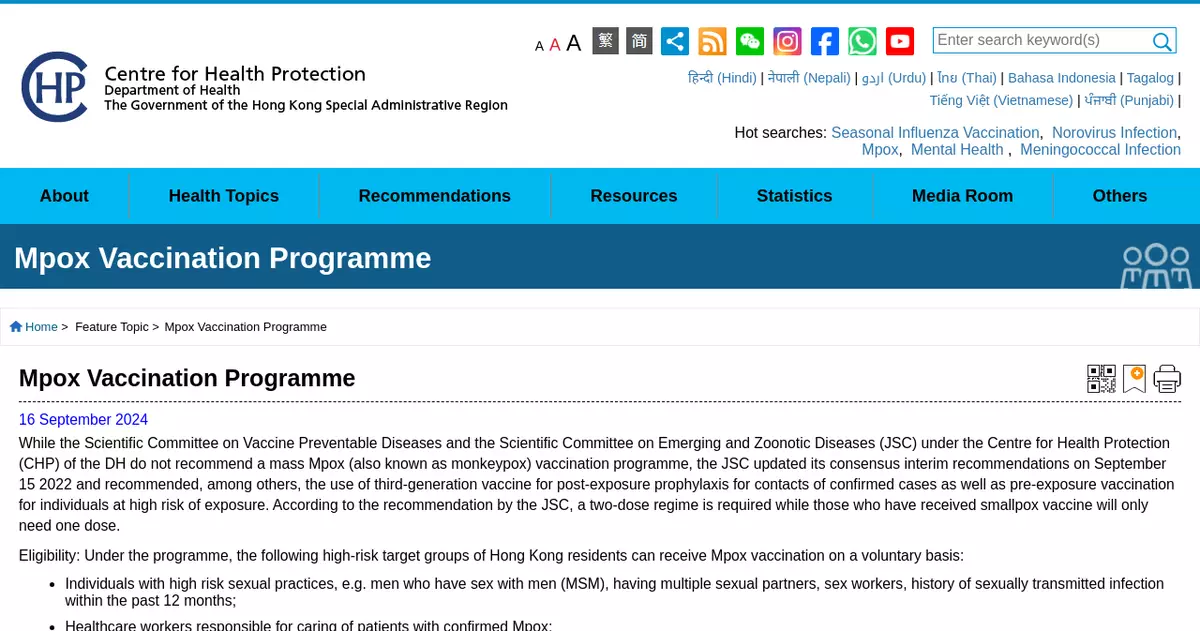
The DH has been providing Mpox vaccination services for high-risk groups, including individuals with high-risk sexual practices (such as having multiple sexual partners), sex workers, or having a history of sexually transmitted infection within the past 12 months.
For more details, please visit the CHP's webpages on Mpox and the Mpox Vaccination Programme.
Source: AI-found images