DALLAS--(BUSINESS WIRE)--Jul 7, 2026--
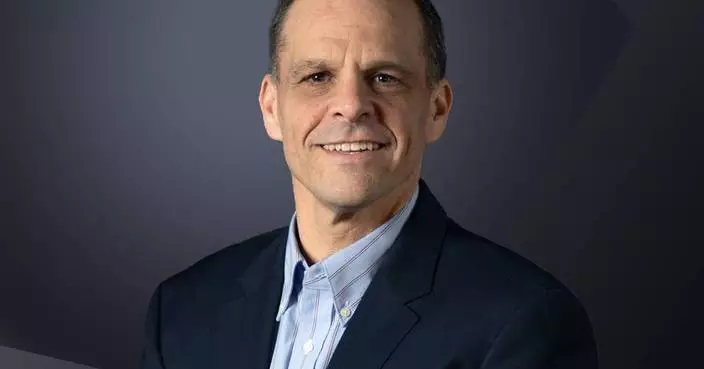
RGP (Nasdaq: RGP), a global professional services firm, today announced the appointment of Amadally Hosseinbukus as Managing Director of its Data, Analytics & AI Practice. His appointment builds on RGP’s growing momentum helping clients move from AI ambition to governed, measurable execution — strengthening the firm’s ability to deliver enterprise-scale data, analytics, automation, and AI solutions that work inside the complexity of the business.
This press release features multimedia. View the full release here: https://www.businesswire.com/news/home/20260707717296/en/
Organizations are currently sitting on fragmented data with inconsistent governance, unable to bridge the gap between AI ambition and AI readiness. And the pressure to drive meaningful returns is intensifying. What’s missing is the experience to architect, govern, and deliver AI at the complexity level most organizations require.
“Amadally has led large-scale AI and data programs from inside some of the world’s most successful organizations,” said Scott Rottmann, President of Consulting Services at RGP. “His experience, especially within the heavily-regulated industry of financial services, gives our clients something they don’t get from most advisors: someone who has actually delivered AI value at enterprise scale.”
Hosseinbukus brings more than 30 years of experience across AI, technology, consulting, and financial services. In his new role, Hosseinbukus will lead RGP’s AI strategy, data and analytics modernization, intelligent automation, and governance capabilities — helping clients accelerate adoption while managing risk.
“Amadally will help our clients move from AI experimentation to AI competitive advantage,” said Stephen Hook, Digital Solutions Leader at RGP.
Most recently, Hosseinbukus served as Managing Director and Global Head of Innovation and AI Delivery for Wells Fargo’s Corporate and Investment Bank, leading the firm's enterprise AI delivery strategy across Markets, Lending, and Investment Banking. He oversaw a portfolio of more than 50 strategic AI initiatives that spearheaded digital transformation, improved operating efficiency, and delivered significant, measurable business value across the organization. He built and led a 70-person cross-functional team, established the AI roadmap and execution model for the division, and drove adoption across the organization.
Prior to Wells Fargo, he spent eight years at IBM Technology & Consulting in senior roles including Lead Account Partner for a global banking client and Practice Lead Partner for IBM’s Capital Markets AI and Automation practice. Earlier, he held senior technology leadership positions at Deutsche Bank — including Global Head of Regulatory Controls Technology and Global Head of Investment Banking Sales and Client Technology — and at Credit Suisse, where he served as Chief Technology Officer for the firm’s Data & Analytics business. He holds a B.Sc. in Computer Science from the University of Durham, UK.
“AI is reshaping every industry, but sustainable value will come only from embedding it into the fabric of the business with trust, accountability, and measurable impact at its core,” said Hosseinbukus. “This is a defining moment for organizations. Those that pair bold ambition with disciplined execution and responsible governance will set the pace for innovation and long-term growth.”
About RGP
RGP (Nasdaq: RGP) has been redefining professional services for 30 years by closing the gap between advice and execution. The firm combines on-demand talent, consulting rigor, and managed services accountability to help organizations accelerate transformation while reducing risk. RGP partners with CFOs and C-suite leaders across finance, digital transformation, data, cloud, and AI — connecting strategy with execution at global scale.
Based in Dallas, Texas, with offices worldwide, RGP annually serves more than 1,500 clients through 40 physical practice offices and multiple virtual offices. As of January 2026, RGP has served 90 percent of the Fortune 100 and has been recognized by U.S. News & World Report and Forbes among the best employers and management consulting firms.
To learn more, visit www.rgp.com.
Dare to Work Differently® — for a world where execution matters.

Amadally Hosseinbukus, Managing Director, Data, Analytics & AI Practice at RGP
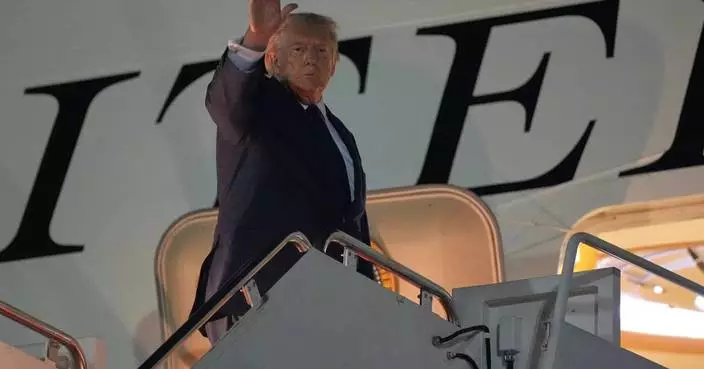
ANKARA, Turkey (AP) — President Donald Trump arrived in Ankara Tuesday afternoon for the NATO summit, as the transatlantic military alliance was announcing billions in arms deals in an attempt to appease the mercurial U.S. leader.
Trump was expected to head first to the presidential compound of Turkish leader Recep Tayyip Erdoğan, a close ally who is hosting this year’s gathering.
Just before Air Force One touched down in Ankara, NATO showcased a series of military projects worth billions of dollars — an investment that the alliance's secretary-general, Mark Rutte, called “money well spent.” An energized Rutte was speaking to government ministers and defense industry officials at a forum billed as NATO’s “big reveal,” to the thrum of techno music and a slick video display.
NATO as an organization does not own any weapons — these are the property of the 32 member countries — but it does have a fleet of 14 AWACS early warning radar surveillance planes that are about 50 years old, along with some newer surveillance drones.
A deal to replace the aging planes was announced Tuesday. Swedish manufacturer Saab will be supplying up to 10 new GlobalEye surveillance aircraft for a 10-nation consortium, Swedish Prime Minister Ulf Kristersson announced.
“It’s a moment of great pride,” he said, noting that the twin-engine aircraft would be “made within the alliance for all the alliance.”
Some of the projects will be paid for with funds from a system of cheap loans for defense purposes set up by the European Union, comprising up to $170 billion raised on capital markets.
“We need to ensure that we are translating our economic might into military capabilities, putting the cash to work from defense plans to drones, from money to missiles and interceptors,” Rutte said.
Trump has branded NATO a “paper tiger” that would cease to function without American arms and leadership. At the forum on Tuesday, Michael Duffy, a U.S. undersecretary of defense, said “the reality is that we need production increases across the board.”
“We will be looking to increase our exports to those who are looking to buy our equipment, and we’ll also be looking to partner with the expansion of production capacity here in Europe,” he said.
Representatives from 15 nations shook hands and patted shoulders on a vast podium under the NATO logo as they announced a multinational effort to buy air-to-air refueling and transport planes from Airbus.
Then Rutte announced a four-country effort to purchase as many as five new Triton surveillance drones to add to NATO’s small fleet.
“It is genuinely made in NATO, and creating jobs on both sides of the Atlantic,” he said.
Rutte told reporters on the eve of the military alliance’s two-day summit in Turkey that “we will announce tens of billions in new contracts that will provide the crucial kit we need to deter and defend.”
However, at Tuesday's event, no dollar figures were given and the display included some projects long since agreed.
The defense industry splash comes a few weeks after Rutte tried to ease U.S. concerns about military spending at NATO with a new pitch using a chart labeled “The Trump Trillion” — showing $1.2 trillion in spending by European allies and Canada since 2017.
Far from being impressed, Trump appeared unmoved, saying he was still disappointed at some NATO allies’ refusal to join the Iran war, which he had launched alongside Israel without consulting them.
“We don’t need their money — we don’t need anything,” Trump said. “I just want loyalty.”
The summit is being held in President Recep Tayyip Erdogan’s sprawling palace compound in Ankara, and Trump has suggested he would come bearing gifts for the Turkish leader.
Speaking Monday on the morning show “Fox & Friends,” Israeli Prime Minister Benjamin Netanyahu urged the U.S. not to sell F-35 fighter jets to Turkey, saying that Erdogan “calls openly for the annihilation of Israel.”
Turkey and Israel have acrimonious relations. Erdogan frequently accuses Israel of committing genocide in its war in Gaza, triggered by the deadly Oct. 7, 2023, Hamas-led attack on southern Israel.
Turkey was barred from the F-35 program in 2019 after it purchased Russian-made S-400 missile defense systems. However, Trump, who has warm relations with Erdogan, has hinted ahead of his planned visit to Ankara that the sales could soon resume.
Netanyahu said selling Turkey F-35s would “upset the power balance in the Middle East, which is ultimately guaranteed by Israeli air superiority and also, I think, by America’s posture in the Middle East.”
Israel’s Air Force depends on hundreds of U.S. fighter jets, including F-35s, F-16s and F-15s.
Turkey beefed up security and banned protests in Ankara during the summit, but a small group of demonstrators gathered on Tuesday in the capital. They were quickly surrounded by police, and a legal association said 22 students affiliated with the leftist Turkish Workers Party and three lawyers had been detained.
The focus of the summit is a stronger Europe for a stronger NATO. The Trump administration has warned the allies that they must handle Europe’s security alone as the United States focuses on China and the Indo-Pacific region.
The Pentagon wants a reboot and is promoting what it calls “NATO 3.0,” a vision of the alliance in which Europe assumes greater responsibility for its own defense, freeing the U.S. to concentrate on other priorities.
But hiking defense spending means increasing taxes or diverting resources from other priorities. U.K. Defense Secretary John Healey unexpectedly quit last month, saying the British government was not willing to spend at a time of rising threats.
Concern is mounting among some northern and central eastern countries that Russia might be preparing a hybrid attack — a combination of conventional warfare with tactics like cyberattacks — on the continent as Russian President Vladimir Putin struggles to secure victory in Ukraine.
Keir Starmer’s office said the British leader will be “focused on building a stronger and more European NATO” on what is likely to be his last foreign trip as prime minister.
Starmer, who announced his resignation June 22, has faced criticism from military leaders, opposition politicians and some in his center-left party for the slow rate of increase in U.K. military spending.
His government has committed to reach the NATO budget target of spending 3.5% of gross domestic product on defense by 2035 but does not have a concrete plan to get there. Its current spending plan will see that spending hit 2.7% of GDP by 2029.
Associated Press writers Jill Lawless in London and Andy Wilks in Istanbul contributed to this report.
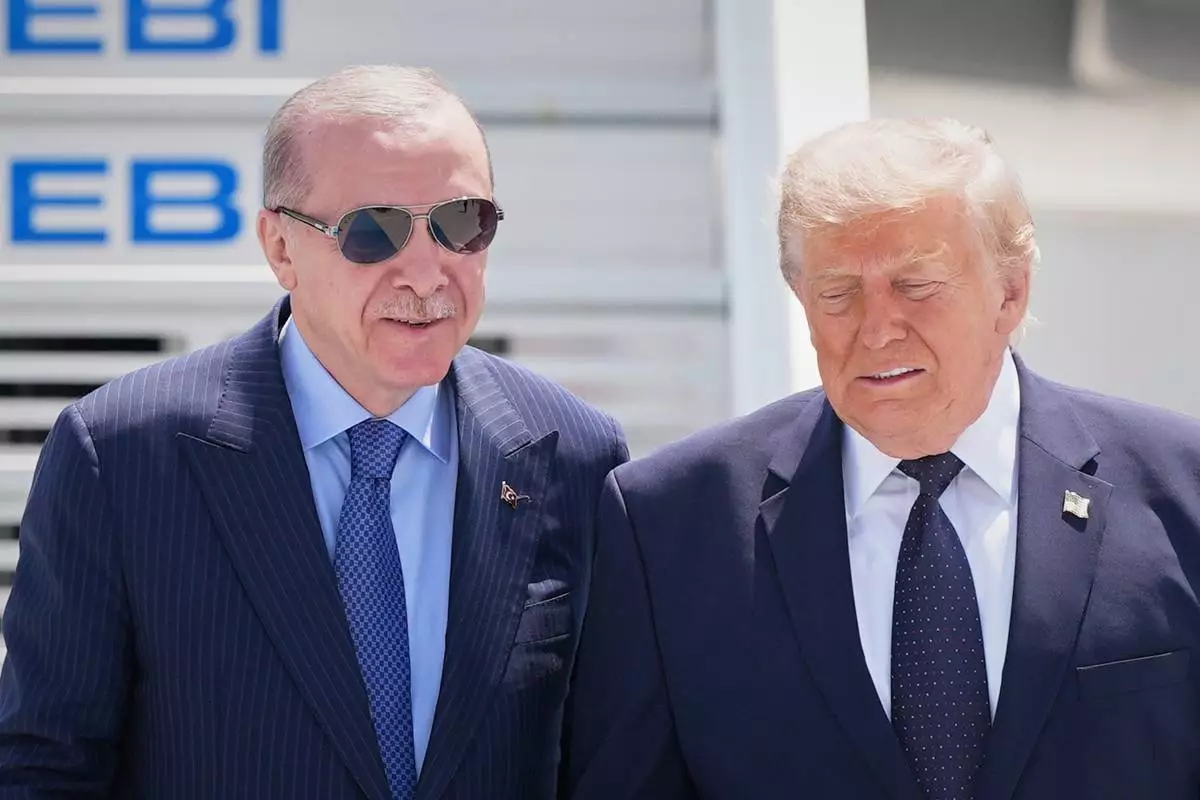
President Donald Trump walks with Turkish President Recep Tayyip Erdogan, left, upon arriving for the NATO summit in Ankara, Turkey, Tuesday, July 7, 2026. (AP Photo/Alex Brandon)
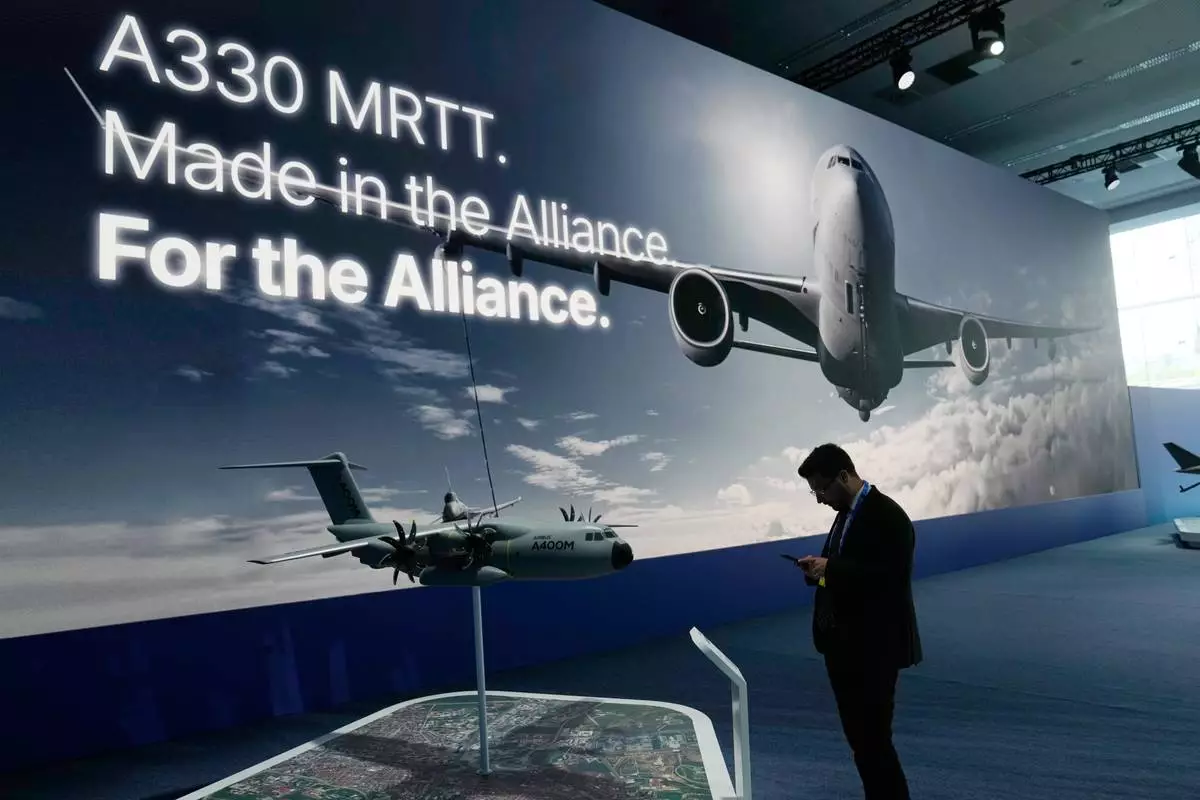
Participants view displays during the NATO Defense Industry Forum at the NATO summit in Ankara, Turkey, Tuesday, July 7, 2026. (AP Photo/Hussein Malla)
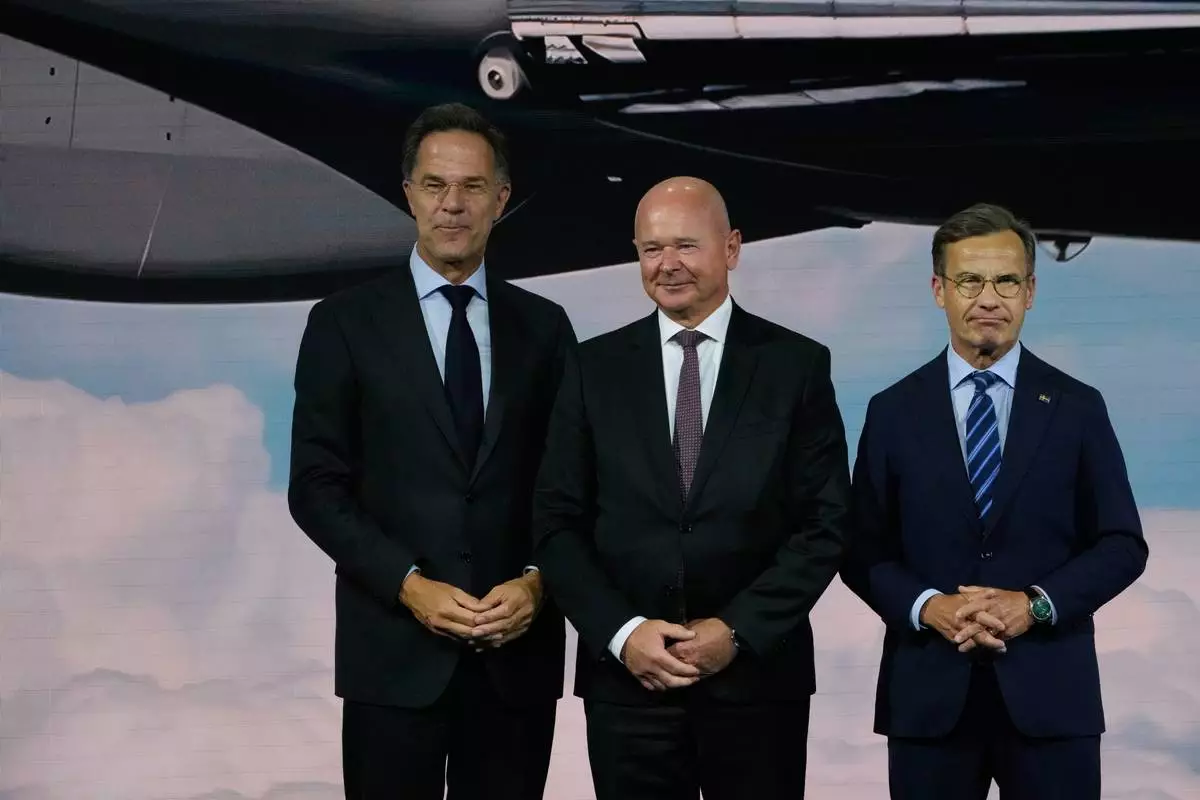
From left, NATO Secretary General Mark Rutte, President and CEO of Saab Micael Johansson and Sweden's Prime Minister Ulf Kristersson during the NATO Defense Industry Forum at the NATO summit in Ankara, Turkey, Tuesday, July 7, 2026. (AP Photo/Hussein Malla)
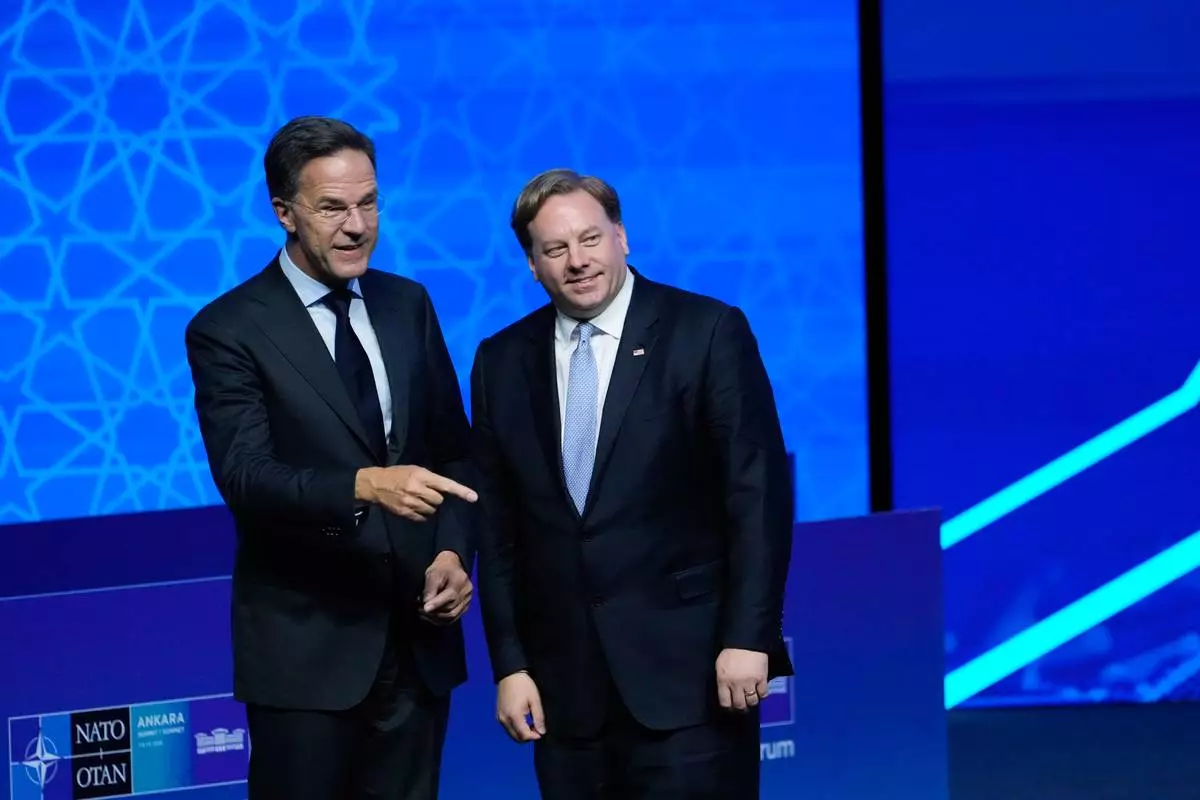
NATO Secretary General Mark Rutte, left, speaks with U.S. Under Secretary of Defense for Acquisition and Sustainment Michael Duffey during the NATO Defense Industry Forum at the NATO summit in Ankara, Turkey, Tuesday, July 7, 2026. (AP Photo/Hussein Malla)
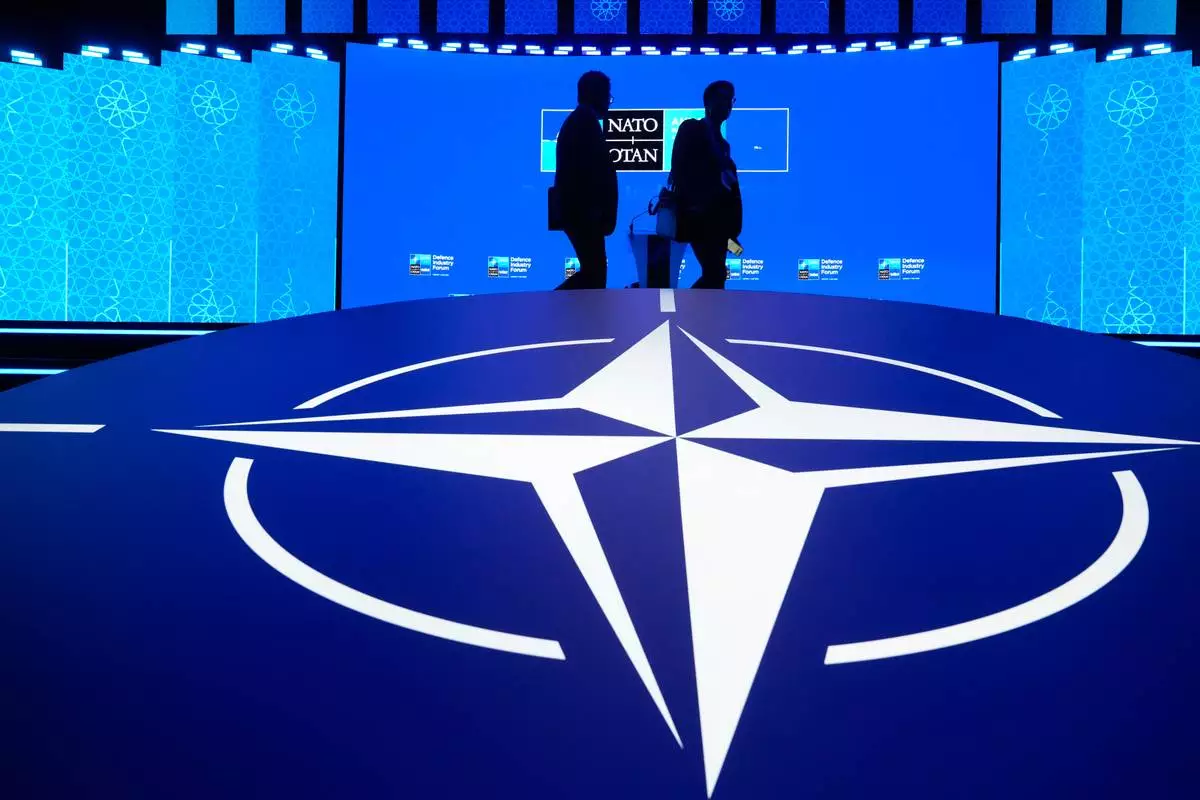
Two men walk past the NATO logo during the NATO Defense Industry Forum at the NATO summit in Ankara, Turkey, Tuesday, July 7, 2026. (AP Photo/Hussein Malla)
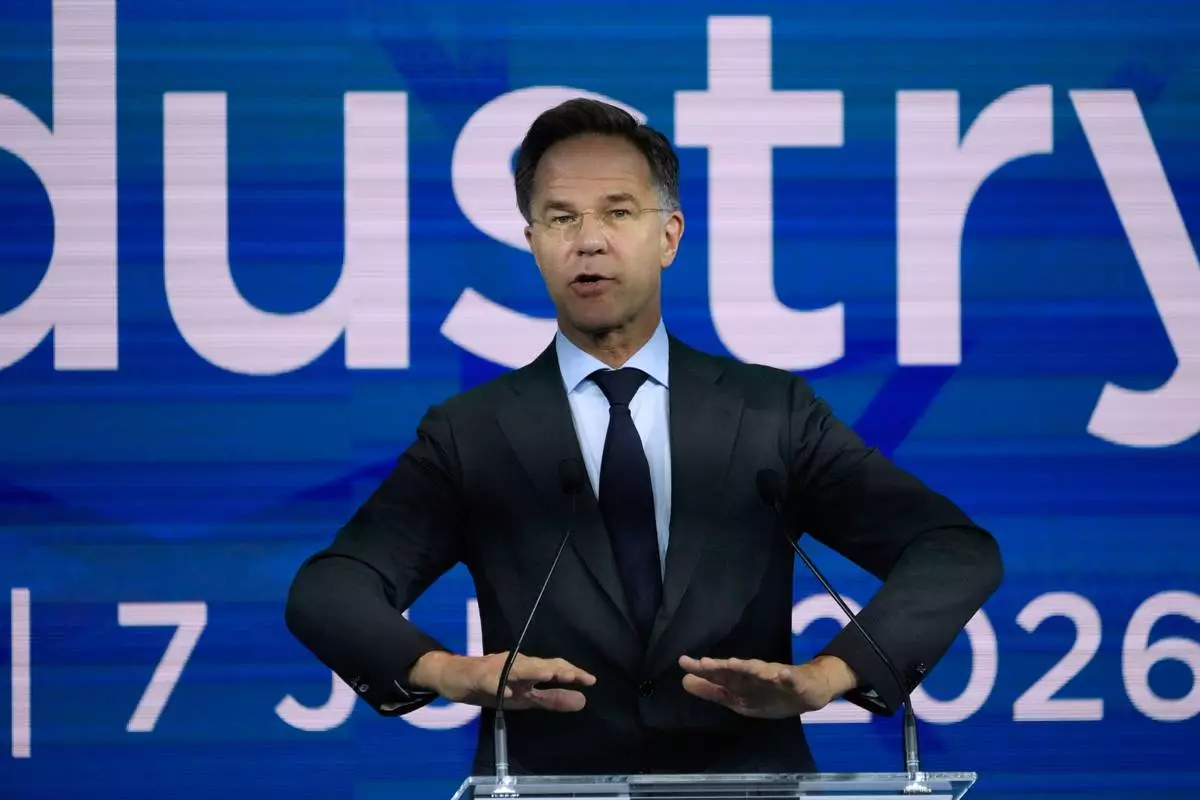
NATO Secretary General Mark Rutte speaks during the opening of the NATO Defense Industry Forum on the sidelines of the NATO summit in Ankara, Turkey, Tuesday, July 7, 2026. (AP Photo/Hussein Malla)
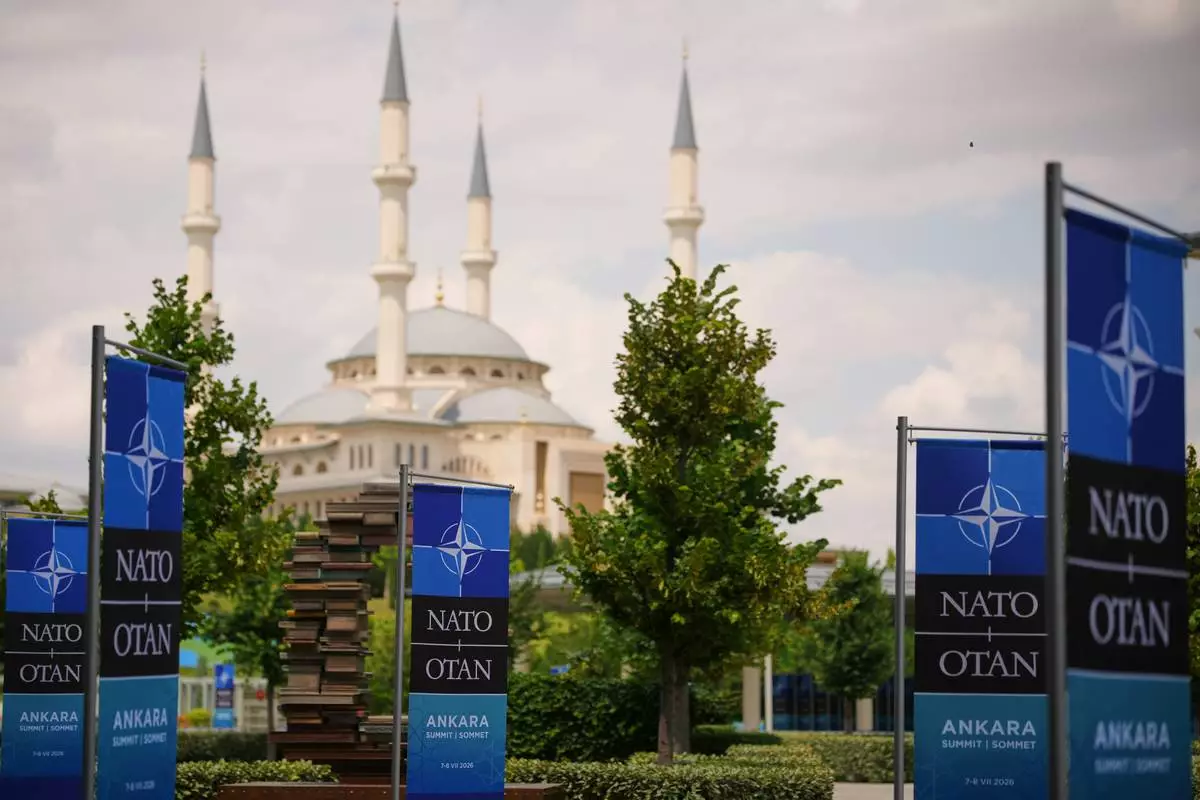
NATO banners in front of the Bestepe National Mosque ahead of the NATO Summit in Ankara, Turkey, Monday, July 6, 2026. (AP Photo/Emrah Gurel)
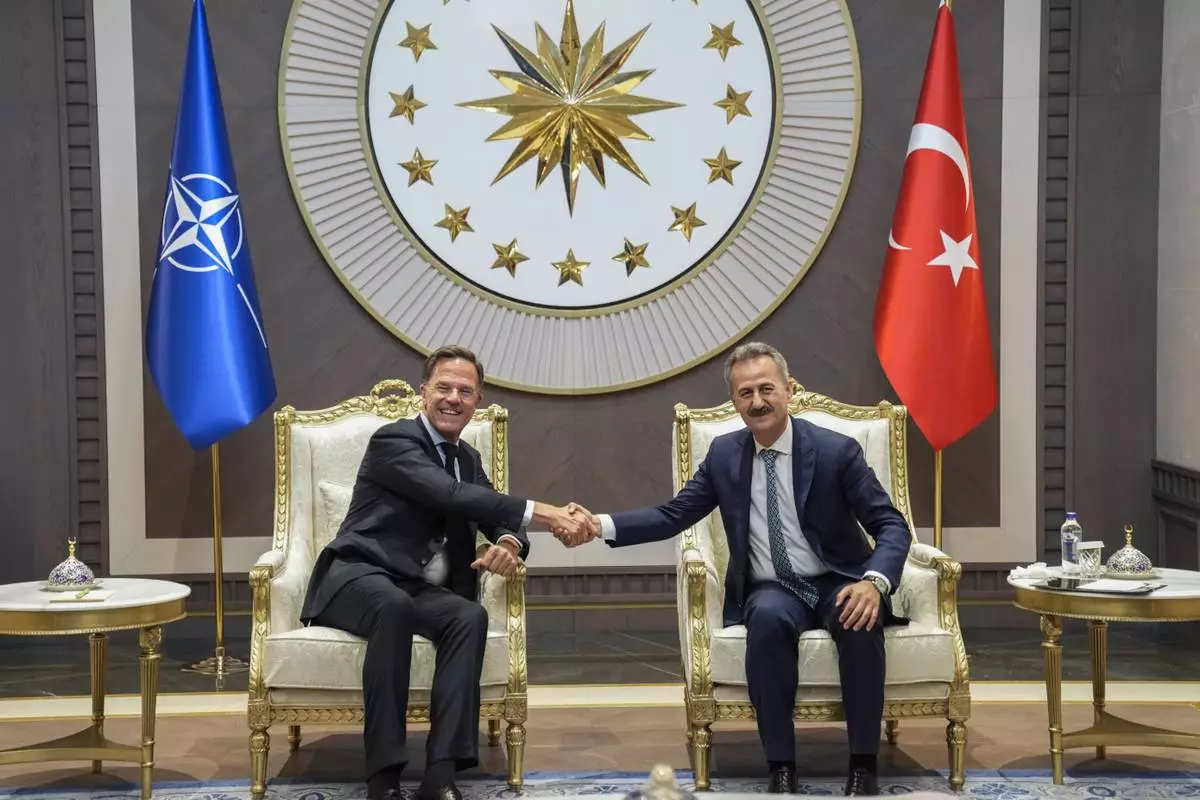
NATO Secretary General Mark Rutte, left, meets with Turkish Presidential Defense Industries Directorate Haluk Gorgun as he arrives ahead of the NATO Summit in Ankara, Turkey, Monday, July 6, 2026. (Osmancan Gürdoğan, Pool Photo via AP)
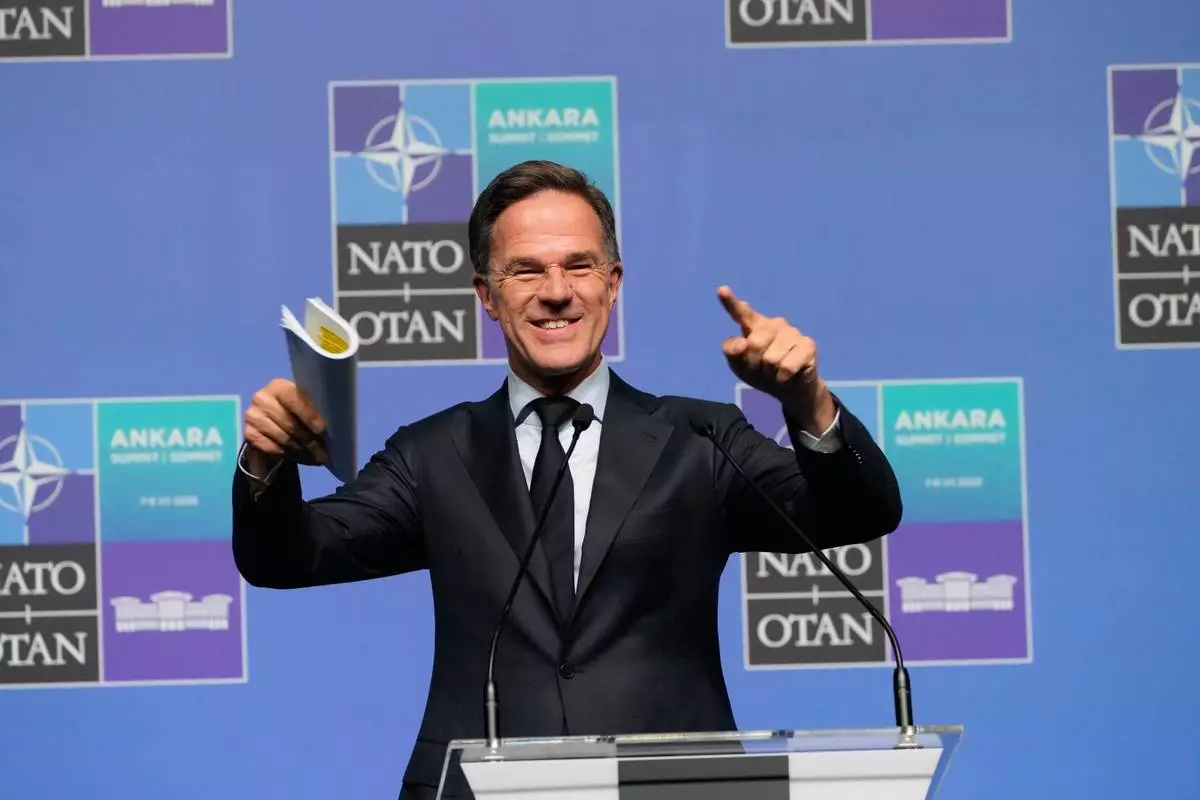
NATO Secretary General Mark Rutte speaks during a media conference at the International Media Center ahead of the NATO Summit in Ankara, Turkey, Monday, July 6, 2026. (AP Photo/Hussein Malla)
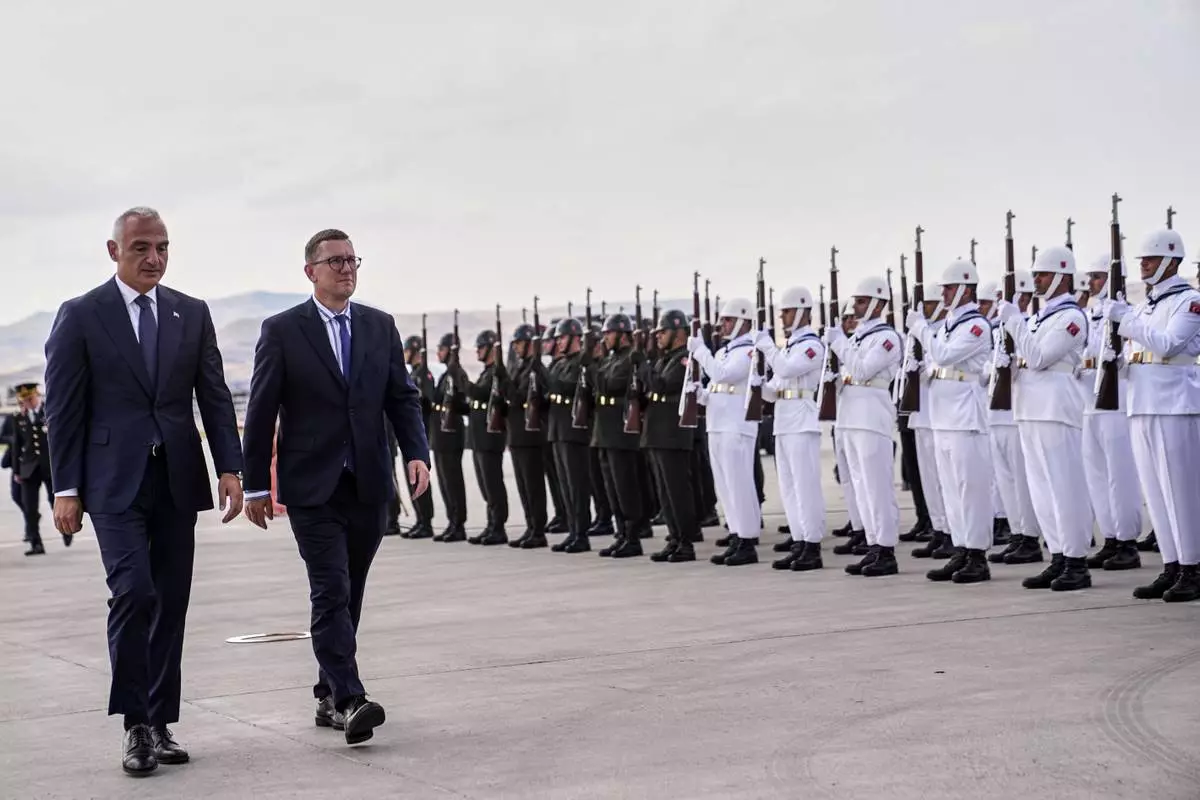
Estonia's Prime Minister Kristen Michal, center left, walks with Turkish Culture and Tourism Minister Mehmet Nuri Ersoy, left, during airport arrivals ahead of the NATO Summit in Ankara, Turkey, Monday, July 6, 2026. (Metin Aktas, Pool Photo via AP)
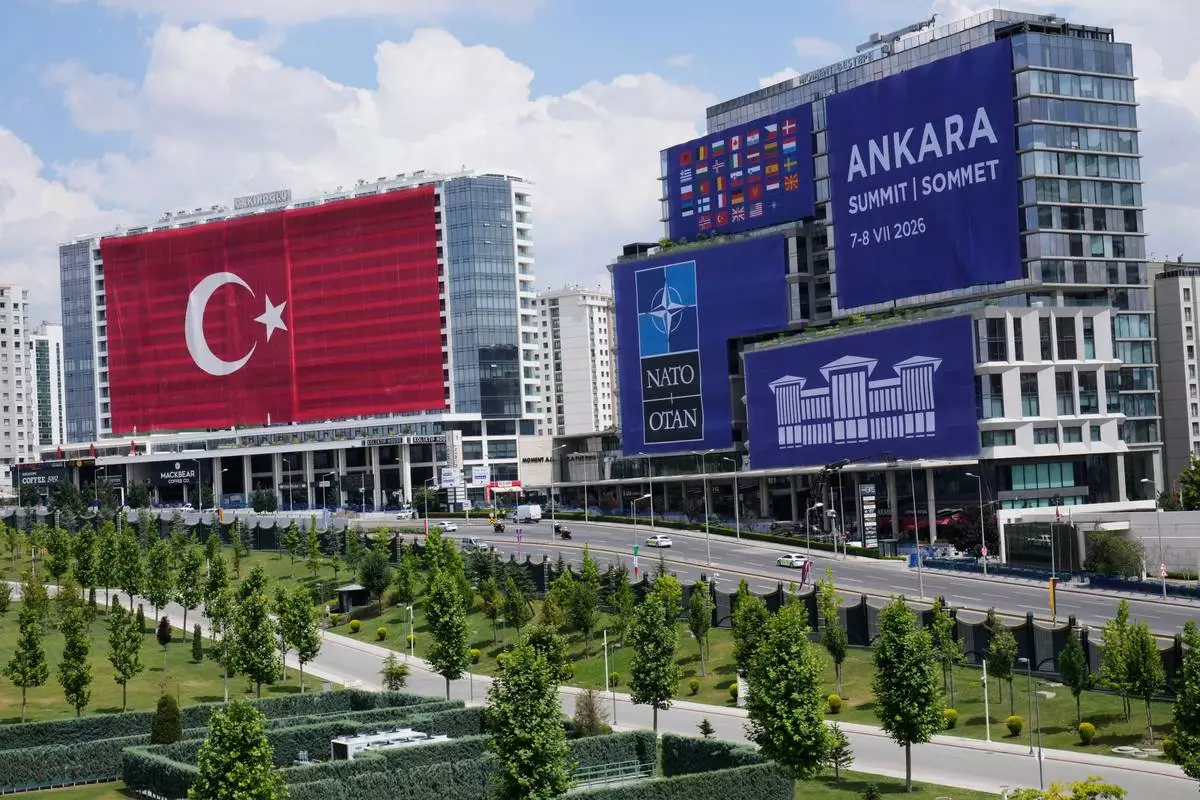
A Turkish flag and NATO banners cover buildings ahead of the NATO Summit in Ankara, Turkey, Monday, July 6, 2026. (AP Photo/Hussein Malla)