June 2026 ranked as the second-warmest June worldwide and the hottest ever in Western Europe, according to the European Union (EU)'s Copernicus Climate Change Service.
The report said Western Europe experienced record-breaking heatwaves during the month, with an average temperature of 20.74 Celsius, more than 3 Celsius above the 1991-2020 average, surpassing the previous record set in June 2025.
Copernicus said the late-June heatwave came only weeks after an intense spell in May, with another emerging in early July. The June heat shattered monthly and all-time records in several countries and contributed to heat-related deaths, underscoring the growing frequency and severity of extreme heat events.
Globally, June 2026 ranked as the second-warmest June on record, with an average surface air temperature of 16.54 degrees Celsius, 0.56 degrees Celsius above the 1991-2020 average for the month and second only to June 2024.
The global average sea surface temperature between 60 degrees south and 60 degrees north reached 20.86 degrees Celsius in June, the highest ever recorded for the month. The figure was 0.01 degrees Celsius higher than the previous June record set in 2024, partly reflecting the development of strong El Nino conditions in the equatorial Pacific.
Samantha Burgess, strategic lead for climate at the European Center for Medium-Range Weather Forecasts, said June 2026 highlighted the continued accumulation of heat in the climate system.
Record warmth in Western Europe and persistently high ocean temperatures have intensified heatwaves and further warmed the oceans, increasing risks to people, ecosystems and infrastructure, she said.
Western Europe posts hottest June on record: EU climate monitor
Western Europe posts hottest June on record: EU climate monitor
Heavy rain triggered by the remnants of Typhoon Maysak has caused severe flooding in Guigang City, south China's Guangxi Zhuang Autonomous Region, leaving over 12,000 teachers and students trapped in the Xijiang Education Park. Local authorities have launched a multi-department emergency rescue operation.
The main entrance to the education park is completely submerged. Water levels have reached depths of seven meters at the deepest point, cutting off all access to the park. Only tree canopies remain visible above the floodwater, and rescuers are using inflatable boats and rubber dinghies to enter the area. Many low-lying buildings have been flooded, and the campus has lost power and water supply.
"Delivery of supplies is also very difficult. All the students and teachers, around 12,000 in total, need to be evacuated. Those who can go home will do so first. For those who cannot, we have set up designated shelters. All collected supplies are being sent to those shelters," said Yang Bing, deputy director of the Guigang Education Bureau.
The rising water levels, vast flooded area, and complex underwater conditions have added to the difficulty of rescue operations.
"The current challenge is that there are too many students—over 12,000. We are continuously strengthening our transport capacity," on-site commander Wang Yonggang explained.
In the meantime, the schools in the park have developed their own transfer plans and registered the information of all stranded individuals.
As of Thursday, an estimated 6,000 to 7,000 students still need to be evacuated, and rescue workers are planning to complete the evacuation later in the day by using powered pontoon bridges and rescue boats.
Local authorities have set up temporary shelters in the city to accommodate evacuated students and ensure their basic needs are met.
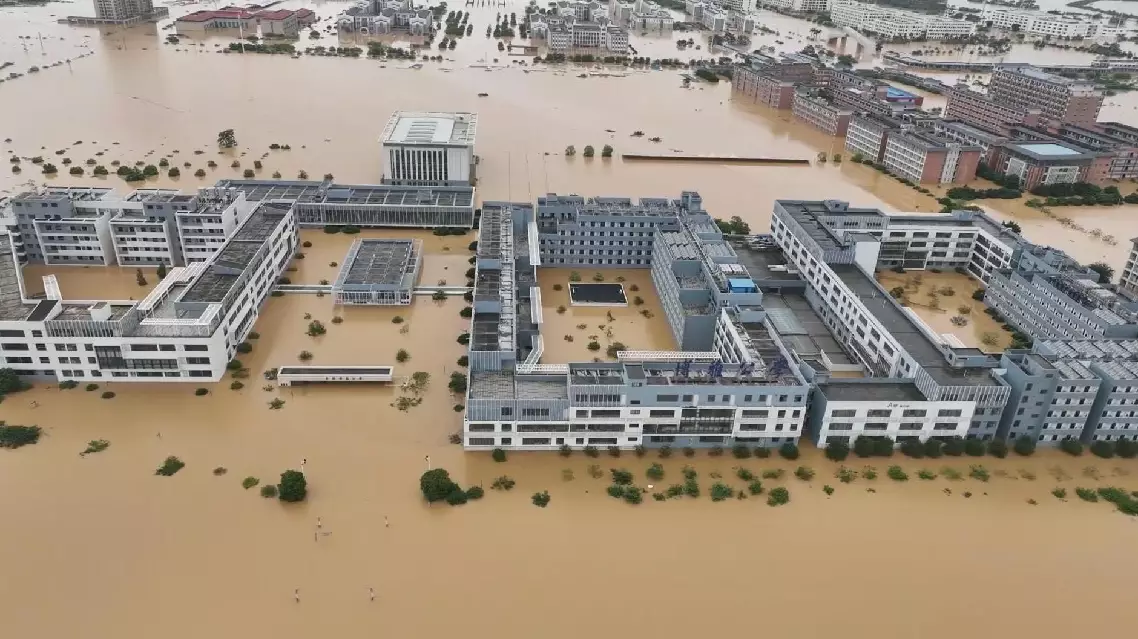
Rescue under way to evacuate all teachers, students trapped by floods in Guangxi