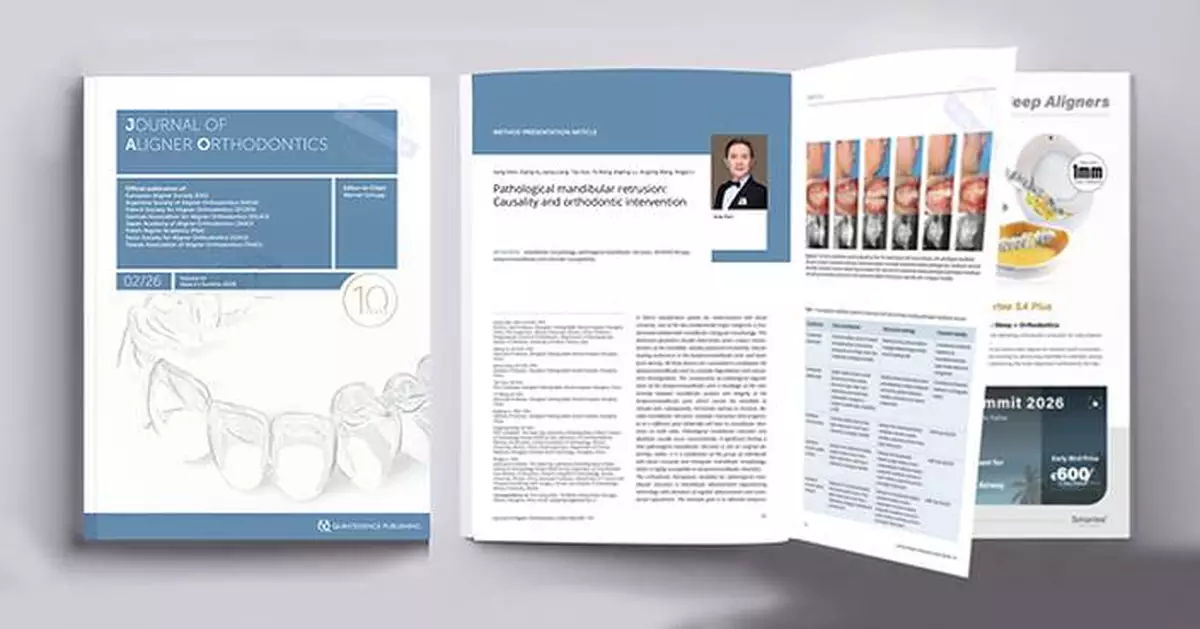
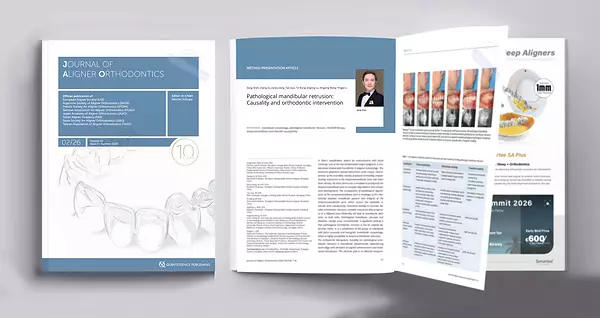
SHANGHAI, July 8, 2026 /PRNewswire/ -- Professor Gang Shen, Chief GS R&D Scientist of Smartee Denti-Technology and Chief Orthodontist at Taikang Dental, together with his orthodontic team, has published a new research article titled "Pathological Mandibular Retrusion: Causality and Orthodontic Intervention" in Issue 2 of 2026 of the Journal of Aligner Orthodontics (JAO).
The publication marks the team's third consecutive paper in JAO since 2025. Together with the previously published "A New Classification System for Malocclusions with Facial Convexity and Working Mechanism" and "Clinical Management of Mandibular Advancement Repositioning Technology in Treating Three-Depth Malocclusion in Adult Patients", the latest study forms a research series covering malocclusion classification, treatment mechanisms, and the pathogenesis and orthodontic management of pathological mandibular retrusion.
Advancing the Understanding of Pathological Mandibular Retrusion
The newly published paper focuses on the etiology, clinical characteristics, and orthodontic management of pathological mandibular retrusion (MPaR). It describes MPaR as a clinical condition associated with temporomandibular joint (TMJ) status, mandibular morphology, and characteristic occlusal features. The study proposes a structured framework for patient assessment and discusses orthodontic intervention approaches based on long-term clinical observations.
According to the authors, patients presenting with skeletal facial convexity and a triangular mandibular morphology may show increased susceptibility to temporomandibular disorders (TMD). The paper further discusses condylar resorption as a potential factor contributing to mandibular retrusion and outlines associated occlusal characteristics that may support earlier identification and more comprehensive clinical evaluation.
From Mechanisms to Orthodontic Intervention
Based on long-term clinical experience and research, the paper further discusses an orthodontic intervention approach centered on mandibular repositioning. The proposed protocol, using the Smartee S8-SGHB clear aligner system, aims to guide the mandible toward a more stable therapeutic position while supporting the reconstruction of occlusal and temporomandibular joint relationships.
The authors also highlight the importance of comprehensive TMJ assessment and longitudinal monitoring before, during, and after orthodontic treatment, particularly in patients with skeletal facial convexity and triangular mandibular morphology.
The publication of this three-paper series reflects the team's ongoing research efforts in mandibular repositioning and related clinical topics. Through continued collaboration between Smartee Denti-Technology and Professor Gang Shen's orthodontic team, research findings are being explored for translation into digital orthodontic technologies and clinical applications, supporting the continued development of clear aligner therapy based on clinical evidence.
** This press release is distributed by PR Newswire through automated distribution system, for which the client assumes full responsibility. **
Professor Gang Shen's Orthodontic Team Publishes Third Consecutive Paper in the Journal of Aligner Orthodontics
HONG KONG, July 9, 2026 /PRNewswire/ -- On a Tuesday morning at the LEAP EAST exhibition hall, a Kingsoft Office product manager pulled up a dashboard on a laptop. She had joined the company just five months ago. Within minutes, the system had pulled customer profiles from a CRM, cross-referenced 300-plus requirements from a request-for-proposal document, and generated a post-project review — all without her opening a single file manually.
For years, enterprise software has promised to make organizations smarter. But behind this moment is a larger shift: the growing recognition that most corporate AI investments are failing to deliver.
According to a Gartner survey of 782 IT leaders published in April, more than 70% of enterprise AI projects are falling short of expected returns. A separate Bain & Company study covering 951 companies found that while AI spending is accelerating rapidly, actual business impact has not kept pace. The bottleneck, according to Kingsoft Office, is not technology — it is integration. Too many AI tools remain trapped in chat windows, answering questions but never executing tasks inside the workflows where work actually happens.
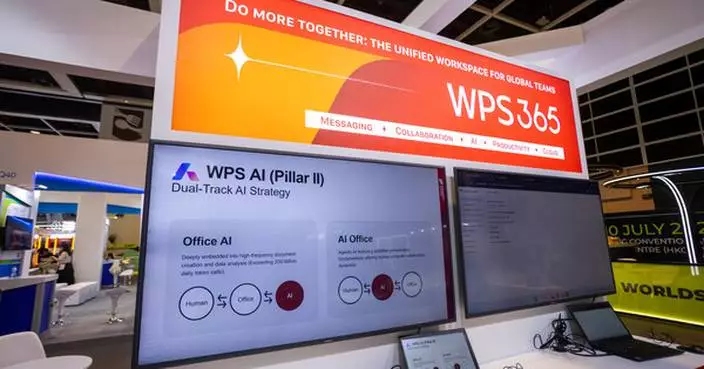
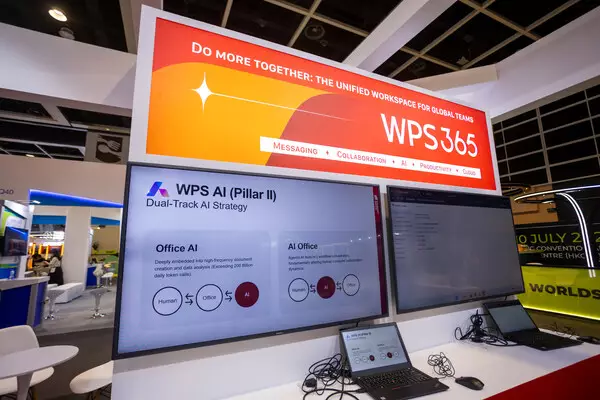
At LEAP EAST, the Hong Kong technology conference that opened July 8, Kingsoft Office unveiled WPS 365, its enterprise productivity platform, with a new proposition: an "Enterprise Brain Execution Layer" that embeds AI directly into business processes rather than layering it on top as a chatbot.
The essential part of the strategy is Qingzhou AI, a lightweight private-deployment architecture designed for companies that cannot risk sending sensitive data to public cloud services. Unlike traditional on-premise AI setups that require racks of servers and high-end GPUs, Qingzhou AI runs on a single standard server, reducing infrastructure requirements by more than 95%. The system uses CPU-friendly auxiliary models and a monolithic architecture instead of microservices, making it accessible to mid-sized enterprises that lack dedicated IT budgets.
"Data sovereignty is not a choice — it is the entry ticket for organizational AI," said Xu Liu, Vice President of Kingsoft Office, in an interview at the event. "We've spent years co-creating with leading enterprises in finance, manufacturing, and government in China. What we've learned is that organizational AI cannot be bought — it must be grown from the soil of a company's own data and real business workflows."
The results are measurable. One technology company applied Qingzhou AI to its legal review process, which involved more than 400 review types and over 20,000 business rules. Document review time dropped from 140 minutes to 40 minutes per file — a more than threefold improvement.
WPS 365 builds on Kingsoft Office's 38-year history in document processing. Rather than attaching an AI chatbot alongside documents, the platform allows AI to operate directly inside files — editing contracts, analyzing spreadsheets, and generating presentations — with version tracking and format integrity preserved. The system supports 14 languages and offers data centers in Germany, Singapore, and Japan, complying with GDPR and SOC2 standards.
For Asia Pacific businesses wrestling with the gap between AI hype and real productivity, Kingsoft Office's pitch is straightforward: the future of enterprise AI is not about smarter chatbots. It is about AI that can actually do the work.
** This press release is distributed by PR Newswire through automated distribution system, for which the client assumes full responsibility. **
WPS Brings 'Enterprise Brain' to Asia Pacific -- One Workflow at a Time