Shanghai, the host city of the upcoming 2026 World Artificial Intelligence Conference (WAIC) and High-Level Meeting on Global AI Governance, offered a special preview into some of the core technologies that will define this year's agenda on Wednesday.
Organizers provided a media tour, which aimed to highlight the industry's latest advancements and set the stage for crucial discussions on the future of artificial intelligence.
Marking its eighth year, the WAIC, scheduled for July 17 to 20, has solidified its role as a premier global platform for artificial intelligence. This year's event will witness over 140 forums and a massive exhibition displaying more than 3,000 cutting-edge products. The event aims to be a comprehensive ecosystem, linking global thought leaders with groundbreaking technology to forge industry consensus and offer solutions for global governance.
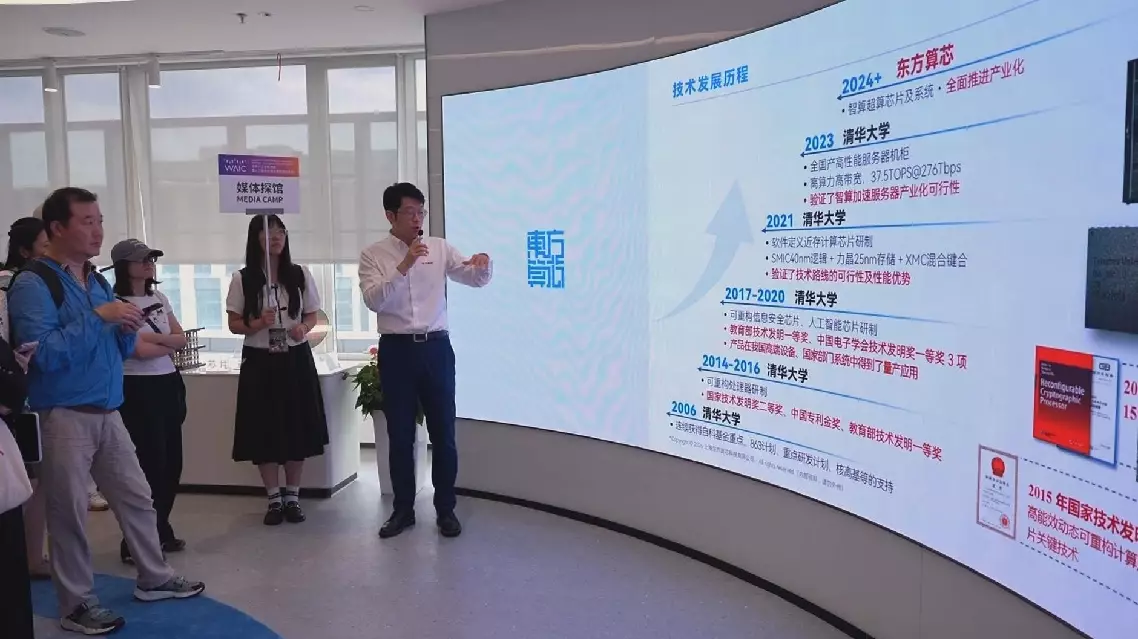
The Wednesday tour also took journalists to leading companies in the field such as Shanghai Eastern Computing Technology and Shanghai Matwings Technology.
Any advancement in AI begins with raw computing power. Shanghai Eastern Computing Technology is rethinking infrastructure design from the ground up and building a resilient foundation for the digital economy.
"Our approach is built on two disruptive innovations: Software-Defined Chips and 3D Near-Memory Computing technology. By combining these, we create intelligent computing chips that deliver both massive computility and immense bandwidth," said Xu Ziming, the company's marketing department head.
AI large models are now biology engineering itself. Shanghai Matwings Technology has developed a generative AI platform to design entirely new proteins, which are the building blocks of life.
"AI model learns so many different protein properties. Therefore, it can rapidly deliver protein products according to the target you set up. It can be used in many different areas, including pharmaceutical applications, drugs, and in vitro diagnostics, and food and agriculture, so on and so forth. And more importantly, since our AI model learns so many protein survived in the extreme environment -those bacteria - therefore, we can build a protein with extreme properties like extreme temperature sensibility, acid, or basic, or [stability]. Therefore, we can deliver protein products which were unknown, unavailable in the market to the public," said Hong Liang, Matwings' founder and chief scientist.
Shanghai previews AI's future with focus on global governance