Skip to Content Facebook Feature Image

Africa secures $900 million in new clean cooking commitments

News

Africa secures $900 million in new clean cooking commitments
News

News

Africa secures $900 million in new clean cooking commitments

2026-07-10 10:14 Last Updated At:11:07

NAIROBI, Kenya (AP) — African countries have secured $900 million in new financial commitments to expand access to clean cooking technologies, which replace polluting fuels with cleaner alternatives, the International Energy Agency, IEA, said Thursday.

The new pledge builds on the $2.2 billion mobilized at the inaugural Africa Clean Cooking Summit in Paris in 2024, bringing total commitments to more than $3.1 billion, which will be used to expand access to cleaner cooking fuels, stoves and related infrastructure across the continent.

The funding was announced during a virtual meeting on clean cooking in Africa convened by IEA and Kenya, where leaders reviewed progress made since the last summit and outlined priorities ahead of the next gathering later this year.

Nearly 1 billion people across Africa still lack access to clean cooking, relying instead on charcoal, firewood and other polluting fuels that the IEA says contribute to an estimated 850,000 premature deaths each year.

The meeting brought together Kenyan President William Ruto, Norwegian Prime Minister Jonas Gahr Store, U.S. Energy Secretary Chris Wright, African Union commissioner for Infrastructure and Energy Lerato Mataboge and IEA executive director Fatih Birol, among others.

Clean cooking refers to the use of low-emission fuels and technologies, such as ethanol, biogas and electricity, instead of traditional fuels like charcoal and firewood. The transition reduces harmful household air pollution and improves health outcomes for millions of African households.

“Access to clean cooking is one of the most impactful yet overlooked challenges of our time,” said Wright, adding that it directly affects the lives of billions of people, particularly women and children.

Kenya’s Ruto said financing remained the biggest obstacle to achieving universal access to clean cooking technologies across Africa. “Ambition alone is not enough. It must be backed by investment,” he said.

Birol said the IEA's latest tracking showed that $740 million, or about one-third of the commitments announced in Paris, has already been deployed across 22 African countries.

“The additional $900 million in commitments demonstrates growing momentum, with more expected before the next summit,” Birol said.

The IEA also released a report showing governments have introduced 121 new clean cooking policies across more than 30 African countries since the Paris summit. Those countries account for about 80% of Africans without access to clean cooking.

The agency said it is working with the African Union to help governments strengthen national clean cooking policies under a continentwide strategy and action plan ahead of the next summit.

It also launched a new public-private Clean Cooking Security Programme aimed at strengthening global supply chains for cooking fuels, particularly liquefied petroleum gas, or LPG. The initiative follows shipping disruptions through the Strait of Hormuz earlier this year that affected about 30% of globally traded LPG, the agency said. More than 3.4 billion people worldwide depend on LPG as their primary cooking fuel.

The program will provide technical assistance to countries seeking to improve fuel security while exploring ways to strengthen international cooperation on clean cooking supply chains.

The Associated Press’ climate and environmental coverage receives financial support from multiple private foundations. AP is solely responsible for all content. Find AP’s standards for working with philanthropies, a list of supporters and funded coverage areas at AP.org.
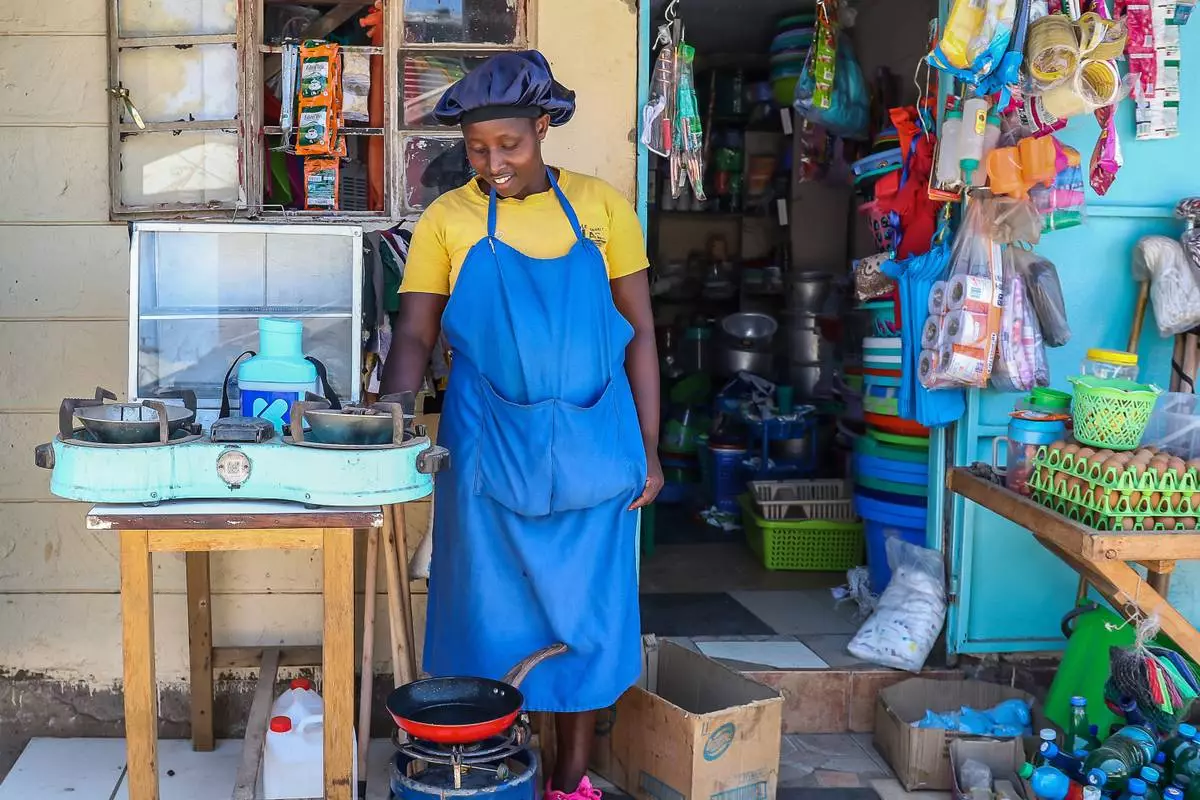
FILE - Grace Kathambi uses a bioethanol fuel stove to fry and sell French fries at her shop in Kibera, an informal settlement on the outskirts of Nairobi, Kenya, on Feb. 4, 2026. (AP Photo/Atieno Muyuyi, File)

FILE - Grace Kathambi uses a bioethanol fuel stove to fry and sell French fries at her shop in Kibera, an informal settlement on the outskirts of Nairobi, Kenya, on Feb. 4, 2026. (AP Photo/Atieno Muyuyi, File)
ISLAMABAD (AP) — Pakistan Navy search teams recovered additional debris from a cargo plane that crashed into the Arabian Sea earlier this week, with the recovered wreckage to be analyzed by investigators as the search for the aircraft’s five missing crew members entered its third day Friday.

The Pakistan Airports Authority said in a post on X that search-and-rescue operations by the Pakistan Navy and the Pakistan Maritime Security Agency remained underway in deep waters, with aircraft and other assets deployed in a coordinated effort to locate the missing crew.

The authority did not provide additional details, saying further updates would be shared later. The cause of the crash remains under investigation.

The cargo plane, operated by Karachi-based private carrier K2 Airways, disappeared from radar late Tuesday while flying from Sharjah in the United Arab Emirates to Karachi, Pakistan, after reporting a malfunction in its navigation system.

The Navy recovered the first pieces of wreckage Wednesday about 100 kilometers (60 miles) off the coastal town of Ormara on Pakistan’s southwestern Makran coast in Balochistan province, but officials have said the aircraft’s main fuselage and all five crew members remain missing.

Pakistan’s Prime Minister Shehbaz Sharif has directed authorities to use all available resources to locate the missing crew members, while K2 Airways said it is extending full cooperation to civil aviation authorities investigating the crash.

The search has been complicated by rough seas, strong winds and shifting ocean currents, which can scatter floating debris over a wide area and make it more difficult to pinpoint the crash site.

The Pakistan Airports Authority has said radar data indicated the aircraft made a sharp change in heading and rapidly descended before radio and radar contact were lost at about 9:21 p.m. Tuesday, about 287 kilometers (178 miles) west of Karachi.

Pakistan has experienced several fatal air crashes in recent decades.

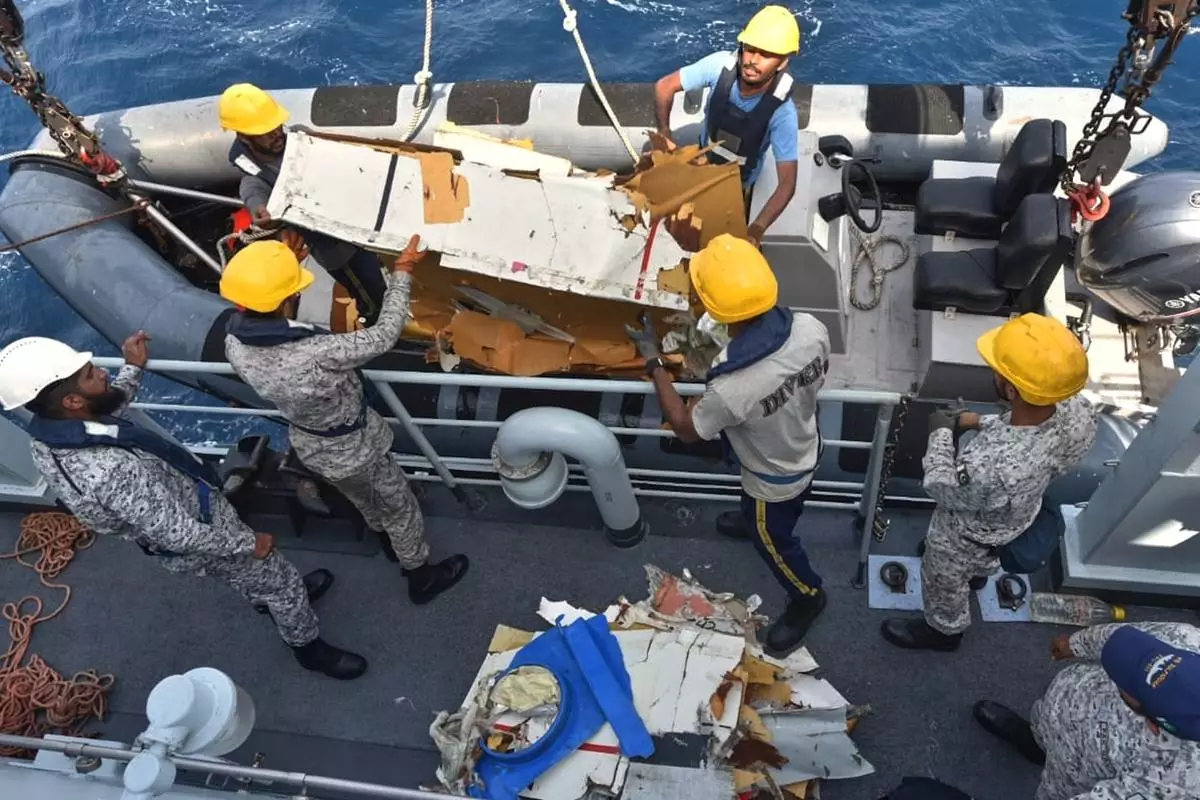
In this photo released by Pakistan Navy, Pakistan Navy personnel shift the wreckage of a cargo plane of the private carrier K2 Airways into a naval ship after recovering them from deep sea near Omara, a town some 360 kms. (220 miles) west of Karachi, Pakistan, Wednesday, July 8, 2026. (Pakistan Navy via AP)

In this photo released by Pakistan Navy, Pakistan Navy personnel shift the wreckage of a cargo plane of the private carrier K2 Airways into a naval ship after recovering them from deep sea near Omara, a town some 360 kms. (220 miles) west of Karachi, Pakistan, Wednesday, July 8, 2026. (Pakistan Navy via AP)

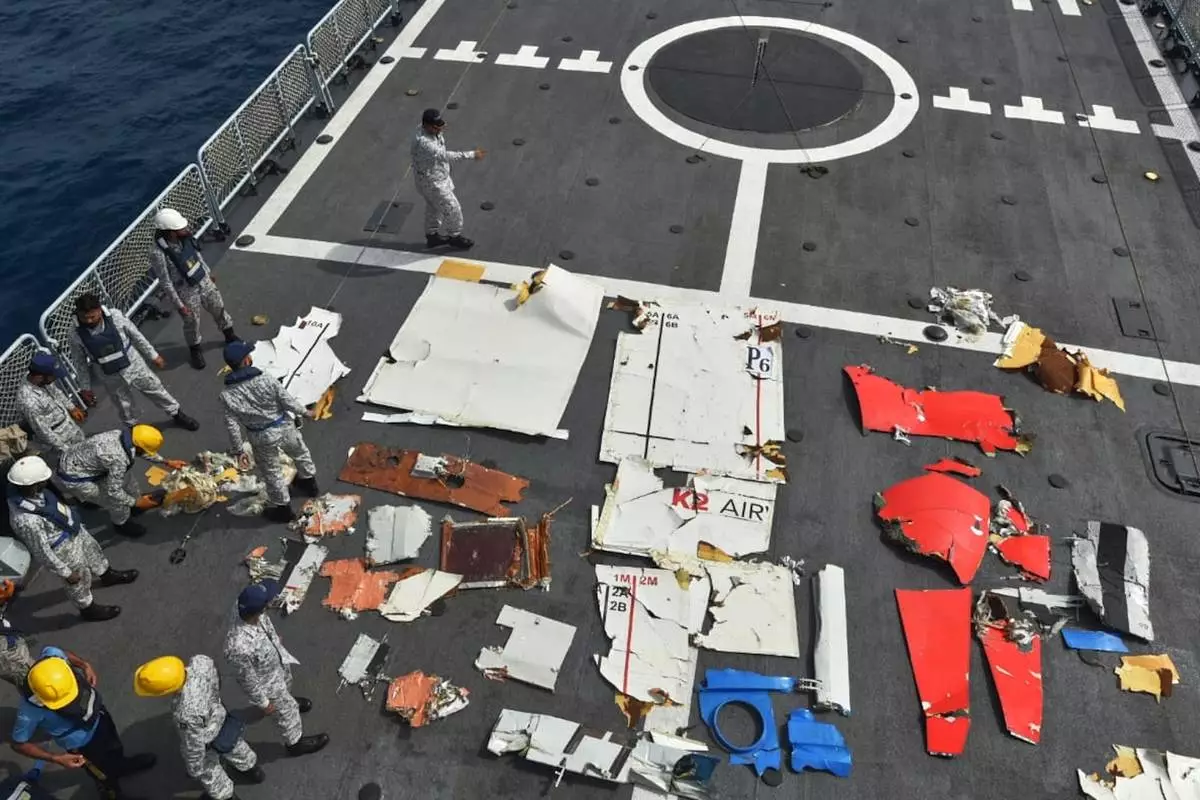
In this photo released by Pakistan Navy, Pakistan Navy personnel examine the wreckage of a cargo plane of the private carrier K2 Airways on a naval ship after recovering them from deep sea near Omara, a town some 360 kms. (220 miles) west of Karachi, Pakistan, Wednesday, July 8, 2026. (Pakistan Navy via AP)

In this photo released by Pakistan Navy, Pakistan Navy personnel examine the wreckage of a cargo plane of the private carrier K2 Airways on a naval ship after recovering them from deep sea near Omara, a town some 360 kms. (220 miles) west of Karachi, Pakistan, Wednesday, July 8, 2026. (Pakistan Navy via AP)

Ghulam Nabi Bahrani, father-in-law of missing cargo plane crew First Officer Faisal Jatoi, showed his picture on a mobile phone in Karachi, Pakistan, Wednesday, July 8, 2026. (AP Photo/Ali Raza)

Ghulam Nabi Bahrani, father-in-law of missing cargo plane crew First Officer Faisal Jatoi, showed his picture on a mobile phone in Karachi, Pakistan, Wednesday, July 8, 2026. (AP Photo/Ali Raza)

Recommended Articles