WASHINGTON (AP) — President Donald Trump will let the bipartisan housing bill approved by Congress become law without his signature, saying Friday that he was refusing to put his name on it because of the little progress made in passing a strict voter ID bill that he has been pushing.
“I will not sign the Housing Bill, which has been fully approved by Congress and sent to the White House, in PROTEST over the fact that the United States Senate is not capable of passing THE SAVE AMERICA ACT,” Trump posted on social media.
Trump had 10 days until the Friday deadline to sign the bill, issue a veto, or allow the measure to take effect without his signature. He has chosen to let the measure become law without his express approval, undercutting his administration's claims that he considers it a priority to combat inflation.
Trump’s rejection of the bipartisan housing legislation exacerbates tensions with his own party in a midterm election year and cuts short their efforts to address a key voter concern about rising costs. His post comes more than a week after he canceled plans to sign the bipartisan legislation, announcing he was using it as leverage in his push for a strict voter ID bill.
The 21st Century ROAD to Housing Act aims to lower the cost of housing and spur more home construction. It’s the broadest federal effort in decades to address America’s housing affordability problems, as state and local regulations have made it difficult to build in many of the communities that are also sources of job growth and economic opportunity. White House economists estimated earlier this year a national shortage of 10 million homes and the bill could help to close a portion of that gap.
But Trump called the bill “a yawn” and “so unimportant” compared to legislation that would require proof of citizenship for all voters.
He surprised Republican lawmakers on June 24, when, shortly before a planned signing ceremony at the Capitol, he announced he would not approve the bill until lawmakers first passed the voting legislation.
That bill, the SAVE America Act, doesn’t have enough Republican support to pass.
House Speaker Mike Johnson, R-La., said after submitting the housing bill to the White House that he told Trump he should get the “fattest black marker you have, and sign your name really big on that.”
“I hope he does sign it,” Johnson told reporters at the time. “If he doesn’t, it’s still law. We’ll still celebrate it.”
He said he also understood Trump was trying to make a point that the elections bill is the top priority. “And I think he’s making it very effectively,” Johnson said.
Still, Trump’s decision not to sign the bill gave Democrats an opening to criticize him on the issue of affordability.
“His priorities couldn’t be clearer: higher cost for families and more power for himself,” Senate Democratic leader Chuck Schumer said on X.
The housing bill passed the Senate on an 85-5 vote and the House approved it with an 358-32 vote.
That legislation seeks to cut federal housing rules, slim-down environmental reviews, make it faster to build homes and limit the ability of corporations to buy single-family homes.
The bill does not address all of the causes of the country’s housing woes, including a shortage of construction workers, climbing insurance costs and wages that have not risen fast enough for renters and buyers.
But the bill has drawn support from the real estate industry and housing advocates.
The U.S. housing market has been a driver of recent affordability challenges as skyrocketing prices have kept aspiring buyers out of the market. The National Association of Realtors said Thursday that the median sales price increased 1.8% in June from a year earlier to $440,600, an all-time high on data going back to 1999.
Associated Press reporter Kevin Freking contributed to this report.

President Donald Trump speaks with reporters in flight on Air Force One after landing at U.S. Air Force Base at RAF Mildenhall, in Suffolk, Eastern England, Wednesday, July 8, 2026. (AP Photo/Alex Brandon)
MADRID (AP) — A wildfire roared through a remote expat community in southern Spain overnight, killing at least 12 people as victims tried to flee the flames in cars and on foot, authorities said Friday. Eight people were injured and 23 missing, Andalusia’s regional leader Juan Manuel Moreno said.
The blaze, one of Spain's deadliest wildfires, broke out late Thursday in a semi-arid area near the Sierra de Los Filabres mountains in Almeria province, as the country has been dealing with soaring temperatures.
Most of the victims died after ignoring shelter-in-place instructions, said Antonio Sanz, head of Andalusia’s emergency services. Some tried to escape via a dry riverbed that “turned into a death trap,” he said.
Four victims were believed to be British nationals because the steering wheel of their burned-out car was on the right side, as with British vehicles, regional authorities said. Other unspecified nationals also were believed to be among the dead, and the death toll was expected to rise, authorities said.
Seven people died while on foot after abandoning their cars, Sanz said.
“The consequences have been terrible," Sanz said. “Everything seems to indicate that, in the case of the deceased … we are dealing for the most part, if not entirely, with foreign nationals.”
The fire was still burning as of Friday afternoon. Some 150 firefighters and 220 soldiers from Spain’s military emergency unit were battling the blaze, which had consumed more than 3,200 hectares (7,900 acres) of forest and farmland.
Moreno, the Andalusian regional leader, said containing the fire was difficult because of the steep, dry terrain.
“It consists mainly of scrubland and esparto grass,” Moreno said. “Everything is extremely dry due to the heat waves, making it the perfect fuel; combined with the wind, it’s a ticking time bomb.”
Spanish Prime Minister Pedro Sánchez expressed his condolences. “Immense sadness and desolation in the face of the terrible consequences of the fire affecting the province of Almeria,” he wrote on X.
Spain has battled frequent and severe heat waves in recent years, with temperatures often exceeding 40 C (104 F). Wind, high temperatures and little rainfall help small wildfires grow into unchecked blazes.
In June, Spain experienced several days of record-setting heat, with over 1,000 excess deaths attributed to heat.
Europe is the world’s fastest-warming continent, with temperatures increasing twice as fast as the global average since the 1980s, according to the European Union’s Copernicus Climate Change Service. Parts of Western Europe are facing their third heat wave in six weeks. Globally, 2025 was the third-hottest year on record, bringing several intense heat waves across Europe.
France is experiencing the peak of its third heat wave of the summer, with temperatures reaching 40 C (104 F) across western and central areas and around 37 C (98 F) in Paris.
French authorities have also warned of a very high wildfire risk, as large fires in the south have already scorched thousands of hectares this week, disrupting the Tour de France cycling race and stretching firefighting resources.
The largest wildfire, in the eastern Pyrenees near the Spanish border, had decreased in intensity by Friday, authorities said. But it has burned about 5,000 hectares (12,000 acres) and forced the temporary evacuation of more than 10,000 people from nearly villages.
Last month was France’s hottest June on record, with deaths surging by nearly a third during the hottest week.
Scientists warn that climate change caused in part by the burning of fuels like gasoline, oil and coal is exacerbating the frequency and intensity of heat and dryness, making certain regions more vulnerable to wildfires.
Spain is no stranger to wildfires, with last year's fire season burning more than 393,000 hectares (almost 1,520 square miles), according to the European Forest Fire Information System, an area twice as large as London. Four people died.
Spain's deadliest wildfire was in 1979 when 21 people perished in Lloret de Mar, a coastal town about an hour north of Barcelona.
In 2017, a wildfire in neighboring Portugal left 66 people dead in Pedrogao Grande, located 200 kilometers (120 miles) northeast of Lisbon. In that blaze, 47 people died on one road while similarly attempting to flee in their cars.
———
Associated Press journalist Sylvie Corbet, in Paris, contributed.
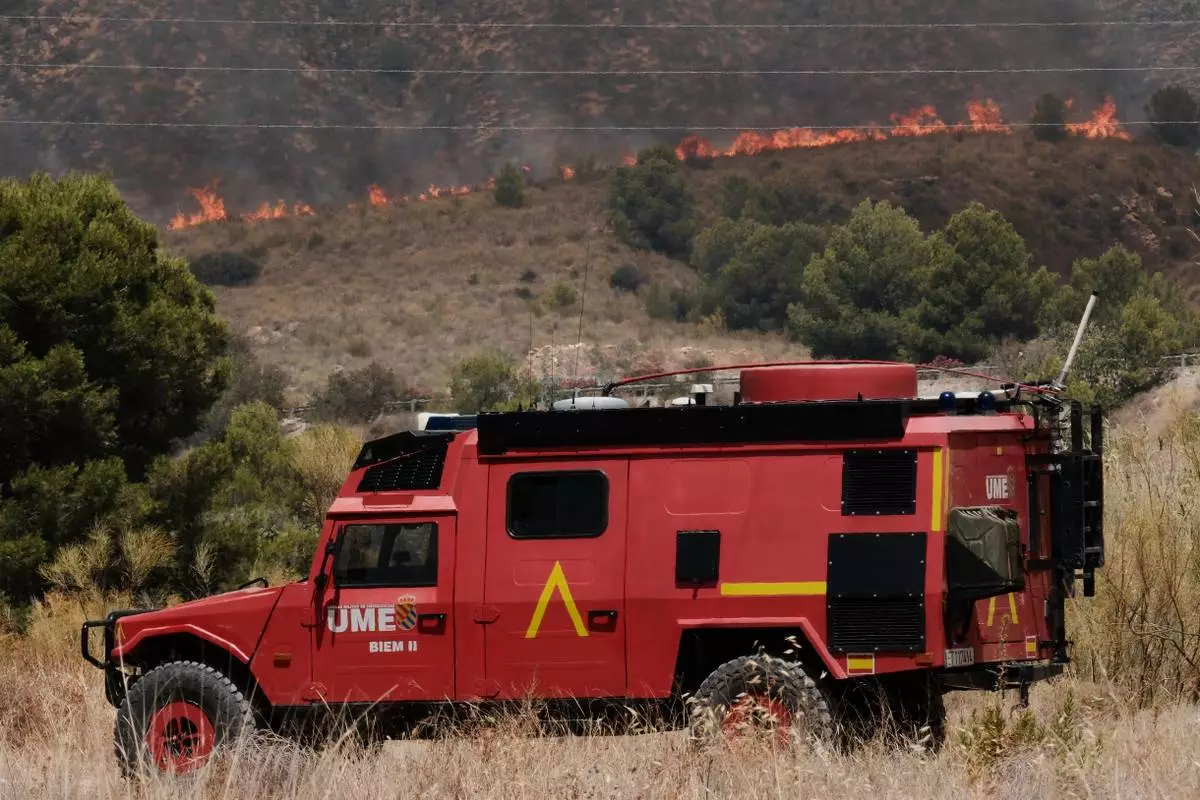
A Military Emergency Unit vehicle operates as a wildfire rages in Alfajir, near Almeria in southeastern Spain, Friday, July 10, 2026. (AP Photo/Gregorio Marrero)
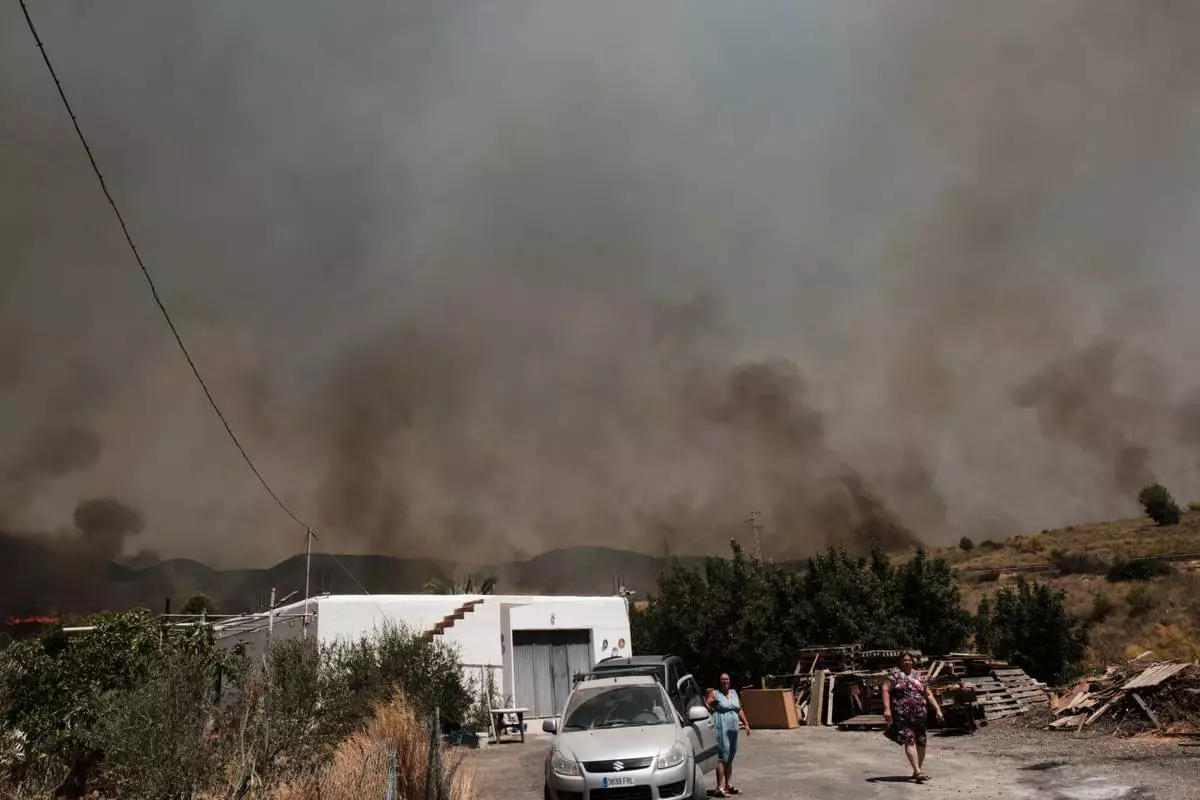
A wildfire rages in Alfajir, near Almeria in southeastern Spain, Friday, July 10, 2026. (AP Photo/Gregorio Marrero)
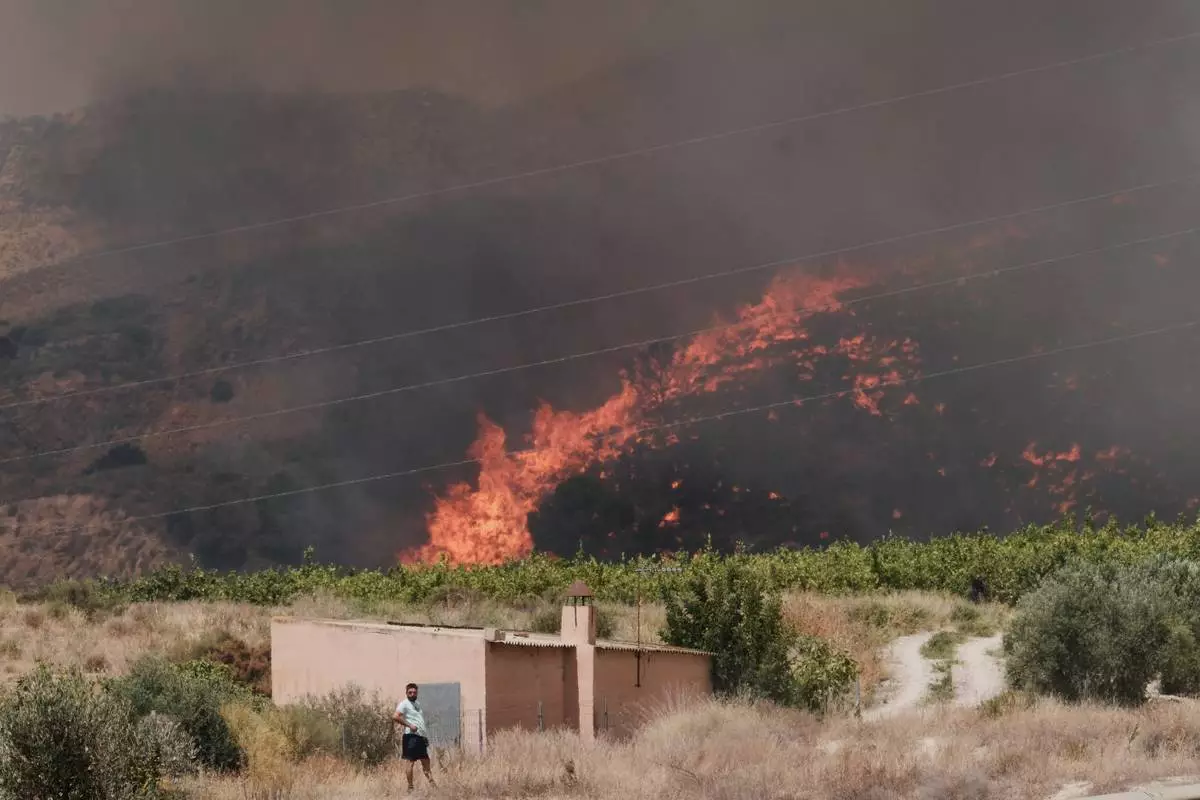
A wildfire rages in Alfajir, near Almeria in southeastern Spain, Friday, July 10, 2026. (AP Photo/Gregorio Marrero)