DALLAS--(BUSINESS WIRE)--Jul 11, 2026--
L&T Technology Services (BSE: 540115, NSE: LTTS), a global leader in Engineering Intelligence Solutions & ER&D Consulting Services successfully concluded Engineering Intelligence (EI) OpenHack 2026, a first-of-its-kind global innovation challenge conducted simultaneously across nine locations spanning India, the U.S. and Europe.
This press release features multimedia. View the full release here: https://www.businesswire.com/news/home/20260711032850/en/
The hackathon brought together nearly 4,000 engineers (770+ teams) from Bengaluru, Mysuru, Chennai, Hyderabad, Pune, Vadodara, Mumbai, Dallas and Munich to tackle complex engineering challenges through AI-led innovation. More than 500 challenge statements were aligned with company’s strategic growth priorities, spanning Software Defined Mobility, Plant Buildout & Modernization, Energy & Automation, Next-Gen Compute & AI Infrastructure, Digital Manufacturing, MedTech, and Software Platforms & AI. By combining domain expertise with emerging technologies, participants developed AI-powered solutions across industrial automation, cybersecurity, autonomous systems, supply chain intelligence, enterprise optimization, and healthcare - all aimed at helping enterprises reimagine products, operations, and decision-making.
An esteemed jury comprising senior LTTS leaders and technology experts evaluated the solutions through multiple rounds, assessing entries on innovation, technical excellence, scalability, real-world relevance and effective use of AI. Winning teams were awarded cash prizes worth over INR 30 lakh, while standout innovations received opportunities for further development through Project Equinox, an LTTS platform that supports promising, scalable solutions. Patent-worthy innovations were also shortlisted for special recognition, enabling participants to transform breakthrough ideas into valuable intellectual property.
Congratulating the participants and winning teams, Mritunjay Kumar Singh, Chief Operating Officer, L&T Technology Services, said, “The EI OpenHack 2026 reflects LTTS’ vision of Engineering Intelligence, where engineering expertise and AI come together to solve real-world industry challenges. What stood out was not only the scale of participation, but the ability of our engineers to apply contextual understanding, domain knowledge and AI prowess to develop solutions with tangible business relevance.Initiatives like OpenHack create opportunities for our talent to experiment, collaborate and develop solutions that will shape the future of engineering.”
About L&T Technology Services Ltd
L&T Technology Services (LTTS) is a global leader in Engineering Intelligence Solutions & ER&D Consulting Services. A listed subsidiary of Larsen & Toubro (L&T), we offer design, development, testing, and sustenance services across products and processes. Purposeful. Agile. Innovation. is how we drive growth across the Mobility, Sustainability and Tech segments. Our client base includes 69 Fortune 500 companies and 57 top ER&D companies across industrial products, medical devices, transportation, telecom & hi-tech, and process industries. Headquartered in India, we have over 23,800 employees across 22 global design centers, 31 global sales offices, and 98 innovation labs, as of March 31, 2026.
For additional information about L&T Technology Services log on to https://www.ltts.com/.
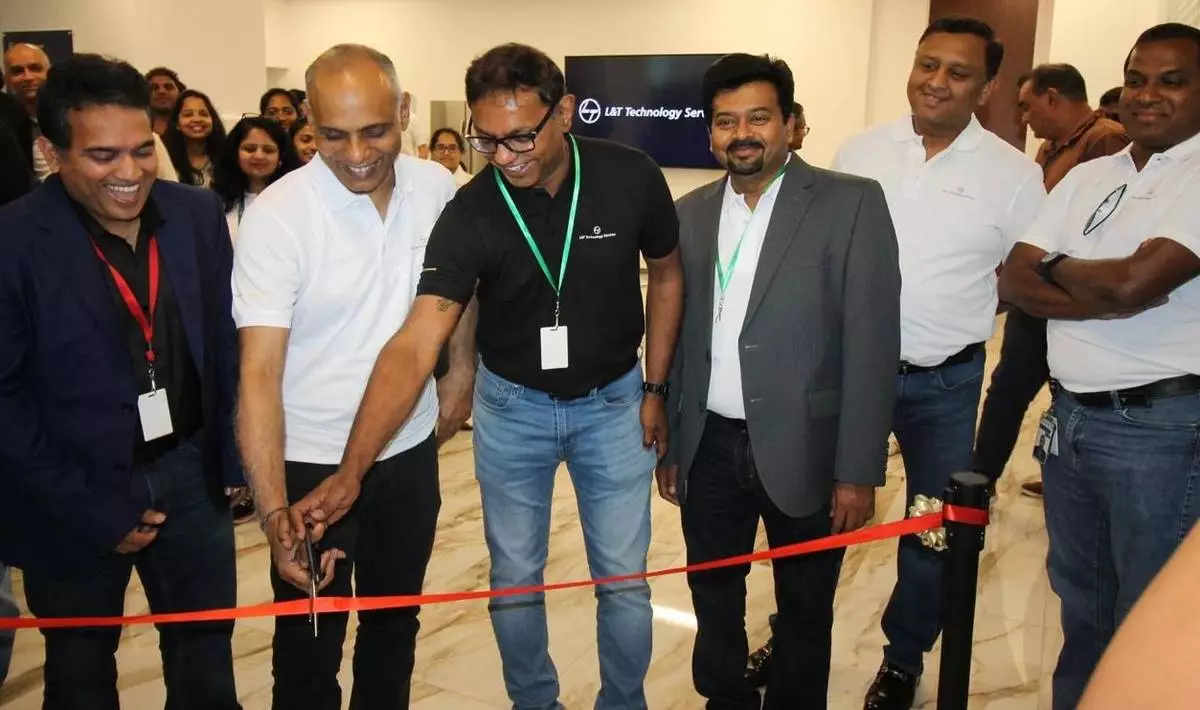
LTTS Global EI OpenHack at the Dallas office
DUBAI, United Arab Emirates (AP) — U.S. and Iranian leaders traded further threats on Saturday as the interim deal to end the war buckles under repeated crossfire in the Middle East.
President Donald Trump upped threats of further missile attacks against Iran in a string of comments on his Truth Social that came after senior U.S. officials demanded that Iran make a public statement saying the Strait of Hormuz is open and that ships crossing the vital corridor won’t be attacked.
Trump also made the comments after the funeral of Supreme Leader Ayatollah Ali Khamenei saw open calls for the U.S. leader's killing.
Later Saturday, Iranian Supreme Leader Mojtaba Khamenei vowed that Iranians would continue to avenge the killing of his father, Ali Khamenei, who was mourned in funeral events throughout Iran this week. He said in remarks carried by state television that such revenge “is the will of our nation and must certainly be carried out.”
So far, Tehran has not submitted to U.S. demands over the Strait of Hormuz, instead insisting that the route remain under its control and that it be allowed to charge ships moving through it.
There had been multiple days of U.S. airstrikes targeting Iran, as well as Iranian retaliatory fire targeting nations across the Middle East. Those strikes had been sparked by Iran attacking three ships in the strait earlier this week.
On Truth Social on Friday, Trump declared the ceasefire over but said the U.S. would continue negotiations. Iranian Foreign Minister Abbas Araghchi traveled to Oman for more talks on Saturday, a day after Qatari mediators separately traveled to Iran to meet with officials amid the regional strikes.
A thousand “missiles are Locked and Loaded and aimed at the Islamic Republic of Iran, with thousands more to immediately follow, should the Iranian Government act on its threat,” Trump wrote on his website.
The U.S. president said he was responding to threats “to assassinate, or attempt to assassinate” him. During Khamenei's funeral, mourners repeatedly held posters or banners calling for him to be killed along with Israeli Prime Minister Benjamin Netanyahu.
The Iran war's opening moments on Feb. 28 saw an airstrike that killed Khamenei, 86. Iran only buried Khamenei this week following a dayslong funeral ceremony that saw his body taken to cities in both Iran and Iraq.
Trump added in his post that the U.S. military would “completely decimate and destroy all areas of Iran — PRAISE BE TO ALLAH!”
Trump, repeatedly during the war and its uneasy ceasefire, has invoked the name of God in Arabic, as well as threatened to destroy Iran’s very civilization. The Council on American-Islamic Relations, a nationwide advocacy group, has in the past criticized Trump’s “deranged mocking of Islam.”
U.S. officials, who spoke on condition of anonymity to describe to reporters the state of play with Iran, said the resumption of strikes this week came after what they described as a rogue faction of Iranian hard-liners trying to sabotage the ceasefire between Tehran and Washington.
However, Iran has insisted its theocracy is unified after the war under the country's new supreme leader.
The U.S. officials said Friday that Trump is giving U.S. negotiators limited time to reach a deal with Iran but, in a sign of the challenges ahead, they underscored that the president had a wide range of options if talks fall apart.
Moments before the U.S. officials spoke, however, Tehran’s diplomat at the United Nations told reporters that any activity in the Strait of Hormuz, including its opening or demining operations, “rests exclusively with Iran.”
Qatari mediators separately traveled to Iran to meet with officials on Friday, Iranian Foreign Ministry spokesperson Esmail Baghaei said.
Iran has said the strait must now be under its sole control and that vessels should begin paying fees to Tehran — even though the world has for decades considered it an international waterway. About a fifth of all traded oil and natural gas passed through the strait before the war began.
Iran’s grip on the strait during the conflict led to a global energy crisis, though oil prices have sharply dropped since wartime highs of $120 a barrel.
After the U.S. wrapped up its latest strikes on Thursday, more attacks reportedly hit Iran, leaving questions about who else may be targeting the Islamic Republic. Israel didn't claim them, meaning the Gulf Arab states may have launched them, likely as a means to deter Iran from attacking them again. Iran on Thursday retaliated for U.S. strikes by targeting Bahrain, Jordan, Kuwait and Qatar.
The strikes in Iran over two days killed at least 17 people and wounded 115 others, Iranian Health Ministry spokesperson Hossein Kermanpour said.
Across the Strait of Hormuz on Saturday, Araghchi is scheduled to meet with his counterpart in Oman. Turkish Foreign Minister Hakan Fidan told his country’s state broadcaster TRT that he believed “a solution can be reached” this weekend between Iran and Oman, which lie on opposite sides of the narrow waterway.
However, Araghchi on Saturday accused the U.S. of violating the interim deal by ending waivers allowing Iran to sell crude oil on the open market in U.S. dollars. Washington did that in response to the attacks on ships in the strait.
“Reality check: There can only be mutual compliance,” Araghchi wrote on X.
The U.S. continues to urge mariners to travel on a southern route through Oman’s territorial waters to avoid Iranian waters and the commands of its paramilitary Revolutionary Guard. That has angered Tehran and sparked the attacks in the strait.
The U.S. officials also told journalists that any deal on Iran’s nuclear program would require Tehran to turn over its stockpile of highly enriched uranium. That's something Iran has repeatedly refused.
If the U.S. does not reach a deal with Iran to turn over its nuclear material, it has military options to ensure that it remains buried underground forever, the officials said. They did not detail those options.
The uranium, enriched to near weapons-grade levels, is believed to be at nuclear sites the U.S. bombed in 2025. Iran long has insisted its nuclear program is peaceful, despite the International Atomic Energy Agency saying the Islamic Republic is the only country in the world to enrich uranium so highly without a weapons program.
The officials also insisted that they would never reach a nuclear deal with Iran if it did not first stop its attacks on ships in the Strait of Hormuz.
Price and Weissert reported from Washington. Sam Metz contributed reporting from Ramallah, West Bank.
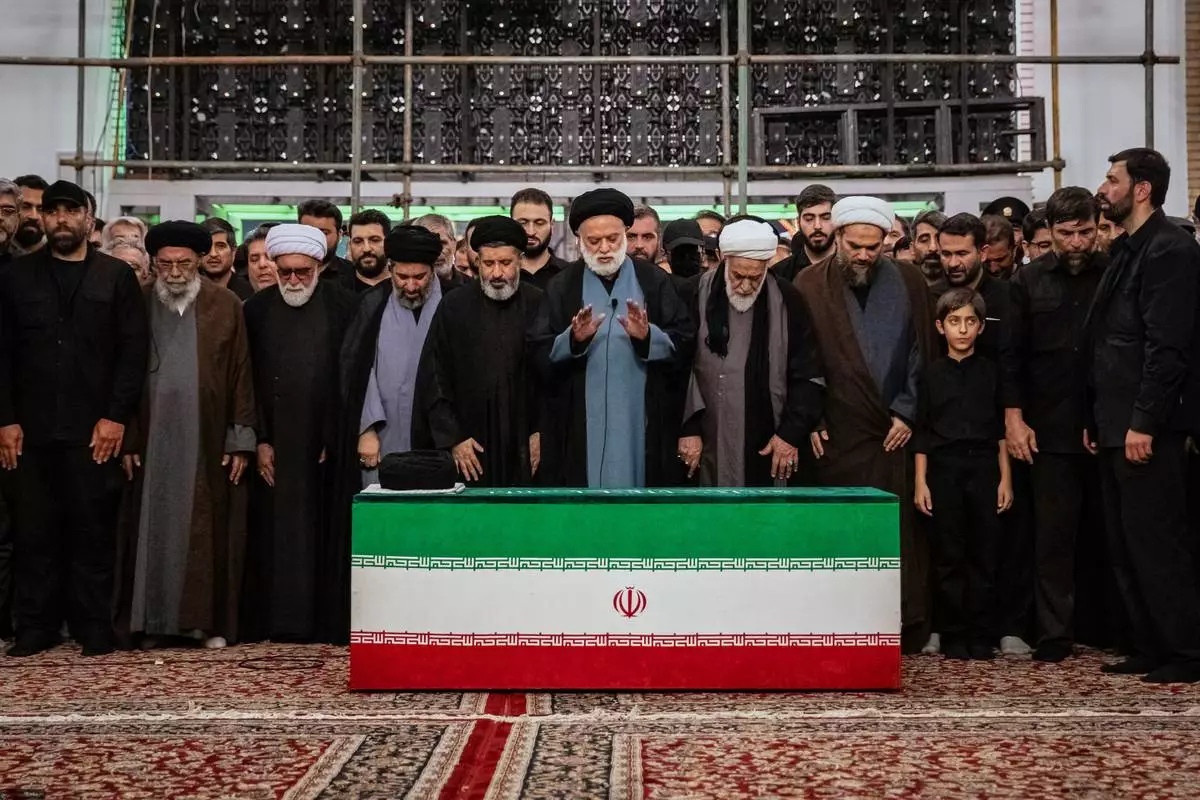
Mostafa Khamenei, center, brother of Iran's new Supreme Leader Mojtaba Khamenei, leads a prayer over the coffin of his late father, Iranian Supreme Leader Ayatollah Ali Khamenei before his burial at the Imam Reza Shrine in Mashhad, northeastern Iran, Thursday, July 9, 2026. (Office of the Iranian Supreme Leader via AP)
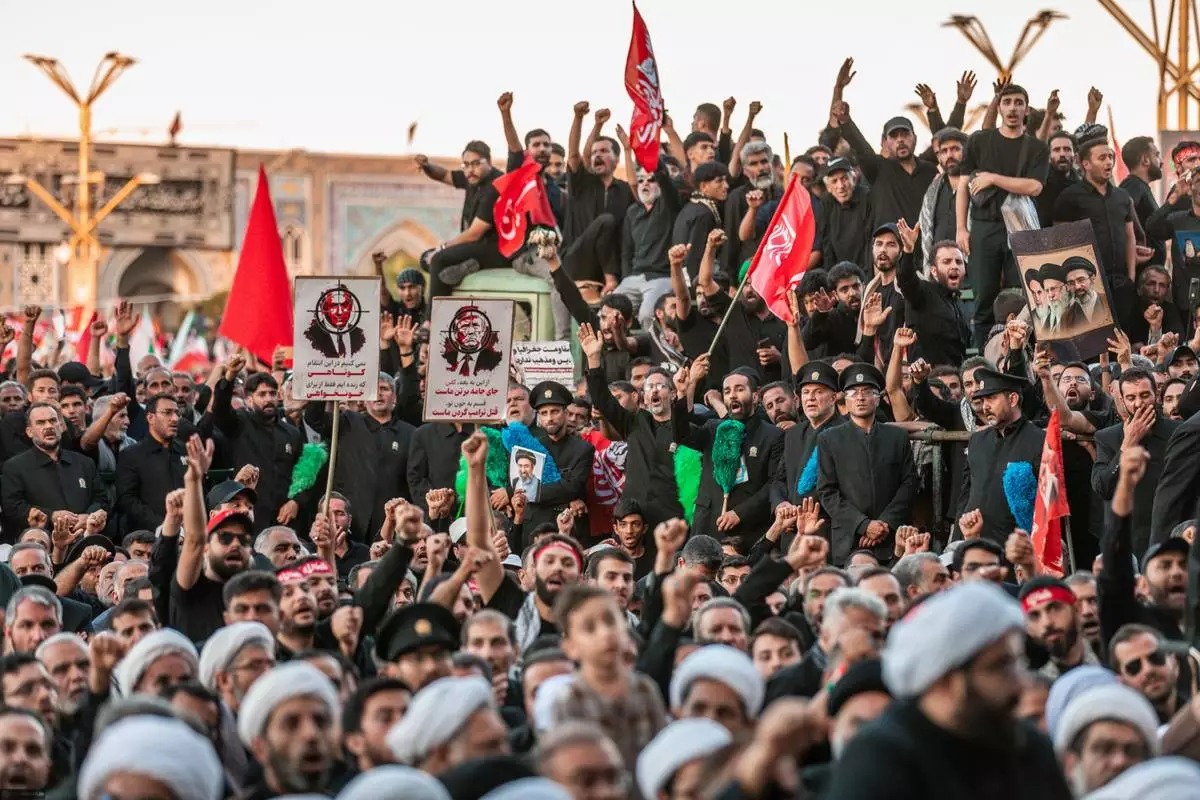
In this photo released by Iran's Supreme Leader's office, mourners chant and raise their fists during the final funeral ceremony for the late Iranian Supreme Leader Ayatollah Ali Khamenei at the Imam Reza Shrine before his burial in Mashhad, northeastern Iran, Thursday, July 9, 2026. (Office of the Iranian Supreme Leader via AP)
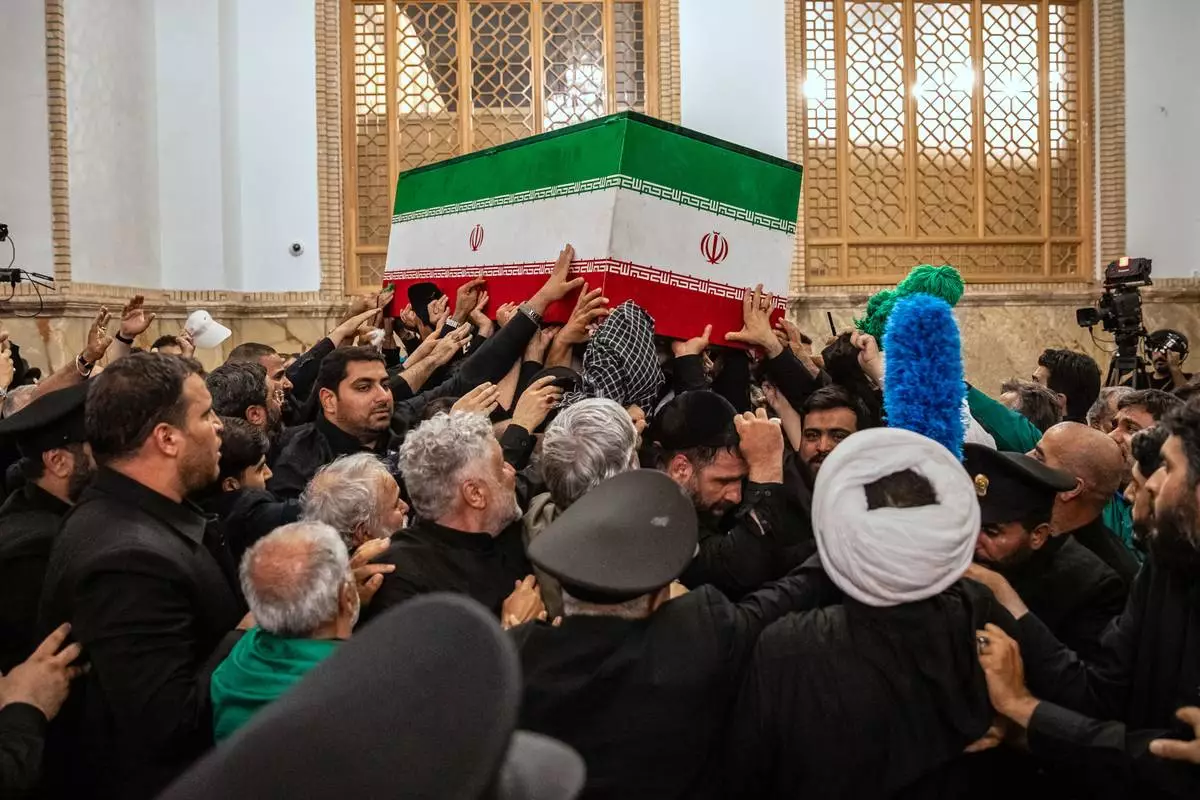
In this photo released by Iran's Supreme Leader's office, mourners carry the coffin of the late Iranian Supreme Leader Ayatollah Ali Khamenei above the crowd for the final prayer before his burial at the Imam Reza Shrine in Mashhad, northeastern Iran, Thursday, July 9, 2026. (Office of the Iranian Supreme Leader via AP)