BRUSSELS (AP) — Four countries hoping to join the European Union took important steps forward on their membership quests Tuesday, in one of the bloc’s biggest enlargement moves in more than 20 years.
Intergovernmental conferences were being held in Brussels to ceremonially open or close negotiating tracks for the top four candidates to join the 27-nation EU: Albania, Montenegro, Moldova and war-ravaged Ukraine. But it could still be years before any of them join.
“We have not seen this in more than two decades. The last time, it was in 2002. This is a Super Tuesday for EU enlargement and Ukraine is part of it,” Enlargement Commissioner Marta Kos told reporters.
While holding four meetings in one day is a rarity, 10 countries — most of them from central Europe — joined the EU in 2004. Croatia, the last country to be welcomed into the world’s biggest trading bloc, joined in 2013.
Tuesday’s move is a sign of the important political and geostrategic changes happening in Europe. In 2019, French President Emmanuel Macron insisted that he would block any attempt at enlargement until the EU itself had undergone deep reforms.
But Europe’s biggest land war in decades and its fallout have altered that calculus. The EU has sought to encourage reform in the candidate nations, fearing the growing influence of Russia and China.
Ukraine’s progress has been impressive. It only applied for membership in 2022, four days after Russia launched a full-scale invasion. Moldova too has been under heavy Russian pressure.
Ukraine sees EU membership as one “security guarantee” for a stable future once the war ends. Its best guarantee would be NATO membership, but the Trump administration insists that cannot happen, and other NATO members are wary of it joining while fighting continues.
European countries see the war as an existential threat, and fear that Russian President Vladimir Putin could target them in coming years, especially if he wins in Ukraine.
“The case for Ukraine’s EU membership is very strong,” Kos said.
“The future security architecture of our continent is unimaginable without Ukraine,” she said. “Ukrainians have turned their country into a military powerhouse with capabilities few other nations can match, especially with its rapidly evolving drone technologies.”
The prospect of EU membership is a powerful driver for pro-democratic reform, and joining has boosted trade and creates jobs, notably in the volatile Balkans region, where a series of wars in the 1990s tore apart the former nation of Yugoslavia. Most candidates for EU member are Balkan states.
Countries hoping to join the EU must complete negotiations in 35 policy areas, known as chapters, from agriculture to taxation and energy to trade. That process can take years.
Last month, Ukraine and Moldova opened negotiations on a cluster of five chapters linked to the values and principles on which the EU was founded, such as the rule of law, respect for fundamental rights and the functioning of democratic institutions.
They each opened a second cluster on Tuesday focused on foreign relations, security and defense policies, as well as trade policy, development cooperation and humanitarian aid.
Albania’s meeting will serve to provisionally close negotiating tracks on science and research, education and culture, and external relations. Montenegro – which hopes to join in 2028 – is doing the same with competition policy and customs rules.
An important factor that has led to the EU's new-found speed is a change of government in Hungary.
Ukraine’s accession process was long stymied by Hungary’s stridently nationalist former prime minister Viktor Orbán, who was considered Russia’s strongest ally in Europe and possible threat to the EU project. The candidacies of Ukraine and Moldova were linked and neither could progress.
But U.S. President Donald Trump's friend was ejected by voters in April in spectacular fashion after 16 years in power.
Orbán routinely exploited voting rules that require all 27 member countries to agree on certain rules, sanctions and even political statements. Unanimous agreement is required for each negotiating chapter to be opened, and then again for it to be closed.
Nine countries are officially candidates to join the EU: Albania, Bosnia, Montenegro, North Macedonia, Serbia, Georgia, Moldova, Ukraine and Turkey. Accession talks for Georgia and Turkey are on hold due to concerns about democratic standards.
Kosovo has also applied to join but has not been granted candidate status.
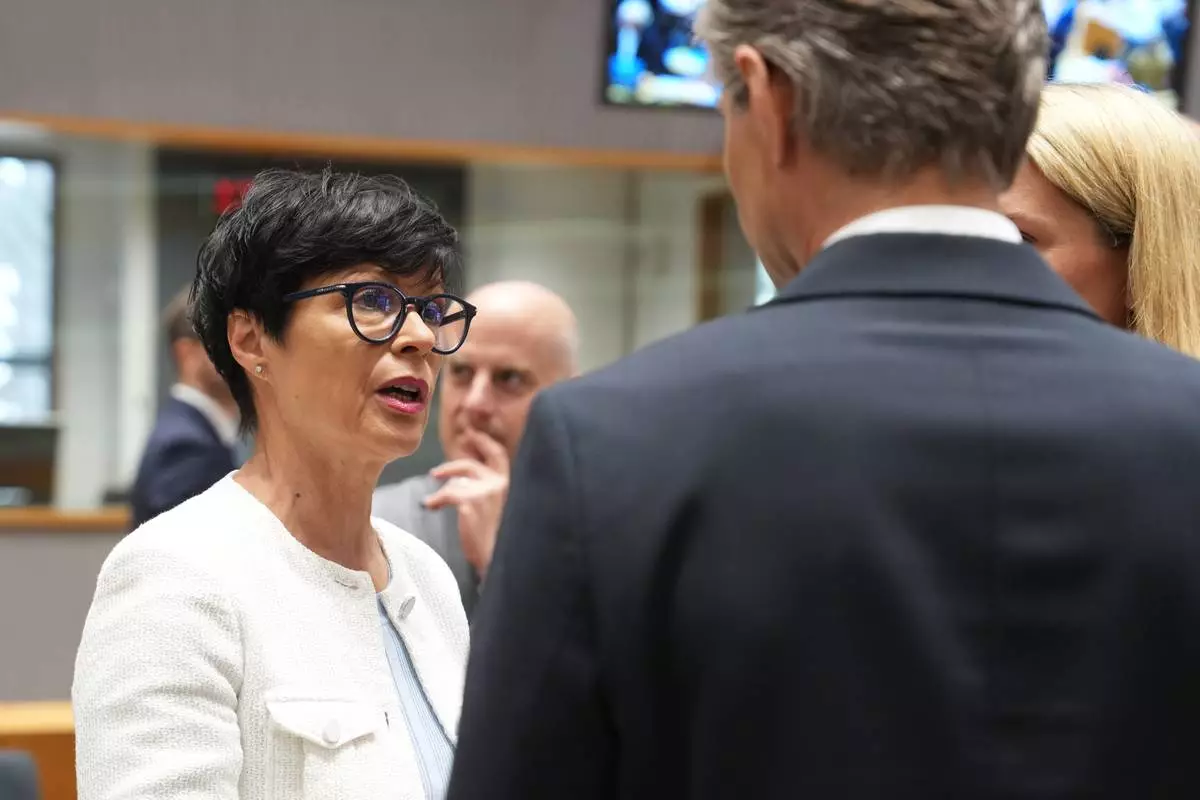
European Commissioner for Enlargement Marta Kos, left, speaks with Lithuania's Foreign Minister Kestutis Budrys, center, and European Union foreign policy chief Kaja Kallas, right, during a round table meeting of EU foreign ministers in Brussels, Monday, July 13, 2026. (AP Photo/Marius Burgelman)
LOS ANGELES--(BUSINESS WIRE)--Jul 14, 2026--
Lickly, an audience-first creator intelligence platform built for data-driven brands ready to scale repeatable marketing campaigns, today announced the appointment of Nita Patel as Chief Marketing Officer.
This press release features multimedia. View the full release here: https://www.businesswire.com/news/home/20260714722124/en/
As Lickly prepares for its broader public launch in early fall, Patel will lead brand strategy, product marketing, demand generation and go-to-market execution while using the platform to build Lickly itself. The approach will put Lickly’s intelligence model to work across its own audience strategy, creator selection, campaign planning and growth programs.
Patel brings more than two decades of enterprise technology marketing leadership, having held executive roles across AI, enterprise SaaS, intelligent automation and cybersecurity, where she has built brands, launched innovative products and led go-to-market strategies for both emerging companies and global tech leaders.
U.S. creator ad spending is projected to reach $37 billion, up 26% year over year and growing four times faster than the broader media industry, according to IAB data reported by Business Insider.
The money is moving because creators can deliver what traditional media struggles to match at the same speed — trust, relevance and distribution inside communities where people are already paying attention. But as more budget moves into the channel, the old operating model is starting to break. Most platforms still start with a list of creators. Lickly starts with the audience.
That shift is especially important as growth moves through nano and micro communities, where influence is more specific, more contextual and often closer to the buying decision. Smaller is not the strategy. Relevance is. A creator only becomes valuable when they carry credibility inside the audience a brand actually needs to reach.
Lickly was built for that shift. The platform helps mid-market brands understand which audiences are ready to move, which nano, micro and scaled creators can influence them, and which campaigns are worth repeating before more budget is spent. A list of influencers is still just a list unless there is intelligence to act on.
An engineer by training and a digital marketing leader by experience, Patel brings technical fluency, product discipline and growth instinct to Lickly. Her mandate is not only to market the platform, but to prove how an audience-first intelligence model can help a company move faster, stand out and scale in a category where many brands are still buying creator access without enough intelligence behind the decision.
“Brands do not need another static influencer list,” said Patel. “They need to understand where influence actually lives. Sometimes that is a scaled creator. Often it is a nano or micro creator with real trust inside a specific community. Lickly helps brands see that before they spend. We are going to build Lickly with Lickly and prove how audience-first intelligence turns creator marketing into a repeatable growth system.”
As Lickly prepares for its public launch, the company is applying the same audience intelligence principles across its own marketing, product strategy and customer acquisition — using the platform to validate its approach before bringing it to market at scale.
“Across our portfolio, we’re seeing major scale from brands that put audience intelligence first,” said Jeremy Barnett, co-founder of Lickly and CEO of parent company RAD Intel. “Those learnings shaped how we built Lickly's self-serve platform for mid-market teams that need to manage more creator programs without sacrificing strategic control. Creator marketing is growing because it brings trust, relevance and distribution into the same channel. The waste happens when brands confuse access with intelligence. The power is knowing which audiences are ready to move, which communities hold influence and which creators can activate them. Nita is the right leader to build Lickly with Lickly and show the market how this model scales.”
Patel’s appointment comes as Lickly prepares for its full public launch in early fall and continues building self-serve capabilities for data-driven mid-market brands. The platform is being built for teams ready to move beyond manual campaign management and toward a model where audience insight, creator selection, campaign learning and workflow automation work together.
“Self-serve SaaS only works when every campaign makes the next one smarter. That’s exactly how Lickly is designed,” added Patel. “That is the standard we are building toward. Lickly gives teams a way to make better decisions before spend happens, then use every campaign to improve the next one.”
About Lickly
Lickly, a RAD Intel company, is the audience-first influencer intelligence platform that helps brands understand audiences before selecting creators. By combining AI-powered audience intelligence, creator intelligence, predictive forecasting, brand safety and workflow automation, Lickly enables marketing teams to identify the right audiences, discover the creators who genuinely influence them and build more measurable, repeatable creator marketing programs. For more information, visit www.lickly.com.
About RAD Intel
RAD Intel is an AI marketing holding company built around a shared intelligence layer, with a portfolio that includes RAD Amplify (enterprise managed services) and Lickly (SaaS for mid-market operators). RAD Intel is backed by multiple institutional funds and was selected by the Adobe Fund for Design. For more information, visit www.radintel.ai.

Lickly appoints Nita Patel as Chief Marketing Officer.