TAGUIG CITY, Philippines, July 15, 2026 /PRNewswire/ -- For the second consecutive year, Globe has been recognized in TIME and Statista's World's Most Sustainable Companies 2026, becoming the only Philippine telecommunications company included in the global ranking and one of only two Philippine companies recognized this year, underscoring its commitment to responsible business practices and long-term value creation.
Selected from more than 5,000 of the world's largest and most influential companies, the ranking evaluates organizations across more than 20 key performance indicators in a four-step process covering sustainability criteria: Sustainable Business, Commitment and Ratings, Reporting and Transparency, and Environmental and Social Stewardship. The final list recognizes the top 750 companies worldwide.
Globe's inclusion reflects more than a sustainability milestone. The recognition places Globe alongside many of the world's most respected companies, reinforcing that Philippine businesses can compete globally on sustainability, transparency, and responsible governance. As sustainability stands as a vital benchmark for investors, customers, regulators, and communities, recognitions such as these demonstrate that Philippine businesses can meet the same standards of accountability and long-term thinking expected of leading global organizations.
"Earning a place on this global ranking shows that Philippine companies can meet the highest global standards for sustainability, transparency, and responsible governance," said Carl Cruz, President and CEO of Globe. "Our sustainability practice continues to strengthen, it has become a measure of how we build trust, create long-term value, and remain competitive in a rapidly changing world."
The recognition comes at a time when sustainability is increasingly viewed as a measure of corporate trust. Beyond environmental performance, the ranking evaluates companies on factors such as governance, transparency, accountability, external ratings, and social impact. These are the same qualities that shape confidence among customers, investors, regulators, employees, and communities. As expectations continue to evolve, trust is no longer built solely through products and services, but through how organizations create value, manage risks, and deliver on their commitments over the long term.
Globe's inclusion in the ranking reflects its commitment to responsible business practices and measurable outcomes. Through its decarbonization strategy, the company achieved a 15.13% year-on-year reduction in gross Scope 1 and 2 greenhouse gas emissions and a 9.49% reduction in gross Scope 3 emissions, outpacing its annual reduction target of 4.2% for Scope 1 and 2 and 2.5% for Scope 3. Most recently, it has also expanded its use of renewable energy, transitioning approximately 700 sites as of end-May 2026 and targeting at least 3,000 sites by 2028 as part of its broader sustainability agenda.
As businesses navigate growing expectations around environmental, social, and governance performance, Globe continues to integrate sustainability into the way it operates, invests, and serves its stakeholders. The recognition from TIME and Statista reinforces the company's belief that sustainable growth and trusted leadership go hand in hand.
ABOUT GLOBE
Globe Telecom, Inc. is a leading digital platform in the Philippines with interests in telecommunications, fintech, venture building, shared services, and digital marketing. It is listed on the Philippine Stock Exchange under the symbol GLO. The company delivers a full suite of mobile, broadband, data, and managed services to meet the needs of consumers and businesses. A UN Global Compact Participant, Globe is the first publicly listed Philippine firm with approved near- and long-term science-based targets under the SBTi. It was named one of TIME and Statista's Most Sustainable Companies in 2026. Its back-to-back inclusion in the Fortune Southeast Asia 500 in 2024 and 2025 affirms its growth and leadership. Its principals are Ayala Corporation and Singtel, prominent industry leaders in the region.
** This press release is distributed by PR Newswire through automated distribution system, for which the client assumes full responsibility. **

Globe Bags Back-to-Back Recognition in TIME's World's Most Sustainable Companies, Remains Only Philippine Telco on Global List
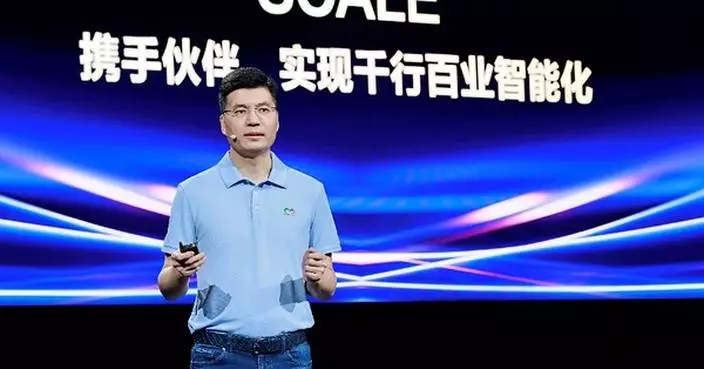
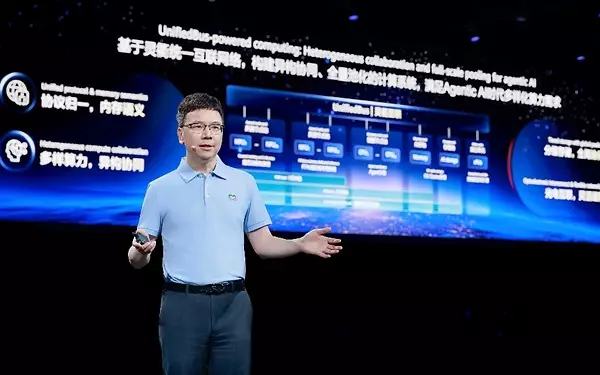
SHANGHAI, Sept. 21, 2026 /PRNewswire/ -- In a keynote speech on computing architecture innovation at HUAWEI CONNECT 2026, Yang Chaobin, Huawei's Executive Director of the Board and CEO of the ICT Business Group, unveiled new details about the UnifiedBus interconnect architecture, announced a series of computing products based on this architecture, and explained how the company has collaborated with open-source communities to enable application innovation by customers, partners, and developers.
In a traditional computing architecture, resource utilization declines as a cluster scales. As little as 20% of a 100,000-NPU cluster's computing capacity is actually utilized by models, with a vast amount of compute sitting idle during data communications. A 10 trillion-parameter model, which requires massive amounts of intermediate data to train, far exceeds the capacity of the memory on a single accelerator under traditional architectures. Interconnection and communications between components within a cluster have become a key performance bottleneck for computing systems.
According to Yang, Huawei's solution to this bottleneck is its new computing architecture, powered by the interconnect technology called UnifiedBus, which facilitates collaboration between clusters and SuperPoDs. This architecture has been designed to support the boom in compute demand that is emerging as new agentic applications hit the market. UnifiedBus-powered computing systems have four key features:
- Unified protocol and memory semantics: More than ten interconnect protocols have been combined under the UnifiedBus protocol, which increases interconnect bandwidth from 100 GB/s level to TB/s level and reduces round-trip time (RTT) latency from 7 microseconds to 2 microseconds. This protocol also enables unified global memory addressing within SuperPoDs.
- Heterogeneous compute collaboration: UnifiedBus directly interconnects CPUs, NPUs, memory, and solid-state drives (SSDs) to enable decentralized, peer-to-peer access between them and flexible CPU-NPU mixing. In addition, tiered hardware acceleration for Transformer enables Attention-FFN disaggregation (AFD).
- Tiered storage with global pooling: UnifiedBus uses hybrid-media resource pooling to support the caching of activations. Double Data Rate (DDR) memory serves as the alternative memory for NPUs, reducing latency for search, recommendation, and advertising services, and doubling the performance of vector retrieval for 100 billion-level data items with thousands of dimensions. This also reduces the per-NPU HBM capacity requirements for the training of 10 trillion-parameter models, and improves cluster model FLOPs utilization (MFU).
- Optoelectronic interconnect and flexible networking: UnifiedBus serves as a global ultra-high bandwidth, ultra-low latency "data highway", enabling flexible scaling of compute.
Yang then moved on to unveil Huawei's newest UnifiedBus interconnect products that cover interconnection within cabinets, between cabinets, and across clusters. This enables elastic scaling from a single cabinet to a million-NPU cluster.
- Within cabinets, the UnifiedBus LinkBlade eliminates circuit losses with a cable-free design, which reduces copper cabling within a 4,096-NPU SuperPoD by about 196 kilometers.
- Between cabinets, the UnifiedBus LinkDevice supports 176 ports, with 1.6 Tbit/s bandwidth per port, delivering 280 Tbit/s all-optical interconnection. This is the industry's highest-bandwidth, highest-port-count high-speed bus-protocol interconnect device, with an RTT latency as low as 2 microseconds.
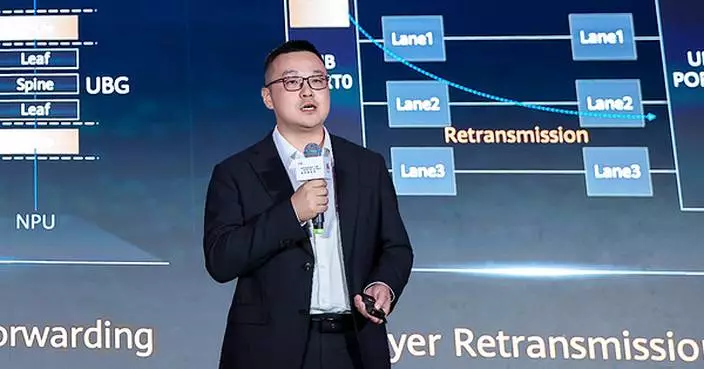
- Across clusters, the UnifiedBus UBG switch provides a massive radix fan-out capacity of up to 1,024, meaning it can support a million-NPU SuperCluster and evolution towards supporting tens of trillions of model parameters.
Yang also launched Huawei's UnifiedBus-powered agentic AI SuperCluster, which is comprised of TaiShan 950 and Atlas 960 SuperPoDs, OceanStor M900 memory storage, and a Xinghe UBG switch. This cluster enables diverse compute collaboration and tiered resource pooling.
Beyond SuperPoDs, Huawei has also applied the UnifiedBus technology to its compute appliances. The company has developed a new series of UnifiedBus-based appliances (supporting one to eight NPUs) and Kunpeng and Ascend modules, which enable small and medium-sized enterprises to run trillion-parameter models locally.
On the ecosystem front, Yang said that Ascend is collaborating with open-source frameworks like DeepSeek Harness, OpenCode, and openJiuwen to develop fully open-source intelligent management, inference acceleration, and security framework agent plugins.
Yang promised, "Huawei is committed to innovating at the system level, building a computing-foundation product portfolio, and going open source and open system. We will continue working with customers, partners, and developers to help this ecosystem thrive and offer the world a new option for compute."
** This press release is distributed by PR Newswire through automated distribution system, for which the client assumes full responsibility. **
Huawei Unveils New UnifiedBus Computing Architecture for SuperPoDs and Clusters