Typhoon Bavi has unleashed torrential rains in northeast China's Jilin and Liaoning provinces, triggering floods and swelling rivers, with firefighters racing against time to rescue stranded residents.
Typhoon Bavi, the ninth of the year, made landfall twice along the coast of east China's Zhejiang Province at 23:20 Saturday and again around midnight, then moved inland. It is the second typhoon this month following Typhoon Maysak, which brought heavy floods and wreaked havoc in southern China.
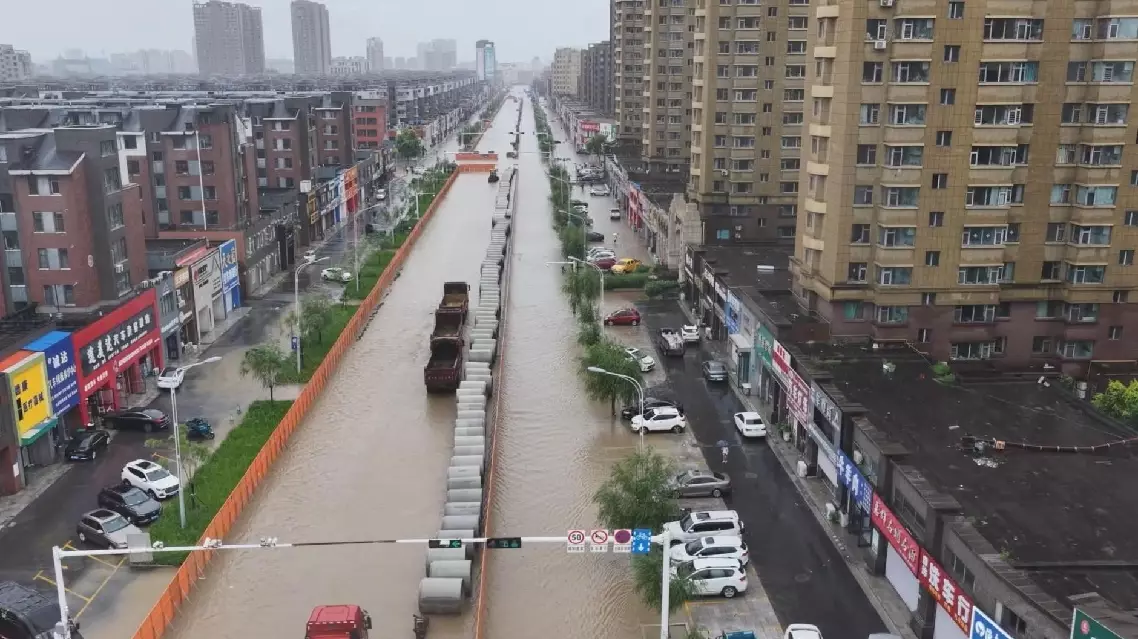
Due to the impact of Typhoon Bavi, Meihekou City in Jilin has experienced heavy rainfall since early morning on Monday, with river levels rising and urban waterlogging. At 11:15 that day, the city raised its flood control emergency response from Level II to Level I. Local authorities have organized the evacuation of residents along riverbanks and carried out drainage operations in flooded areas to ensure public safety.
In low-lying areas prone to flooding, local power departments have deployed mobile pumping equipment for round-the-clock drainage, and have set up flood barriers and sandbags to protect electrical facilities, ensuring power supply for nearly 20,000 households in the areas.
Affected by rainfall and upstream water convergence, the Huifa River, which flows through Meihekou, has remained at high water levels and is currently 0.79 meters above the safety water level. Local authorities have issued notices warning of possible major dike breaches. As a result, nearly 7,000 residents along the Huifa River have been relocated to safe places.
"We have medical teams from the health department here. We arranged groupings on each floor, and have volunteers and staff there to ensure that when people need help, someone will respond immediately," said Shan Lili, head of an emergency shelter in Meihekou City.
In Shenyang City of Liaoning, heavy rainfall flooded residential communities, prompting emergency evacuations by firefighters.
Early Tuesday morning, a community in Hunnan District was surrounded by floodwaters. An elderly resident fell ill and needed urgent hospital care. Firefighters rushed to the scene in a rubber boat. Guided by the patient's family, they waded into the apartment, where water had already risen above shins.
The elderly man was conscious but unable to move. Firefighters carefully carried him through water onto the rubber boat, along with his family members. Due to severe road flooding, the man was eventually transferred to a fire truck and taken to a hospital for emergency treatment.
Firefighters then continued to search the community. By around 2:00, all trapped residents had been safely evacuated.
Fire crews resumed rescue operations the following day and successfully evacuated more stranded residents.
Rescue operations are still underway in the affected areas.
Typhoon Bavi triggers emergency evacuation in northeast China
Artificial intelligence is reshaping the world at an unprecedented pace, from production and office work to daily essentials. For young people, AI is not merely a tool but also a companion, though it carries hidden risks.
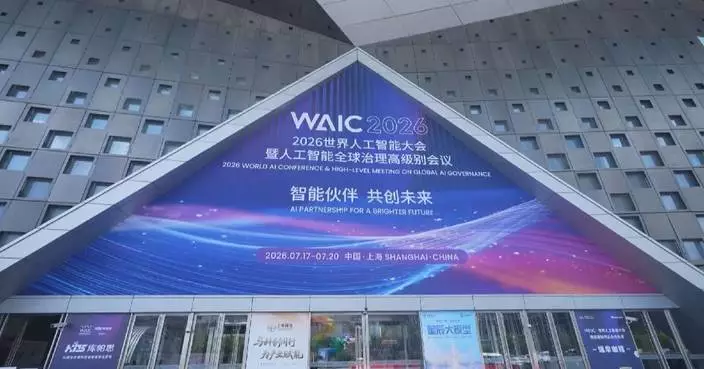
On the eve of the 2026 World Artificial Intelligence Conference (WAIC), voices from the streets reveal a generation grappling with where the red lines of AI development lie.
Many young people see AI as an invaluable partner in daily life. They praise its efficiency in handling repetitive tasks and its ability to deliver quick, reliable results.
"I think it's a best colleague, especially for some low-efficiency, repetitive things. It can help you achieve relatively high returns in a very short time. I think the current AI is already quite high-level, and it can be rated as a fairly outstanding colleague," said Xu Yuanchun, a Shanghai resident.
"I think it's a best workmate, because in my daily life now, the AI user experience is quite good. Sometimes, for example, when I travel, I'd ask it to make an itinerary. Also for medical matters that I don't understand, I ask and it gives feedback. It's much more convenient than before," said Jin Yichun, another Shanghai resident.
When asked about the most important red line that AI development must hold, Yuan Luming, a student at the School of International Relations and Public Affairs at Fudan University, emphasized that AI is ultimately a technology, and technology must serve humanity.
"I think AI is ultimately a technology, so technology must ultimately serve people. The connections, communication, and emotions between people are things that AI cannot replace. So I think technology cannot ultimately replace human beings, and people must not fade away amid technological development. I think we must firmly uphold the bottom line of putting people first," she said.
Regarding the governance cooperation outcomes expected from this year's WAIC, Zhao Tongyang, founder and chief executive officer of Yuanmeng Intelligence, expressed hope for two key results.
"For this artificial intelligence conference, regarding new global AI governance, the outcomes I most hope for are, first, how to achieve multilateral win-win and create a better co-creation and symbiotic ecosystem. The second is that the cross-border inclusive benefits of AI can be better realized under a cross-platform open-source governance structure, so that a new mechanism will be established to encourage innovation while developing new standards along the way," she said.
2026 World AI Conference and High-Level Meeting on Global AI Governance will be held in Shanghai from Friday to Monday.
Themed "AI Partnership for a Brighter Future," the event will include more than 140 forums, bringing together 1,400 guests from home and abroad, while featuring six sections: Conferences and Forums, Exhibitions and Showcases, Awards and Competitions, Application Experiences, Innovation Incubation, and Talent Attraction.
AI development should embrace future while holding bottom-line: young people