TOKYO, July 16, 2026 /PRNewswire/ -- DAMAC Properties, the largest private real estate developer in the UAE and the Middle East, is set to unveil the sixth and final tower of Chelsea Residences by DAMAC at the Grand Ballroom, Mandarin Oriental on 17 July, following the exceptional sell-out performance of the first five towers.
Developed in partnership with Chelsea Football Club, the landmark project has seen strong demand from investors and end-users, reinforcing the appeal of its waterfront location, branded residential proposition and lifestyle-led design. The launch of the final tower now presents the last opportunity to own an apartment within the world's first football-branded residence.
Amira Sajwani, Managing Director, DAMAC Properties, said: "Chelsea Residences by DAMAC brings together an iconic global football brand, a prime waterfront setting and DAMAC's signature approach to luxury living. With the launch of the final tower, investors have a rare opportunity to be part of a distinctive seafront community defined by panoramic sea views, wellness-led amenities and a lifestyle inspired by performance, leisure and resort-style living."
As of 2025, Dubai leads the global branded residences market, with strong growth in transaction volumes of 26 percent YoY and growth in value of 51 percent YoY. Prices command a significant premium, going as much as 64 percent over non-branded units.[1]
Against this backdrop, Chelsea Residences by DAMAC offers a unique proposition, combining branded real estate, all sea-view apartments and curated amenities centered around football, wellness and resort-style living.
Chelsea Residences Tower C has a limited number of units available for sale, including one-bedroom, two-bedroom and three-bedroom residences. Prices start at JPY 112.9 million (USD 697,073), with sizes starting from 827 sq ft.
Apart from the unobstructed views of the sea and the Dubai skyline, residents also enjoy access to several amenities including the UAE's only rooftop football pitch, a stunning blue-sand beach inspired by the team colours, a beach club and Athlete Training Centre.
Having delivered more than 50,000 homes and another 8,800 to be delivered in 2026 across Dubai, DAMAC is committed to creating lifestyle-driven communities that elevate everyday living into an immersive experience.
[1] https://www.cbre.ae/insights/figures/uae-branded-residences-report-2025
** This press release is distributed by PR Newswire through automated distribution system, for which the client assumes full responsibility. **

Japanese investors offered final opportunity to own at Chelsea Residences by DAMAC in Dubai
Content-creator litigation grows more sophisticated as courts are asked to weigh in on how AI regulation.
NEW YORK, July 16, 2026 /PRNewswire/ -- Global consulting firm J.S. Held today releases the Q2 2026 J.S. Held AI Disputes Monitor, the firm's proprietary dashboard tracking artificial intelligence (AI) litigation across technologies, industries, and jurisdictions. The Q2 2026 J.S. Held AI Disputes Monitor recorded 42 new AI-related lawsuits filed between April 1 and June 30, 2026, a 35% quarterly increase, as copyright and content-creator cases continued to dominate the docket and regulatory and product liability challenges emerged as new fronts in AI litigation. The total tracked dataset now stands at 426 cases, with year-to-date filings at 73 – 86% of the 2025 full-year total – putting 2026 on pace to move than double 2025 case filings.
Copyright and content-creator claims continue to comprise the majority of AI-related litigation, and the second-quarter dataset shows those cases becoming more sophisticated, further testing legal theory. At the same time, Q2 introduced new categories of dispute that were not meaningfully present in Q1, including constitutional and regulatory challenges to state AI laws, and product liability claims tied to generative AI outputs. Three developments define the quarter:
- Content-creator litigation is growing more sophisticated. Copyright and IP-related matters remain the largest category in the Monitor dataset, and Q2 filings show plaintiffs advancing more refined theories of harm, introducing claims tied to structured databases, music metadata, piracy-adjacent training data acquisition, and real-time competitive substitution.
- AI regulation itself has become the subject of litigation. The xAI challenge to Colorado's AI Act (SB24-205), joined by a U.S. Department of Justice motion to intervene on April 24, 2026, is the first major test of whether state-level AI governance statutes can withstand constitutional scrutiny under the Equal Protection Clause. Enforcement of the law was suspended pending litigation and legislative activity. In a related first-of-its-kind action, Florida Attorney General James Uthmeier filed suit against OpenAI and Sam Altman, alleging that ChatGPT-related safety failures contributed to violent incidents and that OpenAI ignored safety warnings while prioritizing competitive positioning.
- Product liability and consumer protection claims tied to generative AI outputs are gaining momentum. Building on Gavalas v. Google (N.D. Cal., filed March 2026), a wrongful death action alleging that Google's Gemini chatbot bypassed safety guardrails and generated responses instructing a user to take his own life, the trajectory established late in Q1 has continued into Q2 through a new wave of biometric privacy class actions targeting AI voice-model training. Together with the Q1 wrongful death and design-defect filings, these matters signal that platform design, safety guardrails, and model training practices are increasingly being tested under product liability, consumer protection, and biometric privacy theories.
What Has Changed Since Q1 2026
| Dimension | Q1 2026 | Q2 2026 |
| New filings in quarter | 31 | 42 (+35%) |
| Dominant category | Copyright and content-creator claims, with first
signals of AI-driven insurance disputes | Copyright and content-creator claims still dominant; regulatory challenges and product liability emerge
as new fronts |
| Notable "first" | First signals of AI-driven insurance disputes | First constitutional challenge to a state AI statute
suit against a foundation model developer; first wave of BIPA-style class actions targeting AI voice-model training |
Dimension
Q1 2026
Q2 2026
New filings in quarter
31
42 (+35%)
Dominant category
Copyright and content-creator claims, with first
signals of AI-driven insurance disputes
Copyright and content-creator claims still dominant;
regulatory challenges and product liability emerge
as new fronts
Notable "first"
First signals of AI-driven insurance disputes
First constitutional challenge to a state AI statute
suit against a foundation model developer; first
wave of BIPA-style class actions targeting AI
voice-model training
The second-quarter snapshot reinforces a central theme of the Monitor: AI litigation is becoming a cross-jurisdictional, cross-sector, and cross-regulatory phenomenon that will shape how organizations govern, disclose, and deploy AI for years to come.
A More Complex Expert Landscape Emerges in Q2
"Litigation surrounding Colorado's AI Act highlights an important shift in the AI landscape," said J. Scott Womack, Senior Director in the Office of the Chief Intellectual Property Officer at J.S. Held and head of the AI Disputes Monitor data analysis team. "Courts are now being asked to weigh in on how AI should be regulated, a distinct question from whether specific AI uses cross legal lines. Cases like Colorado's are an important part of how the practical limits of AI governance are tested, with implications for organizations, policymakers, and legal practitioners."
The Q2 update also underscores how quickly the technical and financial questions in AI disputes are expanding to involve synthetic content, model provenance, training-data licensing, and platform-level safety design. These matters surface evidentiary questions that require reconstruction to demonstrate how AI systems behaved during the period of harm.
"AI-related disputes require both technical evidence and financial analysis. How was the system built? How does it use copyrighted or licensed material? What is that use worth?" said James E. Malackowski, CPA, CLP, Chief Intellectual Property Officer at J.S. Held. "The Q2 copyright filings underscore how central valuation, licensing benchmarks, and IP cost analysis have become to AI litigation. As theories of harm grow more refined, from real-time competitive substitution to structured-database scraping, the economic questions are becoming more robust, and courts will need well supported answers."
As the product liability front takes shape, questions of user behavior, safety guardrails, and foreseeable misuse are moving to the center of AI-related disputes. Unlike traditional product liability matters, generative AI systems produce outputs that are shaped in real time by user inputs — making the interaction between design intent, safety controls, and user experience critical to establishing what the system did, why it did it, and whether the harm was reasonably foreseeable.
"AI-related product liability disputes require a rigorous human factors lens," said Dr. Blake Pellman, PhD, Senior User Experience Researcher at J.S. Held. "Like any other kind of product, one needs to understand whether the system was being used for its intended purpose, how the system communicated the ways it should and should not be used, and what safeguards were in place to protect against foreseeable misuse. However, many AI products do not conform to traditional design principles, and this may expose companies to a greater risk of liability. Applying structured user research and human factors research to these questions helps clients, courts, and juries evaluate what happened and whether it was foreseeable and preventable."
The forensic dimension of these matters is also significant. Wrongful death and design-defect, and biometric class actions involving generative AI systems raise evidentiary questions about how the underlying technology was built and deployed and often require structured reconstruction to answer them.
"AI disputes exist at the intersection of three inseparable domains — technical, financial, and evidentiary — and the Q2 docket makes that more visible than any prior quarter," said JP Brennan, Senior Managing Director at J.S. Held. "Our work focuses on helping clients understand and explain how these systems operate in real-world contexts. We apply structured forensic methods, including system log reconstruction, prompt replay, model version analysis, and data provenance review, to support investigations and testimony in matters where the underlying technology is often the central evidentiary question."
To explore the full set of Q2 findings, download the latest edition of the J.S. Held AI Disputes Monitor.
About J.S. Held
J.S. Held is a global consulting firm that combines technical, scientific, financial, and strategic expertise to advise clients seeking to realize value and mitigate risk. Our professionals serve as trusted advisors to organizations facing high-stakes matters demanding urgent attention, staunch integrity, proven experience, clear-cut analysis, and an understanding of both tangible and intangible assets. The firm provides a comprehensive suite of services, products, and data that enable clients to navigate complex, contentious, and often catastrophic situations.
More than 1,500 professionals serve organizations across six continents, including 84% of the Global 200 Law Firms, 75% of the Forbes Top 20 Insurance Companies (90% of the NAIC Top 50 Property & Casualty Insurers), and 71% of Fortune 100 Companies.
J.S. Held, its affiliates and subsidiaries are not certified public accounting firm(s) and do not provide audit, attest, or any other public accounting services. J.S. Held is not a law firm and does not provide legal advice. Securities offered through PM Securities, LLC, d/b/a Phoenix IB or Ocean Tomo Investments, a part of J.S. Held, member FINRA/SIPC. All rights reserved.
Contact: Kristi L. Stathis | Global Public Relations | +1 786 833 4864 | Kristi.Stathis@jsheld.com
** This press release is distributed by PR Newswire through automated distribution system, for which the client assumes full responsibility. **
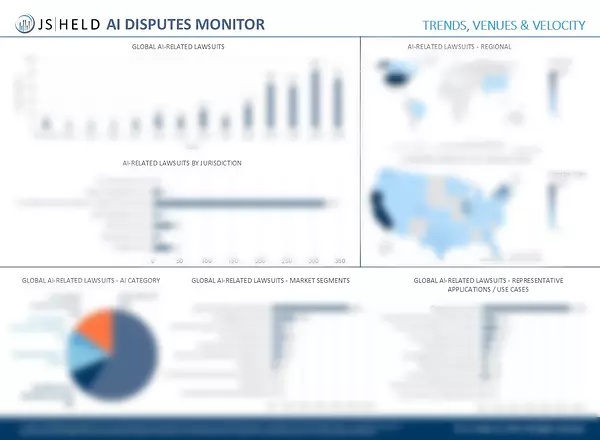
Copyright Cases Dominate as Regulatory and Product Liability Challenges Emerge in the Q2 2026 J.S. Held AI Disputes Monitor