A new home for giant pandas is set to welcome its first human visitors on Thursday, with this facility offering the fluffy national treasures a smarter, roomier and more nature-like living haven as the zoo celebrates its 120th anniversary this year with the landmark project.
Unveiling a 13,000-square-meter state-of-the-art facility, Beijing Zoo has blended wilderness-inspired design with cutting-edge technology to create a sprawling pavilion that features four indoor exhibition halls, five animal enclosures and five outdoor exercise areas.
The pavilion recreates wild habitat elements with undulating terrain and simulated stream systems, allowing pandas to move freely between indoor and outdoor areas, said Lu Yanping, deputy head of the zoo.
Fixed perches, along with movable enrichment items such as tires and balls, have been installed, Lu added.
"After arriving at their new home, the pandas have been playing and exploring. They've settled in well and are clearly enjoying themselves," said Lu.
As China's first giant panda venue with the highest three-star green building rating, the pavilion sets a new benchmark for eco-friendly facilities of its kind. Adopting environmentally friendly building materials for its exterior facade, the venue is fitted with intelligent temperature control and fresh air ventilation systems. A tailored smart management system integrates security monitoring, health tracking and automatic environmental regulation, while a dedicated timed spray cooling system has also been installed to help pandas beat the summer heat.
The first five residents, Meng Lan, Bai Tian, Ji Nian, Fu Jiang and Fu Xing, have already settled in and are adapting well.
Beijing Zoo, founded in 1906, was China's first public zoo open to visitors. It began keeping giant pandas in 1955 and built dedicated panda halls for the 1990 Asian Games and the 2008 Beijing Olympic Games. Currently, the zoo is home to 10 giant pandas.
Following the opening of the new pavilion, the adjacent Asian Games panda hall will jointly host public exhibitions, while the Olympic panda hall will temporarily serve as a backup resting area for pandas. A rotational exhibition system will be implemented, meaning visitors may encounter different fluffy panda stars on each visit, bringing fresh surprises every time.

Giant pandas move into new home at Beijing Zoo

Giant pandas move into new home at Beijing Zoo
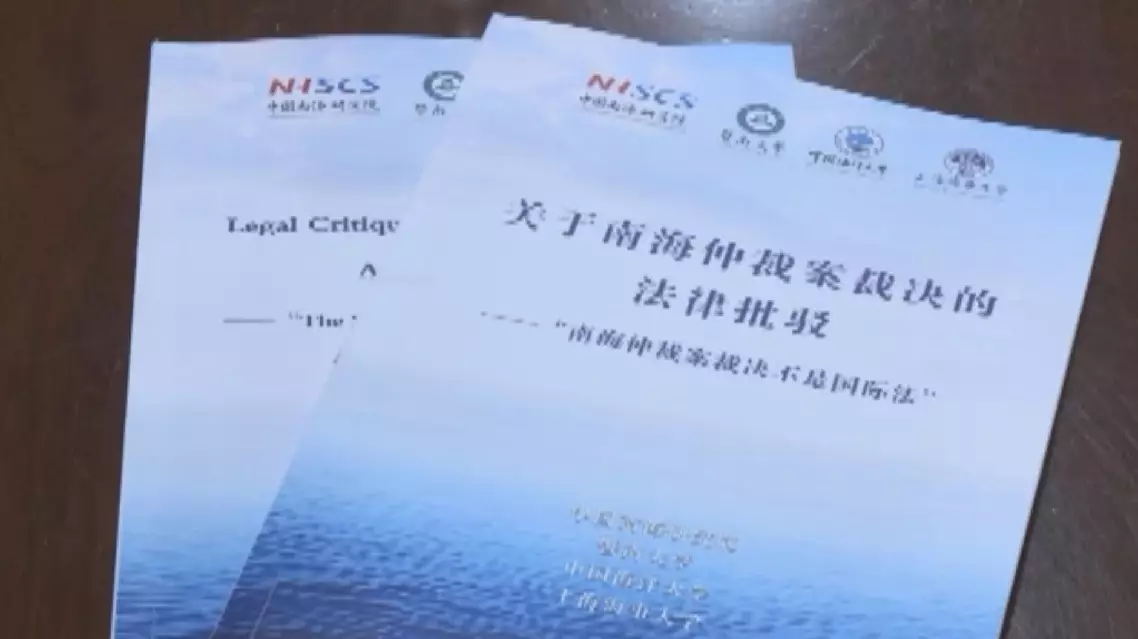
The so-called "South China Sea arbitration awards" run counter to the international judicial practice, according to a report released on Thursday.
The report, titled "Legal Critique of the South China Sea Arbitration Awards -- 'The South China Sea Arbitration Awards Are Not International Law'," was penned by scholars from the National Institute for South China Sea Studies, Jinan University, Ocean University of China, and Shanghai Maritime University.
The report presents its analysis along three main threads -- arbitral jurisdiction, the application of substantive rules, and the validity of the awards.
Many scholars pointed out that jurisdictional issues are the first problem to emerge in this case and also the most decisive legal obstacle.
"In fact, the way the Philippines packaged the dispute was a key prerequisite for the arbitral tribunal to overstep its authority in accepting the case. The report lays bare the entire process by which the Philippine side, through carefully crafted rhetoric, framed territorial issues and maritime delimitation disputes as issues that could be interpreted under the Convention (the United Nations Convention on the Law of the Sea). In essence, this is a sleight of hand that disguises sovereignty and maritime delimitation disputes as legal and technical issues," said Xu Qi, assistant dean in the School of Law of Jinan University.
According to the report, the arbitral tribunal's substantive hearing also exhibited serious systemic errors. Moreover, the "awards" were delivered by a makeshift "arbitral tribunal" without jurisdiction. They contained fundamental flaws in the application of law, and have no validity under international law from the outset.
"These arbitrators were all previously academics. But in this case, they acted more like politicians. In the 'South China Sea arbitration case', they had in fact abandoned their academic independence and respect for the law, and had instead become tools of political maneuvering. This is something we absolutely cannot accept," said Zhou Yong, vice president of the National Institute for South China Sea Studies.
The report wraps up by exploring how to settle the South China Sea issue. Scholars emphasized that consultation and negotiation is the right way forward.
"Through the release of this report, we also hope that more countries, especially the international community, will better understand the illegal nature of the 'South China Sea arbitration awards.' The 'awards' cannot be used to resolve the South China Sea issue, nor are they of any help in doing so. Therefore, we should properly return to the 'dual-track approach' -- that is, on the one hand, we set aside disputes, and on the other hand, we promote the peaceful resolution of the South China Sea issue through consultation and negotiation," Xu said.
South China Sea arbitration awards run counter to international judicial practice: report