China's 2026 interim earnings season has officially begun to offer an early snapshot of corporate performance and broader economic trends in the first half of 2026, with the first one released Wednesday.
The first report, released by a Shenzhen-listed chemical company, showed operating revenue of 1.33 billion yuan (about 196.48 million U.S. dollars) in the first half of the year, up 7.87 percent year on year. Net profit surged 103.87 percent to 82,586,300 yuan.
All A-share listed companies are scheduled to publish their full interim reports by August 31.
Meanwhile, earnings forecast disclosures have entered a peak period. As of 17:00 Wednesday, a total of 1,668 A-share listed companies had released performance forecasts for the first half of 2026. Of them, 902 companies expect year-on-year net profit growth, while 181 others anticipate turning losses into profits. More than half of the reporting firms forecast profit increases.
From an industry perspective, companies in such areas as artificial intelligence (AI) computing power, commercial aerospace, electronic manufacturing, chemicals and nonferrous metals, and new energy reported particularly strong expected growth.
"Hard-tech sectors, such as memory chips and fiber-optic communications, have posted sharp profit increases due to rising product prices and expanding market demand, fully demonstrating their growth potential. At present, under the dual drivers of policy guidance and market demand, hard technology and high-end manufacturing are becoming key engines of earnings growth, with the results of China's economic structural adjustment gradually becoming evident," said Tian Lihui, an academic committee member of the China Capital Market Society.
While tech and green energy sectors caught the spotlight, analysts noted traditional blue-chip sectors, including finance, non-ferrous metals and energy, have demonstrated strong resilience and anchored the overall profitability of the A-shares market.
"The AI industrial chain and hardware equipment are experiencing rapid growth. The green and low-carbon sectors remain highly active. Traditional sectors, such as chemicals and non-ferrous metals, are now deeply integrated with the new energy supply chain and have shown the global competitive advantage of Chinese manufacturing under the dual carbon goals [of peaking carbon dioxide emissions before 2030 and achieving carbon neutrality before 2060]," said Fan Wei, general manager of the fixed income financing headquarters at Shenwan Hongyuan Securities.

First 2026 interim reports released as over half of A-share firms forecast profit growth
China has had 2.1 gigawatts of concentrated solar power (CSP) capacity in operation as of the end of June 2026, ranking second worldwide behind only Spain, the China Electricity Council said on Thursday.
China had 24 CSP projects in operation, while another 26 projects with a combined capacity of 3.2 gigawatts were under construction, according to data released at a clean energy forum in northwest China's Qinghai Province.
"At present, there are 26 solar thermal projects under construction in China, with an installed capacity of 3.2 gigawatts, which is more than double the scale that has been put into operation. China has become the absolute main force in the global new installed capacity of solar thermal power generation," said Yang Kun, executive vice chairman of the China Electricity Council.
CSP plants use mirrors to concentrate sunlight and produce heat, which can be stored and used to generate electricity when needed. Their stable and dispatchable output can help power grids manage fluctuations in wind and photovoltaic generation.
Since the beginning of the 14th Five-Year Plan period (2021-2025), the compound annual growth rate of China's solar thermal power industry has reached 11.7 percent, significantly higher than the global growth rate of 4.24 percent.
Currently, China has reached the international leading level in the field of fourth-generation solar thermal power generation technology. It has achieved multiple innovative results in molten salt thermal storage technology and high-efficiency concentrating solar thermal system, and the operation and maintenance technology of power stations has been continuously improved.
China has localized more than 95 percent of CSP equipment, while average construction costs have halved over the past decade to about 15,000 yuan (roughly 2,200 U.S. dollars) per kilowatt.
"China has mastered mainstream solar thermal power generation technologies such as configurations of tower, trough and Fresnel, and has built a globally leading solar thermal power generation industrial chain. The technical equipment localization rate exceeds 95 percent, and key materials and equipment have achieved independent control," Yang said.
China unveiled a policy roadmap last December to accelerate solar thermal power development, targeting around 15 gigawatts of installed capacity by 2030, with costs broadly comparable to coal-fired power.
The guideline, jointly issued by the National Development and Reform Commission and the National Energy Administration, emphasizes project construction and the expansion of application scenarios to facilitate large-scale deployment of solar thermal power.
By 2030, China aims to build the sector into an internationally competitive new energy industry, characterized by globally leading technologies that are fully domestically controllable, alongside market-oriented and industrialized growth, according to the document.
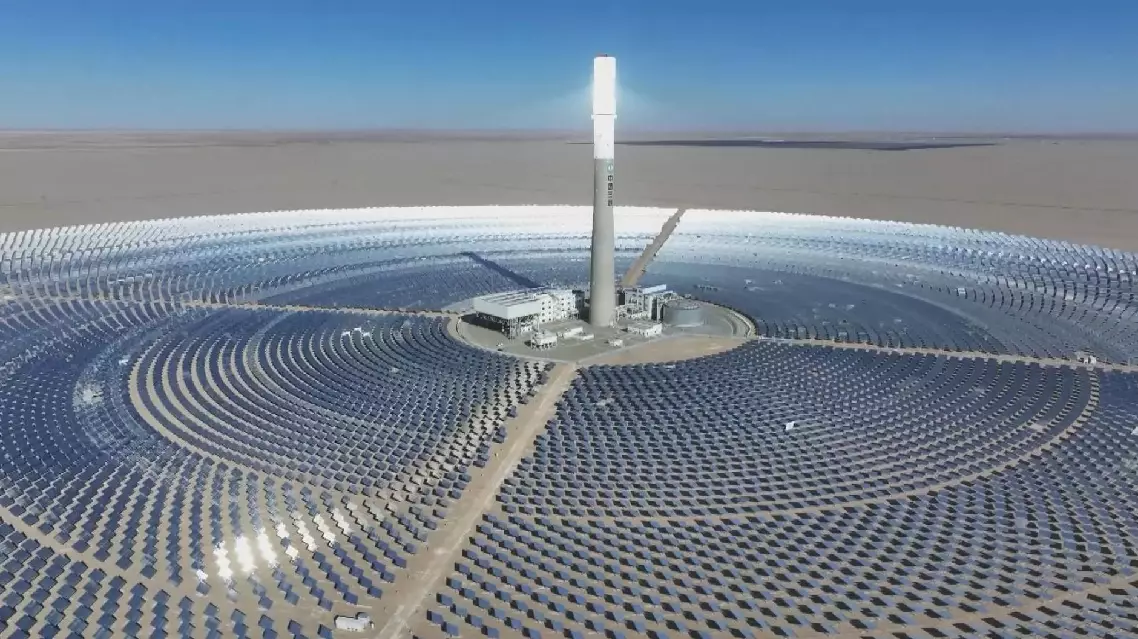
China ranks second globally in solar thermal power capacity