KINGSTON, Jamaica (AP) — Jamaica’s government said two of its three citizens recently deported by the United States to the African kingdom of Eswatini have formally declined offers to be repatriated to the Caribbean nation.
The Ministry of Foreign Affairs said late Thursday that Jamaican officials were still attempting to contact the third citizen.
“During the discussion, the men were advised of the consular assistance available to them and of the government’s readiness to facilitate their return to Jamaica,” the Foreign Ministry said.
The Jamaican government advised the pair that authorities "could not determine their immigration status in the United States or secure their return there. Both men maintained that they did not wish to return to Jamaica.”
Contact was established through the Jamaican Consulate in Miami and a legal adviser representing the men, who haven't been identified.
Jamaica’s outreach followed diplomatic inquiries directed at U.S. officials in Washington, alongside formal representations made to Eswatini’s government through Jamaica’s diplomatic mission in Pretoria, South Africa.
The growing number of third-country deportations by the U.S. government to places including Eswatini have been widely criticized by lawyers and human rights groups.
Eswatini is a tiny kingdom bordering South Africa where the king holds absolute power and has been accused of clamping down on pro-democracy movements.
Orville Etoria, who was the first Jamaican national sent to Eswatini under the program, was repatriated to his country last September.
His lawyers have accused the U.S. of deporting him unlawfully there in July 2025 and said that he and others were repeatedly denied visits by a lawyer.
Etoria was repatriated with help from the International Organization for Migration, or IOM, a U.N. agency.

FILE - The Matsapha Correctional Complex in Matsapha, near Mbabane, Eswatini, July 17, 2025. (AP Photo, File)
LUXEMBOURG--(BUSINESS WIRE)--Jul 17, 2026--
Corporación América Airports S.A. (NYSE: CAAP), (“CAAP” or the “Company”), one of the world’s leading private airport operators, reported today a 4.1% year-on-year (YoY) decrease in passenger traffic in June 2026.
This press release features multimedia. View the full release here: https://www.businesswire.com/news/home/20260717485211/en/
Passenger Traffic Overview
Total passenger traffic decreased by 4.1% in June compared to the same month in 2025. Domestic traffic declined by 12.5% year over year, primarily due to lower traffic in Argentina. International traffic increased by 2.8%, with all operating countries posting year-over-year growth except Argentina. Overall traffic performance was supported by double-digit year-over-year growth in Armenia and continued growth in Italy, Brazil, and Uruguay, offset by declines in Argentina and Ecuador.
In Argentina, total passenger traffic declined by 13.0% year over year in June, reflecting lower domestic and international traffic volumes. Domestic traffic decreased by 18.0% year over year, primarily driven by reduced capacity at Flybondi, which operated only three aircraft during the month—representing approximately 30% of its originally scheduled fleet—as well as lower capacity at Aerolíneas Argentinas following fuel price increases. Meanwhile, JetSMART recorded year-over-year passenger growth despite scheduled maintenance affecting part of its fleet. The top three domestic destinations were Bariloche, Córdoba, and Mendoza, all with load factors exceeding 80%. International traffic declined by 4.3% year over year. While seat capacity remained broadly stable compared to June 2025, the load factor decreased by three percentage points. Regional capacity declined across most markets, mainly reflecting capacity adjustments by Aerolíneas Argentinas and GOL. June traffic was also affected by the FIFA World Cup, which had a temporary dampening effect on leisure and business travel as passengers postponed or adjusted their travel plans. The top three international destinations during the month were Santiago de Chile, São Paulo, and Madrid.
In Italy, passenger traffic increased by 4.0% year over year, reflecting growth across both the international and domestic segments. International traffic, which represented more than 80% of total passenger volumes, grew by 4.7%, supported by strong demand at both airports, led by Pisa International Airport. Domestic traffic also expanded, rising by 1.7%, with positive contributions from both Pisa and Florence airports.
In Brazil, total passenger traffic increased by 3.9% year over year. Domestic traffic, which accounted for almost 55% of total traffic, declined slightly by 0.8% year over year, while transit passengers increased by a strong 10.5% year over year. Brasília International Airport continues to benefit from its position as a key secondary hub within the domestic network.
In Uruguay, total passenger traffic, predominantly international, increased slightly by 0.3% year over year. Among other developments, Azul Linhas Aéreas Brasileiras recently launched a new Montevideo–Belo Horizonte route, operating two weekly frequencies.
In Ecuador, passenger traffic declined by 4.1% year over year, as ongoing security concerns continued to weigh on travel demand. International traffic increased by 3.4%, supported by strong demand on U.S. routes, the launch of new services by Avianca, JetBlue, and LATAM Airlines, and additional frequencies operated by American Airlines. Domestic traffic, however, declined by 10.8% year over year, as elevated airfares continued to constrain demand, compounded by reduced operations on the Guayaquil–Quito route.
In Armenia, passenger traffic increased by a robust 16.0% year over year despite disruptions related to the conflict in Iran, which resulted in flight cancellations and airspace restrictions across the region. However, the impact proved to be more limited than initially expected, as strong demand from Western and Eastern Europe, Asia, and Russia continued to support overall traffic growth. In addition, the new Wizz Air base at Zvartnots International Airport, launched in late 2025, together with several new airlines and destinations, continued to support the airport's strong performance.
Cargo Volume and Aircraft Movements
Cargo volume, decreased by 9.1% year over year, with declines in all countries of operation. By country, performance was as follows: Argentina (-4.9%), Armenia (-17.1%), Brazil (-27.0%), Italy (-7.8%), Ecuador (-6.0%), and Uruguay (-1.9%). Argentina, Brazil, and Uruguay accounted for nearly 80% of total cargo volumes in June.
Aircraft movements declined by 5.7% year over year, as positive contributions from Armenia and Italy, were more than offset by declines in Ecuador, Brazil, Argentina, and Uruguay. Performance by country was as follows: Armenia (+14.3%), Italy (+2.1%), Brazil (-1.4%), Uruguay (-7.1%), Argentina (-11.8%), and Ecuador (-1.6%). Argentina, Brazil, and Italy accounted for more than 80% of total aircraft movements in June.
About Corporación América Airports
Corporación América Airports acquires, develops and operates airport concessions. Currently, the Company operates 52 airports in 6 countries across Latin America and Europe (Argentina, Brazil, Uruguay, Ecuador, Armenia and Italy). In 2025, Corporación América Airports served 86.7 million passengers, 9.8% above the 79.0 million passengers served in 2024. The Company is listed on the New York Stock Exchange where it trades under the ticker “CAAP”. For more information, visit http://investors.corporacionamericaairports.com.
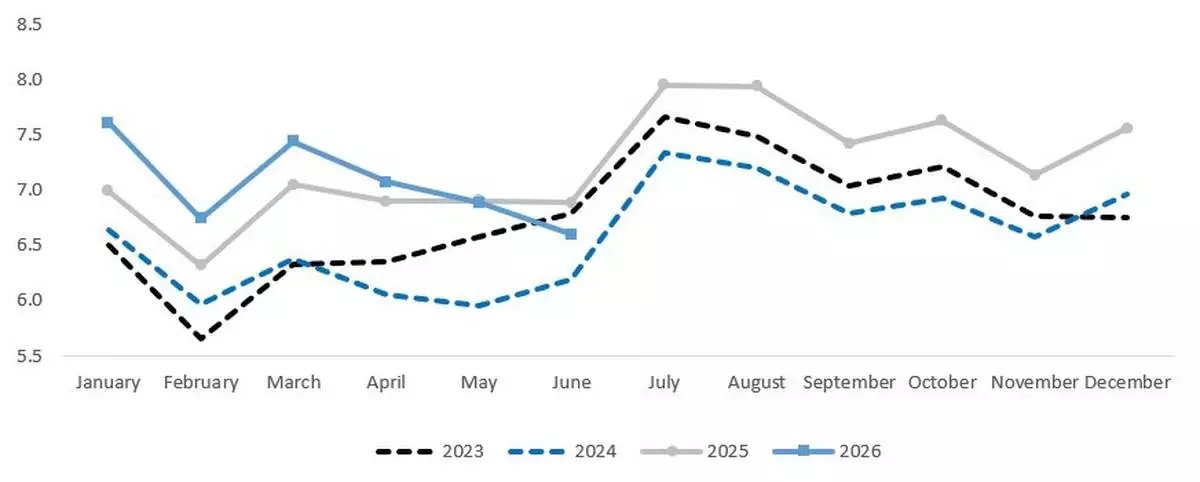
Monthly Passenger Traffic Performance (In million PAX)