New Development Bank (NDB) President Dilma Rousseff said on Friday that effective AI governance will rely on multilateral frameworks to bridge divides in technology, regulation, and capacity.
Roussef is also the former president of Brazil, a country that is now building its first smart public hospital in Sao Paulo using a 1.7 billion-yuan loan from the NDB. The facility will feature AI-driven diagnostics, 5G-connected ambulances, and smart ICUs to reduce emergency wait times.
While attending the 2026 World AI Conference and High-Level Meeting on Global AI Governance in Shanghai, Rousseff highlighted the project materialized under the BRICS framework and benefits from significant support from China's AI sector.
"I would like to talk about a very important project, that is intelligent hospitals. It is a partnership of some BRICS countries. They are going to be built in Sao Paulo. China contributes in some kind of innovations," she said, speaking to a reporter from her seat at the conference.
This year, the 2026 World AI Conference runs from Friday to Monday under the theme of "AI Partnership for a Brighter Future." At the opening ceremony, Chinese President Xi Jinping gave an address to attendees, urging all parties to seize AI development opportunities by encouraging open source, openness, collaboration and sharing, as well as joint efforts to establish a just and equitable system for global AI governance.
According to Rousseff, the president's call comes at a timely moment as the world begins to decide its path forward with regard to AI's development.
"I think this conference is very important, because he (Chinese President Xi Jinping) puts on the table one question: what about AI governance? That is, open sources require good governance. Good governance requires multilateral cooperation. These all are linked -- how to create a better world," she said.

Good AI governance requires multilateral cooperation: NDB president

Good AI governance requires multilateral cooperation: NDB president
Russia declared on Thursday that it will ensure the security of its Kaliningrad region, warning that any attempts to exert pressure on the exclave are completely unacceptable.
Kaliningrad, a Russian exclave on the Baltic Sea, is separated from the Russian mainland and lies between NATO members Poland and Lithuania. It is a strategically important military outpost for Russia, hosting air defense systems, missiles and naval forces.
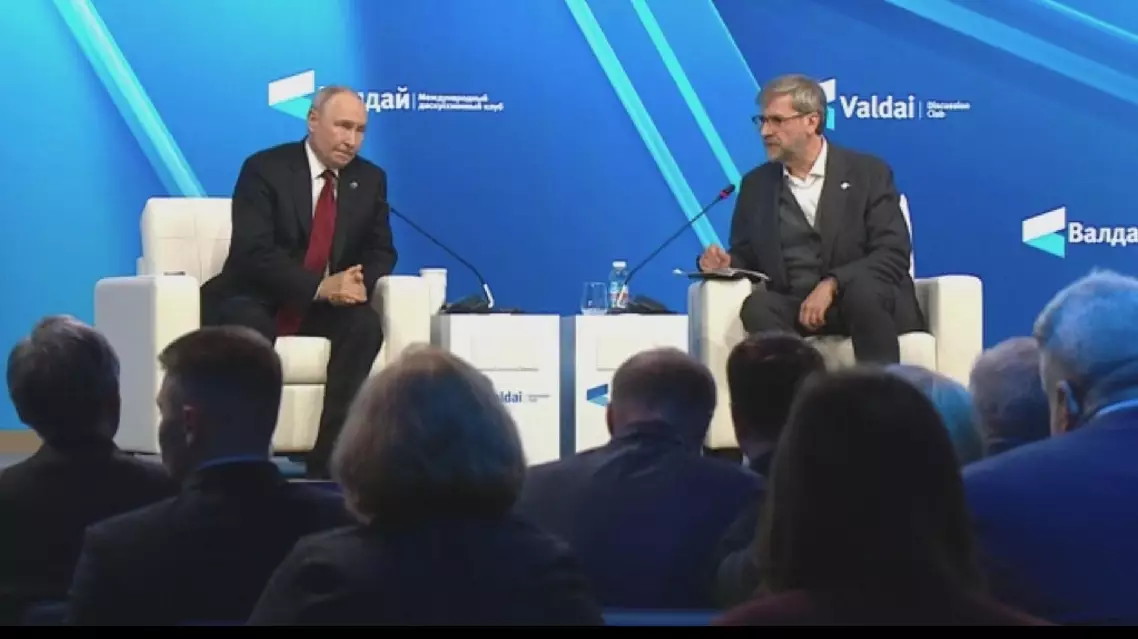
Speaking at the plenary session of the 23rd annual meeting of the Valdai Discussion Club on Thursday, Russian President Vladimir Putin clarified speculations regarding a potential nuclear strike in response to a hypothetical NATO blockade of Kaliningrad. He stated that Russia has never publicly declared plans to use nuclear weapons, but emphasized that the country will utilize all available forces and means, reserving the right to determine the specific methods.
Dmitry Peskov, press secretary to the Russian President, reiterated on the same day that Kaliningrad is an inalienable part of the Russian Federation, and that any attempts to covet or pressure the region are unacceptable.
He added that Russia poses no threat to Europe and has no plans to use nuclear weapons against it, noting that if NATO has no plans to act against Russia, there is no reason for concern.
Russian embassies in Britain, Belgium and Ireland have recently posted warnings concerning the Kaliningrad on their Telegram accounts, saying that Russia would use its "entire arsenal" to defend its territory if NATO countries attempted to "blockade" the region. Posts by the Russian embassies in Britain and Ireland explicitly said that this could include the use of nuclear weapons.
NATO Secretary General Mark Rutte responded on Wednesday by describing NATO as a "defensive alliance" and condemning what he called Russia's "nuclear threats."
According to media reports, Lithuania, Poland, France and other countries conducted exercises in nearby areas in June, including scenarios involving the disruption of railway links to the Kaliningrad region.
In August, dozens of military aircraft from NATO countries conducted exercises around the region, simulating the disruption of communications and suppression of air defense systems.
Founded in 2004, the Valdai Discussion Club held annual forum this year in Moscow under the theme: "Responsibility for the Future: Limits of the Possible, or Limitless Possibilities?" It gathered around 120 delegates from 40 countries and regions.
Russia vows to defend Kaliningrad exclave, clarifies stance on nuclear response