Two weeks after shuttering his bid for Wisconsin governor, David Crowley reentered the state's Democratic primary on Saturday, with the Milwaukee County executive boasting a last-minute backing from outgoing Gov. Tony Evers in a seeming move to best position the party for success in November.
Evers had initially declined to endorse in the race, but threw his weight behind Crowley and resuscitated his bid to lead the swing state known for razor-thin election margins, where appealing to moderate and independent voters is crucial. It was the latest turn in a chaotic Democratic primary that has jeopardized the party's chances this fall and comes after Lt. Gov. Sara Rodriguez said she was abandoning her campaign for the state’s top office after a campaign finance scandal.
Democrats are looking to November to secure full control of Wisconsin state government for the first time since 2010, and hope it will send a signal about where the country’s politics are headed by shaping a key political battleground that helps decide presidential campaigns.
In an event in Milwaukee Saturday relaunching his campaign, Crowley referenced the stakes, saying that “winning this election will require building the broadest possible coalition,” and touting his ability to forge relationships across partisan divides. And Evers' endorsement, he went on, “reflects his confidence that I have the experience” to lead and to win.
Evers was on a trade visit to Africa and not in attendance at Crowley’s Saturday event but acknowledged in a social media post that he was now “all in” for Crowley, touting his executive leadership on issues including job creation and balancing budgets.
“He’s not just a candidate who can win in November, but he’s the kind of person who cares about doing the job right,” Evers wrote.
Crowley, 40, is reemerging into a competitive primary for Wisconsin’s open governor’s race that was turned on its head Friday with the departure of Rodriguez, who earlier in the week fired her campaign manager after discovering her campaign had hundreds of thousands of dollars less on hand than expected.
Now, as they approach Wisconsin’s primary election on Aug. 11, Democrats are hoping to hold onto the governor’s office as they also eye flipping majority control of the state Legislature, which Republicans have held since 2011.
The primary also comes following democratic socialists' earlier victories in the liberal strongholds of New York City, Washington, D.C., and Denver. Francesca Hong, a single mother who has worked as a dishwasher and line cook, is trying to do the same with her campaign for Wisconsin governor, with her candidacy turning the Democratic contest into a test of just how far left voters are willing to go in the November midterms.
Crowley, who would be the state’s first Black governor if elected, had shuttered his own bid two weeks ago to back Rodriguez. Now, he’s returning to a contest against Hong, former Lt. Gov. Mandela Barnes, state Sen. Kelda Roys and Joel Brennan, a former top aide to Evers.
In an interview Saturday afternoon, Crowley told The Associated Press that voters would see “a much more aggressive campaign” from him in the primary's closing weeks, buoyed in part by Evers' backing and “a renewed, energized, volunteer base.”
“I wouldn’t have gotten into this race if I didn’t believe a pathway was there," Crowley said. "We can not only get over the hump in winning on the Aug. 11 primary, but then we’ll be able to really focus on how we can make sure that Tom Tiffany doesn’t bring an extreme MAGA agenda to the state of Wisconsin," Crowley said.
Democrats have been struggling to overcome disarray in other messy primaries across this year’s midterm calendar. In California, the race to replace outgoing Gov. Gavin Newsom devolved into a chaotic free-for-all, with dozens of names on the ballot, and one of the leading contenders, Democratic Rep. Eric Swalwell, abruptly quit both his campaign and Congress following sexual assault allegations. Democrat Xavier Becerra and Republican Steve Hilton ultimately advanced from a “ jungle primary.”
In the first iteration of his campaign, Crowley leaned into his background, highlighting how his family was once homeless in Milwaukee but he rose to become a community organizer and was elected to the state Assembly in 2016 at age 30. He served until the middle of 2020, when he was elected as executive of Milwaukee County, the state’s largest county. He was the first Black person to hold that job and also the youngest at age 33.
The winner of the Democratic primary will advance to the general election against Republican Rep. Tom Tiffany, who faces only token primary opposition.
In a statement to AP, Tiffany portrayed Crowley as “asleep at the wheel” in his role as county executive and described his reemergence as Democrats' “only shot at stopping the socialist who wants to abolish the police and prisons.”
In an email statement, the Republican Governors Association said that “watching Wisconsin Democrats is like watching a clown car crash into a parked semitruck.”
Associated Press reporter Scott Bauer in Madison, Wisconsin, contributed to this report.

FILE - Wisconsin Gov. Tony Evers speaks during a news conference, Jan. 12, 2026, in Madison, Wis. (AP Photo/Scott Bauer, File)
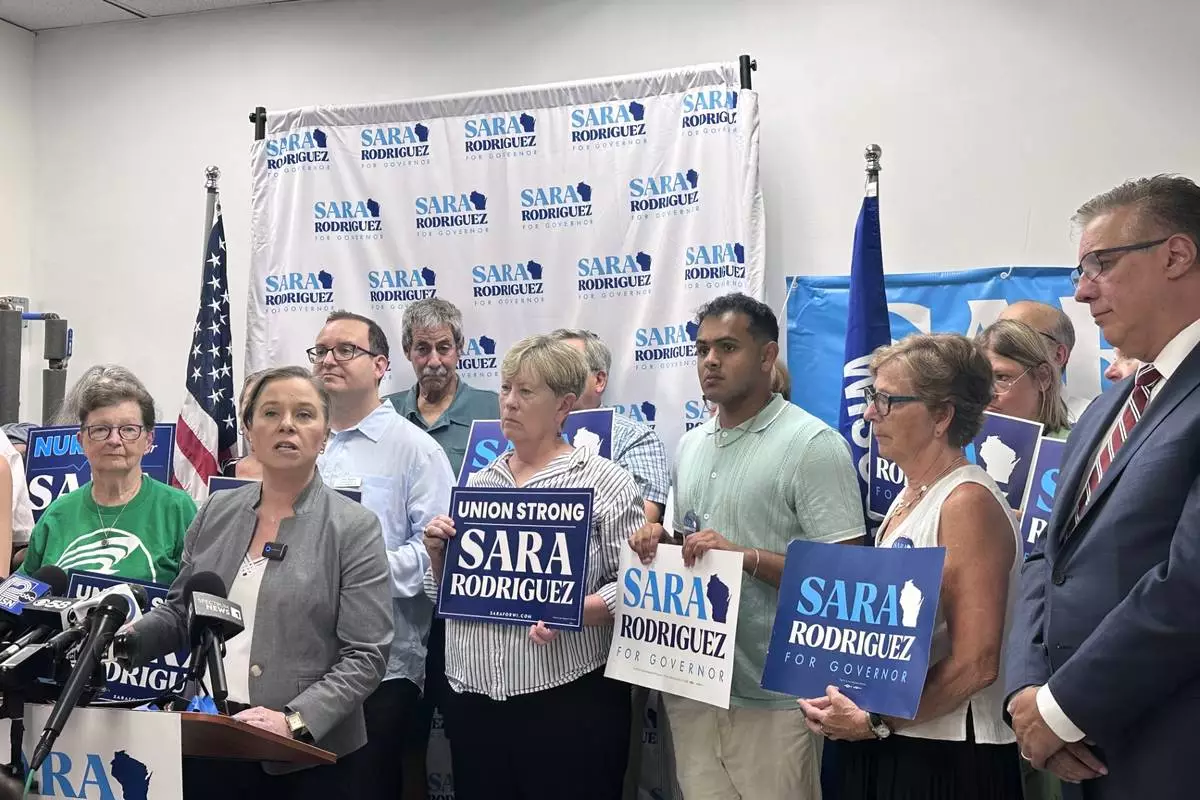
Democratic candidate for Wisconsin governor Sara Rodriguez speaks to supporters, Monday, July 13, 2026, in Madison, Wis. (AP Photo/Scott Bauer)

FILE - Milwaukee County Executive David Crowley addresses a crowd, March 29, 2025, in Milwaukee. (AP Photo/Andy Manis, File)

EASTERN UKRAINE (AP) — The commander leading Ukraine’s drone war says his country’s recent strikes in Crimea are the first phase of a campaign aimed at rendering the peninsula — illegally annexed by Russia in 2014 — unusable as a staging ground for Russian forces.
Maj. Robert “Magyar” Brovdi, one of Ukraine’s most prominent commanders among a new generation of soldiers, said his forces could strike seven times more military targets in Crimea if the money pledged by Western allies came faster.
“Crimea falls within the key conceptual pillars on the path to ending the war,” Brovdi told The Associated Press in an interview.
Despite that shortfall, Ukraine’s summer campaign in Crimea has already inflicted significant damage: striking rail bridges, oil depots and power infrastructure to disrupt supply lines and blind Russian air defenses as drones fly in.
Brovdi said his forces are equipped at just 14% of what they would need to carry out the Crimea campaign at full capacity.
A firm believer in numbers since his past life running an international grain trading business, Brovdi joined Ukraine’s territorial defense as a volunteer in the war’s opening days. He rose quickly, commanding one of the country’s most effective drone brigades before being tapped to lead a force with no precedent before this war — Ukraine’s Unmanned Systems Forces.
“It’s not that the production capacity of Ukrainian manufacturers doesn’t allow us to make the necessary quantities” of drones, Brovdi said. “It’s the banal problem of untimely financing, which our partners do allocate, but which moves significantly slower than our plans.”
A devoted patron of the arts, Brovdi's underground command post resembles a museum, with pieces of Ukrainian art on display, including by renowned painter Maria Prymachenko — each with small placards noting their titles and a QR code linking to more information. “Please don’t touch the sculpture,” reads a sign beneath one piece.
The artwork sits against a backdrop of dozens of screens streaming live footage from the front, along with real-time data that drives decisions on the battlefield. Soldiers can grab good coffee, pick a book, work out or rest in sleeping pods — a culture that feels closer to a Silicon Valley office than a war room.
They work around the clock to try to prevent Crimea from functioning as a staging ground for the Russian military, said Brovdi, whose call sign, Magyar, nods to his ethnic Hungarian roots in Zakarpattia, the western Ukrainian region bordering Hungary.
He pointed to one sign of progress — in four recent large-scale Russian missile barrages from the peninsula, only five missiles were launched in total, a drop he credited to the systematic destruction of Russian air defenses there. The AP couldn’t independently verify the claim.
To open that “window” for drones to strike the peninsula without being shot down en masse, his forces destroyed more than 300 air defense assets over recent months — surface-to-air systems, radar stations, electronic warfare equipment.
The window metaphor sends him into a sidetrack about something personal — he loves sleeping with one open, a pleasure he rarely gets anymore as one of Russia’s most hunted men, who spends most of his time in underground bunkers.
Much of Russia's Soviet-era air defense hardware runs on the power grid, which is one of the reasons Crimea's electrical infrastructure has become a recurring target. Russian soldiers become “blind,” left with just machine guns and rifles, he said. The tactic has also impacted access to power for civilians, and Brovdi said he has twice publicly apologized to Ukrainians living in Crimea for the disruptions.
Wherever Starlink connectivity reaches across Crimea, his forces can now destroy even the most heavily defended target using an average of just three drones, mixing munitions with different characteristics and warheads depending on what’s being hit. He described the strikes as deliberately calibrated — different munitions for a bridge pier than for a fuel truck or a moving train — and said his forces avoid hitting civilian infrastructure.
“Creating conditions that make it impossible for any kind of military capability … to remain there will make Crimea uninteresting ... as a military staging ground,” he said.
Ukraine is also working to dismantle Crimea’s role as a naval base — a blow to Russia’s presence near NATO’s borders, he added.
The campaign’s early results have not been made public, Brovdi said. But roughly two weeks into the offensive that began in late June, he said Ukrainian intelligence indicated Russian authorities had ordered all military commands and security services to relocate off the peninsula, along with a covert order to remove secret archives and artworks. The AP could not independently verify the account.
Meanwhile, Russia is working to counter Ukraine’s edge. It is installing jamming systems at a scale that will, to some degree, degrade Starlink connectivity, Brovdi said.
Russia is also building its own satellite communications system to rival Starlink, he said. “This is a risk for the entire planet,” Brovdi said, “because a dictatorship will gain access to information across the whole globe.”
He also pointed to other threats facing Ukraine. The concentration of jet-powered Shahed drones, which are much harder for Ukraine to shoot down, has increased two and a half times in recent weeks, he said.
Russia's military can currently fire a simultaneous salvo of 77 ballistic missiles, he said, and plans to increase that to 200. That is one of Ukraine’s most vulnerable points, since the country is running short of interceptors for the U.S.-made Patriot — the only system Ukraine has in its arsenal against ballistic missiles — meaning dozens fired by Russia during mass barrages get through and hit their targets.
“Even if they only manage half of that, it will all be flying at us,” Brovdi said. The only way to bring the number down, he said, is by striking every facility involved in producing those missiles — underscoring the importance of Ukraine’s long-range strikes deep inside Russian territory.
Ukraine has increasingly targeted Wildberries, Russia’s largest online marketplace sometimes described as the country’s answer to Amazon, and Brovdi named it as a target.
“Wildberries is, first of all, a supply platform — it’s the war’s quartermaster,” he said, noting the company runs a dedicated section selling goods for Russia’s military.
At the same time, he said, the strikes on the retail chain are meant to make ordinary Russians feel the war directly, in hopes the resulting desire to end it could weigh on Russia’s ability to keep fighting.
Brovdi declined to give a timeline for the Wildberries campaign, saying only that the strikes will continue “until it becomes impossible for it to recover quickly.”
“Ultimately, Wildberries is, forgive the expression, a consumer gambling addiction,” he said, arguing that losing access to it — like restrictions on social media — creates an intrusion on one's personal life that most Russians feel.
“It turned out to be a sensitive sensor of the comfort of Russia’s massive population — people who consider themselves completely untouched by the actions of the aggressor country," he said.
AP reporters Vasilisa Stepanenko in eastern Ukraine and Volodymyr Yurchuk in Kyiv contributed.
A Ukrainian "Chaklun" long-range strike drone takes off from a mobile launcher during an operational launch targeting Russian military installations in Crimea, from an undisclosed location in Ukraine on Thursday, Aug. 6, 2026. (AP Photo/Dan Bashakov)
A Ukrainian serviceman prepares a "Chaklun" strike drone used for deep-strike operations against Russian positions in Crimea, in an undisclosed location in Ukraine on Thursday, Aug. 6, 2026. (AP Photo/Dan Bashakov)
Maj. Robert "Magyar" Brovdi speaks during an interview with The Associated Press in an undisclosed location in Ukraine on Friday, Aug. 7, 2026. (AP Photo/Dan Bashakov)
Ukrainian servicemen prepare a "Chaklun" strike drone used for deep-strike operations against Russian positions in Crimea, in an undisclosed location in Ukraine on Thursday, Aug. 6, 2026. (AP Photo/Dan Bashakov)
Maj. Robert "Magyar" Brovdi stands in the control room during a long-range unmanned aerial vehicle operation targeting Russian positions in an undisclosed location in Ukraine on Friday, Aug. 7, 2026. (AP Photo/Dan Bashakov)