MIAMI (AP) — A famous Cuban dissident artist and musician, Luis Manuel Otero Alcántara, arrived in Miami on Saturday after being released from a five-year prison sentence on the condition that he leave his country.
Alcántara, 38, was greeted at the airport by a crowd that was cheering, singing and holding their phones high in the air to get a photo of him. They draped him in a Cuban flag, printed with the words “Patria y Vida” — “Homeland and Life” — the title of a song he shared a Grammy for that became an anthem for Cuba’s political opposition against repression.
The United States granted him parole into the country earlier this week, according to a social media page maintained by his friends and supporters. They wrote that he accepted exile as the only way to escape persecution and continue his art and activism.
Alcántara co-founded a group of Havana artists, writers and musicians called the San Isidro Movement — named for the neighborhood where Alcántara lived.
He was arrested on July 11, 2021, during a public protest. In 2022, a court sentenced him to five years in prison for public disorder, contempt and disrespect toward national symbols.
His arrest and incarceration had long been denounced by human rights organizations and the U.S. government. Groups including Amnesty International called him a political prisoner, an allegation the Cuban government rejected.
Alcántara was held in a maximum-security prison, he said, and was expected to be released last week. But for days, advocates said they still could not contact him and did not know where he was.
The organization Cubalex, which legally advises dissidents and reports human rights violations from outside of the country, filed a habeas corpus petition on his behalf Monday.
Until he boarded a plane Saturday, his advocates were not sure of his location, or if he was truly free.
His said his first stop on American soil would be at the Shrine of Our Lady of Charity to make an offering.
Other political prisoners remained imprisoned, including his fellow artist Maykel “Osorbo” Castillo Pérez, his advocates said, and they hoped Alcántara's release would prompt insistence that Pérez also be set free.
Alcántara brought from Cuba a broken statue of the Virgin Mary, which he described as a symbol of hope and healing, a chance to put back together something from fragments.

Cuban dissident artist Luis Manuel Otero Alcántara reacts after arriving at Miami International Airport on Saturday, July 18, 2026, after serving a five-year prison sentence in Cuba. (AP Photo/David Santiago)

Cuban dissident artist Luis Manuel Otero Alcántara arrives at Miami International Airport on Saturday, July 18, 2026, after serving a five-year prison sentence in Cuba. (AP Photo/David Santiago)
MILWAUKEE (AP) — The eerie glow of an orange sun through thick wildfire smoke might be unnerving, but the biggest risk from the haze is something much harder to see.
Tiny particles in the air can cause a range of short-term and chronic health issues, experts say.
Wildfire smoke can settle over cities for days — like the recent blanket over parts of the U.S. from burning fires in Canada, which has created hazardous air for millions of people across multiple states.
Health officials advise people to stay indoors — and to take steps to keep the air in your home clean.
If you have central air conditioning, it should clean the air in your home.
Make sure filters are replaced on schedule and are of the highest level of filtration your system can handle. Filters rated MERV 13 or higher are ideal. Set the air to recirculate and close any vents that pull air from outside if you can. The University of Oregon's Center for Wildfire Smoke Research and Practice recommends running the system's fan through the entire smoke event, not just when cooling.
If you buy a portable air filter, look for a HEPA air filter or one that says it traps small particles of pollution. Ensure it does not generate ozone, another harmful air pollutant.
If you can only afford one portable air filter, use it to create a “clean room” in your house where you can spend most of your time.
“The basic message is that something is better than nothing,” said Amy Kalkbrenner, an environmental epidemiologist at the University of Wisconsin-Milwaukee.
There’s good evidence that DIY filters made by duct-taping furnace air filters to a box fan work.
They’re simple, relatively affordable and scientists at the Environmental Protection Agency have found they are just as good at removing fine particles of pollution from the air as a small commercial air purifier.
“The good news is they really work,” said Kalkbrenner.
All you need to have to make one is: four 20-by-20-inch (50.8-by-50.8-centimeters) furnace air filters rated MERV 13 or higher, a box fan, cardboard and duct tape. The EPA's website shows how you can modify the design to only use one or two filters. The fan should blow out, and the arrows on the filters should point in. Make sure everything is taped up air-tight.
Many window air conditioners, mini-split heat exchangers and portable air conditioners don’t have the filters needed to remove fine pollution particles. But heat can also be dangerous.
“When smoke and heat occur together, the impacts on your health are even greater than when they occur by themselves,” said Jess Downey, a researcher at the University of Oregon’s Center for Wildfire Smoke Research and Practice
Downey said the ideal scenario is running the AC unit and using an air purifier or a DIY box fan filter to clean the air. Make sure your AC is well-sealed in your window frame, she added.
Make sure the window units are set to recirculate air. Portable units with a single hose should be used sparingly, according to the University of Oregon wildfire smoke center.
If you don't have AC, any reprieve from hot, smoky air is important. Head to the library, shopping mall or other space with clean, cool air.
Whether it's a towel, some tape, or something else — plug areas where air could enter from outside.
“Being from Chicago, I think you can liken it to trying to keep the cold air out,” said Dr. Khalilah Gates, a lung doctor with Northwestern Medicine. “Any areas in which air can come in, consider sealing up those areas to reduce the amount that's coming into the home.”
When smoke levels are high, experts recommend avoiding anything that burns — candles, fireplaces, even gas stoves — so plan ahead with some meal prep.
Exposure to wildfire smoke can lead to shortness of breath, chest tightness, headaches, and a burning sensation in the nose and eyes.
“When you ever start to feel those symptoms and they’re not severe, it’s important to acknowledge, ‘Oh, my body is responding to this. I need to move away from it. I need to move inside,'” Gates said.
If you're wheezing, can't catch your breath or are in distress, get to the emergency room immediately, she said.
The Associated Press Health and Science Department receives support from the Howard Hughes Medical Institute’s Department of Science Education and the Robert Wood Johnson Foundation. The AP is solely responsible for all content.
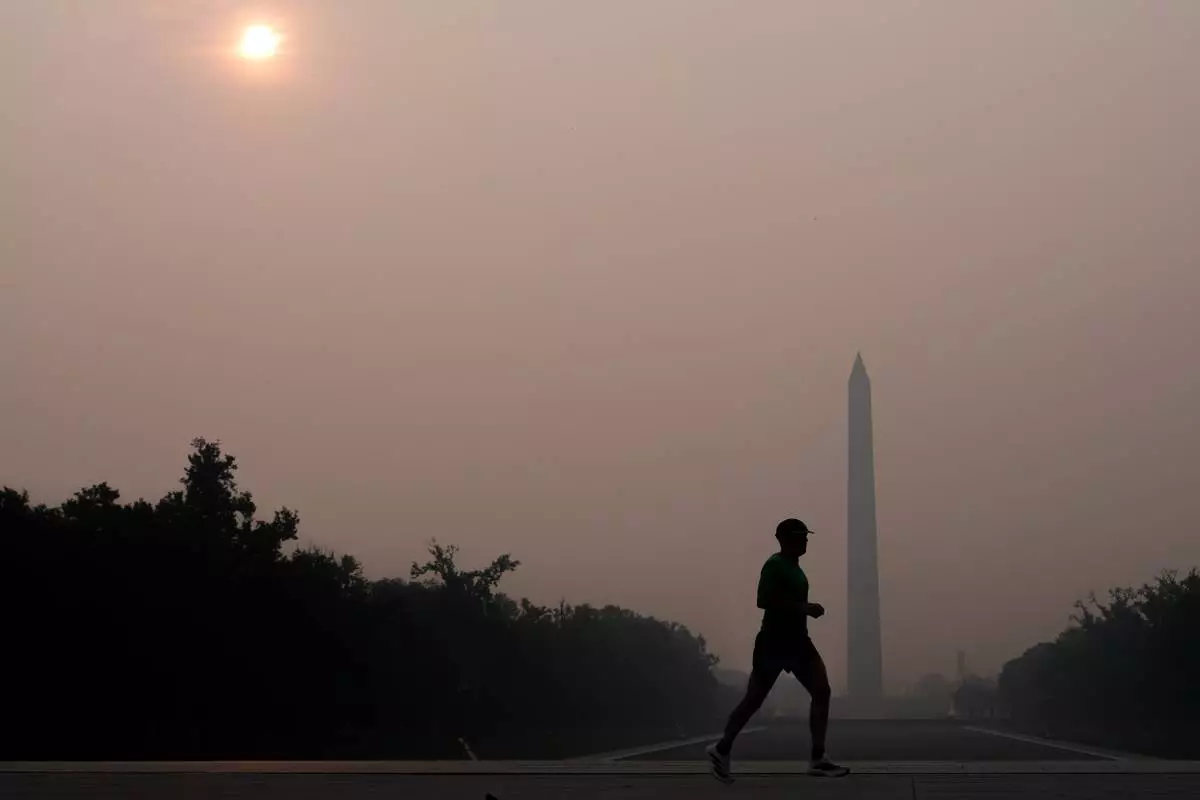
The sun is obscured by wildfire smoke as a person runs in front of the Washington Monument and Lincoln Memorial Reflecting Pool, Friday, July 17, 2026, on the National Mall in Washington. (AP Photo/Julia Demaree Nikhinson)