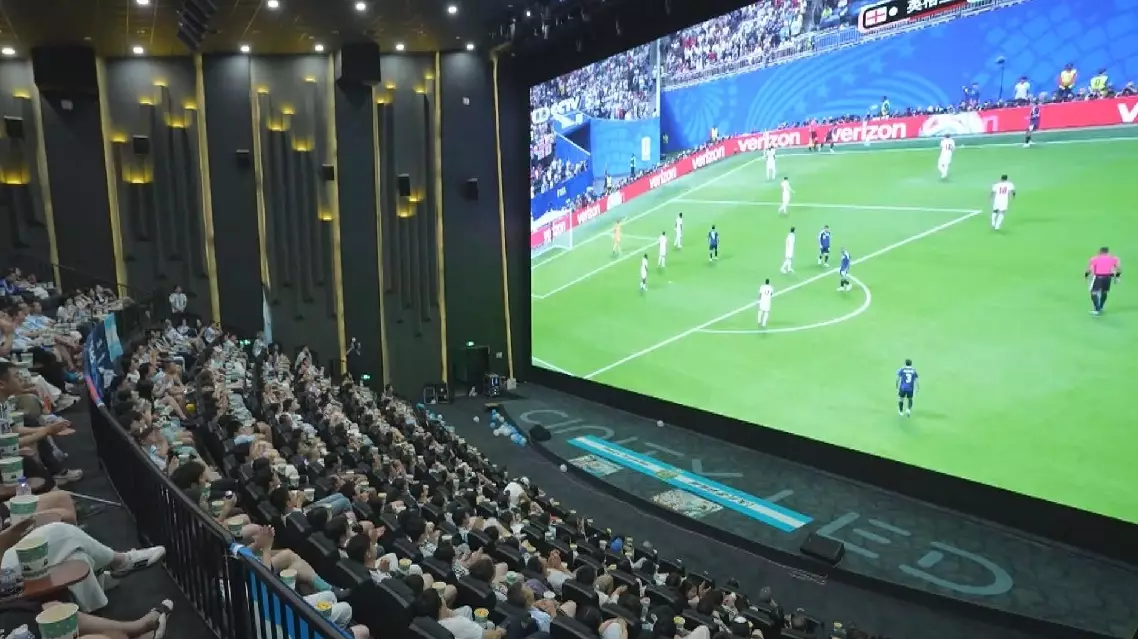
Cinemas across China have been screening World Cup matches from June to July, a move that not only boosts business but also provides football fans with authentic game-day viewing experiences.
Despite many matches being broadcast live in China during the early hours, cinemas screening World Cup games have consistently been packed with football fans enthusiastically cheering for their teams.
"It was absolutely fantastic. Everyone had their own team to support, and when a goal was scored, the atmosphere made me feel like I was in a football stadium. The immersion was great. People were applauding and cheering from time to time. The experience was amazing," said a football fan in Beijing.
Hosted by China Media Group and China Film Group Corporation, the live cinema screening event for World Cup matches has launched in nearly 20 cities across China. It has drawn thousands to theaters, allowing viewers to enjoy a grand football feast in among a crowd of fellow fans.
The initiative not only increases attendance during off-peak hours at cinemas but also drives up revenue from snacks, beverages and themed merchandise.
"By screening World Cup matches, we can attract audiences who don't usually watch movies, especially those young viewers with strong consumption power and enthusiasm, to come back to the cinema. Our nighttime business, including the World Cup-themed cultural and creative merchandise, as well as other packaged offers, has also seen a significant boost in sales," said Yu Chao, deputy general manager of Capital Cinema.
World Cup screenings boost sales in China’s cinemas
The Northeast China Football League, China's first cross-provincial city-based football tournament, is in full swing across northeast China, transforming a low-cost ticket into a golden key that unlocks regional tourism and fuels a surge in consumer spending this summer.
Fresh off the conclusion of the 2026 FIFA World Cup in North America, football fever is just heating up in China's northeastern region.
Officially called "The 2026 Northeast China City Football League," an eight-team amateur competition spanning the three northeastern provinces of Liaoning, Jilin and Heilongjiang, plus the Inner Mongolia Autonomous Region, opened simultaneously in Shenyang, Changchun, Harbin and Hohhot, the four capitals of the provinces and the region, on May 23.
While match tickets cost less than three U.S. dollars, their value extends far beyond the pitch. Ticket holders enjoy free entry to landmarks like the Shenyang Imperial Palace, as well as discounts at partner hotels, restaurants and local businesses, with a single match ticket unlocking a host of city-wide benefits.
"The ticket allows us to visit attractions such as the Shenyang Imperial Palace and Marshal Zhang’s Mansion, all of which have discounts. This is something we particularly like. So, taking advantage of the weekend, we should have a good time in the area," said a fan from Heilongjiang.
The bundled benefits have significantly lowered travel costs for fans, turning weekend trips into economical getaways.
"We can enjoy discounts on food, drink and entertainment with our ticket. Roughly calculated, it feels like this trip will save four to five hundred yuan for me," said another fan from Heilongjiang.
This tournament model, which is organized and promoted by local governments, features wide community participation and deep integration with culture, tourism and commercial sectors, and has been widely recognized as a proven success.
Since the launch of the Jiangsu Football City League in 2025, the format has been adopted by regions across China as a way to drive consumption, boost local economies and enrich public life, while also strengthening cultural exchanges between cities.
"We have nearly 20 people here. We hope to use regional football leagues to improve the exchanges between cities and deepen the bond between people. These competitions are just as popular as the World Cup among local fans. We can enjoy intense and exciting matches and their atmosphere right at our doorsteps. This is one of our original goals for football," said Hao Junjie, secretary general of the Jiangsu Zhenjiang Fan Association.
For many visiting supporters, the trip is as much about immersing themselves in local culture as it is about watching football.
"We have experienced Northeast China-style bathhouses and night market barbecue. The football culture and heritage in Shenyang are very good, and this time we are here specifically to watch the Northeast China Football League match. The overall travel cost is approximately 3,500 yuan," said a fan from Jiangsu.
Outside the stadium, thousands of "second viewing venues" have emerged across host cities' core business districts, paired with supporting services including specialty catering, cultural exhibitions and dedicated outdoor match screenings. Every weekend, host cities buzz with vibrant energy, with street stalls bustling with crowds and local businesses thriving.
Local merchants have reported a noticeable surge in activity as the league turns cities into vibrant weekend destinations.
"Business has been very good recently. Since the start of the Northeast China Football League, the customer flow in our entire neighborhood has increased significantly. For our store, the revenue has increased by 10 percent," a local coffee merchant said.
The league's vibrant atmosphere and rich local offerings have even attracted international visitors seeking an authentic cultural experience.
"I'm a Korean who came specifically from Nanjing to watch the match of the Northeast China Football League. I really like it here. It's very lively and fun. I like to eat Northeastern style pork belly and iron pot stew, which are particularly delicious," said a South Korean football fan.
The league is now serving as a powerful catalyst for renewed vitality, proving that the passion for the beautiful game can drive tangible economic and social benefits. The World Cup may be over, but in this corner of China, the season is just beginning.
Grassroots sporting events fuel regional tourism, consumption