Skip to Content Facebook Feature Image

World AI Conference highlights growing demand for global AI partnership

China

China

China

World AI Conference highlights growing demand for global AI partnership

2026-07-19 22:22 Last Updated At:07-20 12:00

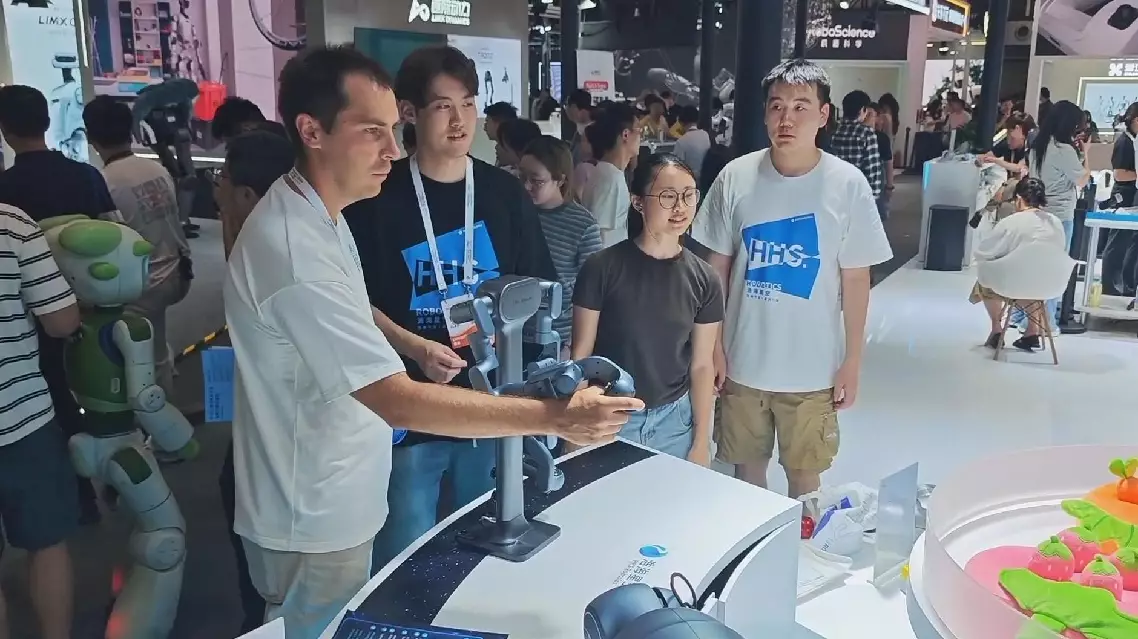
Business leaders, researchers and entrepreneurs from around the world gathered at the 2026 World Artificial Intelligence Conference (WAIC), where discussions are focusing on turning AI innovation into cross-border partnerships and real-world applications.

The 2026 WAIC is running in Shanghai from Friday to Monday under the theme "AI Partnership for a Brighter Future."

Across the exhibition halls, conversations often extended beyond product demonstrations, with visitors exploring potential partnerships, supply chains and overseas expansion.

Among them was Paolo Brizzi, chief information officer of Italy's Competence Center for Industry and Manufacturing (CIM), who met with a Chinese AI company to discuss cooperation ranging from industrial applications to entering the European market.

"My point is not to be a customer or a provider of technologies, but to identify parts [where we can] actually collaborate and work together," he said.

The four-day conference has also created opportunities for startups to connect with investors, researchers and potential customers. One startup launched an online networking group on the opening day, attracting hundreds of participants who exchanged ideas, explored business opportunities and sought technical solutions.

Participants said AI innovation depends not only on technological breakthroughs but also on cooperation across industries and countries.

"Collaboration is important because alone you cannot do so much. It needs to be a team support ecosystem," said Florian Wohlrab, CEO of Canada-based OpenHW Foundation.

For many international visitors, the conference is also an opportunity to explore how AI can help address practical challenges. Omar Khan, a participant from Pakistan, said international cooperation is essential to ensuring AI benefits everyone.

"I think, for me, we are all the one. We're human and I think we can cooperate a lot," he said.

Some attendees were looking for solutions to challenges in their home countries. A visitor from Kenya said AI applications such as weather forecast and soil analysis could help improve agricultural productivity across many parts of Africa, where farming remains a cornerstone of the economy.

As countries race to advance AI technologies, participants at this year's WAIC said the conference has become a platform for connecting ideas, technology and demand across borders, helping turn AI innovation into practical international cooperation.
World AI Conference highlights growing demand for global AI partnership

World AI Conference highlights growing demand for global AI partnership
China has unveiled a new plan to support the development of small and medium-sized enterprises (SMEs) during the 2026-2030 period, setting targets for business growth, innovation and the development environment.

By 2030, China's SMEs, a key pillar of economic vitality and resilience, are expected to achieve growth in both quality and scale, with per capita operating revenue of major SMEs posting cumulative growth of around 15 percent over the five-year period, according to the plan, which was jointly issued by 10 central government departments, including the Ministry of Industry and Information Technology (MIIT).

The plan sets out seven key tasks, including keeping businesses and employment stable, strengthening enterprise cultivation, accelerating digital, intelligent and green development, promoting coordinated and integrated development, improving the supply of production factors, strengthening the SME service system, and enhancing legal and policy safeguards.

The plan places greater emphasis on intelligent, green and integrated development, and adopts a more tailored approach to different industries and enterprise types. The new plan builds on progress made during the 14th Five-Year Plan until 2025, when China's SMEs saw significant improvements in business scale, innovation capacity and specialized expertise.

"The plan focuses on advancing high-quality and innovative development by establishing mechanisms to promote the growth of SMEs that use specialized and sophisticated technologies to produce novel and unique products, facilitating tiered growth of SMEs, and advancing intelligent, green, and integrated development. At the same time, it addresses practical difficulties such as talent shortages, funding constraints, and difficulties in rights and interests protection, adopting a tailored and categorized approach to help SMEs achieve steady and long-term growth," said Liang Zhifeng, director of the SME Bureau of the Ministry of Industry and Information Technology.

"The plan encourages universities and research institutes to license scientific and technological achievements to SMEs on a use-before-payment basis, providing SMEs with opportunities to access innovation resources and advance collaborative innovation. In addition, the establishment of a tiered cultivation program for high-quality SMEs will help more of these enterprises grow into technology- and innovation-oriented SMEs, SMEs that use specialized and sophisticated technologies to produce novel and unique products, 'little giant' firms, and manufacturing champions," said Xu Yingjie, director of the SME Research Office of the Enterprise Research Institute under the Development Research Center of the State Council.

"Little giant" firms refer to the novel elites of SMEs that are engaged in manufacturing, specialize in a niche market and boast cutting-edge technologies.

Supporting SME development is among the priorities of China's 15th Five-Year Plan (2026-2030) for national socioeconomic development.

This year's government work report also pledged stronger support for SMEs undergoing digital and intelligent transformation.

China made notable progress in SME development during the 14th Five-Year Plan period (2021-2025), with more than 63 million SMEs operating nationwide by the end of 2025, accounting for over 95 percent of all business entities.

China's new five-year plan targets SME innovation, digital, green growth

China's new five-year plan targets SME innovation, digital, green growth

Recommended Articles