China has continued to translate its vision of promoting the beneficial and inclusive development of artificial intelligence into a clear and actionable roadmap, constantly narrowing the global digital divide, said international officials and experts at the 2026 World Artificial Intelligence Conference (WAIC) in Shanghai.
Faced with the stark reality of the Global South's lag in AI access and adoption -- underscored in a UN report earlier this month -- China has stepped up efforts with new action plans, targeted training programs, and large-scale open-source models, said an official with the UN.
"First of all, there is an infrastructure challenge. There is infrastructure divide. Also, very importantly, AI, if it is only in a few languages, and if it does not consider all the languages, and it's not based on the data from those countries, AI is going to be biased. We need to work on responsible governance and capacity building so that there is shared prosperity, and there is shared security. The announcement for building capacity with 5000 places for the Global South and building capacity for AI is a very important development. So this will help us move our understanding of AI, the ability of nations to develop their own data and their own AI systems," said Shahbaz Khan, Director of UNESCO Regional Office for East Asia.
After the release of the AI Capacity-Building Action Plan for Good and for All and the Global AI Governance Action Plan, China has newly launched the artificial intelligence cooperation and development action plan and the international artificial intelligence ethics governance action plan this year.
From inclusive empowerment and global governance to coordinated development and ethical norms, China continues to transform the concepts in the Global AI Governance Initiative into clear and actionable roadmaps.
"We are in the middle of establishing an artificial intelligence center, which China is supporting. And China is not a patron, China is making a contribution using its own advantage that it actually has," said Blade Nzimande, Minister of Science, Technology and Innovation of South Africa.
As a pragmatic measure by China to promote global AI sharing, "open source" is a core keyword in almost all the outcome documents of this conference. Currently, the cumulative downloads of China's large open-source models have exceeded 10 billion, ranking first globally.
Chinese companies are deeply involved in global open-source collaboration, continuously contributing code, computing power, and industry scenarios, lowering the innovation threshold for global developers, according to experts. "We call it 'leaving no one behind', and if we want it to benefit all people, then open source is a very important strategy. From the very beginning, China's plan for developing artificial intelligence was to use it as an enabling technology to promote the realization of a community with a shared future for mankind. I think we have certainly promoted the value of the open source concept of artificial intelligence in a wider range and in an unprecedented way," said Zeng Yi, Wu Yuzhang Chair Professor, a prestigious title awarded to distinguished scholars at Renmin University of China (RUC).
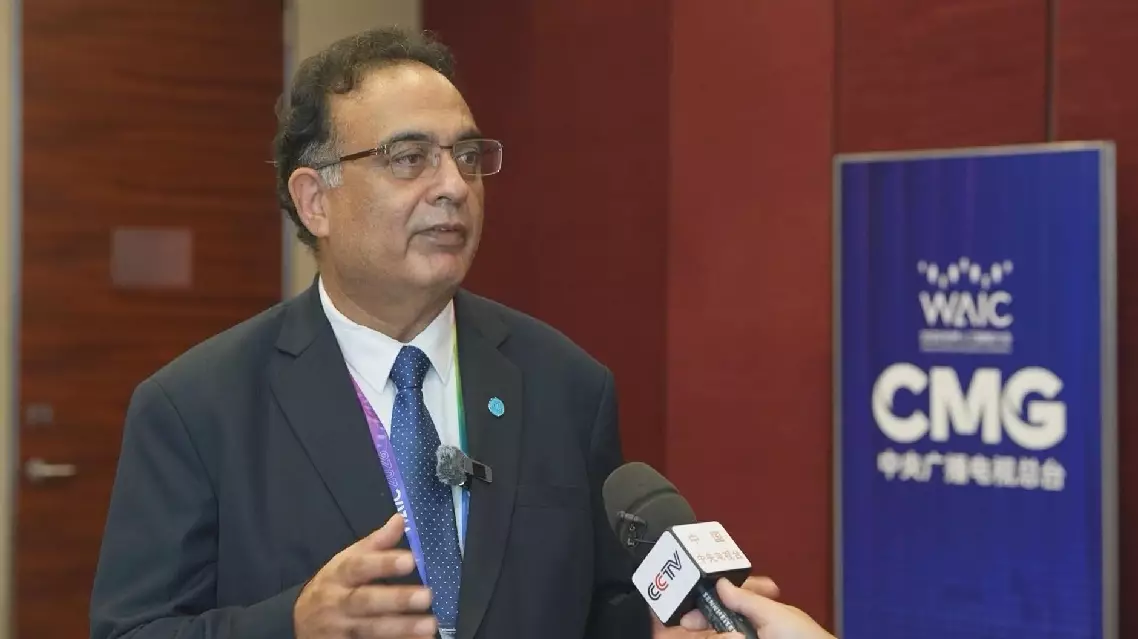
Int'l guests laud China for promoting global AI development in open, inclusive way