Tangshan Port, an important port of China's import and export, saw steady year-on-year growth in cargo throughput in the first half of this year, showing the vitality of the country's high-level opening up.
In the first half of the year, China's total imports and exports exceeded 25 trillion yuan (about 3.7 trillion US dollars) for the first time in the same period in history, maintaining its position as the world's largest trading nation in goods.
Tangshan Port plays an important role in unloading imported iron ore and exporting steel. Currently, The port has over 130 berths capable of handling ships of 10,000 tons or more, and serves as a hub on over 230 domestic and international trade routes, forming a highly efficient and convenient land-sea intermodal transport corridor connecting the world.
During the first six months, Tangshan Port handled approximately 440 million tonnes of cargo, representing a year-on-year increase of over 2.5 percent; among which, foreign trade cargo throughput reached approximately 190 million tonnes, a year-on-year increase of over 7 percent.
Ore, steel, and coal were the three main cargo types supporting the stable growth of Tangshan Port's cargo volume during the period.
In recent years, Tangshan Port has continued to build and improve its cargo transportation infrastructure to increase operational efficiency.
"A large-scale, specialized bulk cargo berth with a capacity of 250,000 tonnes and an automated conveyor belt system have been built, along with a cargo handling and unloading system including highways, railways, and conveyor belt corridors, ensuring rapid cargo unloading. The company's average throughput growth rate exceeded 8 percent in the past three years, and since the beginning of 2026, we once again have broken the record for the same period," said Jing Yanming, vice general manager of the Tangshan Port Group Ore Terminal Company under the Hebei Port Group.
As a major importer of bulk mineral raw materials such as iron ore and copper ore, China's massive domestic market continues to absorb global resources, injecting strong momentum into the world economy. On the export side, high-value-added products such as high-quality steel, heavy equipment, and engineering vehicles are continuously flowing overseas relying on the advantages of the port, precisely meeting global market demand.
"In the first half of the year, Tangshan Port's Jingtang Port Area exported 4.654 million tons of steel, a year-on-year increase of 98 percent; and the export of engineering vehicles and light and heavy trucks achieved a year-on-year increase of 115 percent," said Deng Guochao, deputy director of Tangshan Port Group Production Business Department under the Tangshan Port Group.
Liu Han has been engaged in import and export trade and logistics in the Tangshan Port Economic Development Zone for 15 years. He noted as the types of imported goods at Tangshan Port have gradually expanded, so does his business scope.
"The types of goods traded in both directions are becoming increasingly diverse, especially in exports. Previously, these were small-scale, scattered, and small-to-medium-sized orders, but now we see bulk export of specialty steel products. The trade has shifted from traditional raw materials to high-value-added goods, breaking away from the old model of relying on the export of primary raw materials," Liu said.
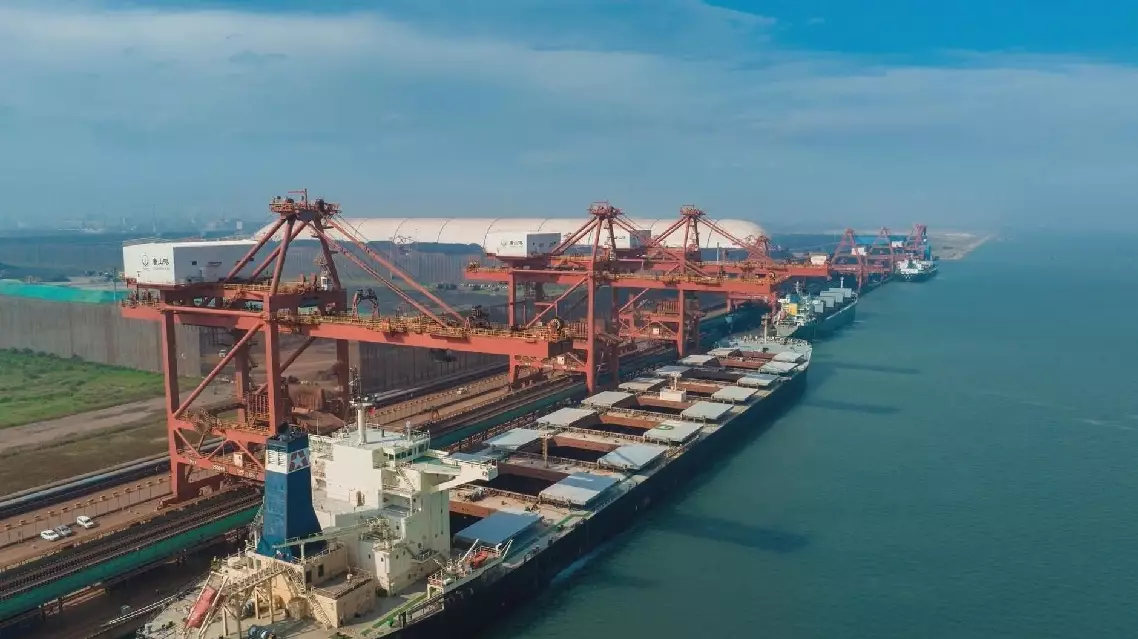
Growing cargo throughput at Tangshan Port demonstrates vitality of China's foreign trade