HUNTINGTON BEACH, Calif.--(BUSINESS WIRE)--Jul 22, 2026--
Karman Space & Defense (“Karman,” “Karman Holdings Inc.” or “the Company”) (NYSE: KRMN), a leader in the rapid design, development and production of critical, next-generation system solutions that align with the U.S. Department of Defense’s core mission priorities and the nation’s accelerating demand for access to space, today announced that Northrop Grumman Corporation has awarded a $21.3 million contract for the Proof of Manufacture (“POM”) phase of the U.S. Navy’s MK 54 Torpedo Fleet Exercise Section (“FES”) program.
This press release features multimedia. View the full release here: https://www.businesswire.com/news/home/20260722222702/en/
This contract award builds on Karman’s decades of proven performance as a critical supplier of maritime defense systems across submarine, surface ship, and autonomous naval platforms, including mission critical undersea warfare and fleet readiness applications.
The MK 54 Fleet Exercise Section (FES) is a recoverable training configuration used in U.S. Navy anti-submarine warfare exercises involving the MK 54 lightweight torpedo. It replaces the live warhead with a non-explosive exercise and recovery assembly, enabling safe deployment in training environments, collection of performance data, and recovery of the system for reuse. The FES supports fleet readiness, reduces lifecycle training costs, and enhances safety during operational training.
The MK 54 Lightweight Torpedo is deployed across multiple platforms, including submarines, aircraft, and surface ships operated by the U.S. Navy and allied partner nations.
The POM phase will validate the system’s design, manufacturing, and testing processes while supporting the transition to Low-Rate Initial Production (“LRIP”), enabling the U.S. Navy to conduct full system qualification prior to fleet fielding.
“We’re excited to move forward from the Proof of Demonstration phase to the Proof of Manufacture phase for the next generation of the U.S. Navy’s MK 54 Fleet Exercise Section,” said Jon Rambeau, chief executive officer of Karman. “The FES is an innovative solution to a complex challenge that Karman developed, tested and is now poised to produce for the Navy. Serving our nation’s military needs is core to our mission and drives our team to achieve the impossible every day.”
About Karman Space & Defense
Karman Space & Defense is a leader in the rapid design, development and production of critical, next-generation system solutions that align with the U.S. Department of Defense’s core mission priorities and the nation’s accelerating demand for access to space. Building on nearly 50 years of success, we deliver Payload Protection & Deployment Systems, Hydro/Aerodynamic Interstage Systems, and Propulsion & Launch Systems to more than 80 prime contractors supporting over 130 space and defense programs. Karman is headquartered in Huntington Beach, California, with multiple facilities across the United States. For more information, visit Karman Space & Defense.
LinkedIn
X
Instagram
YouTube
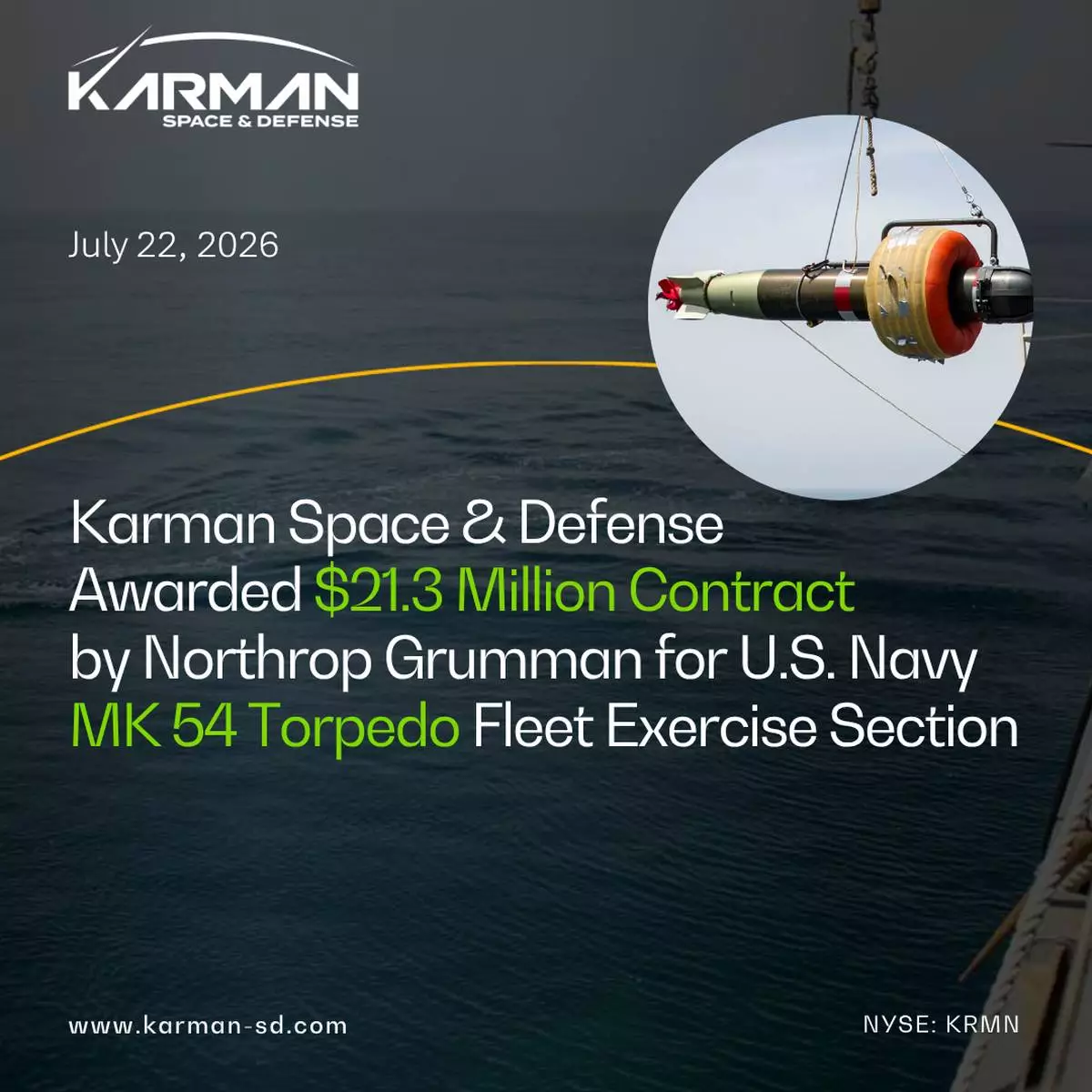
MK 54 Torpedo Fleet Exercise Section
WASHINGTON (AP) — The United States has confirmed for the first time that it has deployed weapons in space, a remarkable revelation after previous warnings about countries such as Russia possibly weaponizing a global frontier long agreed in treaties to be used for only peaceful purposes.
Air Force Secretary Troy Meink told the Air and Space Cyber Conference in Maryland on Monday that the U.S. has fielded “on-orbit space control weapons capable of defending the Joint Force against hostile adversary action.”
Meink did not detail what the weapons were, how they work or if they were targeting other objects in space or on Earth. The U.S. had warned two years ago that Russia was developing a new space-based, anti-satellite weapon, though the White House said the danger wasn’t imminent at the time.
But reports of the anti-satellite weapon reflected longstanding worries about space threats from Russia and China, given that much U.S. infrastructure is dependent on satellite communications. The U.S. has also previously demonstrated its own abilities to shoot down satellites from Earth.
In his remarks, Meink also said the Air Force was adding more autonomous systems to its capabilities and predicted the service would look “radically different” by 2032. For example, he foresaw one-way attack drones replacing artillery as the “primary killer.”
“We are increasing readiness against existing threats," he said.
The revelation comes as the Trump administration puts a growing focus on space.
In 2019, during his first term, Trump created the Space Force as a separate military branch. In his second term, he has announced the “Golden Dome” missile defense system, which includes plans to put U.S. weapons in space.
Trump said last year that he expected the system would be “fully operational before the end of my term,” which ends in January 2029, and have the capability of intercepting missiles “even if they are launched from space.”
Trump also has directed the Pentagon to pursue the space-based interceptors, in an executive order during the first week of his presidency.
The Congressional Budget Office estimated that just the space-based components of the Golden Dome could cost as much as $542 billion over the next 20 years.
The Biden administration announced in 2024 that Russia was developing a space-based nuclear weapon that could loiter in space for long durations, then release a burst that would take out satellites around it.
That kicked off a renewed debate on the idea of weapons in space at the United Nations.
In April 2024, Russia vetoed a joint U.S.-Japanese resolution that would have called on all countries not to develop or deploy nuclear arms or other weapons of mass destruction in space, as banned under a 1967 international treaty that included the U.S. and Russia.
The treaty also declared that outer space was a global commons that could be used for only peaceful purposes.
The Russian delegation called the resolution hypocritical and a double standard and instead proposed a rival resolution to ban all weapons in space “for all time.” It ultimately failed.
Russia had argued that the United States and its allies opposed a ban on all weapons in outer space because they planned to deploy weapons there.
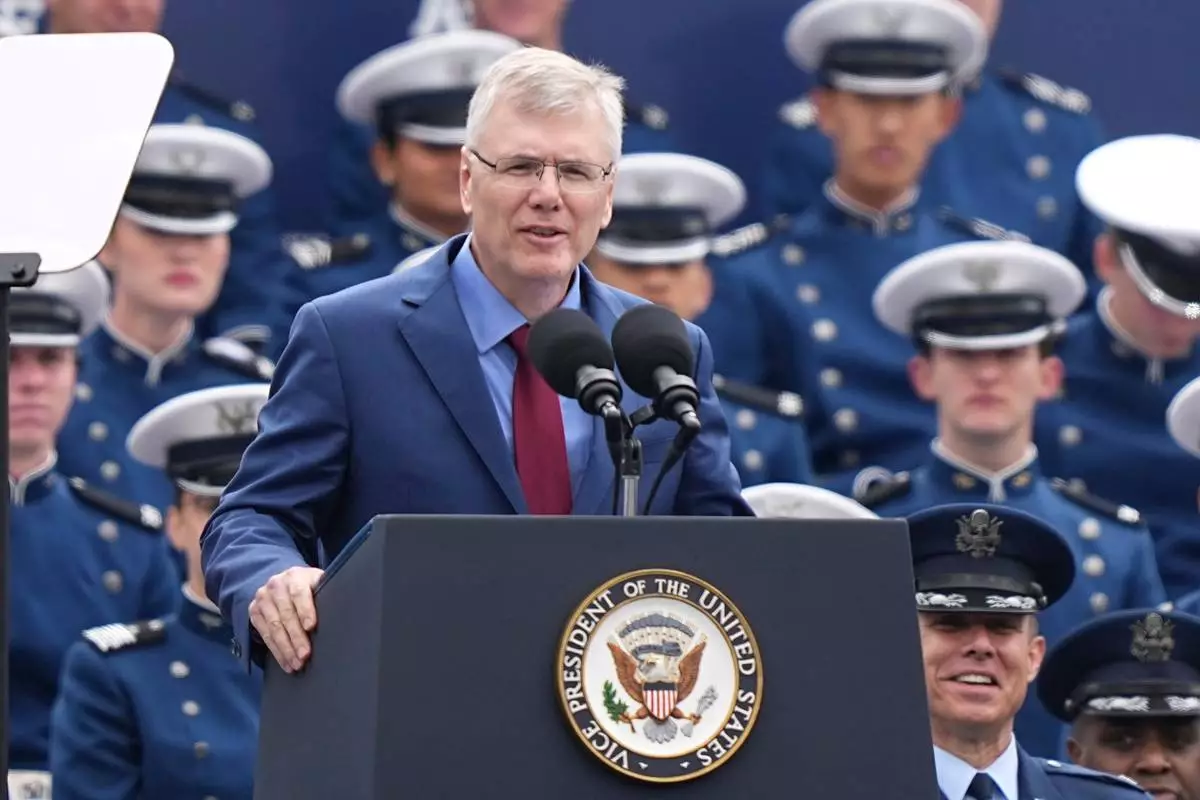
FILE - Secretary of the Air Force Troy Meink speaks during the United States Air Force Academy Graduation Ceremony at Falcon Stadium, Thursday, May 28, 2026, at the United States Air Force Academy in Colorado Springs, Colo. (AP Photo/Matt Rourke, Pool, File)