FARNBOROUGH, England--(BUSINESS WIRE)--Jul 22, 2026--
FARNBOROUGH AIR SHOW – GE Aerospace (NYSE:GE) and Magellan Aerospace Corporation signed a strategic Memorandum of Understanding (MOU) to establish maintenance, repair, and overhaul (MRO) capabilities in Canada for the F414-GE-39E engine that powers the Saab JAS 39 Gripen E fighter. The MOU is predicated on whether the Government of Canada proceeds with the acquisition of the Saab JAS 39 Gripen E fighter as part of the future Royal Canadian Air Force fighter fleet.
This press release features multimedia. View the full release here: https://www.businesswire.com/news/home/20260722242282/en/
“Today’s MOU signing builds on a six-decade relationship between GE Aerospace and Magellan that spans both military and commercial engines and will ensure the Royal Canadian Air Force has access to engine sustainment services in country to ensure readiness of the F414 engines,” said Paul Ferraro, Vice President of Defense Engines & Services at GE Aerospace.
"This MOU reflects our shared intent to build enduring sovereign aerospace capabilities in Canada," said Haydn Martin, Magellan’s Vice President, Business Development, Marketing, and Contracts. "Should the Saab JAS 39 Gripen E aircraft be selected, Magellan Aerospace will be ready to provide world-class engine maintenance, repair and overhaul services that enhance operational readiness for the Royal Canadian Air Force while maintaining highly skilled Canadian jobs, developing advanced technical expertise, and strengthening Canada's long-term defence industrial capacity."
Under the agreement, GE Aerospace would provide training and license Magellan as Canada's domestic center of excellence for engine sustainment, delivering comprehensive MRO services to support the operational readiness, availability, and long-term performance of the Royal Canadian Air Force F414 fleet. The MRO work would take place at Magellan’s Mississauga facility. The initiative would represent the next phase of Magellan’s legacy of providing Canada with the sovereign capability for advanced military engine support, ensuring that critical maintenance expertise, specialized infrastructure, and highly skilled technical personnel are developed and retained within Canada. The capability would also strengthen Canada's defense industrial base drawing on the ‘build, partner, buy’ guidance described within the Defense Industrial Strategy for a critical element of the nation's future air combat capability.
With more than five million flight hours, the F414 engine continues to exceed goals for reliability, durability, and time on wing. The F414 offers unrestricted engine performance on demand with rapid engine throttle response and zero throttle restrictions. The engine’s six-module architecture is easy to maintain and interchangeable to keep life-cycle costs low. With no scheduled overhauls and on-condition maintenance, the F414 maximizes engine availability More than 1,600 F414 engines have been delivered to eight nations.
About GE Aerospace
GE Aerospace is a global aerospace propulsion, services, and systems leader with an installed base of approximately 50,000 commercial and 30,000 military aircraft engines. With a global team of approximately 57,000 employees building on more than a century of innovation and learning, GE Aerospace is committed to inventing the future of flight, lifting people up, and bringing them home safely. Learn more about how GE Aerospace and its partners are defining flight for today, tomorrow, and the future at www.geaerospace.com.
About Magellan Aerospace Corporation
Magellan Aerospace Corporation is a Canadian headquartered global aerospace company that provides complex assemblies and systems solutions to aircraft and engine manufacturers, and defence and space agencies worldwide. Magellan designs and manufactures aeroengine and aerostructure assemblies and components for aerospace markets, advanced proprietary products for military and space markets, and provides engine and component repair and overhaul services worldwide. Magellan is a public company whose shares trade on the Toronto Stock Exchange (TSX: MAL), with operating units throughout North America, Europe, and India.
Forward Looking Statements
Some of the statements in this press release may be forward-looking statements or statements of future expectations based on currently available information. When used herein, words such as "expect", "anticipate", "estimate", "may", "will", "should", "intend", "believe", and similar expressions, are intended to identify forward-looking statements. Forward-looking statements are based on estimates and assumptions made by the Corporation in light of its experience and its perception of historical trends, current conditions and expected future developments, as well as other factors that the Corporation believes are appropriate in the circumstances. Many factors could cause the Corporation's actual results, performance or achievements to differ materially from those expressed or implied by the forward-looking statements, including those described in the "Risk Factors" section of the Corporation's Annual Information Form (copies of which filings may be obtained at www.sedar.com ). These factors should be considered carefully, and readers should not place undue reliance on the Corporation's forward-looking statements. The Corporation has no intention and undertakes no obligation to update or revise any forward-looking statements, whether as a result of new information, future events or otherwise, except as required by law.
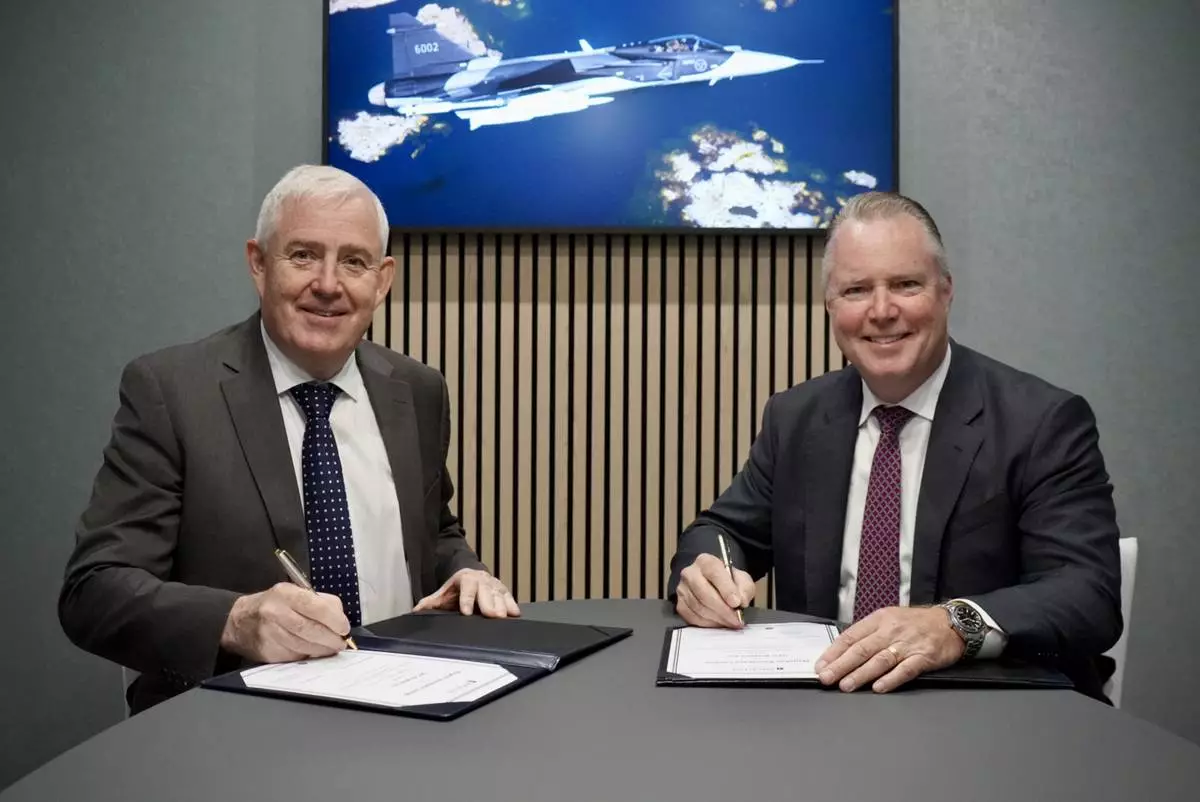
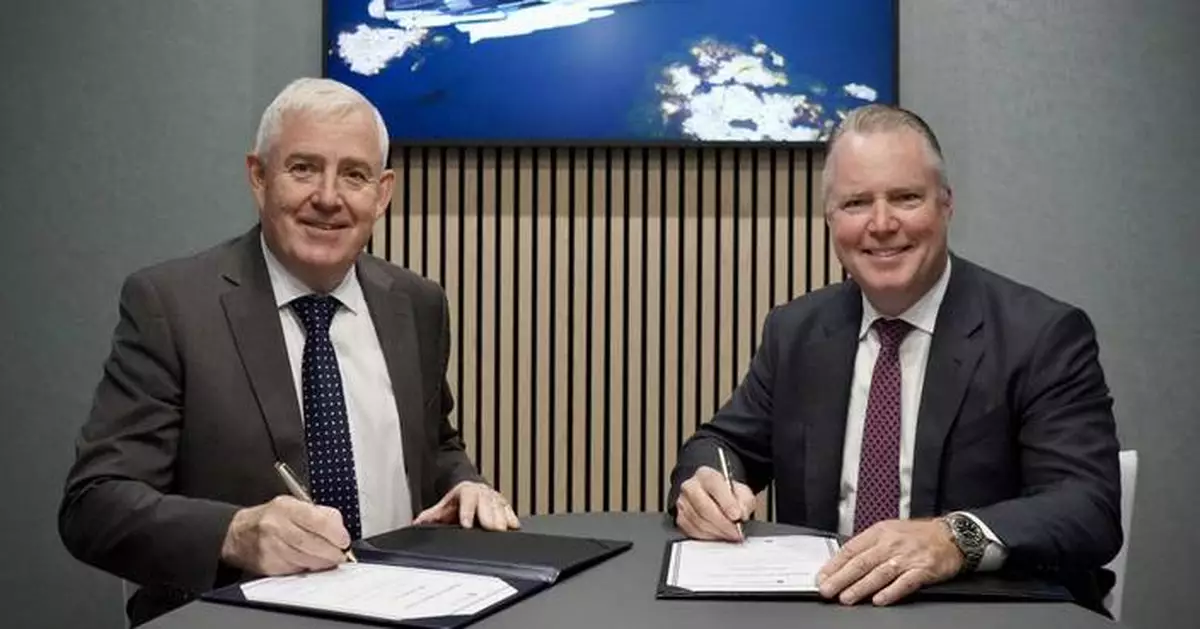
(Left to right) Haydn Martin, Vice President, Business Development, Marketing, and Contracts, Magellan Aerospace, and Paul Ferraro, Vice President & General Manager, Defense Engines & Services, GE Aerospace, sign agreement at Farnborough Air Show.

WASHINGTON (AP) — The U.S. and Saudi Arabia on Wednesday forged a new agreement that could potentially provide the kingdom with uranium enrichment capability for its civilian nuclear program.
U.S. Energy Secretary Chris Wright and Saudi Minister of Energy Abdulaziz bin Salman formally signed the nuclear cooperation agreement, known as a 123 agreement, alongside what the Trump administration described as a “bilateral safeguards agreement.”
The U.S. administration released scant details of the deal, but the framework paves the way for the building of a uranium enrichment facility in Saudi Arabia after a joint U.S.-Saudi study, according to two people familiar with the matter who were not authorized to comment publicly and spoke on the condition of anonymity.
“These agreements reflect our two nations’ shared commitment to strengthening U.S.-Saudi commercial relations, delivering prosperity at home and security to our allies abroad,” Wright said in a statement. “Rest assured, these agreements uphold the highest standards of nuclear safety and nonproliferation, while relying on the world’s best nuclear technology and scientists, designed right here in the United States.”
Earlier, Secretary of State Marco Rubio sought to head off emerging criticism of the decision under questioning by reporters about the risk that helping the Saudis fulfill their long-standing desire to enrich their own uranium could lead to new rounds of nuclear proliferation and competition in a volatile region.
“The U.S. is not going to reach any agreement with any country in the world that leads to the risk of proliferation,” said Rubio, who was traveling in the Philippines on Wednesday.
The agreement does not include the International Atomic Energy Agency 's Additional Protocol, which would allow for more monitoring, inspections and verification, according to one of the people familiar with the decision.
The deal is expected to last 30 years and involve U.S. firms in developing the program. The Energy Department in a statement said it will be submitted for review to Congress, where it could face opposition.
The announcement comes during the war against Iran launched by the U.S. and Israel, in part, to wipe out Tehran’s ability to develop a nuclear weapon. Iran has insisted its nuclear enrichment program is peaceful.
Ahead of the announcement, Alexander Bollfrass, a nuclear expert at the International Institute for Strategic Studies in London, called the deal “a revolutionary new approach” to nuclear nonproliferation policy.
“The revolutionary aspect of this agreement is that the United States is not asking Saudi Arabia to abide by the highest possible safeguards, internationally monitored safeguards that are standard and are available today, but instead is willing to at least theoretically transfer highly sensitive technology without the same level of oversight that one would expect,” Bollfrass said.
Both President Donald Trump and former President Joe Biden tried to reach a nuclear deal with the kingdom to share American technology.
Nonproliferation experts warn any spinning centrifuges within Saudi Arabia could open the door to a possible weapons program for the kingdom, something its assertive de facto leader, Crown Prince Mohammed bin Salman, has suggested he could pursue if Tehran obtains an atomic bomb.
Wright traveled to Saudi Arabia last year shortly before Trump visited and discussed building out the kingdom’s commercial nuclear power industry with his Saudi counterpart. The U.S. Department of Energy has not responded to multiple requests for comment.
Already, Saudi Arabia and nuclear-armed Pakistan signed a mutual defense pact after Israel launched an attack on Qatar targeting Hamas officials. Pakistan’s defense minister then said his nation’s nuclear program “will be made available” to Saudi Arabia if needed, something seen as a warning for Israel, long believed to be the Middle East’s only nuclear-armed state.
Enrichment isn’t an automatic path to a nuclear weapon — a nation also must master other steps, including the use of synchronized high explosives, for instance. But it does open the door to weaponization, which has fueled the West's concerns over Iran’s program.
The United Arab Emirates, a neighbor to Saudi Arabia, signed what is referred to as a “123 agreement” with the U.S. to build its Barakah nuclear power plant with South Korean assistance. But the UAE did so without seeking enrichment, something nonproliferation experts have held up as the “gold standard” for nations wanting atomic power.
Rubio, as a Republican senator representing Florida, backed a bipartisan 2018 proposal that called for requiring Congress to approve any 123 agreement with Saudi Arabia. The bill was reintroduced by a group of Democratic lawmakers in March but has not passed into law.
Typically, 123 agreements — which authorize U.S. companies to sell nuclear technology abroad — go into effect unless veto-proof majorities of Congress pass joint resolutions of disapproval.
Rosemary Kelanic, the Middle East director at Defense Priorities, a Washington think tank, said that uranium enrichment capability could give Saudi Arabia “a potent source of leverage to extract future concessions from Washington, including new security guarantees, by threatening to weaponize its program unless the United States promises enhanced military protection.”
“Giving Riyadh uranium enrichment could functionally enmesh the United States with the Kingdom of Saudi Arabia forever,” Kelanic added.
Rep. Brad Sherman, a California Democrat, predicted the deal would benefit U.S. nuclear giant Westinghouse, which builds the large light-water reactors Saudi Arabia is seeking.
The Trump administration said last month it is providing $17.5 billion in loans to speed development of 10 new large nuclear reactors designed by Westinghouse to meet skyrocketing power demand from massive data centers. The new reactors could use the same design, Westinghouse’s AP1000, in the planned Saudi deal.
Sherman said the U.S. military is “bombing Iran because they insist upon enriching and reprocessing” nuclear material.
Now it appears that U.S. officials “are entering into an agreement with Saudi Arabia, giving them the green light to reprocess and to enrich, and the only difference I see here is that Westinghouse stands to make an awful lot of money on this deal, whereas the Iranians were not enriching American companies,” Sherman said at a House Foreign Affairs Committee hearing Wednesday.
Price reported from Manila, Philippines. Associated Press writers Danica Kirka in London and Will Weissert contributed to this report.
President Donald Trump speaks while meeting with Lebanese President Joseph Aoun in the Oval Office at the White House, Tuesday, July 21, 2026, in Washington. (AP Photo/Mark Schiefelbein)
Secretary of State Marco Rubio speaks during a press conference on the sidelines of the Association of Southeast Asian Nations (ASEAN) Foreign Ministers' Meeting in Pasay, Metro Manila, Philippines Wednesday, July 22, 2026. (Brendan Smialowski/Pool Photo via AP)