JAKARTA, Indonesia (AP) — Indonesian President Prabowo Subianto received a collection of cultural artifacts from the country's Papua region that had been illegally taken to the United States, officials said Thursday.
The handover took place late Wednesday during a meeting with FBI Director Kash Patel at Prabowo’s residence in the Indonesian capital Jakarta. Patel arrived in Jakarta shortly after talks with Cambodian Prime Minister Hun Manet concerning joint efforts to combat international online scam operations that cheat victims out of billions of dollars annually.
The exchange underscored growing cooperation between Indonesia and the U.S. in recovering stolen cultural heritage and returning the items to the country of origin, Indonesia Culture Minister Fadli Zon said.
The artifacts from Papua are part of the cultural heritage of the Dani and Asmat tribes and Lake Sentani communities. They were repatriated through cooperation between Indonesia’s Culture Ministry and the FBI after provenance research established the objects had been smuggled out of Indonesia, Zon said.
“These are very valuable objects because this repatriation process is part of our effort to restore our cultural sovereignty,” Zon said, adding that the artifacts will be displayed at Indonesia’s National Museum.
Images from Indonesia's Presidential Secretariat show several polished stone ax heads and ceremonial objects traditionally associated with Papuan societies.
Traditional Papuan stone axes were more than utilitarian tools. Among highland communities such as the Dani, they historically served as symbols of wealth and status, were exchanged in marriage and ceremonial transactions and were often passed down as treasured ancestral heirlooms, the Culture Ministry said.
The return is the latest in a series of efforts by U.S. authorities to recover and repatriate Southeast Asian cultural property that was trafficked through international antiquities networks, the U.S. Embassy in Jakarta said in a statement.
Earlier this month, U.S. Attorney for the Southern District of New York Jay Clayton announced the return of two bronze, Buddhist sculptures depicting Avalokiteshvara from the eighth century, the embassy said.
During a repatriation ceremony at the Indonesian Consulate on July 10, Clayton said U.S. authorities would continue working with Homeland Security Investigations to combat illicit trafficking in cultural property and return stolen artworks to their origin countries.
The sculptures were stolen from Indonesian archaeological sites and sold to an American collector by the late antiquities dealer Douglas Latchford. The sculptures were among 34 Southeast Asian antiquities voluntarily relinquished by the collector in 2021 after investigators determined they had been looted.
The Indonesian sculptures were removed decades ago by organized looters before entering the international art market through Latchford, a Bangkok-based dealer who was indicted by U.S. authorities in 2019 for allegedly orchestrating a large-scale trafficking scheme involving antiquities looted from Cambodia and other Southeast Asian countries. The case was later dismissed following his death, the U.S. embassy said.
The FBI has previously assisted Indonesia in recovering stolen cultural objects, including bronze statues and artifacts from historical and archaeological sites, according to Zon, who expressed hope that the cooperation on cultural repatriation and restitution would continue.
Indonesia has intensified efforts in recent years to track down cultural treasures scattered abroad through colonial-era collecting, theft and illicit trafficking, including from the Netherlands, which colonized Indonesia for centuries.
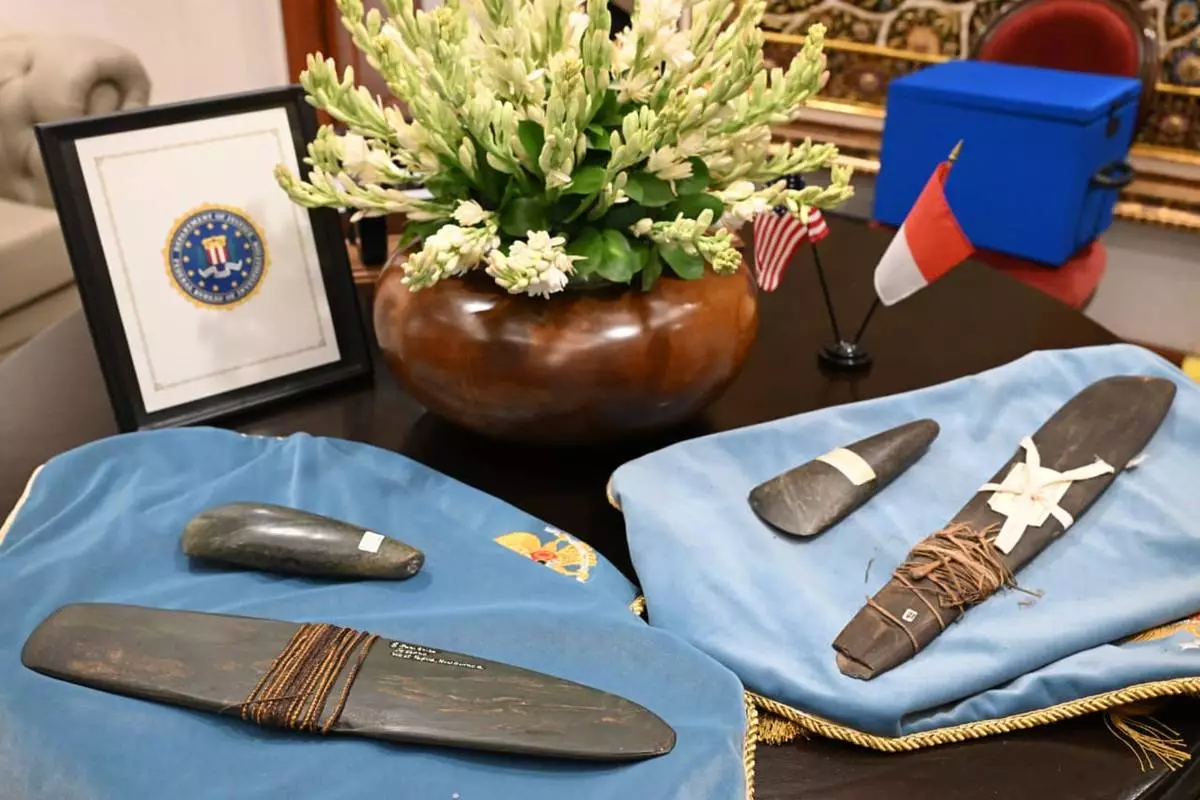
CHECKING DATE - In this photo released by the Press, Media and Information Bureau of the Indonesian Presidential Secretariat, several repatriated artifacts are presented during the meeting between Indonesian President Prabowo Subianto and FBI Director Kash Patel in Jakarta, Indonesia, Wednesday, July 22, 2026. (Indonesian Presidential Secretariat via AP)

In this photo released by the Press, Media and Information Bureau of the Indonesian Presidential Secretariat, Indonesian President Prabowo Subianto, right, walks with FBI Director Kash Patel during their meeting in Jakarta, Indonesia, Wednesday, July 22, 2026. (Indonesian Presidential Secretariat via AP)

In this photo released by the Press, Media and Information Bureau of the Indonesian Presidential Secretariat, Indonesian President Prabowo Subianto, left, talks with FBI Director Kash Patel during their meeting in Jakarta, Indonesia, Wednesday, July 22, 2026. (Indonesian Presidential Secretariat via AP)
VANCOUVER, British Columbia--(BUSINESS WIRE)--Jul 23, 2026--
Nano One® Materials Corp. ("Nano One" or the "Company") (TSX: NANO) (OTCQB: NNOMF) (Frankfurt: LBMB), a process technology company specializing in lithium-ion battery cathode active materials (CAM), is pleased to provide a further progress update on its lithium iron phosphate (LFP) production capacity expansion project at its Candiac Facility, which will increase total production capacity to approximately 800 tonnes per annum (tpa).
This press release features multimedia. View the full release here: https://www.businesswire.com/news/home/20260723280236/en/
Expansion Project Update
Further to its March 17, 2026 update, the Company is pleased to report that detailed engineering is now 85% complete as of mid-July 2026 and that the expansion project remains on schedule.
Major equipment purchase orders were completed in March 2026; some equipment has been shipped, with initial deliveries already received at the Candiac Facility. Vendors for the balance of smaller equipment have been selected, with final purchase orders expected to be completed by the end of August 2026. Approximately 95% of the project's equipment, measured by procurement cost—and 100% of IP-sensitive equipment—is being sourced from Canada, the US and the EU. The project remains on track with commissioning of the newly expanded production capacity targeted for the first half of 2027.
“Having now attained 85% completion as of mid-July, we expect to complete the project on time and on budget,” states Denis Geoffroy, Chief Operating Officer of Nano One. "Our currently contracted funding programs, for which we have approximately $24 million left undrawn*, together with our working capital, fund this capital project to completion."
Existing Production and Scale-Up at Candiac
The Candiac Facility demonstrates the One-Pot™ process in full-scale, production-intent equipment, de-risking adoption and enabling Nano One's Design One Build Many licensing and joint-venture model. The expansion integrates and automates an existing full-scale 20m³ reactor whose design can be replicated in modular fashion. Alongside this, the lines generate commercial sales and support customer sample qualification, product and process improvement and raw material validation.
The Candiac Facility includes multiple front-end One-Pot production lines feeding shared downstream processing equipment, each designed for a distinct role, with total facility capacity of approximately 800 tpa once the expansion is commissioned:
A product C-sample is required to demonstrate production readiness and generally consists of several 1-tonne batches. The objective is to provide comfort to end customers that the material can be produced repeatably at or near production scale, off production-intent equipment and processes, with the quality control and assurance systems in place.
Design One Build Many—Licensing and Partnerships
Nano One’s Design One Build Many model lowers the barrier to technology adoption. A cathode producer can adopt One-Pot technology without the inherent lead times and upfront capital required to build its own Demonstration Line, and the cell manufacturers it supplies keep working with existing supply chain partners. The licensing model is flexible: customers with a preferred engineering vendor can license the One-Pot technology directly from Nano One and engineer the production line through to a final investment decision, while those seeking a more complete solution can procure the integrated CAM Package developed with Worley.
The CAM Package provides a feasibility-level One-Pot production line with pre-qualified equipment vendors and raw material feedstocks, and Worley's technology solutions team supports project execution and deployment, helping customers de-risk their investment. Both paths are backed by the Candiac Facility, where customers can run sample validation cycles to secure large-volume offtakes before building a plant of their own, supported by operator training built on Nano One's LFP manufacturing know-how—reducing start-up cost and risk.
* As of the Company’s most recent Q1 2026 Public Filings
About Nano One®
Nano One® Materials Corp. (Nano One) is a process technology company changing how cathode active materials (CAMs) are produced for lithium-ion batteries. Nano One’s platform is built on a portfolio of patented processes, decades of manufacturing know-how and modular plant designs that enable scalable, cost-competitive and easier-to-permit CAM production with resilient supply chains. The technology eliminates wastewater and byproducts while enabling regionally sourced raw materials and reducing exposure to foreign supply chain volatility. Modular plants are designed with fewer steps to reduce capex, energy and environmental intensity and to accelerate deployment, manufacturing and licensing. Product development and process optimization are based at Nano One’s Innovation Centre in Burnaby, British Columbia while piloting, demonstration and commercial production are based in Candiac, Québec, supported by a team with more than 15 years of commercial cathode manufacturing experience supplying global cell manufacturers. Strategic collaborations with global partners including Sumitomo Metal Mining, Rio Tinto and Worley support Nano One’s Design-One-Build-Many growth strategy. Nano One has received funding support from the Governments of Canada, the United States, Québec and British Columbia.
For more information, please visit nanoOne.ca.
Cautionary Notes and Forward-Looking Statements
Certain information contained herein may constitute "forward-looking information" and "forward-looking statements" (collectively, "forward-looking statements") within the meaning of applicable securities legislation. Generally, all statements, other than statements of historical fact, are forward-looking statements. Forward-looking statements in this news release include, but are not limited to, statements regarding the timing, cost, scope and completion of the Candiac Facility expansion and the commissioning of approximately 800 tpa of capacity in the first half of 2027; the expectation that the project will be completed on time and on budget and funded to completion from contracted funding programs (including approximately $24 million of undrawn funding) together with working capital; the expected benefits and performance of the One-Pot™ process; the ability of the expanded capacity to support large-volume sampling, customer qualification, offtakes, plant design licensing and joint-venture opportunities; and the Company's "Design One Build Many" strategy and its collaborations with Sumitomo Metal Mining, Rio Tinto and Worley. Generally, forward-looking statements can be identified by the use of terminology such as "believe", "expect", "anticipate", "plan", "intend", "continue", "estimate", "may", "will", "should", "ongoing", "target", "targeted", "potential" or variations of such words, or statements that certain actions, events or results "will" occur.
Forward-looking statements are based on the current opinions and estimates of management as of the date such statements are made and are not, and cannot be, a guarantee of future results or events. They are subject to known and unknown risks, uncertainties and other factors that may cause actual results, performance or achievements to differ materially from those expressed or implied, including but not limited to: project delays, cost overruns and execution challenges in engineering, procurement, construction, commissioning and scale-up; the availability and timely drawdown of contracted funding and satisfaction of related milestones; the performance and scale-up of the One-Pot™ process; the timing and conversion of customer sampling and qualification into commercial agreements; the Company's licensing, joint-venture and supply-chain strategies; general and global economic, market and regulatory changes; the Company's need for and access to additional capital; competition and changes in battery chemistries and demand; and the other risk factors identified in Nano One's most recent Annual Information Form and MD&A, and its recent securities filings, available atwww.sedarplus.ca.
Although management has attempted to identify important factors that could cause actual results to differ materially from those contained in forward-looking statements, there may be other factors that cause results not to be as anticipated, estimated or intended. There can be no assurance that such statements will prove to be accurate, as actual results and future events could differ materially. Accordingly, readers should not place undue reliance on forward-looking statements. The Company does not undertake any obligation to update forward-looking statements, except as required by applicable securities laws.
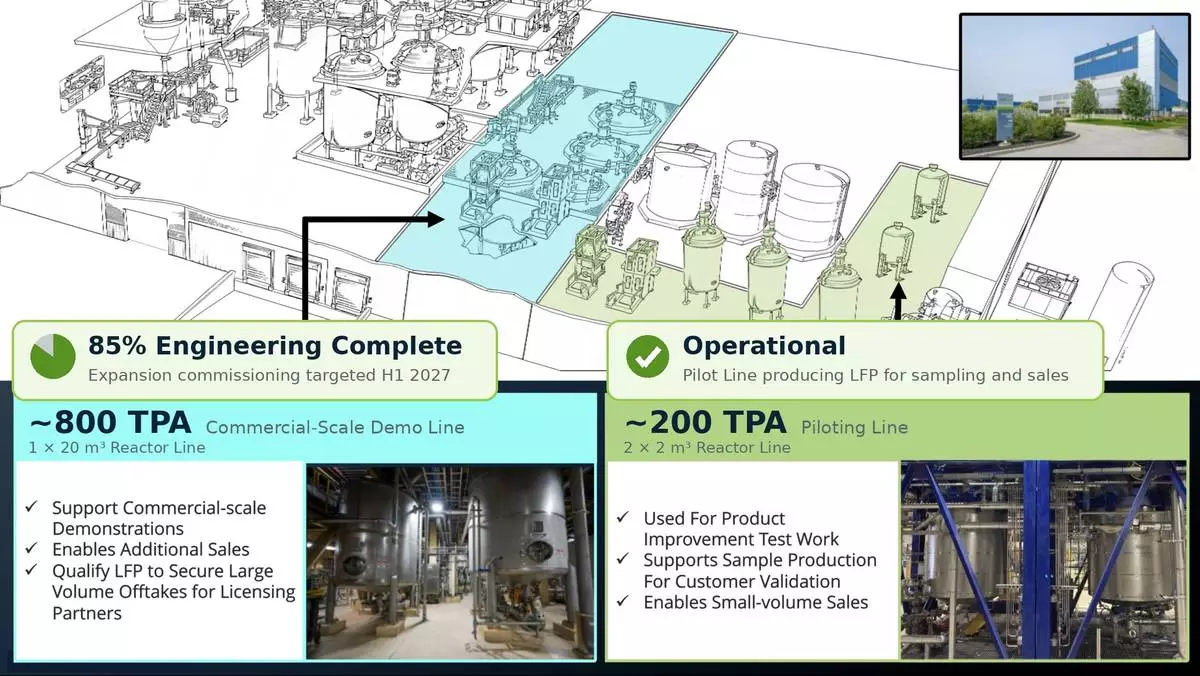
Image: Nano One’s Candiac Facility—Demonstration Line expansion 85% engineering complete as of mid-July 2026.