COEUR D’ALENE, Idaho--(BUSINESS WIRE)--Jul 23, 2026--
Idaho Strategic Resources, Inc. (NYSE American: IDR) (“IDR”, “Idaho Strategic” or the “Company”) is pleased to announce that it has identified significant heavy rare earth elements mineralization, including the increasingly important element yttrium, at its Diamond Creek project.
This press release features multimedia. View the full release here: https://www.businesswire.com/news/home/20260723497223/en/
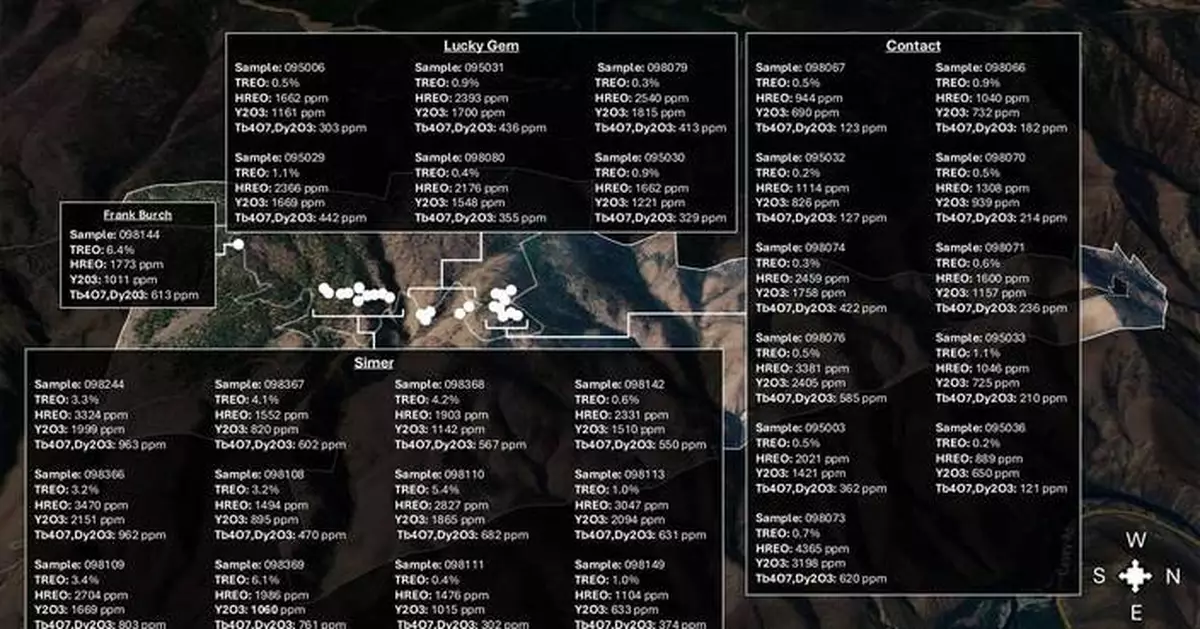
Surface sampling has revealed rare earth elements (REE) mineralization at four distinct prospects along a 3.2-kilometer lineament. From north to south, these prospects are known as Contact, Lucky Gem, Simer and Frank Burch. Select samples are shown in Figure 1 and results average approximately 1.8% total rare earth oxides (TREO) with enriched heavy rare earth oxides (HREO) averaging greater than 2,000 ppm, including more than 1,300 ppm yttrium. Of the four distinct prospects mentioned above, the Lucky Gem prospect at Diamond Creek, was trenched and drilled in 2022. A single 32-meter surface trench averaged 1.5% TREO with HREO enrichment averaging approximately 2,300 ppm including 1,600 ppm yttrium. Similarly, Diamond Creek drillhole DC 22-8, also located at the Lucky Gem prospect, intersected 11.3 meters of mineralization averaging 1.5% TREO with more than 2,500 ppm HREO including 1,700 ppm yttrium, reported in drilled thickness.
These results compare quite favorably to many North American peers, where HREO enrichment is less common than light rare earth dominance seen at existing REE mines and development projects. In the context of U.S. dependence on China for refined heavy rare earths—essential for high-temperature magnets in EVs, wind turbines, defense systems, and data centers—Diamond Creek’s mineralization offers the potential for an early-stage domestic pathway to bolster supply chains amid looming fears of reinstated Chinese dual-use export controls and domestic sourcing mandates (see risk score in Figure 2).
Idaho Strategic’s President and CEO, John Swallow commented, “Our interest in additional Diamond Creek exploration is the result of an increasing number of conversations with global end-users who lack a reliable ex-China source of heavy rare earth elements and yttrium. While these groups have always been around, it is only lately that conversations have been driven more by their need for supply chain resiliency (actual supply) rather than financial preferences/sensitivities. In the grand scheme of things, heavy rare earths and yttrium typically are not a huge cost driver of the finished goods that they are a part of, making the potential for a small-scale domestic operation appealing to a price-insensitive customer. While still early-stage and requiring further test work, IDR’s results across its Idaho REE-Th Belt holdings (including Diamond Creek, Lemhi Pass, and Mineral Hill) underscore the strategic potential of Idaho’s REE endowment to meet the growing demand for heavy rare earths and yttrium, reducing geopolitical exposure in critical technologies.”
Yttrium, in particular, stands out as a potential high-value product at Diamond Creek, with concentrations frequently in the 800–2,000 ppm yttrium range. As a key input for superconductors, high-performance alloys, phosphors, and ceramics, yttrium faces similar supply risks as other heavy rare earths. Moving forward, IDR plans to conduct additional exploration fieldwork at Diamond Creek in 2026, further refine mineralogical studies (which show xenotime as the primary yttrium bearing mineral to date), and begin evaluating the potential for a bulk sample of ore from the Lucky Gem prospect. Based on previous work at Lucky Gem, the Company has produced a preliminary geological model suggesting the mineralized zone may contain approximately 20,000 tonnes of material grading 1,600 ppm yttrium, with the potential to substantially grow through additional exploration (Figure 3).
Beyond the mineralogical and HREO grade advantages seen to date at Diamond Creek, the project also benefits from relatively easy access from the town of Salmon, Idaho and the Company’s Salmon field office, located about 30 minutes from the site. Additional benefits include the potential for relatively easy access to ore that outcrops at the surface within a road cut that wouldn’t require drilling and blasting for initial bulk sample extraction. With the 2026 geology field season in Salmon in full swing, Idaho Strategic is looking forward to sharing its results when appropriate.
The early-stage model of mineralization at Lucky Gem is conceptual in nature and based on limited exploration to date. Under S-K 1300 guidelines, it is insufficient to be considered a formal Mineral Resource. Additional drilling, geological modeling, and independent review will be required to determine whether a Mineral Resource can be estimated. Idaho Strategic is not relying on the estimate for economic or development decisions. Results from Idaho Strategic’s planned exploration may be combined with prior exploration results to provide an updated resource estimate in the future.
Qualified Person and QA/QC
IDR's Vice President of Exploration, Robert John Morgan, PG, PLS is a qualified person as such term is defined under S-K 1300 and has reviewed and approved the technical information and data included in this press release, however he has not reviewed and approved the modelled mineralization at the Lucky Gem prospect under S-K 1300 guidelines. Rare earth samples from the Lucky Gem prospect were analyzed by ALS Chemex using Ore Grade Rare Earth Elements and Niobium analysis (ME-MS81h). The Company’s QA/QC program includes certified reference materials to ensure analytical accuracy, with results reviewed by a Qualified Person.
About Idaho Strategic Resources, Inc.
Idaho Strategic Resources (IDR) is an Idaho-based gold producer which also controls the largest rare earth elements land package in the United States. The Company’s production-backed exploration business plan was established in anticipation of today’s volatile geopolitical and macroeconomic environment. In addition to gold and gold production, the Company has built a substantial land position in Idaho, providing significant exploration exposure to gold and rare earth elements - in addition to thorium, copper, and silver. IDR finds itself in a unique position as the only publicly traded company with growing gold production and significant blue-sky potential for discovery and development in one Company.
For more information on Idaho Strategic Resources, visit www.idahostrategic.com or call:
Travis Swallow, Investor Relations & Corporate Development
Email: tswallow@idahostrategic.com
Phone: (208) 625-9001
Forward Looking Statements
This release contains “forward-looking statements” within the meaning of Section 27A of the Securities Act of 1933, as amended, and Section 21E of the Securities Exchange Act of 1934, as amended that are intended to be covered by the safe harbor created by such sections. Often, but not always, forward-looking information can be identified by forward-looking words such as “intends”, “potential”, “believe”, “plans”, “expects”, “may”, “goal’, “assume”, “estimate”, “anticipate”, and “will” or similar words suggesting future outcomes, or other expectations, beliefs, assumptions, intentions, or statements about future events or performance. Forward-looking information includes, but are not limited to, the potential for Diamond Creek to be a viable source of rare earth elements in the future, the potential for Idaho Strategic to advance the project through additional exploration, the potential for continued exploration success, the potential for future conversations with industry participants, the potential for a small-scale domestic project to be preferred by industry end-users, the potential for a bulk sample of mineralization to occur, and the potential for mineralogical studies and processing test work to yield favorable results. Forward-looking information is based on the opinions and estimates of Idaho Strategic Resources as of the date such information is provided and is subject to known and unknown risks, uncertainties, and other factors that may cause the actual results, level of activity, performance, or achievements of IDR to be materially different from those expressed or implied by such forward-looking information. Investors should note that IDR’s claim as the largest rare earth elements landholder in the U.S. is based on the Company’s internal review of publicly available information regarding the rare earth landholdings of select companies within the U.S., which IDR is aware of. Investors are encouraged not to rely on IDR’s claim as the largest rare earth elements landholder in the U.S. while making investment decisions. The forward-looking statement information above, and those following are applicable to both this press release, as well as the links contained within this press release. With respect to the business of Idaho Strategic Resources, these risks and uncertainties include risks relating to widespread epidemics or pandemic outbreaks; interpretations or reinterpretations of geologic information; the accuracy of historic estimates; unfavorable exploration results; inability to obtain permits required for future exploration, development or production; general economic conditions and conditions affecting the industries in which the Company operates; the uncertainty of regulatory requirements and approvals; fluctuating mineral and commodity prices; the ability to obtain necessary future financing on acceptable terms; the ability to operate the Company’s projects; and risks associated with the mining industry such as economic factors (including future commodity prices, and energy prices), ground conditions, failure of plant, equipment, processes and transportation services to operate as anticipated, environmental risks, government regulation, actual results of current exploration and production activities, possible variations in ore grade or recovery rates, permitting timelines, capital and construction expenditures, reclamation activities. Although the Company has attempted to identify important factors that could cause actual results to differ materially from those contained in forward-looking information, there may be other factors that cause results not to be as anticipated, estimated, or intended. Readers are cautioned not to place undue reliance on such information. Additional information regarding the factors that may cause actual results to differ materially from this forward‐looking information is available in Idaho Strategic Resources filings with the SEC on EDGAR. IDR does not undertake any obligation to update publicly or otherwise revise any forward-looking information whether as a result of new information, future events or other such factors which affect this information, except as required by law.
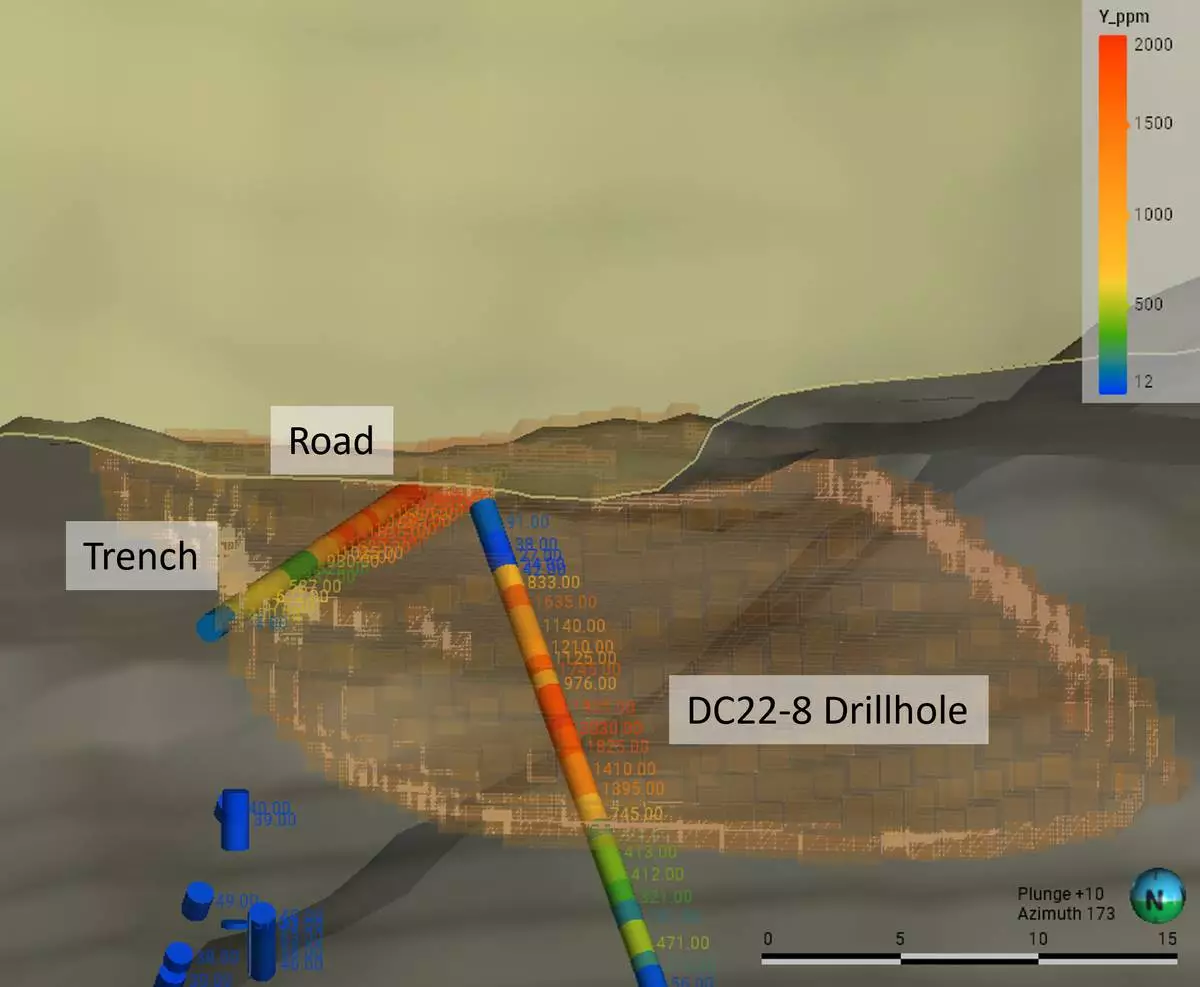
Figure 3: Block model of the identified rare earth elements mineralization at Lucky Gem, with a focus on estimated contained yttrium. The block model is based on one 32-meter trench and one drillhole with 16-meter extrapolation. The mineralization starts at surface and outcrops in an existing road cut.
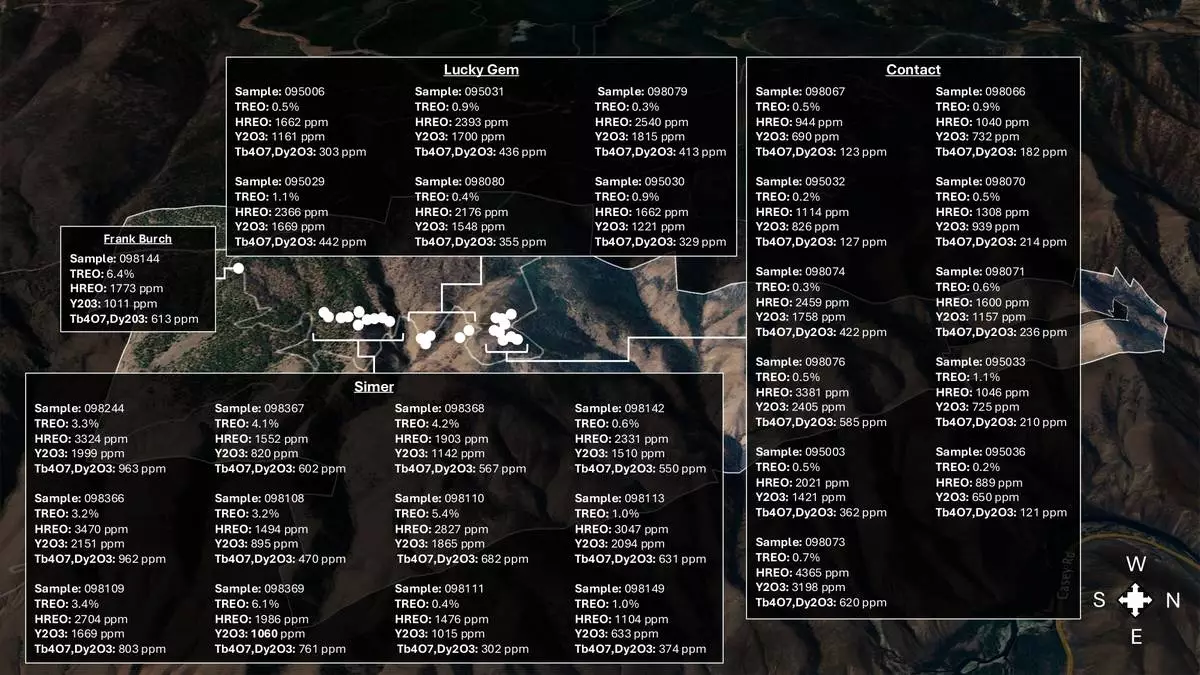
Figure 1: Select IDR surface sampling results along a 3.2-kilometer lineament at Diamond Creek. Prospects identified through surface sampling from north to south are Contact, Lucky Gem, Simer, and Frank Burch.