- HD Korea Shipbuilding & Offshore Engineering signs definitive agreement with Siemens to implement next-generation marine platform and establish a 3D single-data platform
- Aims to build an autonomous manufacturing system that digitally connects the entire shipbuilding process, including design, production, logistics, inspection and sea trials
- "By building a smart shipyard of the future powered by AI and digital technologies, we will set a new standard for the shipbuilding industry"
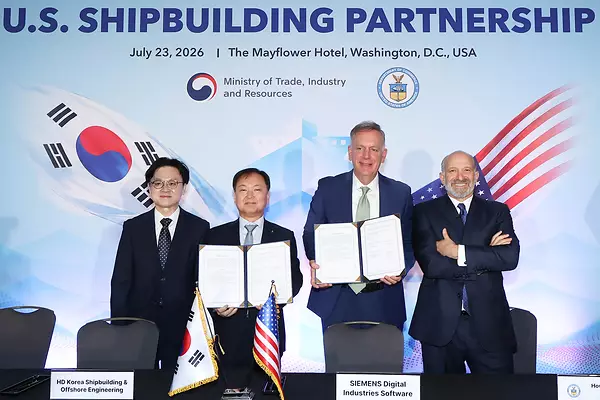
SEOUL, South Korea, July 24, 2026 /PRNewswire/ -- HD Korea Shipbuilding & Offshore Engineering, the intermediary holding company for HD Hyundai's shipbuilding business, shared on Thursday, July 23, that it has signed a definitive agreement with Siemens Digital Industries Software, a global engineering software company, to implement a next-generation marine platform.
The agreement marks a key step in the company's' efforts to develop an AI-powered shipyard of the future and drive the transformation of the shipbuilding industry.
The signing ceremony, held in Washington, D.C., was attended by executives and representatives from both companies, including President & CEO of HD Korea Shipbuilding & Offshore Engineering, Kim Hyung-kwan, and President & CEO of Siemens Digital Industries Software, Tony Hemmelgarn.
The next-generation marine platform is centered on integrating the entire shipbuilding process—from vessel design and production to supply chain management, quality control and maintenance—into a single 3D-model-based data environment powered by AI and digital technologies, enabling the use of consistent information across every stage of the process.
Through the platform, shipyards will be able to transmit design changes and real-time production status updates directly to the production floor and supply chain, enabling informed decision-making to help prevent schedule delays and quality issues.
To support this effort, HD Korea Shipbuilding & Offshore Engineering plans to develop a Virtual Shipyard that mirrors actual shipyard operations, enabling the simulation of production processes and equipment operations in a digital environment. As learning and analytical capabilities are essential to realizing a future Physical AI shipyard, where robots and autonomous production systems perform tasks independently, HD Korea Shipbuilding & Offshore Engineering plans to further enhance the next-generation marine platform.
Ultimately, the company aims to establish an autonomous manufacturing system that digitally connects every stage of ship construction, from design and production to logistics, inspection, and sea trials.
"As a leader in industrial AI, automation and digital twin software, Siemens is uniquely positioned to help transform how shipyards design, build and sustain the next generation of vessels," said Tony Hemmelgarn, President and CEO of Siemens Digital Industries Software. "This strategic collaboration is about more than technology deployment, it's about establishing a repeatable blueprint for modern shipbuilding. By combining Siemens' digital capabilities with HD Hyundai's operational excellence, we can help shipbuilders improve throughput, quality, and workforce productivity while strengthening global shipbuilding competitiveness."
"AI is not merely a tool for improving productivity, but a transformative technology that is reshaping how ships are designed, built and operated," said H.K. Kim, President & CEO of HD Korea Shipbuilding & Offshore Engineering. "By integrating AI, digital twin, and automation technologies into a connected digital shipyard environment, we aim to establish a future-ready model for the shipbuilding industry. Together with Siemens, we look forward to helping accelerate the digital transformation of shipyards worldwide, while contributing to the modernization and competitiveness of the U.S. shipbuilding industry."
** This press release is distributed by PR Newswire through automated distribution system, for which the client assumes full responsibility. **
HD Korea Shipbuilding & Offshore Engineering Pursues AI-Driven Transformation of Shipbuilding Industry
SHENZHEN, China, July 24, 2026 /PRNewswire/ -- Australia's approach to Beyond Visual Line of Sight (BVLOS) drone operations has entered a new phase. Since the Civil Aviation Safety Authority (CASA) introduced its TMI 2025-03 policy, qualified Remote Operator Certificate (ReOC) holders have been able to self-assess and secure broad area BVLOS approvals — cutting what was once a months-long approval process down to days or weeks. DJI Dock, with its automated, remote-operated capability, has become a key enabler for operators across mining, agriculture and beyond looking to capitalise on this regulatory shift.
Under the TMI 2025-03 framework, CASA offers four standardised pathways: A1 and A2 for RPA with a physical dimension of less than 1 metre, and B1 and B2 for RPA with a physical dimension between 1 and 3 metres. Rather than applying for site-specific approval on a per-project basis, qualified operators can now self-assess whether an operating area meets the defined criteria and proceed accordingly. This has reduced typical approval timelines from six to twelve months down to a matter of days or weeks in many cases. Mining, agriculture, energy, infrastructure and emergency services have been identified as the sectors set to benefit most, and a growing number of operators have already been certified under the framework, with more applications progressing through the pipeline — reflecting rising industry confidence in the new pathway.
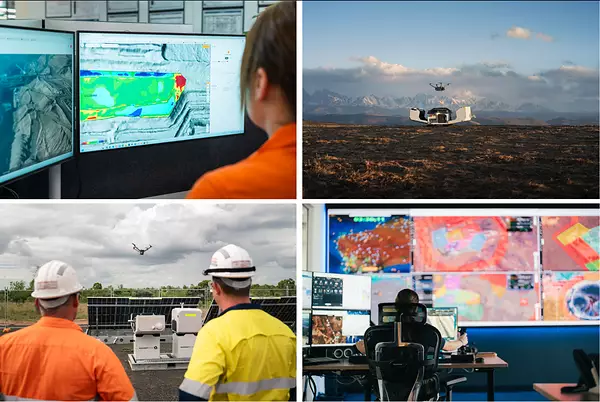
In the mining sector, this regulatory shift is already translating into measurable operational gains. Large-scale mine sites often span vast, remote terrain, where routine pit monitoring, surveying and emergency response have traditionally required significant on-site resourcing — a challenge Broad Area BVLOS is now helping operators address. At mine sites operated by BMA and Rio Tinto, RocketDNA's xBot system supports pit monitoring, emergency response and surveying missions under its own Broad Area BVLOS capability. RocketDNA has also achieved BARS Gold Certification, a safety standard widely required by Tier 1 mining companies. Its Perth and Adelaide-based Remote Operations Centres (ROC) now runs BVLOS operations around the clock, completing approximately 4,500 flights per month - reflecting the growing maturity of BVLOS operations across the sector.
Agriculture is expected to be the next sector to benefit significantly from this shift. From crop monitoring to livestock and paddock inspection, the ability to operate BVLOS across broader areas removes a constraint that has historically limited large-scale agricultural drone deployment. Unlike mining sites, which are typically confined to a single, well-defined lease area, agricultural operations often span multiple properties across a region — making the ability to cover broad areas under a single approval especially valuable for operators serving the sector at scale. DJI is working with a number of Australian agricultural drone operators to explore real-world applications in this space, with further case studies to be announced in the coming months.
Underpinning much of this progress is the capability of DJI's Dock 3 and FlightHub 2 platform. Dock 3 supports operations at ranges of up to 10 kilometres and is built to operate reliably across a wide temperature range, from -25°C to 45°C, suited to the demands of remote, harsh-environment deployment across Australia. FlightHub 2 adds AI-assisted detection and automated reporting, further reducing the coordination overhead for operators managing multiple sites and helping turn a single approval into a genuinely scalable operating model.
As CASA continues to modernise its regulatory framework, Australia is shifting from a market where only individual projects could fly BVLOS, to one where a growing number of operators can scale standardised, broad area operations. This shift is unlocking new efficiencies for operators across mining, agriculture and beyond, and marks a new phase in the scaled deployment of autonomous drone infrastructure across the Australian market.
Learn more:
https://enterprise-insights.dji.com/blog/a-new-era-for-australian-aviation-unlocking-the-true-potential-of-bvlos
About DJI
Since 2006, DJI has led the world with civilian drone innovations that have empowered individuals to take flight for the first time, visionaries to turn their imagination into reality, and professionals to transform their work entirely. With a solution-oriented mindset and genuine curiosity, DJI has expanded its ambitions into areas such as renewable energy, agriculture, public safety, surveying and mapping, and infrastructure inspection. In every application, DJI products deliver experiences that add value to lives in more profound ways than ever before.
** This press release is distributed by PR Newswire through automated distribution system, for which the client assumes full responsibility. **
DJI Dock Powers Australia's Broad Area BVLOS Rollout Across Mining and Agriculture