Stronger optimism about the macroeconomic environment sustains regional confidence, even as consumers remain cautious about their personal finances
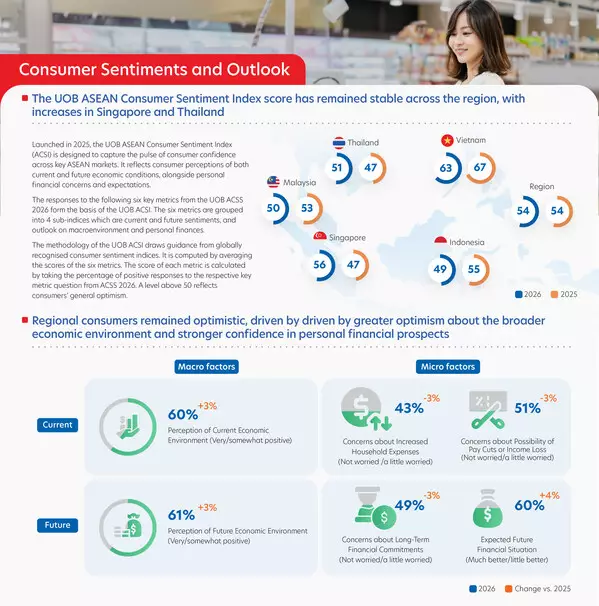
SINGAPORE, July 24, 2026 /PRNewswire/ -- ASEAN consumers remained optimistic about both the macroeconomic environment and their personal finances in 2026, with the UOB ASEAN Consumer Sentiment Index (the Index)[1] holding steady at 54. Despite ongoing macroeconomic uncertainties such as geopolitical tensions in the Middle East and concerns over rising oil prices, consumers' sentiment proved resilient as most major ASEAN economies continued to show steady growth. Stronger optimism about the macroeconomic environment helped sustain regional confidence, even as consumers remained pragmatic about their personal finances amid concerns over household expenses, income security and long-term financial commitments. Against this backdrop, Singapore recorded the region's strongest improvement, with its country's Index surging nine points to 56. Together with a pickup in sentiment in Thailand, this helped to counterbalance softer sentiment in the rest of the region.
The Index is based on six key indicators from the eighth edition of the flagship UOB ASEAN Consumer Sentiment Study (ACSS)[2], covering consumers' perceptions of current and future economic conditions and their personal financial outlook. An Index score above the neutral level of 50 indicates overall optimism among consumers across the region. This year's Index reflected a region that remained confident about broader economic prospects despite ongoing volatility and geopolitical uncertainty.
Stronger optimism towards the macroeconomic environment was the key driver underpinning regional sentiment, with the macro sub-index rising by three points to 61. Positive perceptions of the current economic environment rose from 57 per cent to 60 per cent, while optimism about economic performance over the next six to 12 months increased from 58 per cent to 61 per cent. This stronger macro confidence helped sustain the overall Index, even as consumers remained more measured about their personal finances.
Consumers remained cautious about their personal finances, with the micro (personal finances) sub-index easing slightly from 52 to 51 this year. While there are more respondents who expected themselves to be financially better off next year (four percentage points increase to 60 per cent), concerns around increased household expenses, prospects of pay cuts and ability to sustain long-term financial commitments weighed on sentiment, with each indicator dipping by three percentage points from a year ago.
Mr Suan Teck Kin, Head of Research, Global Economics and Markets Research, UOB, said: "ASEAN-5 economies remained resilient in the first half of 2026, with Singapore and Thailand outperforming expectations. Amid heightened geopolitical tensions, ASEAN remains a compelling investment destination for multinational corporations as companies diversify supply chains and expand their regional presence. This is supporting employment growth and broader economic opportunities across the region, and is reflected in consumers' stronger optimism about the macroenvironment."
Singapore and Thailand drive regional uplift as macro confidence strengthens
Consumer sentiment diverged across ASEAN markets in 2026, reflecting differing economic conditions and consumer priorities. Vietnam retained the highest level of consumer sentiment, while Singapore and Thailand recorded the strongest year-on-year improvement.
Vietnam recorded its country's Index at 63, making it the most optimistic market in the region despite a four-point decline, and surpassing the regional average by nine points. Confidence was underpinned by exceptionally strong sentiment on the macroeconomic environment, with 84 per cent of Vietnam consumers expressing positive views of both their current and future economic performance. More consumers (80 per cent, an increase of three percentage points) also expect that they will be better off financially this time next year, despite increasing concerns about their personal finances and income security.
The buoyant consumer sentiment was supported by the country's position as the fastest growing economy in ASEAN, with healthy economic fundamentals and government measures that cushioned elevated energy prices and alleviated broader price pressures. Foreign investors remained confident in Vietnam's medium-term prospects as supply chain diversification continued to favour the country, with data for the first half of 2026 suggesting that foreign direct investment (FDI) inflows are on track to remain near record highs this year.
Singapore recorded the region's strongest improvement, with its country's Index surging nine points to 56. This was driven by uplifts across all macroeconomic and personal finance indicators. Positive perceptions of the current economy rose 16 percentage points to 66 per cent, while confidence in future economic performance increased 13 percentage points to 63 per cent. This reflected Singapore's strong growth performance in the first half of 2026, as tailwinds from artificial intelligence-related demand supported activity across manufacturing, wholesale trade, transport and storage, with positive spillovers into the services sector.
Improved personal finance sentiment also contributed to Singapore's higher Index score, with fewer consumers expressing concerns over household expenses and more of them feeling positive about their long-term financial commitments compared to last year. Government efforts to alleviate cost-of-living pressures through measures such as CDC vouchers, U-Save rebates and Cost-of-Living support payments have helped cushion household expenses amid ongoing global uncertainty. Wealth effects from gains in equity markets may also have bolstered consumer sentiment and discretionary spending.
Thailand's Index rose four points to 51, as improved optimism towards both current and future economic conditions drove the strong uplift, with both indicators increasing from 39 per cent to 50 per cent. Government stimulus measures, particularly the Thai Chuay Thai Plus programme, alongside resilient tourism and exports, easing external pressures, and seasonal gains in farm incomes supported consumer sentiment. Sentiment towards personal finances remained relatively stable (only one percentage point improvement from last year), likely a reflection of the country's persistently high household and business debt, elevated living costs, and uncertainty stemming from geopolitical tensions and US tariff measures.
On the other hand, Malaysia's Index eased three points to 50, bringing overall sentiment closer to neutral. Despite a more positive economic outlook, concerns over household expenses, income security and long-term financial commitments weighed on sentiment, with an increase of nine, eight, and seven percentage points respectively from last year. While headline inflation suggests that overall price pressures remain manageable, rising living costs across essential categories such as food, utilities, healthcare and insurance have likely contributed to the more cautious outlook. Mitigating factors such as fuel subsidies and stable labour market conditions continued to buffer for higher expenses, while strong export performance, higher mining output and sustained domestic demand supported Malaysia's economic resilience. Following Malaysia, Indonesia also recorded a slight dip in its Index at 49, from 55 a year ago, amid a more challenging external environment marked by currency pressures and global uncertainty.
As ASEAN continues to navigate a complex and fast-changing global environment, the UOB ASEAN Consumer Sentiment Index offers a timely barometer of how consumers across the region are responding to economic shifts, policy measures and financial pressures. Backed by insights from the flagship UOB ASEAN Consumer Sentiment Study, this year's findings point to an increasingly nuanced consumer landscape, where optimism about the broader economic outlook coexists with a prudent approach towards personal finances. This balance between optimism and pragmatism underscores the resilience of ASEAN consumers and reinforces the importance of UOB's deep regional presence in understanding and supporting their evolving needs across the region.
About UOB
UOB is a leading Asian bank with a global network in Southeast Asia, Asia Pacific, Europe and North America. Operating through our head office in Singapore and banking subsidiaries in China, Indonesia, Malaysia, Thailand and Vietnam, we have a global network of about 430 branches and offices in 19 markets.
Since its incorporation in 1935, UOB has grown organically and through a series of strategic acquisitions. Today, UOB is rated among the world's top banks: Aa1 by Moody's Investors Service and AA- by both S&P Global Ratings and Fitch Ratings.
For more than nine decades, UOB has adopted a customer-centric approach to create long-term value by staying relevant through its enterprising spirit and doing right by its customers. UOB is focused on building the future of ASEAN – for the people and businesses within, and connecting with, ASEAN.
The Bank connects businesses to opportunities in the region with its unparalleled regional footprint and leverages data and insights to innovate and create personalised banking experiences and solutions catering to each customer's unique needs and evolving preferences. UOB is also committed to help businesses forge a sustainable future, by fostering social inclusiveness, creating positive environmental impact and pursuing economic progress. UOB believes in being a responsible financial services provider and is steadfast in its support of education, children and art, doing right by its communities and stakeholders.
Annex
About UOB ASEAN Consumer Sentiment Study 2026
UOB's ACSS 2026 surveyed 5,000 participants aged 18 to 65 years old from Indonesia, Malaysia, Singapore, Thailand and Vietnam. The survey was conducted online from May to June 2026.
The survey broadly categorises respondents into four age groups, namely Generation Z (18 to 27 years old), Generation Y (28 to 43 years old), Generation X (44 to 59 years old) and Baby Boomers (60 years old and above).
About UOB ASEAN Consumer Sentiment Index
Launched in 2025, the UOB ASEAN Consumer Sentiment Index ("the Index") is designed to capture the pulse of consumer confidence across key ASEAN markets. It reflects consumer perceptions of both current and future economic conditions, alongside personal financial concerns and expectations.
The responses to the following six key indicators from the UOB ACSS form the basis of the Index. The six indicators are grouped into 4 sub-indices which are current and future sentiments, and outlook on macroenvironment and personal finances.
| Current | Future | |
|
|
| Macro |
|
|
| Micro (personal finances) |
Current
Future
- Perception of Current Economic Environment
- Perception of Future Economic Environment
Macro
- Concerns about Increased Household Expenses
- Concerns about Possibility of Pay Cuts or Income Loss
- Concerns about Long-Term Financial Commitments
- Expected Future Financial Situation
Micro (personal finances)
The methodology of the Index draws guidance from globally recognised consumer sentiment indices. The Index is computed by averaging the scores of the six indicators. The score of each indicator is calculated by taking the percentage of positive responses to the respective key indicator question from the ACSS.
For the full insights from UOB ACSS 2026 and the Index, please visit: https://uobgroup.com/acss2026
| [1] Details of the Index's methodology can be found in the Annex. |
| [2] Details of UOB ACSS 2026's research methodology can be found in the Annex. |
[1] Details of the Index's methodology can be found in the Annex.
[2] Details of UOB ACSS 2026's research methodology can be found in the Annex.
** This press release is distributed by PR Newswire through automated distribution system, for which the client assumes full responsibility. **
Consumer confidence remains resilient across ASEAN as Singapore records the strongest improvement in the region: UOB's regional Consumer Sentiment Index