The number of measles cases in the U.S. has surpassed the record-breaking tally for all of 2025, with five more months of 2026 still to come.
The U.S. Centers for Disease Control and Prevention logged 2,318 cases of measles as of Thursday, according to an agency update on Friday.
The nation had 2,289 cases in 2025, the worst year for measles in more than three decades. Now, 2026 has easily become the U.S.’s worst year for measles since 1991, as major outbreaks in South Carolina, Utah and Arizona have sickened hundreds and smaller clusters of cases sparked in other states.
In November, international health officials will meet to determine if the U.S. and Mexico have lost their measles-free status. The U.S. eliminated local measles spread in 2000 by maintaining high vaccination rates, which have fallen in recent years to below the 95% coverage needed to prevent outbreaks.
While measles cases in the U.S. are climbing, it may be impossible to say exactly how far-reaching the spread is. Public health departments and disease researchers have long acknowledged that official counts are incomplete, because some people get sick and don’t seek out treatment — something not unique to measles.
Furthermore, experts say the spread might be greater than what’s known because the virus is one of the most contagious known to medicine and vaccination rates nationwide have declined. National vaccination rates for measles, mumps and rubella — which dropped to 92.5% among kindergartners in the 2024-25 school year, from 95.2% in 2019-20 — obscure even lower rates in certain communities.
In Utah, where public health officials have fought measles for more than a year, the virus has sickened more than 700 people during that time, according to the state health department. Experts relying on mathematical modeling and genetic analyses indicate that a large outbreak on the Utah-Arizona border could be around three to four times bigger than what’s currently known, state epidemiologist Dr. Leisha Nolen said.
The picture is muddier in South Carolina, which had the nation’s largest outbreak in 35 years. There, the 997 total is likely an undercount, the state health department has said, but it doesn’t know by how much.
Dr. Brannon Traxler, acting director of the state department of health, said the undercount is “impossible to know and may vary during the course of an outbreak.”
Data gaps can make it hard to reliably estimate an outbreak’s true scope. Experts say hospitalization rates can be a good barometer, but measles hospitalizations are not required to be reported in every state.
“If we really had some kind of solid gold standard for the percentage of all cases that have hospitalization or some measure of severity, then that would be another way of estimating the outbreak size that we could see if it’s consistent with these other methods,” said Damon Toth, an applied mathematician at the University of Utah’s medical school who is working on one of the Utah outbreak analyses.
In Texas, researchers are still working to estimate the size of the state’s 2025 outbreak and early findings show it might have been nearly twice the size of the 762 known cases.
Rémy Pasco, a mathematical epidemiologist at the University of Colorado Boulder who is working on the analysis, said the undercounts were unsurprising. In the absence of an adequate community vaccination rate — 95% according to health experts — “there’s just not much you can do about measles once you have it,” he said.
The CDC defines an outbreak as three or more linked cases. But by the time three such cases are identified in communities with low vaccination rates and less disease surveillance, “either you missed the previous ones or you’re going to have a lot more,” he added.
Dr. Varun Shetty, Texas’ chief state epidemiologist, said there were instances where people tested positive for measles but health officials couldn’t confirm who else was in the person’s household or if they were sick.
“What we’re able to count and report is almost always an underestimate of what actually occurred, because it relies on people being willing to be able to get tested, to share information with healthcare providers and with public health,” Shetty said. “Sometimes that just doesn’t happen.”
The state health department previously reported that 182 probable measles cases went unconfirmed in March 2025 among minors in Gaines County — the epicenter of the outbreak — due to a lack of information. The confirmed case count for the western Texas county for the whole outbreak is 414.
Shetty expects to keep seeing measles cases and even outbreaks because so many people are unprotected.
“It’s really critical, not only for individual people, but for communities, to have high vaccination coverage,” he said.
Dr. Mark Roberts, retired director of the Public Health Dynamics Lab at the University of Pittsburgh School of Public Health, worries most for the people he calls “innocent bystanders.”
Research and measles modeling by his team shows those who cannot get vaccinated — young babies, people with weak immune systems and those who rarely don’t get robust immunity from the vaccine — bear the brunt of outbreaks early on.
Some people see skipping vaccination as like deciding not to wear a seat belt in a car, Roberts said.
“Not vaccinating your kid is like saying, ‘I don’t want my car to have brakes,’” he said. “Because it’s other people that you can hit. It’s not just you in your car. It’s other people.”
The Associated Press Health and Science Department receives support from the Howard Hughes Medical Institute’s Department of Science Education and the Robert Wood Johnson Foundation. The AP is solely responsible for all content.
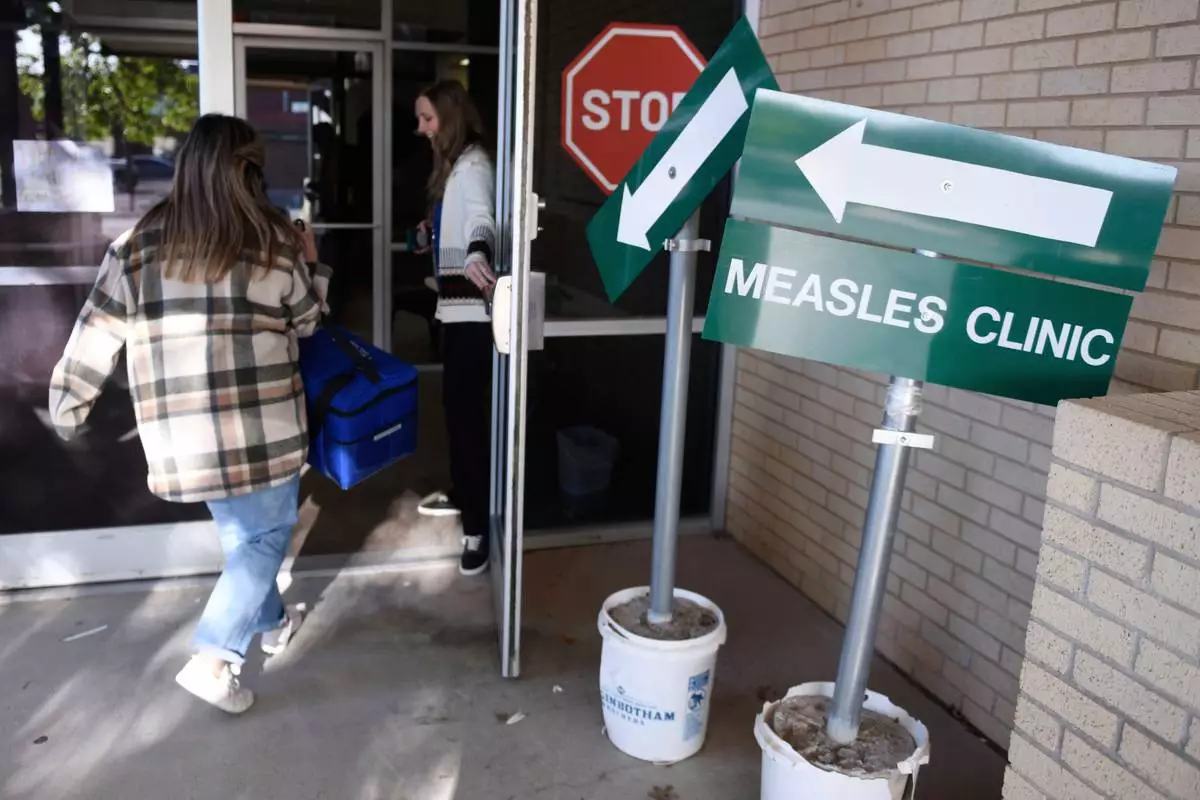
FILE - Health department staff members enter the Andrews County Health Department measles clinic carrying doses of the measles, mumps and rubella vaccine, April 8, 2025, in Andrews, Texas. (AP Photo/Annie Rice, File)