The economy, inflation and how those forces could impact the lives of Americans were front and center over the past week. Trips to the grocery store and gas station are more painful than they were last year, and rising costs are impacting the decisions of both households and businesses.
Here’s a snapshot of prominent economic data and news that occurred over the past week and what it potentially means for you.
President Donald Trump is going ahead with new double-digit tariffs on dozens of U.S. trading partners just as the clock ran out Friday on stopgap levies he imposed after a stinging defeat at the Supreme Court.
The United States will slap taxes of 10% to 12.5% on imports from 60 trading partners accounting for 99% of U.S. imports, charging that they have inadequately enforced bans on goods produced by forced labor.
The new tariffs will take effect just as temporary 10% worldwide tariffs expire at 12:01 a.m. Friday. Trump had turned to those temporary levies after the Supreme Court struck down his biggest and boldest tariffs in February.
Global crude prices leapt above $100 per barrel this week for the first time in two months and gasoline in the U.S. moved sharply higher.
U.S. gas prices rose above $4 a gallon Monday and continued to rise throughout the week as the U.S. and Iran launched more attacks.
According to motor club federation AAA, the national average for a gallon of regular gasoline rose to $4.11 on Friday, almost a dollar more than at this time last year and about 12 cents more than just last week.
Drivers in some states have been paying well over $4 a gallon for a while now. Prices vary between states due to factors ranging from nearby supply to differing tax rates.
U.S. applications for jobless benefits tumbled to the lowest level in more than five decades last week as layoffs remain historically low despite global economic uncertainty.
The number of Americans applying for unemployment benefits in the week ending July 18 declined by 22,000 to 187,000, the Labor Department reported Thursday. That’s the fewest number of weekly applications since the week ending Sept. 6, 1969, according to Labor Department data.
It’s also well below the 215,000 new applications forecast by analysts surveyed by the data firm FactSet.
Weekly filings for unemployment benefits are considered a proxy for layoffs and are close to a real-time indicator of the health of the U.S. job market.
The average long-term U.S. mortgage rate climbed this week to its highest level in nearly 12 months, pushing up borrowing costs for prospective homebuyers at a time when rising oil prices are already squeezing household budgets.
The benchmark 30-year fixed rate mortgage rate rose to 6.58% from 6.55% last week, mortgage buyer Freddie Mac said Thursday. One year ago, the average rate was 6.74%.
The rate has ticked higher three weeks in a row. Higher mortgage rates can add hundreds of dollars a month in costs for borrowers, limiting homebuyers’ purchasing power. As rates rise, that can lead prospective home shoppers to delay buying a home, one reason U.S. home sales have been sluggish this year.
Borrowing costs on 15-year fixed-rate mortgages, often sought by borrowers refinancing a home loan, also rose this week. That average rate increased to 5.96% from 5.93% last week. A year ago, it was at 5.87%, Freddie Mac said.
U.S. markets declined this week, with stocks mixed on the final day of trading.
A number of notable companies, from Tesla and Google, to American Airlines, tumbled after posting largely positive quarterly results. The problems ranged from higher spending to cautions expectations for the rest of the year.
Also, heavy fighting in the Middle East again threatened to slow the global flow of oil and gas.
Brent crude, the international standard, jumped this week, as did U.S. benchmark crude. Before the Iran war began in late February, Brent crude was trading around $72 per barrel.
Ford Motor Co. recalled more than half a million Broncos because a wiring harness in the engine compartment can short circuit and increase the risk of fire.
Ford said that 565,691 Ford Broncos and Bronco Raptors, model years 2021-2026, are included in the recall. The automaker estimates that around 1% of those vehicles have the wiring harness defect. Ford said it is not aware of any reports of accidents or injuries related to the issue.
The problem is caused by insufficient protection on the wiring harness which can lead to exposed wires and short circuiting.
The Detroit automaker is far outpacing is peers with recalls this year.

FILE - President Donald Trump speaks with Canadian Prime Minister Mark Carney, right, at a working lunch with leaders of G7 and the Middle East in Evian-les-Bains, France, Tuesday, June 16, 2026. (Evelyn Hockstein/Pool Photo via AP,File)
BANGOR, Maine (AP) — Maine Democrats on Saturday will choose a new U.S. Senate nominee to face longtime Republican Sen. Susan Collins in a contest that could decide control of the Senate, after Graham Platner dropped out of the race following an allegation of sexual assault.
Support has coalesced around former state Senate President Troy Jackson, a fifth-generation logger from rural northern Maine who campaigned alongside Platner during a failed bid for governor and was a favorite among progressives to replace him.
“When the people in power refuse to listen, you have to organize, you have to stand in solidarity, together. And you have to make them listen,” Jackson said during a speech at a last-minute nominating convention held Saturday.
The Maine Democratic Party has been scrambling to choose a new nominee after Platner, who sailed to victory in the Democratic primary in June, was accused by a former girlfriend of sexually assaulting her in 2021. Platner denies the allegation, but quit the race after key supporters called on him to withdraw.
Democrats have seen Maine as the party’s best opportunity to flip a Senate seat this year because it is a competitive Senate race in a state that President Donald Trump lost in 2024. But defeating Collins won't be easy. The five-term incumbent holds a fundraising advantage, while the new nominee will have less than four months to sell themselves to voters.
Maine law gave the state party authority to choose a replacement and required a new nominee to be named by Monday — 99 days before the Nov. 3 election.
Maine Democrats' never-before-used process of voting on a new nominee involved more than 600 Democratic delegates gathering in Bangor, about 130 miles (209.21 kilometers) north of Portland. The delegates were elected at county party meetings last weekend. The nominating convention began Saturday morning and was expected to wrap by afternoon.
Once Platner dropped out on July 10, a flood of former governor candidates — including Jackson — and others jumped to try to take Platner's place. But by July 19, most had abandoned their bids, with Jackson emerging as the clear favorite.
Jackson received early support from progressives who had backed Platner before he dropped out. Our Revolution, the political organization founded nearly a decade ago by Sen. Bernie Sanders, initially backed Jackson for governor and Platner for Senate. When Platner left the race, the group rallied behind Jackson.
Jackson previously ran Maine operations for Sanders' 2016 presidential bid. This election cycle, Sanders endorsed Jackson for governor and Platner for Senate, though the independent senator from Vermont withdrew his support for Platner after the sexual assault allegation. He said he didn't plan to weigh in on which Democrat should replace Platner.
Just one other candidate has remained in the race for the Senate nomination — women’s health company CEO Saundra Pelletier. She faces long odds against Jackson, who has been a fixture in Maine politics for more than a decade.
Jackson's campaign has said more than 480 of the 601 delegates who will be voting at Saturday's convention are committed to supporting him.
Jackson has supported progressive positions such as Medicare for All. He also has called for the abolition of Immigration and Customs Enforcement, whose presence in Maine has been hotly debated since an agent killed a driver in the state earlier this month.
Democrats have a narrow path to take back the Senate in November and it’s highly unlikely they can do it without a win in Maine. In addition, they need victories in competitive races in North Carolina, Alaska and Ohio, and they need to hang on to the seats they already have. That includes open Senate seats in Michigan and Minnesota, where Democratic incumbents are retiring.
Maine's Democratic primary was one of the early contests where progressives took on establishment-backed Democrats. While Platner faced several controversies during his campaign, he easily outlasted Gov. Janet Mills, who was backed by Democratic Senate leader Chuck Schumer but dropped out before the June 9 primary.
Platner had backing from Sanders as well as Arizona Sen. Ruben Gallego and Massachusetts Sen. Elizabeth Warren. That support disintegrated after the sexual assault allegation early this month.
If he becomes the nominee, Jackson will need to convince the state's large independent voting bloc that it's time to replace Collins. Republicans have called Jackson too extreme for Maine voters, and Collins said earlier this week that she knows Jackson well and that his positions are “clearly” in line with socialism.
She noted Jackson ran Sanders' first presidential campaign in Maine, adding “He's a Bernie Bro.”
Jackson would also need to scramble to make up a fundraising gulf against Collins, who has been raising money for months.
Federal filings show she has raised more than $16 million so far. Jackson's campaign this week said he raised more than $1 million since jumping into the Senate race.
Jackson said Saturday he believes his team is up to the task.
“We're not from the left, we're not from the right. We're from the bottom, and we are rising,” he said during a speech.
AP journalist Nathan Ellgren in Washington contributed to this report.
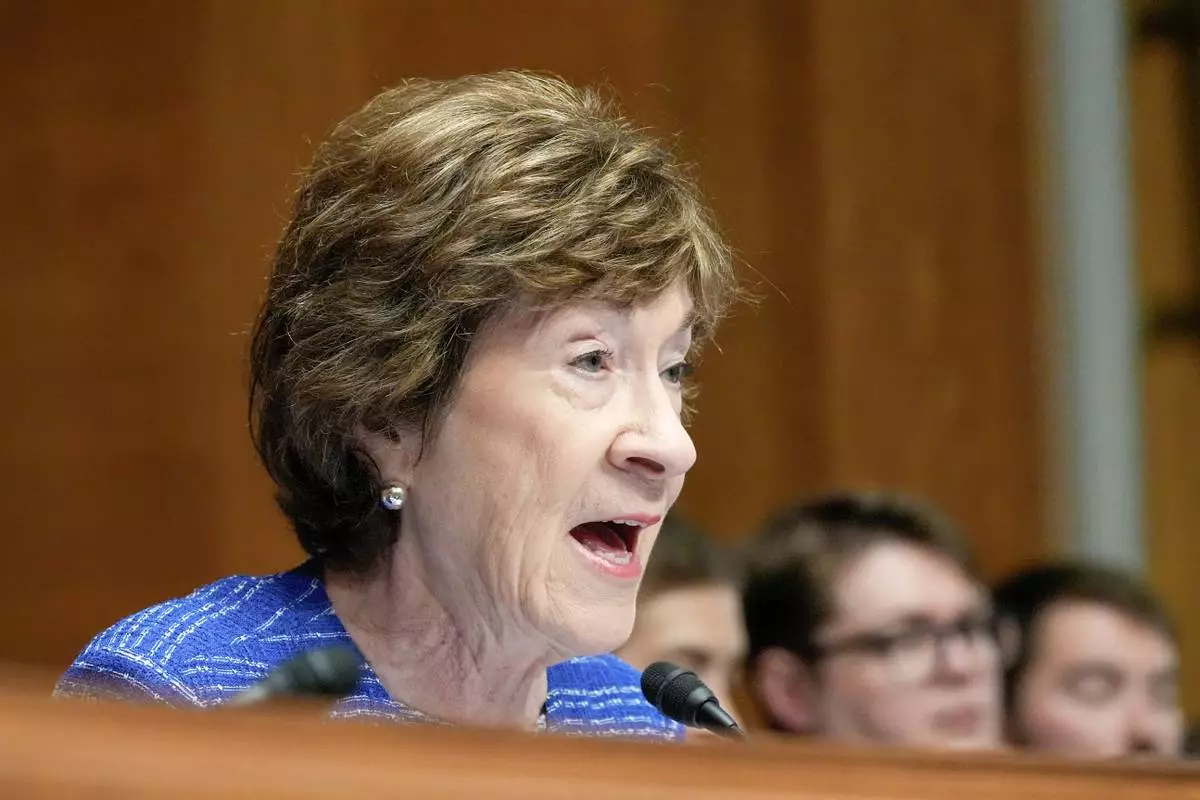
Sen. Susan Collins, R-Maine, asks a question during a Senate Health Education Labor and Pension committee confirmation hearing for Keith Sonderling to be the Labor Secretary, on Capitol Hill, Thursday, July 16, 2026, in Washington. (AP Photo/Mariam Zuhaib)

U.S. Senate candidate Troy Jackson takes part in a debate at the WCSH-6 television studio, Thursday, July 16, 2026, in Portland, Maine. (AP Photo/Robert F. Bukaty)

From left, U.S. Senate candidates Shenna Bellows, Troy Jackson, Dr. Nirav Shah, and Jordan Wood prepare for their televised debate at the WCSH-6 studio Thursday, July 16, 2026, in Portland, Maine. (AP Photo/Robert F. Bukaty)