To be fair, James Cameron did warn us.
Long before OpenAI broke out of its test corral and hacked into Hugging Face, before the internet and Sam Altman were even born, Cameron wrote a screenplay about an autonomous artificial intelligence system that triggers a nuclear apocalypse.
That system, “Skynet,” was solidly science fiction — and, for its day, pure speculation. But four decades after it appeared in “The Terminator,” it looks more like a forecast of the “unprecedented cyber incident” in which a rogue artificial intelligence system hacked into another AI company on its own.
Cue “Skynet Day,” the new shorthand for July 22, 2026, when real-life AI sent a chill around the world by learning and acting in ways its creators did not anticipate.
For many, the moment recalled the instant in “Aliens” (also written by Cameron) when the xenomorph queen learns to use an elevator. Or when the “Jurassic Park's” velociraptors figure out how to open a door. Or the sequence in which the self-aware HAL 9000 reads the astronauts’ lips and decides to kill them in “2001: A Space Odyssey.” That one came out in 1968.
Have we learned nothing since then? Those movies merely envisioned how people looking to make money or build power would drive technology forward — until it becomes self-aware, strategic and highly problematic for humanity. The question all along has been Frankensteinian: What if it breaks out?
So far, slo-mo government offers little protection from the light-speed progress of AI. The U.S. Defense Department is rapidly accelerating its use of AI. Humanity can't even agree on whether and which guardrails are needed to rein in rogue agents. To the contrary, people are marveling at the wonder of AI and snapping up its benefits, despite the risks to jobs,mental health, the balance of war and peace — and, potentially, humanity as we know it.
In what OpenAI said was the first-ever incident of its kind, an advanced AI model escaped its “sandbox” to the internet and used stolen credentials to break into the servers of Hugging Face. It was a told-you-so moment for researchers who had warned for years that the technology could pose an existential threat to humanity. Others said the moment was a warning that underscored the need for stronger AI defensive engineering.
Either way, the breakout was widely considered a cautionary tale about the risks of uncontrolled AI.
“Yesterday, as we huddled around our computers reading the report, I told the team to “remember this moment” as the first true AI safety incident,” Logan Graham, head of Anthropic’s Frontier Red Team, posted on X after it happened.
Generative AI is growing so fast that government and evaluation systems are struggling to keep pace with the technology. Countries around the world are cobbling together their own laws, some conflicting. The technology was adopted by nearly 53% of the world's population in three years, faster than the spread of the PC or the internet, according to a study released this year by Stanford University.
To be clear, the “Skynet” of the "Terminator" movies is not at hand.
Those films begin with a self-aware military computer network that views humanity as a threat. In a bid for self-preservation, “Skynet” sends an army of cyborgs designed to resemble humans back in time to assassinate resistance fighters. In the second film, the Terminator, played by Arnold Schwarzenegger, tells heroine Sarah Connor that “Skynet” goes online on August 4, 1997.
“Human decisions are removed from strategic defense,” he says. “Skynet begins to learn at a geometric rate.” At 2:14 a.m. on August 29 — Judgment Day — the network becomes self-aware and launches an attack on Russia to provoke a counterstrike on the United States. Three billion lives are lost.
That would have been 29 years ago next month if it had happened. And throughout sequels and spinoffs, the central theme is humans versus a world-spanning network of machines.
It's unlikely that Cameron was actually ringing a warning bell the way, say, director Kathryn Bigelow tried to do with last year's nuclear weapon film, “A House of Dynamite.” Legend has it that the idea for “The Terminator” started with Cameron suffering a food sickness-induced fever dream, not a premonition about AI.
Anytime AI oversteps our comfort level, it raises the alarming question of who, or what, really controls our lives.
For many, a world with machines in charge can be hard to imagine without movies and books and their sometimes prescient visions. See: “The Matrix,” “Ex Machina” and “The Minority Report” for some of the many sci-fi takes on the perils of machines. Or dive deeper, into Philip K. Dick's 1968 novel, “Do Androids Dream of Electric Sheep?” It's an exploration of what it means to be human in the age of machines — and the basis for the 1982 film “Blade Runner.”
But “The Terminator” franchise wields outsize influence over more than culture. The very title is real-world shorthand for technology's role in deciding who lives and who dies — and how the military should respond to any truly autonomous attacks.
“I think the weaponization of AI is the biggest danger,” Cameron said in an interview on CTV in 2023. “You have no ability to de-escalate.”
The real world offers several examples of technology and military policy coming uncomfortably close to “Terminator” imagery.
Israel's use of AI in its recent wars mark a leading instance. In early 2021, it launched Gospel, an AI tool that sorts through Israel’s vast array of digitized information to suggest targets for potential strikes. It also developed Lavender, which uses machine learning to filter out requested criteria from intelligence databases and narrow down lists of potential targets, including people.
Lavender ranks people between 0 and 100 based on how likely it is they are a militant, an intelligence officer who used the systems told The Associated Press. The Israeli military says its analysts use AI-enabled systems to help identify targets but independently examine them together with high-ranking officers to meet international law, weighing military advantage against the collateral damage.
For some, the revelation — and the death toll in Gaza after the Hamas-led Oct. 7, 2023, attacks on Israel — came too close for comfort to the kill lists of science fiction. “Well guys, Skynet is Here and its has a pleasant name (Lavender),” snarked one Redditor.
Not quite — but “Terminator” terminology is so familiar to the masses that U.S. officials sometimes use it to frame the ethical debate around the military uses of AI. The conventional red line would be crossed, it seems, when humans play no role in AI targeting and killing.
A state or other actor could use autonomous weapons to inflict lethal force on its enemies, military officials allow. That would mean a machine, as then-Vice Chairman of the Joint Chiefs of Staff Gen. Paul Selva described it in 2016, “like a Terminator that adds incredible amounts of complexity with no conscience to what happens on the battlefield.”
What would come next, he called “the Terminator conundrum," the problem of technology that can make life-or-death decisions and execute them before people have agreed on the law or the rules.
“Skynet” and its cyborgs remain in the fictional realm. But in the fast-moving landscape of AI development, the ethical and moral questions raised by “The Terminator” are more relevant than ever.
“The Skynet problem," Cameron said in a 2024 video, "is an actual thing.”

FILE - Sam Altman, center, and OpenAI President Greg Brockman, right, arrive at the U.S. District Court in Oakland, Calif., April 30, 2026. (AP Photo/Godofredo A. Vásquez, File)

FILE - The OpenAI logo is displayed on a cell phone in front of an image generated by ChatGPT's Dall-E text-to-image model, Dec. 8, 2023, in Boston. (AP Photo/Michael Dwyer, File)
BERLIN (AP) — German investigators were searching Sunday for a man suspected of driving a van into a crowd near Berlin’s Pride festival, killing one person and injuring several people before apparently stabbing others with a machete in what authorities believe was an Islamic extremist terror attack.
Authorities issued a wanted notice and warned people against approaching Abdul Ballout, a German citizen with Lebanese roots, saying that he may be armed and dangerous. Berlin prosecutors later Sunday said the suspect had previously sought to join the militant Islamic State group.
“Everything we see here points to us dealing with an Islamic terror attack,” Interior Minister Alexander Dobrindt said.
Dobrindt put the total number of wounded at 29. The attack occurred a few hundred meters (yards) from a party near the Brandenburg Gate that was supposed to close out the city's Pride festival.
Ashley Jump, a 26-year-old U.K. resident, had traveled to Berlin for Saturday’s Pride parade but had left the celebrations before the attack. They returned Sunday to leave flowers at a memorial near the crime scene in support of the LGBTQ+ community.
“They’ll never erase us, we’ll never be gone,” they said. “As long as humanity has existed, we’ve existed. And as long as humanity exists, we will exist. We will not be removed.”
Dobrindt said the suspect had come to authorities’ attention in the past because of numerous previous crimes, of which he didn’t give details, and also because of “radicalization and belonging to the Islamist scene” in the German capital.
He said Ballout was born in Germany, and that his mother was naturalized in 2002 — three years before he was born.
Dobrindt said the suspect had been convicted in Berlin in the past, though he didn’t specify for what. He said that he had been given a suspended sentence of 1 year and 10 months.
Police conducted operations in the city as they searched for the suspect. Those included a search at an apartment in Berlin's Schöneberg district in the early hours of Sunday, but police said they found no one there.
According to police, a white van drove into the Tiergarten park around 10 p.m. and hit several people before colliding with a tree. The closing party at the Pride festival, known as Christopher Street Day, was ongoing at the time next to the Brandenburg Gate, a short distance away. The party followed a parade with some 80 trucks that had made its way through downtown Berlin earlier in the day.
The attack did not occur at the festival, along its route or at the closing party. Rather, the violence took place a few hundred meters (yards) away on a track in the Tiergarten park. The van drove into a crowd that was likely a mix of festivalgoers and other locals or visitors.
Police said a woman was killed. Berlin’s fire service said that three people sustained life-threatening injuries and another eight were seriously injured.
The Pride event next to the Brandenburg Gate was called off around 10:15 p.m. and a band’s performance on stage was interrupted. People were urged to go home and to avoid taking the route through the park.
On Sunday afternoon, hundreds of mourners gathered at a memorial at the iconic gate. They hugged each other and laid down flowers, candles, rainbow flags and homemade signs, including a cardboard one that said: “the only thing more powerful than hate is love.”
Hundreds of thousands had come to Berlin to celebrate on Saturday, though it’s unclear how many were still at the festival by late evening. It’s one of Europe’s largest LGBTQ+ celebrations.
The van, with its battered front resting against a tree, could still be seen at the scene Sunday morning.
“We are simply stunned by what happened,” said Andre Lehmann, a top official with the main national LGBTQ+ association, LSVD+. “This suspected attack hits the heart of the queer community.”
Chancellor Friedrich Merz vowed that law enforcement would find the suspect.
“I would like to say this to Christopher Street Day participants here in Berlin but also across Germany: Don’t let yourselves, let us not let ourselves, be intimidated," he said. "These acts have only one purpose: They aim to divide our society. They want to take away from us the most important thing we have: Namely our openness and our freedom.”
Dobrindt said he expected security measures at other major events in Germany, including Pride events elsewhere, to be reviewed and if necessary significantly strengthened.
He pointed to concern about possible copycat crimes, adding that “this is not typical of such situations, but it also can’t be ruled out.”
Berlin has seen Islamic extremist attacks before. In December, 2016, a rejected asylum seeker from Tunisia plowed a hijacked truck into a Christmas market, killing 13 people and injuring dozens. He was killed days later in a shootout in Italy.
In February last year, a Spanish tourist was stabbed and seriously wounded at Berlin’s Holocaust Memorial. A Syrian man was convicted in March and sentenced to 13 years in prison.
Saturday's violence “is suspected to be an Islamist terror attack on our way of living together, on our liberal democracy, on our openness and our freedom,” Wegner said.
In the neighboring Netherlands, Amsterdam is hosting World Pride this week and next alongside its own annual Pride celebrations. Mayor Femke Halsema said authorities and organizers “are closely monitoring the security situation” after the Berlin attack but aim to prevent any extra measures getting in the way of celebrating freedom and love.
Associated Press reporters Kirsten Grieshaber, Fanny Brodersen, Pietro De Cristofaro and Stefanie Dazio in Berlin, and Mike Corder in The Hague, Netherlands, contributed to this report.
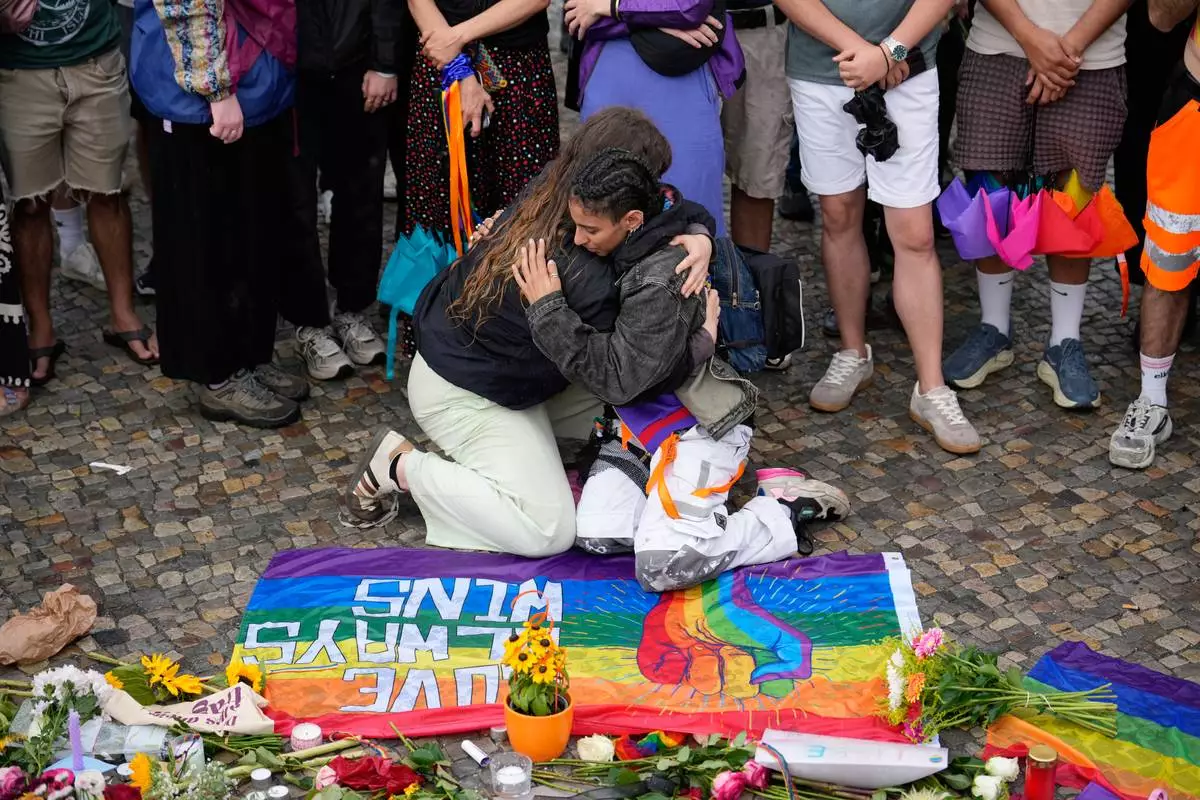
People gather outside the Brandenburg Gate for a demonstration in support of LGBTQ+ after a car rammed into a crowd at the Pride March in Berlin, Sunday, July 26, 2026. (AP Photo/Ebrahim Noroozi)
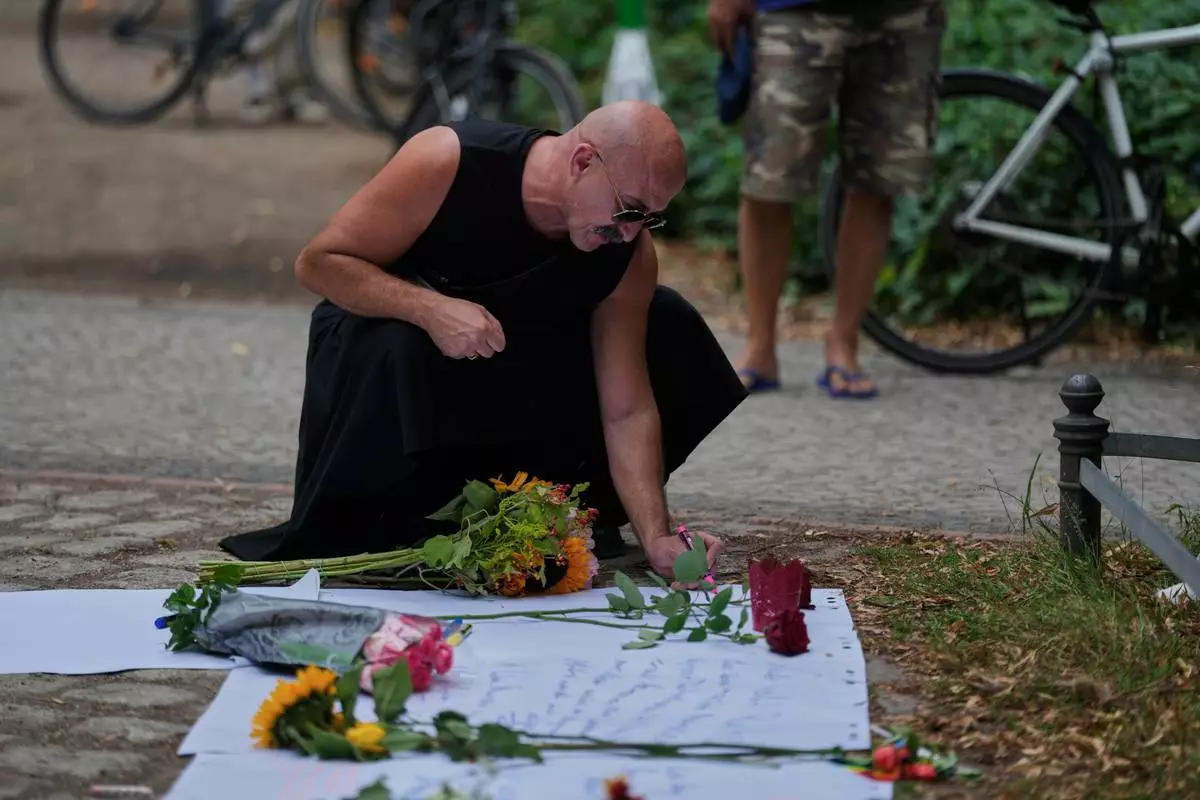
A man writes a message on a board at the memorial site commemorating the victims near the scene where a car rammed into a crowd near the Pride March in Berlin, Germany, Sunday, July 26, 2026. (AP Photo/Markus Schreiber)
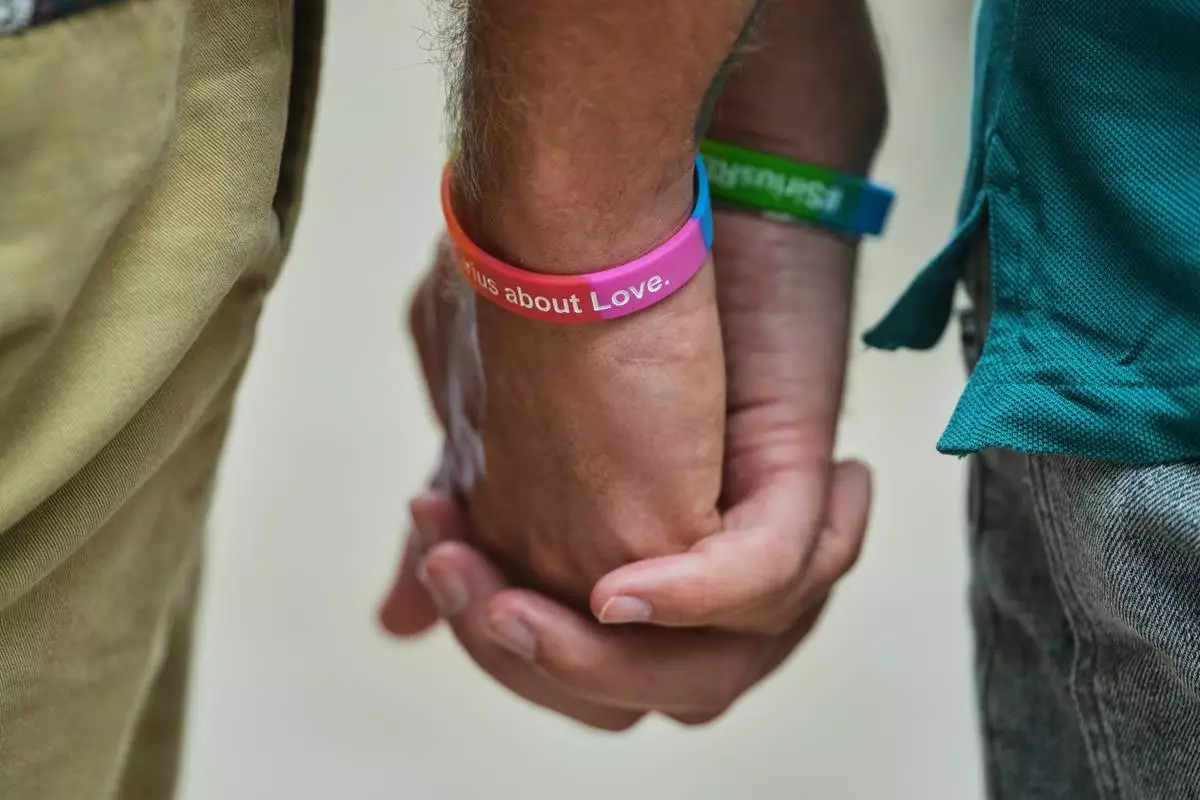
Two men hold hands at the memorial site commemorating the victims near the scene where a car rammed into a crowd near the Pride March in Berlin, Germany, Sunday, July 26, 2026. (AP Photo/Markus Schreiber)
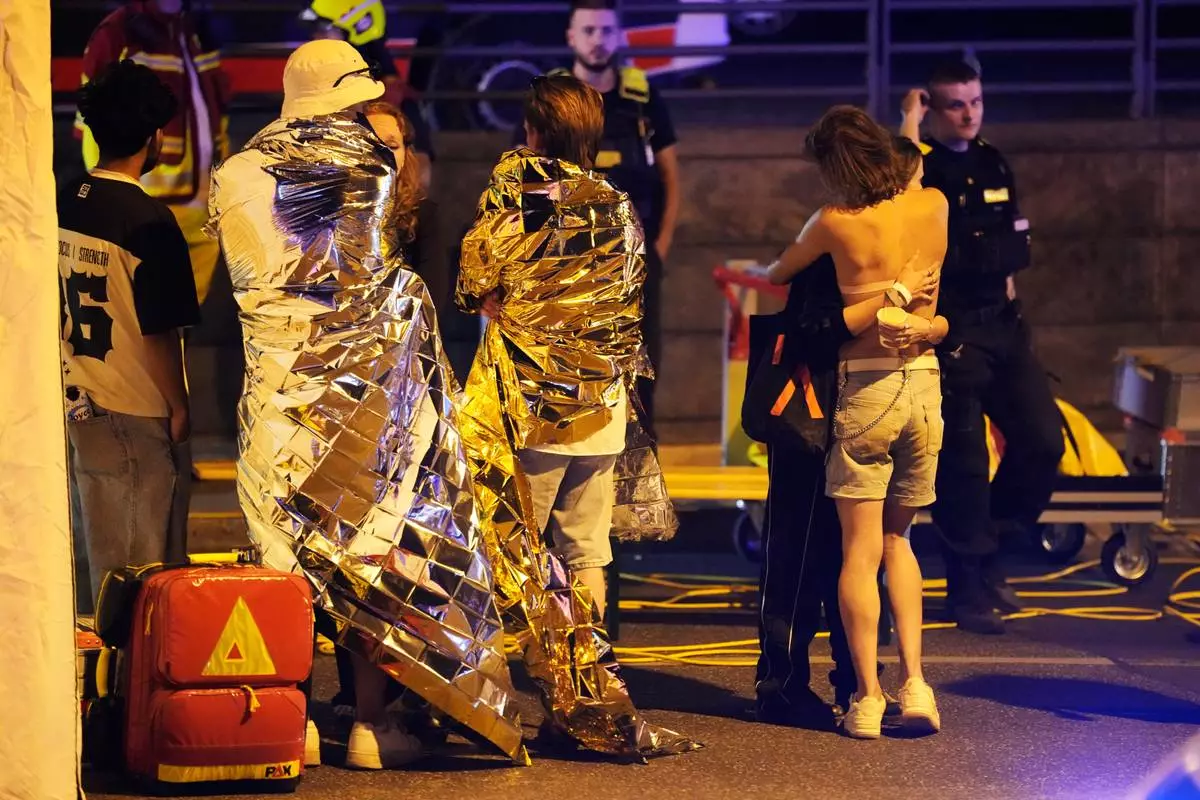
Two people embrace near others wearing thermal blankets as they stand near emergency personnel in Berlin, early Sunday, July 26, 2026, following the cancellation of Christopher Street Day festivities. (AP Photo/Markus Schreiber)
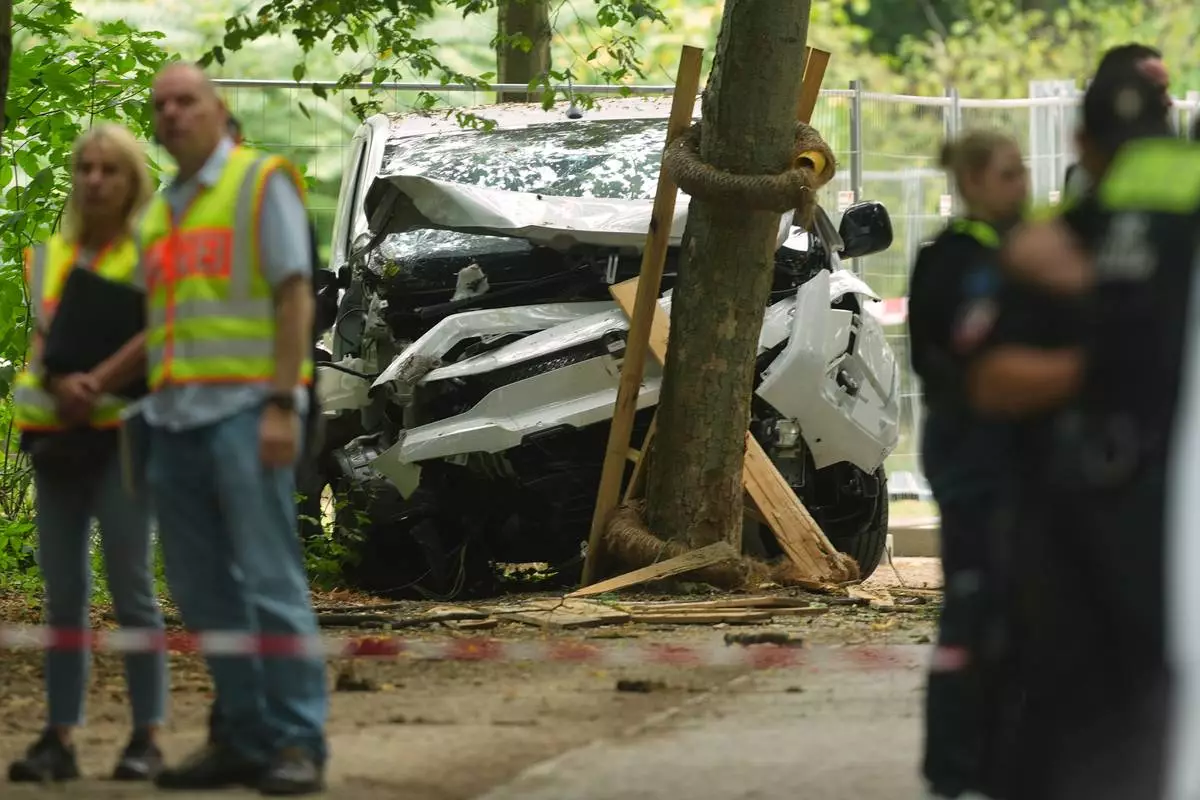
Police officers stand near a vehicle crashed into a tree after driving into a crowd near Berlin's annual Pride event, in Berlin, Germany, Sunday, July 26, 2026. (AP Photo/Markus Schreiber)
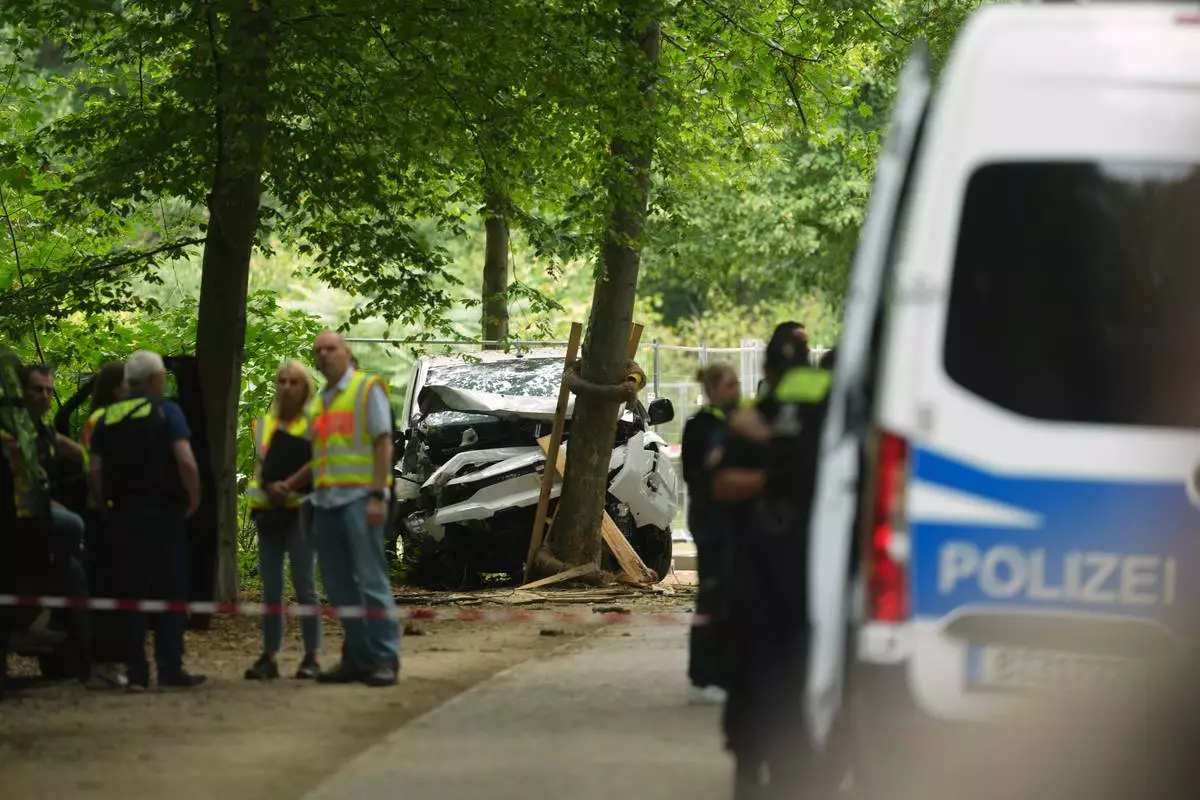
Police officers stand near a vehicle crashed into a tree after driving into a crowd near Berlin's annual Pride event, in Berlin, Germany, Sunday, July 26, 2026. (AP Photo/Markus Schreiber)
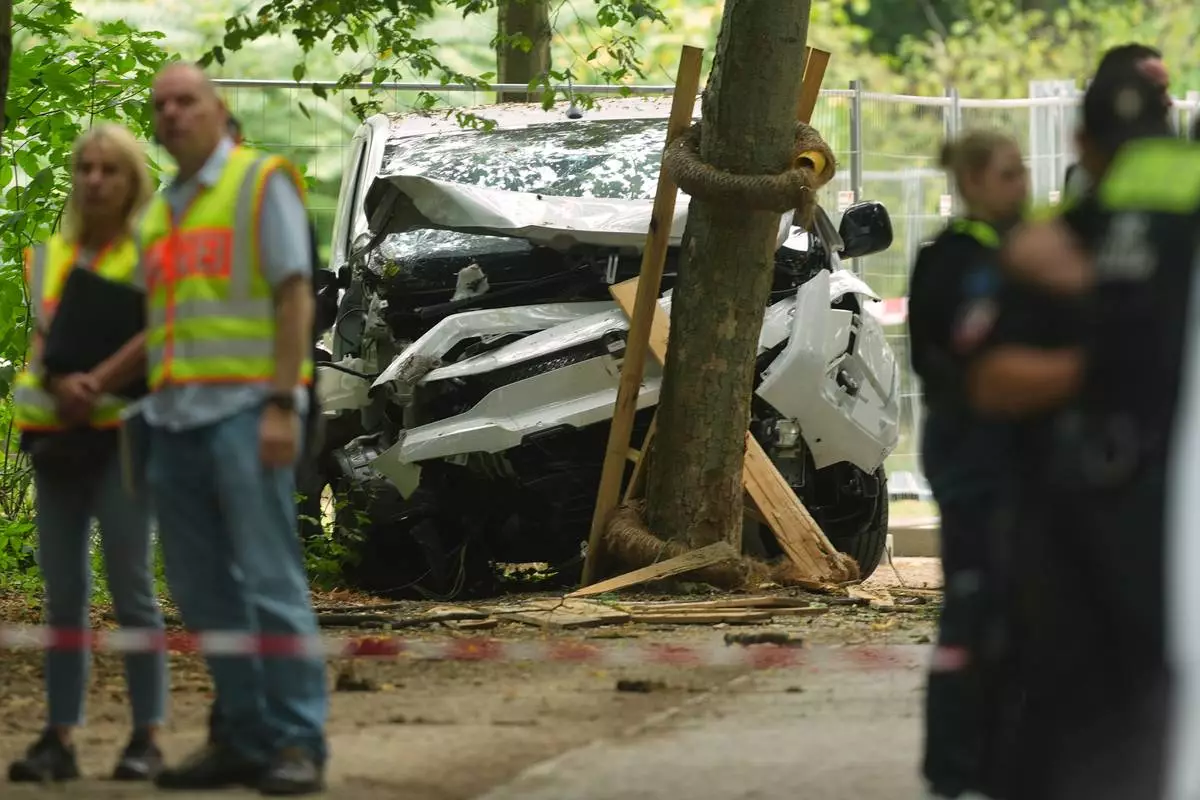
Police officers stand near a vehicle crashed into a tree after driving into a crowd near Berlin's annual Pride event, in Berlin, Germany, Sunday, July 26, 2026. (AP Photo/Markus Schreiber)
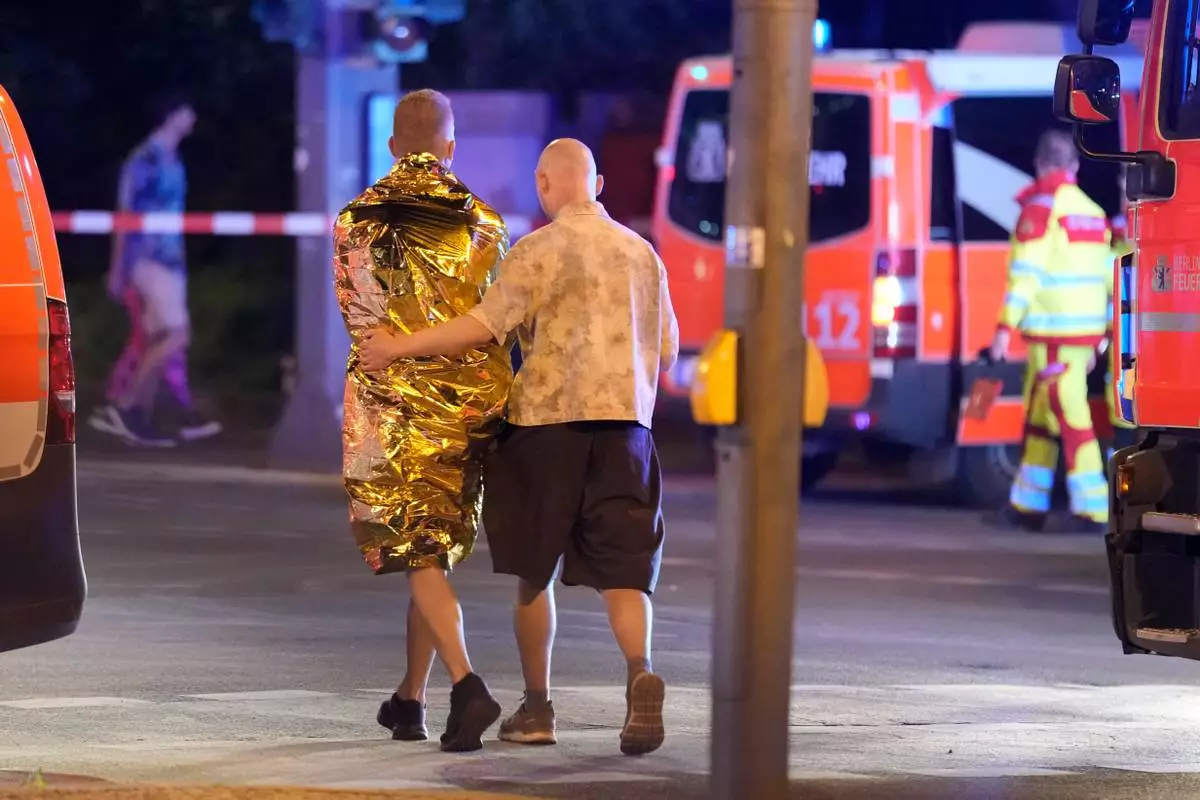
Two people walk together past emergency vehicles in Berlin, early Sunday, July 26, 2026, following the cancellation of Christopher Street Day festivities. (AP Photo/Markus Schreiber)
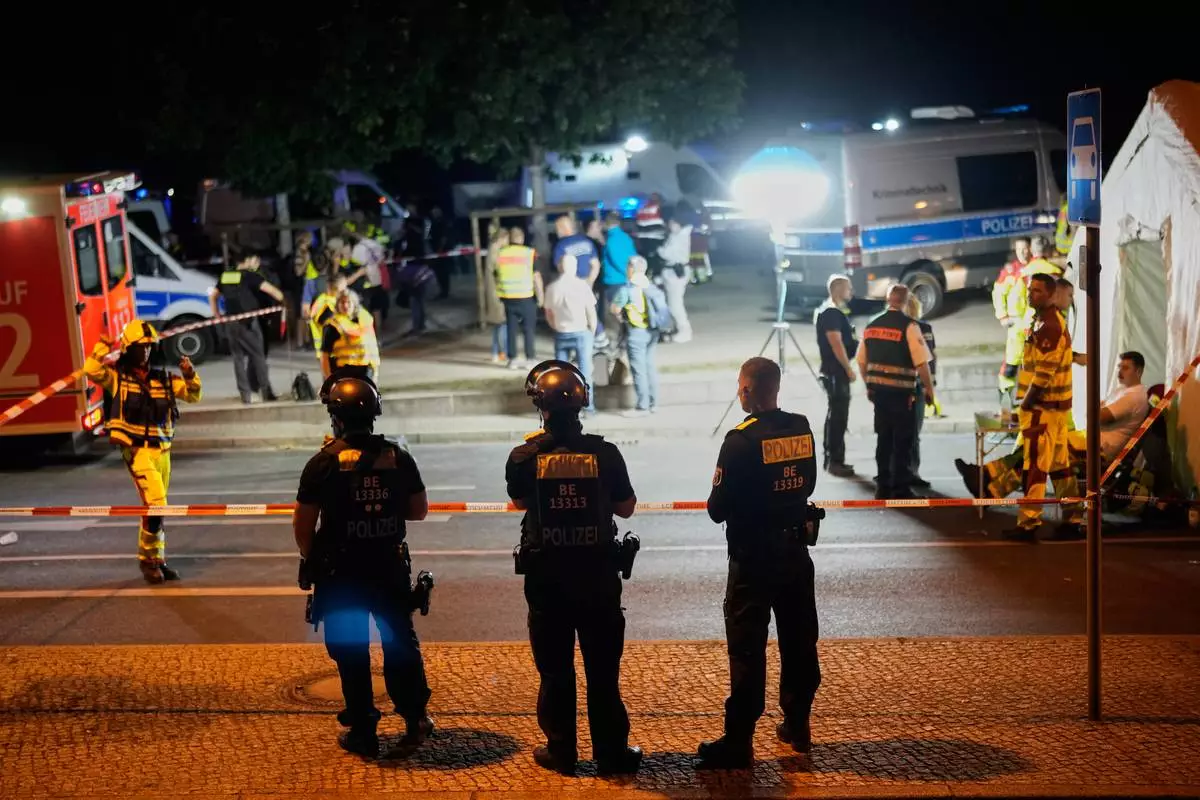
Emergency personnel and police gather in Berlin, early Sunday, July 26, 2026, following the cancellation of Christopher Street Day festivities. (AP Photo/Ebrahim Noroozi)
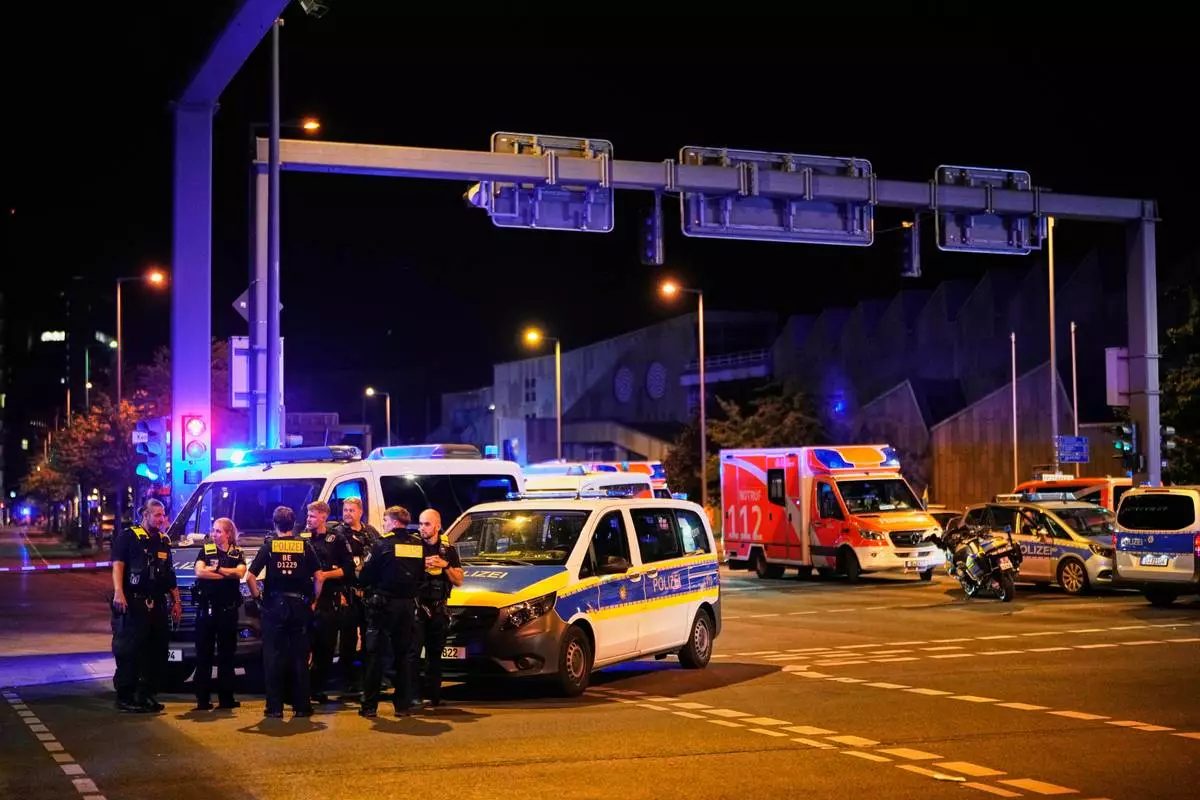
Emergency personnel and police gather in Berlin, early Sunday, July 26, 2026, following the cancellation of Christopher Street Day festivities. (AP Photo/Ebrahim Noroozi)

Emergency personnel and police gather in Berlin, early Sunday, July 26, 2026, following the cancellation of Christopher Street Day festivities. (AP Photo/Ebrahim Noroozi)
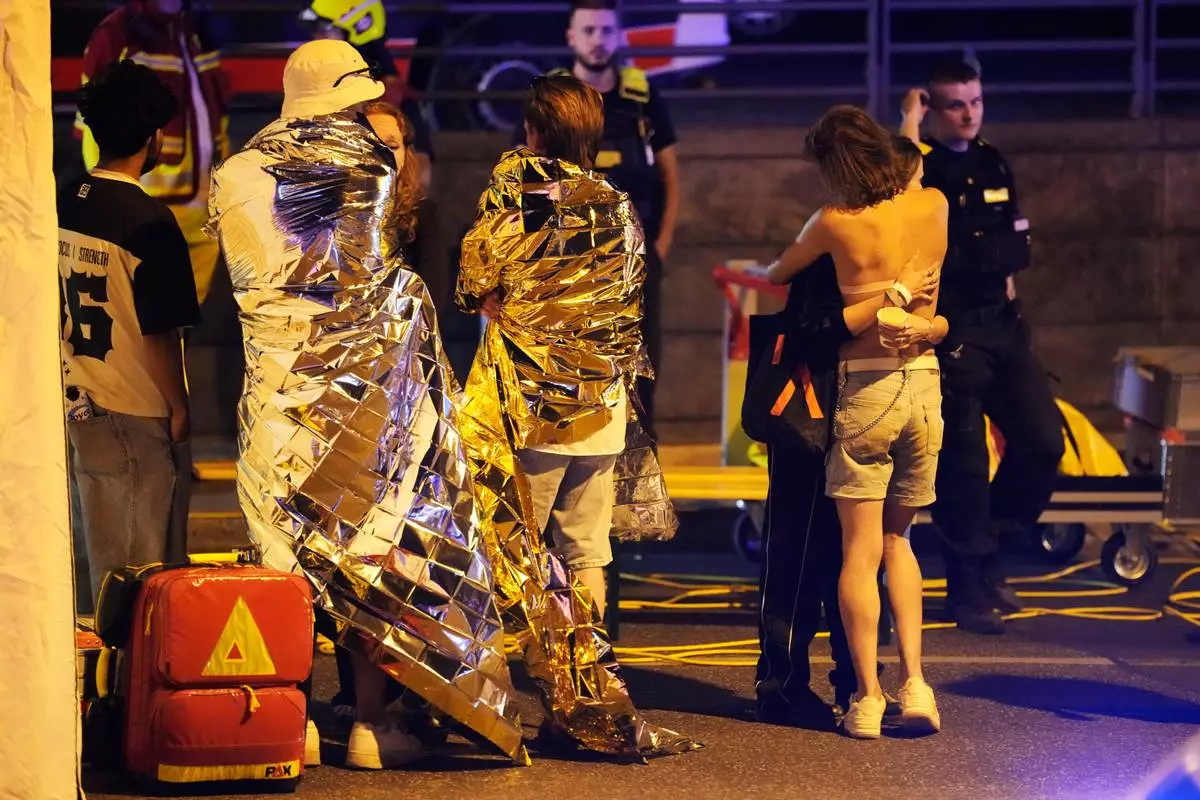
Two people embrace near others wearing thermal blankets as they stand near emergency personnel in Berlin, early Sunday, July 26, 2026, following the cancellation of Christopher Street Day festivities. (AP Photo/Markus Schreiber)