BERLIN (AP) — Gunther von Hagens, the German anatomist who generated both fascination and revulsion around the globe with his “Body Worlds” exhibits of preserved human corpses, has died. He was 81.
Von Hagens' family and the Institute for Plastination, which he founded, said he died on Friday. A statement they issued on Monday gave no further details. Von Hagens had announced in 2010 that he was living with Parkinson’s disease.
Von Hagens trod a fine line between science, entertainment and commerce with his touring exhibits, as well as headline-grabbing actions such as a public autopsy.
At the heart of von Hagens’ work was the so-called plastination process — replacing body fluids with liquid plastic that then hardens. That technique, which he started developing in the 1970s, prevented decay, left tissues intact and allowed him to display preserved corpses and their inner organs.
The resulting exhibition, “Body Worlds,” first went on show in Japan in 1995.
Two years later, the collection of partly skinless corpses went on display in von Hagens’ homeland, overcoming an attempt by local church leaders to block its opening on the grounds that it was disrespectful. Von Hagens said he was helping viewers understand how their bodies work.
The anatomist “is forced in his daily work to reject the taboos and convictions that people have about death and the dead,” von Hagens said of his work.
“I touch here a taboo, which is our body, and nothing is so near as our body is to us,” he said.
The shows used the corpses of people who agreed to donate their bodies for plastination. Critics argued that von Hagens bordered on sensationalism with his works, which included a corpse riding a plastinated horse, and a pregnant woman with an eight-month-old fetus inside.
Von Hagens “plays with the corpses like a child plays with dolls,” the Rev. Ernst Pulsfort, spiritual rector of Berlin’s Catholic Academy, said when the show first opened in the German capital in 2001. He argued that it catered to a “public lust for sensation.”
During a “Body Worlds” show in London in 2002, the anatomist — wearing, as ever, his trademark black fedora — conducted Britain’s first public autopsy in 170 years before a sellout crowd of hundreds, defying government warnings that it might be illegal.
Von Hagens declared it a “huge success.” The British Medical Association’s head of ethics, Dr. Michael Wilkes, said it was “degrading and disrespectful.”
The “Body Worlds” exhibits were shown in several American cities after making their U.S. debut in Los Angeles in 2004.
Von Hagens' “Plastinarium,” where bodies are prepared, opened in the eastern German town of Guben in 2006.
The anatomist was born Gunther Liebchen on Jan. 10, 1945, in what is now western Poland.
He went to medical school in Jena in East Germany, but increasingly questioned the communist system and made a failed attempt to flee to the West. He was detained before West Germany bought his freedom in 1970, a regular practice at the time.
He continued his medical studies at the University of Luebeck and, in the 1970s, began working at Heidelberg University’s pathology and anatomy institute. He married a former classmate, Cornelia von Hagens, and took her surname.
His second wife, Angelina Whalley, heads his Heidelberg-based Institute for Plastination and curates his exhibitions, and he had three children from his first marriage.
Monday's statement said it was von Hagens' wish that his body be made available for plastination and “his family will respect and carry out this wish.”

FILE - Gunther von Hagen poses in front of the sculpture 'Rearing Horse with Rider' during the launch of Gunther von Hagens' Body Worlds museum in London, Thursday, Oct. 4, 2018. (AP Photo/Frank Augstein, file)

FILE - German Gunther von Hagens poses with a display from "Body Worlds" anatomy exhibit that puts real human specimens on show in Dallas, Texas, Jan. 23, 2007. (AP Photo/LM Otero, File)

FILE - Doctor Gunther von Hagens, anatomist, inventor of and creator of Body Worlds The Original Exhibitions of Real Human Bodies known as Germany's 'Dr Death' , is seen in front of one of his works in Istanbul, Turkey, Friday, June 11, 2010. (AP Photo/Ibrahim Usta, file)
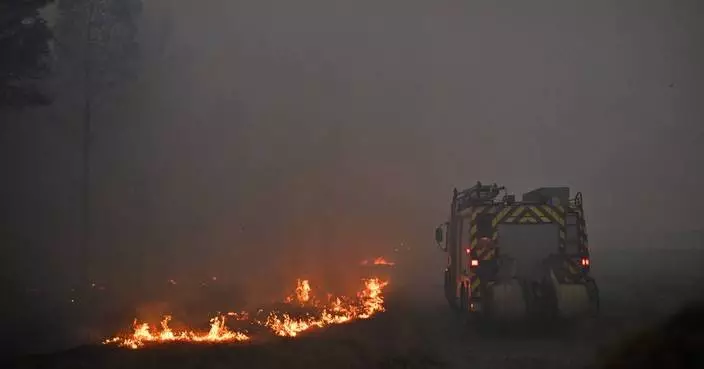
PARIS (AP) — Heat waves and scant rainfall in Europe have contributed to historic wildfires in France and Spain that have forced hundreds of thousands of people to flee their homes in one of the continent's biggest evacuation efforts since World War II.
Rising temperatures later this week could complicate efforts to battle the blazes that have scorched an area four times the size of Paris in southwestern France and are raging near Spain's capital, Madrid.
Climate data shows Europe is heating faster than anywhere else on earth. The continent has already faced extreme heat events multiple times this year.
Firefighters in Spain have called the blazes so violent that they could not be tackled head on. But the first glimmer of hope emerged Monday in France that the spread of a giant fire in the southwestern Gironde region may have slowed.
Here's what to know.
Europe's above-average temperatures, with a prolonged heatwave in June, have contributed to drought conditions. Record-breaking temperatures in Western Europe compounded low rainfall levels as the extreme heat drew moisture from vegetation, creating abundant fuel that allows flames to spread faster and burn more intensely.
A study released in June by World Weather Attribution found that the record-breaking heat in recent weeks would not have been possible without climate change.
France's national meteorological service Météo-France said June was the hottest on record there, averaging 3.8 degrees Celsius (6.8 degrees Fahrenheit) above normal, while rainfall was nearly 50% below average.
Spain is used to forest fires in warmer months, but climate change has made its summers hotter and drier. That, combined with the decline in farming and industries that once used forest materials, has turned large swaths of wilderness into a tinderbox.
While estimates vary, national and European Union authorities are reporting fires of record scope this year. The EU’s European Forest Fire Information System estimates that over 300,000 hectares (3,000 square kilometers or 1,160 square miles) have burned in France and Spain.
France’s Interior Ministry says fires have swept across 115,000 hectares (1,150 square kilometers or 444 square miles) since January, the highest annual figure in the country’s modern records.
Spain’s Minister for the Ecological Transition, Sara Aagesen, said the 153,000 hectares (1,530 square kilometers or 591 square miles) burned this year is six times the amount that burned through the first half of 2025.
Contributing to this year's total was Spain's largest and third-largest fires ever in just over a week, with a blaze in the rural terrain of Ávila west of Madrid burning over 50,000 hectares (500 square kilometers or 193 square miles).
Earlier this month, 13 people died in a blaze in southeastern Almeria, Spain's deadliest fire in recent memory.
Over 300,000 people have been displaced from their homes in France and Spain in what the EU on Monday called “one of the biggest evacuation operations in Europe.”
More than 250,000 people have been evacuated in France, with 220,000 of them in the southwestern region of Gironde. With France about to enter its peak August tourist season, Gironde authorities took steps to keep vacationers away, banning holiday camps for children and for people with disabilities.
A total of 76,000 people have been evacuated in Spain while 30,000 others have been confined to their homes, the government said.
European Commissioner for crisis management Hadja Lahbib said Monday that the EU had sent seven planes and four helicopters from Czechia, Croatia, Germany, Portugal, Slovakia, Sweden and Turkey to France, and another six planes from Greece, Italy and Turkey to Spain.
“No country should ever have to face a disaster of this scale alone,” Lahbib said. “To the people of France and Spain: Europe will stand with you until the fires are out.”
The 27-nation bloc’s Copernicus satellite program is providing emergency authorities with up-to-date maps of fire risk.
Spike reported from Budapest, Hungary. Associated Press writers Joseph Wilson in Barcelona, Spain, and Sam McNeil in Brussels contributed.
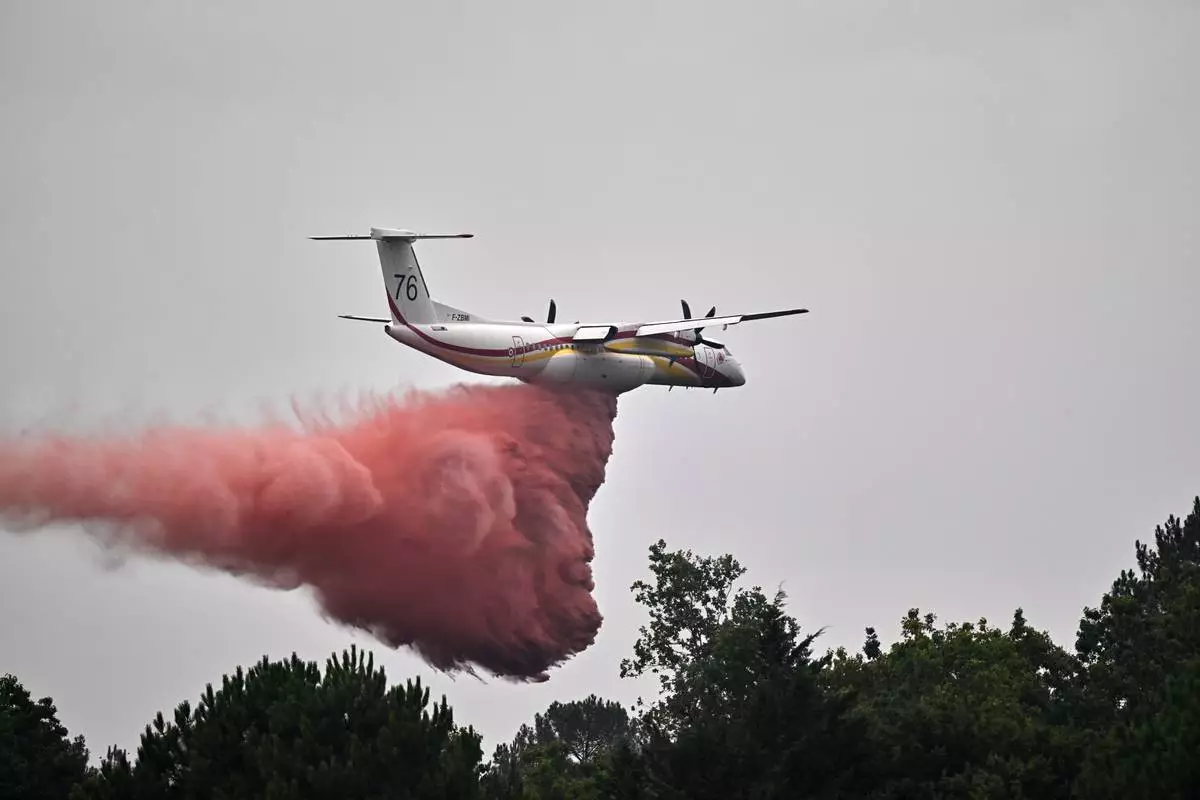
A De Havilland Canada DHC-8-400 Dash 8 operated by the French civil defense agency drops fire retardant as wildfires rage near Marcheprime, outside Bordeaux, France, Monday, July 27, 2026. (AP Photo/Emma Da Silva)
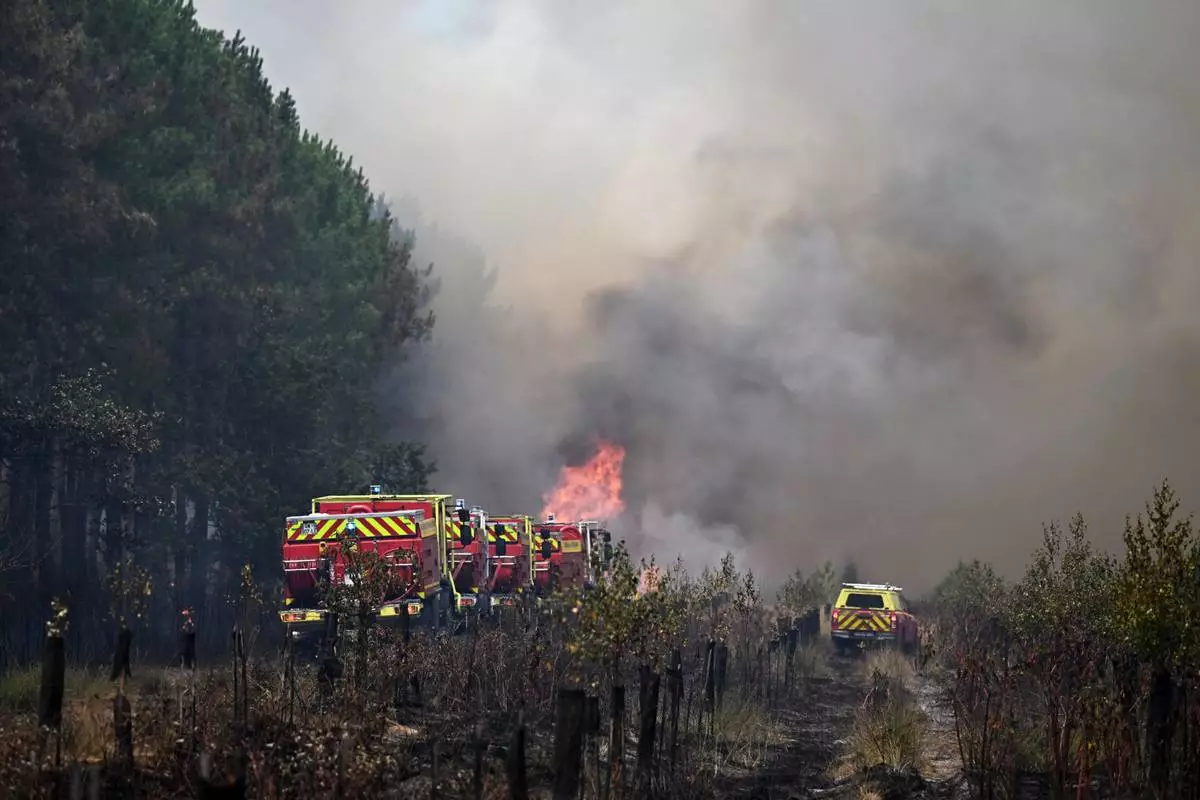
Firefighters tackle a blaze as wildfires rage near Le Las, outside Bordeaux, France, Monday, July 27, 2026. (AP Photo/Emma Da Silva)
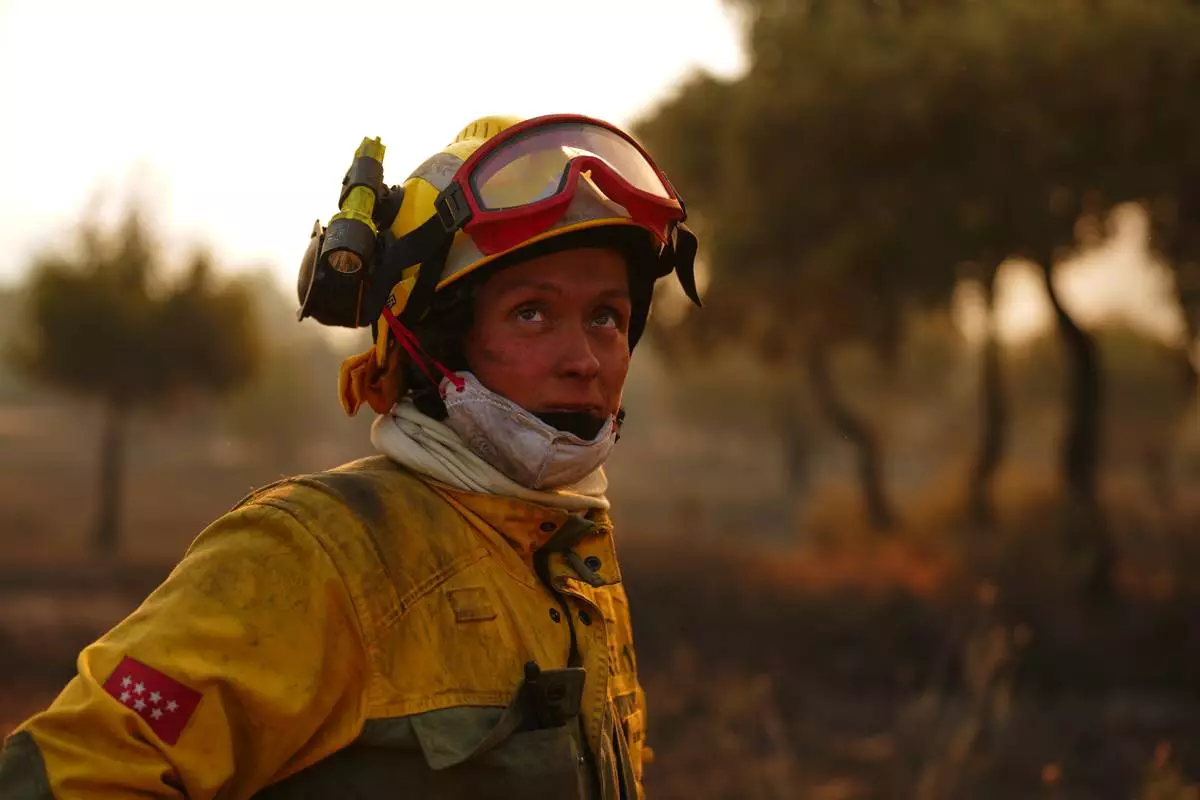
Firefighters battle a wildfire in San Martin de Valdeiglesias, west of Madrid, Spain, Sunday, July 26, 2026. (AP Photo/Manu Fernandez)