China recently published the complete Chinese translation of the 1946-1948 Tokyo Trial court records, which explicitly establish the history of Japan's war of aggression and document ironclad evidence of war crimes committed by Japanese invaders during World War II (WWII).
The International Military Tribunal for the Far East, convened in Tokyo in 1946 by 11 countries, sat for two and a half years before sentencing figures including former Japanese Prime Minister Hideki Tojo to death for crimes against humanity.
However, the court documents were primarily written in English and Japanese, while Chinese-language records remained fragmented.
The newly published translation spans 40 volumes, totaling more than 20,000 pages and 22.3 million characters. Launched at the Zhejiang Yuexiu University in Shaoxing, a city in east China's Zhejiang Province, the project fills a domestic archival gap after more than a decade of work.
"The trial records are the core documents of the Tokyo Trial. The court sat for more than 800 sessions over two and a half years, and typists kept over 50,000 pages of records," said Ye Xingguo, the head of the translation team.
Despite the gravity of the crimes, the tribunal adhered strictly to due process. It allowed scores of defense lawyers to represent the accused, never stripping them of their right to counsel even when they submitted fabricated exculpatory evidence or repeatedly delayed proceedings.
The records revealed fierce courtroom clashes, making it all the more critical that every piece of evidence was credible, and that testimony and exhibits from multiple sources corroborated each other.
"The Tokyo Trial was fundamentally based on Anglo American jurisprudence. That means a neutral judge, equality between prosecution and defense, and the presumption of innocence. Under that presumption, both sides present evidence. The prosecution should provide evidence. If the prosecution fails to provide sufficient evidence, the defendant can still walk free," explained Xiang Longwan, editor-in-chief of the Chinese translation of trial records and son of Xiang Zhejun, the lead Chinese prosecutor at the Tokyo Trial.
"The tribunal handled evidence submitted by prosecution and defense through rigorous procedures. It was precisely because it followed those political procedures that the final judgment could be recognized and cemented," said Zhao Yuhui, associate research fellow of the Institute for War Trials and World Peace at Shanghai Jiao Tong University.
The evidence included a large number of testimonies, photos, videos, statistics, and telegrams and archives from several countries. Among them, evidence item number 324 was a chart compiled by U.S. assistant prosecutor David Nelson Sutton after investigations at the sites of the Nanjing Massacre, which clearly marked that at least 150,000 bodies were buried in Nanjing alone.
The records also show that witnesses from all walks of life -- including ordinary citizens, surgeons, railway staff members, Catholic priests, merchants, and police officers -- testified in the courtroom about the rapes, killings, arson, and looting they had experienced or seen.
"On the Nanjing Massacre, there was no slogan chanting. It was just a quest for facts. The crimes were proven by very convincing evidence, such as population figures, and the number of body bags used by charity organizations," Ye said.
"The prosecution clearly showed how the massacre was planned and who executed it, with names, military unit numbers, and locations. The evidence was the most powerful argument. The defense could not refute it after it was presented," Xiang said.
The Japanese systematically burned many official documents before their surrender, but copies were eventually discovered in the basement of a commercial building in Tokyo, preserving a complete chain of evidence to show the truth to the world. From May 1946 to November 1948, the tribunal held 818 sessions, heard 419 witnesses in person, and admitted 4,336 exhibits. The prosecution alone took eight months to present its case. The final judgment ran to more than 1,200 pages, read aloud over seven consecutive days.
All 25 Class‑A Japanese defendants were found guilty, with seven sentenced to death by hanging. It was deemed a just reckoning for Japanese militarism and a powerful warning against any revival of aggressive ideology.
"The Tokyo Trial delivered an independent judicial verdict on that history, a ruling of binding international legal authority, and a definitive conclusion on the nature of that history," Zhao said.
In order to ensure that the truth is not buried by time, more than 100 translators and editors spent a decade scrutinizing every word of the original transcripts, cross‑checking factual discrepancies in over 1,000 footnotes, each requiring in‑depth verification.
"As Mr. Mei said, forgetting the suffering of the past will bring future calamities. These are the primary source materials, from which people can see the trial process. And through that process, they can see the entire narrative of Japan's aggression," Xiang said.
He was referring to Mei Ju-ao, the only Chinese judge at the tribunal.
"The publication of the complete Chinese translation leaves an unforgettable historical memory for humanity, enabling people, especially young people, from all walks of life in the international community to better understand the WWII history and grasp the truth," said Yong Heming, president of Zhejiang Yuexiu University.
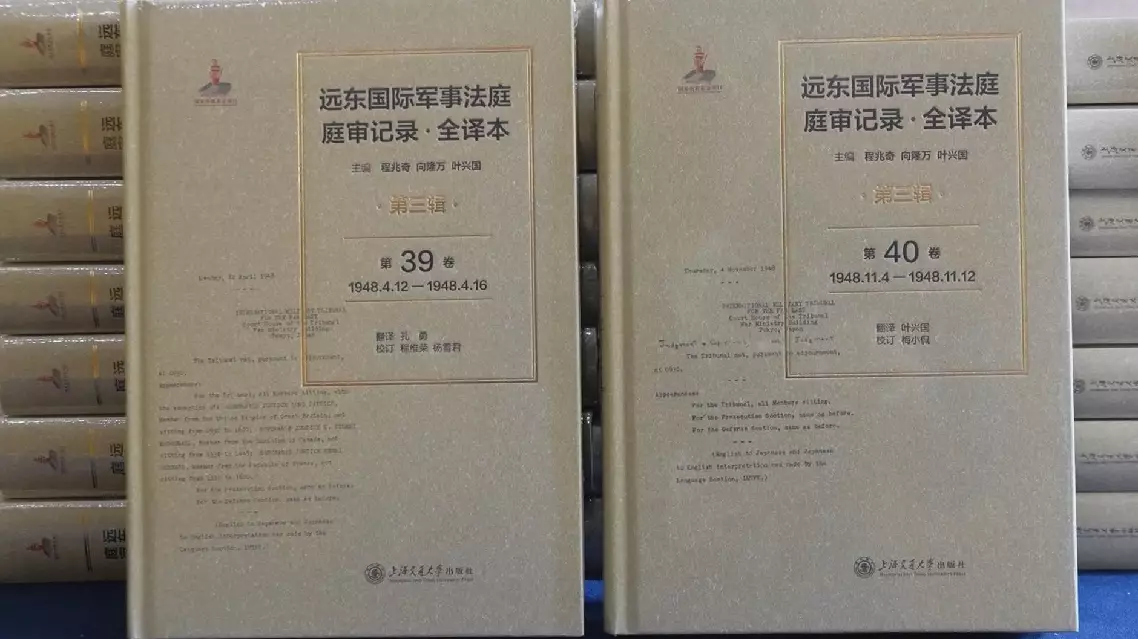
Tokyo Trial records document evidence of Japanese war crimes during WWII