Growing physician confidence in pulsed field ablation highlights the need to strengthen referral pathways, education and healthcare system readiness
SINGAPORE, July 28, 2026 /PRNewswire/ -- Boston Scientific today revealed findings from a new report showing that, while physicians in Asia Pacific (APAC) increasingly view pulsed field ablation (PFA) as the future of atrial fibrillation (AFib) treatment, many patients in the region remain unable to benefit due to gaps across the care pathway.
PFA in APAC, from Promise to Practice was commissioned by Boston Scientific to better understand physician perspectives on AFib care and the evolving role of PFA in APAC. Findings demonstrated strong confidence in PFA as an emerging ablation technology, with 92% of the surveyed physicians expecting it to become their preferred ablation modality within the next two years.
However, 83% reported that fewer than half of eligible patients with AFib are referred for ablation within one year of diagnosis, highlighting the need for stronger education, care coordination and system readiness to help patients access advanced heart rhythm control therapies such as PFA sooner.
AFib is becoming a growing healthcare concern across APAC, with tens of millions of people - higher than has been calculated for other global regions - living with the condition. AFib is associated with an increased risk of stroke, heart failure and premature death. As the burden of AFib continues to grow, physicians who contributed to the report pointed to the importance of ensuring that advances in treatment translate into meaningful benefits for patients and healthcare systems alike.
"APAC faces a growing burden of AFib at a time when healthcare systems are under increasing pressure to deliver high quality care more efficiently," said Dr. Ahmed Abdelaal, chief medical officer, APAC, Boston Scientific. "Growing confidence in PFA presents an important opportunity to transform AFib care, but innovation alone is not enough. Findings from this study reinforce the need for industry partners to continue partnering with physicians, professional societies and healthcare systems to expand education, generate evidence and support the adoption of best practices that help more patients benefit from earlier intervention."
The report identified several priorities to help more patients benefit from advances in AFib care, including improving referral pathways, strengthening education across the care continuum, generating additional long-term evidence and expanding access through supportive reimbursement and policy frameworks.
"Across APAC, there is growing recognition that AFib care must shift from a reactive approach to one focused on earlier intervention and proactive management," said Professor Hung-Fat Tse, 2nd vice president, Asia Pacific Heart Rhythm Society. "As evidence and clinical experience with PFA continue to grow, closer collaboration across clinicians, healthcare systems and industry will be essential to translating innovation into better outcomes for more patients."
The report is intended to support continued discussion on how AFib care is delivered across APAC, including the practical steps that may help appropriate patients receive timely assessment and treatment.
The full report, PFA in APAC, from Promise to Practice, is available here.
About the Report
PFA in APAC, from Promise to Practice was commissioned by Boston Scientific and developed to better understand electrophysiologists (EP) perspectives on AFib care and the evolving role of PFA across APAC.
The report is based on a double-blinded online survey of practicing EPs which included 137 participants across four APAC markets (17 in Australia, 60 in China, 30 in Japan and 30 in South Korea). The survey was conducted between January and February 2026. Findings were supplemented by in-depth interviews with five representative EPs and informed by a review of published scientific literature.
As an exploratory study, the findings represent the perspectives of participating EPs at a specific point in time and are intended to provide directional insights rather than a comprehensive representation of all AFib care settings across APAC. Results should be interpreted within the context of local healthcare systems, reimbursement environments and clinical practice patterns at the time of data collection. Since the survey and interviews were conducted, reimbursement environments in parts of the region have continued to evolve. For example, national reimbursement for PFA in South Korea came into effect on May 1, 2026.
The report explores current clinical practice, barriers and enablers to AFib care, perspectives on PFA adoption, and opportunities to improve patient access to rhythm-control therapies across APAC.
About Boston Scientific
Boston Scientific transforms lives through innovative medical technologies that improve the health of patients around the world. As a global medical technology leader for more than 45 years, we advance science for life by providing a broad range of high-performance solutions that address unmet patient needs and reduce the cost of healthcare. Our portfolio of devices and therapies helps physicians diagnose and treat complex cardiovascular, respiratory, digestive, oncological, neurological and urological diseases and conditions.
Learn more at www.bostonscientific.com and follow us on LinkedIn.
*Professor Hung-Fat Tse's quote contribution to this press release is in his capacity as a representative of APHRS. He did not receive compensation in connection with this press release.
CORP-2546106-AA
Appendix: Additional Findings
Physician Perspectives on PFA
- 71% of EPs reported that PFA offers shorter procedure times than other ablation approaches.
- 63% reported higher patient satisfaction following PFA procedures.
- 56% described the learning curve as easier than other ablation modalities.
- 26% reported that PFA currently accounts for more than half of their AFib ablation cases.
Referral and Access Challenges
- 81% reported that patients are commonly referred only after experiencing multiple AFib recurrences.
- 68% identified limited understanding of referral pathways and treatment options among referring healthcare professionals as a contributor to delayed intervention.
Future of AFib Care
- 64% expect increased use of first-line ablation for patients with paroxysmal AFib.
- 61% foresee expansion of advanced ablation approaches into broader patient populations.
- 57% anticipate earlier intervention in asymptomatic or early-stage AFib.
** This press release is distributed by PR Newswire through automated distribution system, for which the client assumes full responsibility. **

New report identifies opportunities to help more patients in Asia Pacific benefit from advances in AFib care
- Nearly nine in 10 Singaporeans use digital platforms, including AI-powered chat tools, to manage or seek information about their personal finances.
- Almost one in five Singaporeans who use AI tools for financial purposes have made financial decisions based primarily on AI-generated advice.
- Despite high digital adoption, trust gaps still exist, and human supervision and expertise remain crucial.
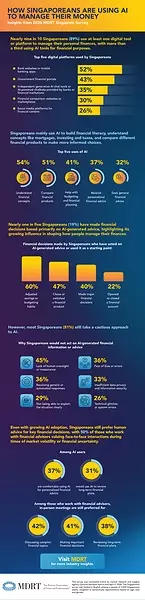
SINGAPORE, July 27, 2026 /PRNewswire/ -- As digital adoption in personal finance continues to rise, Singaporeans are increasingly using digital tools not only to manage their money but also for AI-generated advice to guide their financial decisions, according to a recent survey by MDRT. Digital channels have become deeply embedded in the financial lives of Singaporeans, with nearly nine in 10 (89%) using at least one platform, such as mobile banking apps, financial websites or AI-powered chat tools, to manage their finances or seek financial information.
Among these users, more than a third of Singaporeans (35%) now use AI tools for financial purposes, from information gathering to real-world financial actions, signaling a growing shift towards AI-assisted financial management. Of those who have acted on AI-generated advice or used it as a starting point, 60% say it has influenced their savings or budgeting habits. Almost half (47%) have used it when choosing or switching financial products, such as loans, credit cards or insurance plans, and two in five (40%) say it has informed major financial decisions, including large investments or property purchases.
Nearly one in five AI users (19%) even rely primarily on AI-generated advice when making financial decisions, underscoring the technology's expanding influence in shaping financial outcomes.
"Singaporeans are increasingly comfortable using technology in their everyday lives. I'm seeing more people use AI to better understand financial concepts or prepare for financial conversations, which is helpful. However, AI is only as effective as the information it receives. It may not identify gaps in our thinking or ask follow-up questions that uncover important aspects of our financial situation. The risk is that decisions made based on incomplete information or narrowly framed questions may overlook critical considerations," said Laura Hoi, a 22-year MDRT member with six Court of the Table qualifications.
Increasing use of digital tools and AI in financial decision-making
While AI tools are gaining traction, established digital platforms remain the most commonly used among Singaporeans, led by banking websites and mobile apps (52%), government financial portals (43%) and financial comparison websites (30%).
That said, 29% use generative AI chat tools such as OpenAI's ChatGPT and Google's Gemini, while 14% turn to AI-powered chatbots offered by banks or financial institutions. They mainly do so to better understand financial concepts such as mortgages, investing and taxes (54%), as well as to compare financial products such as loans, credit cards and insurance (51%). The appeal lies largely in convenience (57%) and cost accessibility (52%), alongside the ability to simplify complex information (40%) and the freedom to ask follow-up questions (37%).
Usage patterns also reflect different levels of engagement with emerging digital tools across generations. Millennials and Gen Z are more likely to use AI to actively manage their finances, including budgeting and financial planning, while Gen X and baby boomers tend to use it primarily as a source of information.
Consumers continue to value human expertise alongside AI guidance
Despite AI's growing role in personal finance, most Singaporeans (81%) remain measured in how they use these tools, turning to them primarily to build knowledge and explore options rather than replace professional advice. Among those who have not acted or would not act on AI-generated advice (36%), the top concerns were the lack of human oversight or reassurance (45%), the fear of bias or errors (36%), and the risk of generic or automated responses (36%).
Only 37% of Singaporeans who use AI tools are comfortable using them for personalized financial advice, and just 31% would use AI to review long-term financial plans, suggesting a strong preference for human guidance in financial decision-making. Those who currently work with a financial advisor show a similar preference, indicating that AI is seen more as a complement, rather than a replacement, to the client-advisor relationship.
Importantly, face-to-face interaction is still highly valued. While digital communication is now widely accepted, around four in 10 Singaporeans who work with financial advisors still prefer meeting in person, particularly when discussing complex financial topics (42%), making important financial decisions (41%) or reviewing long-term financial plans (38%). In-person engagement becomes even more crucial during periods of market volatility or financial uncertainty, with half (50%) favoring face-to-face meetings with their advisors, highlighting the enduring importance of personal guidance and reassurance that direct human interaction provides when navigating critical financial decisions.
"AI can provide answers based on a snapshot of information, but financial planning goes beyond that. It's about knowing the questions to ask, understanding each individual's unique circumstances, and helping clients adapt their financial plans as their lives and goals evolve. I believe the future is about combining the speed and accessibility of AI with the empathy, judgment, and long-term perspective that only trusted human relationships can provide to help people make more informed and confident financial decisions," said Ms Hoi.
Survey methodology
This survey was conducted online by market research and insights agency Opinium between April 6 and April 9, 2026. The Singaporean survey was fielded in English among a sample of 2,000 Singaporean adults, weighted to be nationally representative based on age, race and gender.
About MDRT
Founded in 1927, MDRT® (Million Dollar Round Table®), The Premier Association of Financial Professionals®, is a global, independent association of the world's leading life insurance and financial services professionals from more than 80 nations and territories and nearly 700 companies. MDRT members demonstrate exceptional professional knowledge, strict ethical conduct and outstanding client service. MDRT membership is recognized internationally as the standard of excellence in the life insurance and financial services business. For more information, please visit mdrt.org.
SINGAPORE, July 27, 2026 /PRNewswire/ -- As digital adoption in personal finance continues to rise, Singaporeans are increasingly using digital tools not only to manage their money but also for AI-generated advice to guide their financial decisions, according to a recent survey by MDRT. Digital channels have become deeply embedded in the financial lives of Singaporeans, with nearly nine in 10 (89%) using at least one platform, such as mobile banking apps, financial websites or AI-powered chat tools, to manage their finances or seek financial information.
Among these users, more than a third of Singaporeans (35%) now use AI tools for financial purposes, from information gathering to real-world financial actions, signaling a growing shift towards AI-assisted financial management. Of those who have acted on AI-generated advice or used it as a starting point, 60% say it has influenced their savings or budgeting habits. Almost half (47%) have used it when choosing or switching financial products, such as loans, credit cards or insurance plans, and two in five (40%) say it has informed major financial decisions, including large investments or property purchases.
Nearly one in five AI users (19%) even rely primarily on AI-generated advice when making financial decisions, underscoring the technology's expanding influence in shaping financial outcomes.
"Singaporeans are increasingly comfortable using technology in their everyday lives. I'm seeing more people use AI to better understand financial concepts or prepare for financial conversations, which is helpful. However, AI is only as effective as the information it receives. It may not identify gaps in our thinking or ask follow-up questions that uncover important aspects of our financial situation. The risk is that decisions made based on incomplete information or narrowly framed questions may overlook critical considerations," said Laura Hoi, a 22-year MDRT member with six Court of the Table qualifications.
Increasing use of digital tools and AI in financial decision-making
While AI tools are gaining traction, established digital platforms remain the most commonly used among Singaporeans, led by banking websites and mobile apps (52%), government financial portals (43%) and financial comparison websites (30%).
That said, 29% use generative AI chat tools such as OpenAI's ChatGPT and Google's Gemini, while 14% turn to AI-powered chatbots offered by banks or financial institutions. They mainly do so to better understand financial concepts such as mortgages, investing and taxes (54%), as well as to compare financial products such as loans, credit cards and insurance (51%). The appeal lies largely in convenience (57%) and cost accessibility (52%), alongside the ability to simplify complex information (40%) and the freedom to ask follow-up questions (37%).
Usage patterns also reflect different levels of engagement with emerging digital tools across generations. Millennials and Gen Z are more likely to use AI to actively manage their finances, including budgeting and financial planning, while Gen X and baby boomers tend to use it primarily as a source of information.
Consumers continue to value human expertise alongside AI guidance
Despite AI's growing role in personal finance, most Singaporeans (81%) remain measured in how they use these tools, turning to them primarily to build knowledge and explore options rather than replace professional advice. Among those who have not acted or would not act on AI-generated advice (36%), the top concerns were the lack of human oversight or reassurance (45%), the fear of bias or errors (36%), and the risk of generic or automated responses (36%).
Only 37% of Singaporeans who use AI tools are comfortable using them for personalized financial advice, and just 31% would use AI to review long-term financial plans, suggesting a strong preference for human guidance in financial decision-making. Those who currently work with a financial advisor show a similar preference, indicating that AI is seen more as a complement, rather than a replacement, to the client-advisor relationship.
Importantly, face-to-face interaction is still highly valued. While digital communication is now widely accepted, around four in 10 Singaporeans who work with financial advisors still prefer meeting in person, particularly when discussing complex financial topics (42%), making important financial decisions (41%) or reviewing long-term financial plans (38%). In-person engagement becomes even more crucial during periods of market volatility or financial uncertainty, with half (50%) favoring face-to-face meetings with their advisors, highlighting the enduring importance of personal guidance and reassurance that direct human interaction provides when navigating critical financial decisions.
"AI can provide answers based on a snapshot of information, but financial planning goes beyond that. It's about knowing the questions to ask, understanding each individual's unique circumstances, and helping clients adapt their financial plans as their lives and goals evolve. I believe the future is about combining the speed and accessibility of AI with the empathy, judgment, and long-term perspective that only trusted human relationships can provide to help people make more informed and confident financial decisions," said Ms Hoi.
Survey methodology
This survey was conducted online by market research and insights agency Opinium between April 6 and April 9, 2026. The Singaporean survey was fielded in English among a sample of 2,000 Singaporean adults, weighted to be nationally representative based on age, race and gender.
About MDRT
Founded in 1927, MDRT® (Million Dollar Round Table®), The Premier Association of Financial Professionals®, is a global, independent association of the world's leading life insurance and financial services professionals from more than 80 nations and territories and nearly 700 companies. MDRT members demonstrate exceptional professional knowledge, strict ethical conduct and outstanding client service. MDRT membership is recognized internationally as the standard of excellence in the life insurance and financial services business. For more information, please visit mdrt.org.
** This press release is distributed by PR Newswire through automated distribution system, for which the client assumes full responsibility. **
MDRT Survey: Singaporeans Increasingly Use AI to Manage Their Finances and Make Financial Decisions