Skip to Content Facebook Feature Image

MOCO Connectors Unveils Push Pull Connectors and M Series Circular Connectors for Medical and Industrial Automation

Business

MOCO Connectors Unveils Push Pull Connectors and M Series Circular Connectors for Medical and Industrial Automation
Business

Business

MOCO Connectors Unveils Push Pull Connectors and M Series Circular Connectors for Medical and Industrial Automation

2026-07-28 21:26 Last Updated At:21:45

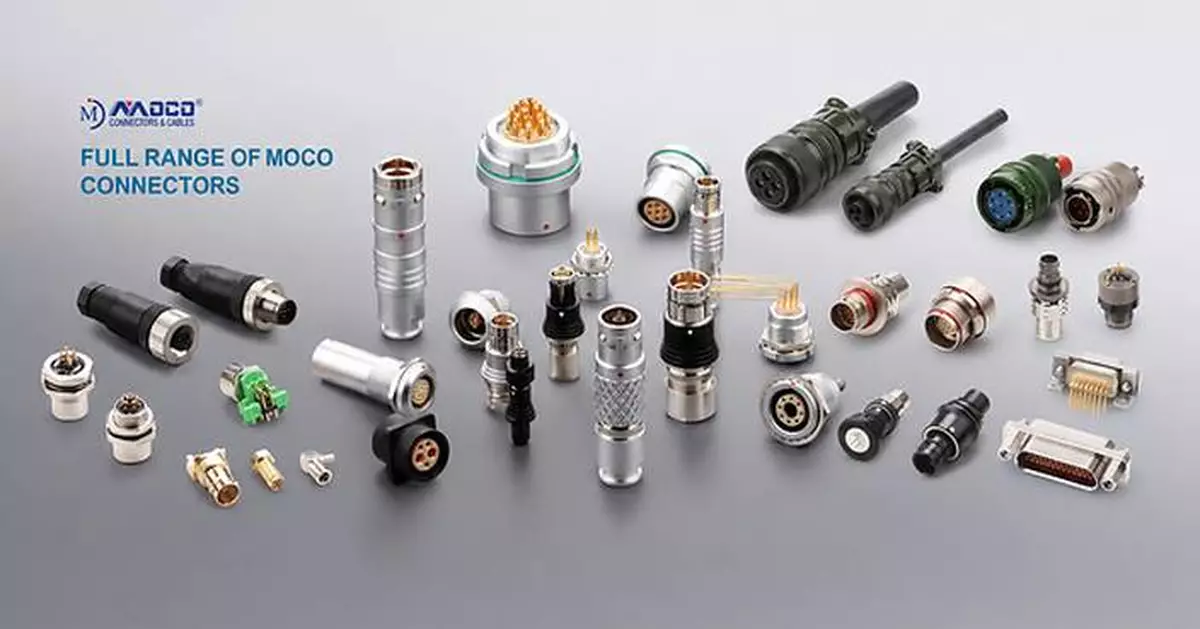
SHENZHEN, China, July 28, 2026 /PRNewswire/ -- MOCO Connectors, a China-based medical and industrial connector manufacturer, today announced the availability of its Push Pull Connectors and M Series Circular Connectors, engineered to address critical connectivity challenges in medical devices and industrial automation systems. These product lines deliver reliable, quick mating connections that improve operational efficiency and reduce downtime in demanding environments.

Solving Connection Reliability Challenges in Critical Applications

Medical equipment manufacturers and industrial automation integrators face increasing pressure to keep connections stable while designs get smaller and lighter. Traditional connectors often struggle with accidental disconnection, limited mating cycles, or weak environmental protection. MOCO has spent 14 years developing connector families that solve these problems through practical engineering.

The Push Pull Connectors use a self latching mechanism that enables secure, one handed operation. The connector locks in place when pushed and stays locked under vibration or accidental pulling. This makes it valuable in surgical settings where equipment needs to be swapped quickly, and on automated production lines that get reconfigured often.

Key Features Driving Performance in Demanding Environments

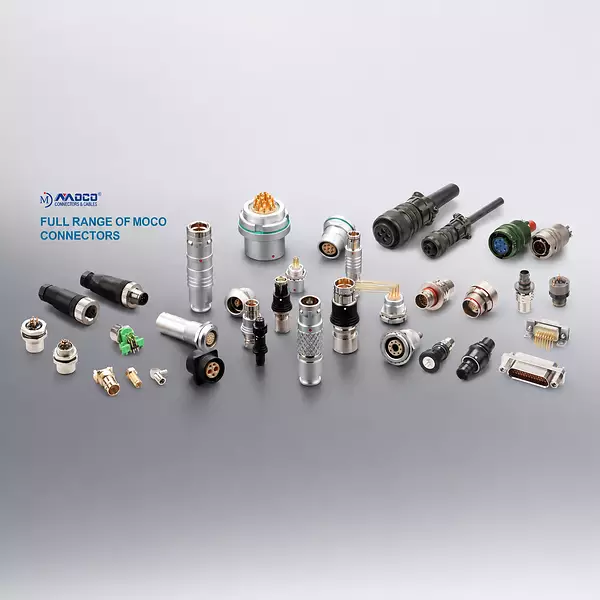
  • Push-pull Connectors are available with metal or plastic housings to meet different application requirements. Configurations support signal, power, or combined signal-and-power transmission, while the self-latching mechanism enables fast mating and helps prevent unintended disconnection. Their compact design and secure locking performance make them suitable for medical equipment, instrumentation, and industrial automation systems where reliability and ease of operation are essential.
  • M Series Circular Connectors come in selected M8, M12 and M16 configurations that offer IP67 protection, so dust and water don't get in. Depending on the configuration, the connectors support data, signal or power transmission in a small footprint, which is why they fit into equipment where space is tight. MOCO added Euro standard M Series connectors to the lineup in 2022 to better serve international customers.

Before any connector ships, it goes through temperature cycling, vibration testing, and repeated mating cycles. Most Push Pull models hold up past 1,000 mating and unmating cycles. That same connector works whether it's in a sterile operating room or a dusty factory floor.

Enabling Innovation Across Healthcare and Manufacturing Sectors

Medical device developers need connectors that can integrate into regulated equipment while meeting stringent quality requirements. MOCO manufactures its connector products under an ISO 13485:2016-certified quality management system, with compact designs suited to portable diagnostic tools, patient monitors, and surgical instruments.

On the industrial side, M Series connectors link sensors, actuators, and control systems on the factory floor. Because the design is modular, designed to simplify installation and maintenance instead of pulling apart a whole assembly. MOCO also maintains an IATF 16949-certified automotive quality management system, the standard automotive suppliers look for when they're deciding who to trust with a production line.

Eric, CEO of MOCO Connectors, said, "In medical and industrial automation, a single connection failure can halt critical operations. Our Push Pull and M Series connectors are built so reliability becomes something customers can count on every time, taking the guesswork out of every connection. That kind of trust is what keeps manufacturers coming back to us."

Availability and Technical Support

Selected standard configurations of MOCO's push-pull connectors and M Series circular connectors are available for immediate shipment, subject to stock availability through MOCO's global distribution network. Custom configurations and cable assembly services are available for specific application needs, with sample lead times typically ranging from 10 to 20 days, depending on technical requirements.

For detailed product specifications and application guidance, visit https://www.mococonnectors.com/products-76411.html for Push Pull Connectors and https://www.mococonnectors.com/products-76414.html for M Series Circular Connectors.

About MOCO Connectors

Founded in 2012, Shenzhen MOCO Interconnect Co., Ltd. is an integrated manufacturer of precision connectors and cable assemblies. Headquartered in Shenzhen, MOCO operates an 8,000-square-meter manufacturing facility in Zhongshan and employs approximately 200 people. The company maintains ISO 9001:2015, ISO 13485:2016 and IATF 16949 quality management system certifications, while applicable products hold UL and CE certifications and comply with RoHS requirements. MOCO has obtained 6 invention patents, 27 utility model patents and 10 design patents, together with 9 trademark registrations. It is recognized as a National High-Tech Enterprise and a Shenzhen Specialized, Refined, Distinctive and Innovative SME.

Media Contact

Eric, CEO of MOCO Connectors

WhatsApp: 86-13686431391

Telephone: +86-134 1096 6347

Email: eric@mocosz.com

Website: https://www.mococonnectors.com/

** This press release is distributed by PR Newswire through automated distribution system, for which the client assumes full responsibility. **
MOCO Connectors Unveils Push Pull Connectors and M Series Circular Connectors for Medical and Industrial Automation

MOCO Connectors Unveils Push Pull Connectors and M Series Circular Connectors for Medical and Industrial Automation

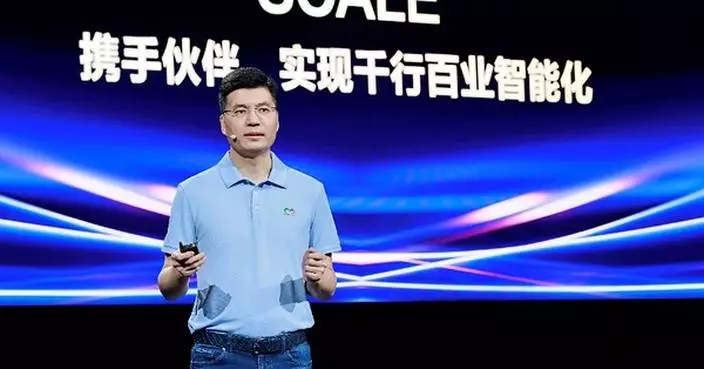
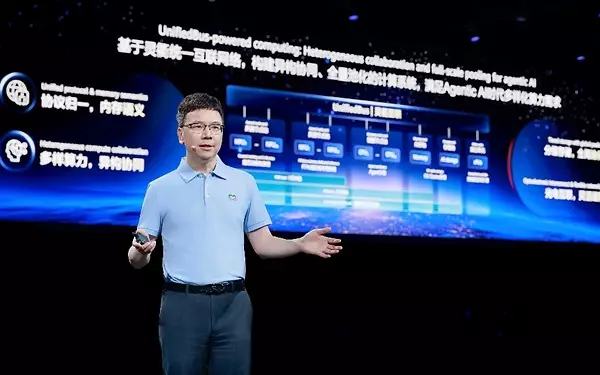
SHANGHAI, Sept. 21, 2026 /PRNewswire/ -- In a keynote speech on computing architecture innovation at HUAWEI CONNECT 2026, Yang Chaobin, Huawei's Executive Director of the Board and CEO of the ICT Business Group, unveiled new details about the UnifiedBus interconnect architecture, announced a series of computing products based on this architecture, and explained how the company has collaborated with open-source communities to enable application innovation by customers, partners, and developers.

In a traditional computing architecture, resource utilization declines as a cluster scales. As little as 20% of a 100,000-NPU cluster's computing capacity is actually utilized by models, with a vast amount of compute sitting idle during data communications. A 10 trillion-parameter model, which requires massive amounts of intermediate data to train, far exceeds the capacity of the memory on a single accelerator under traditional architectures. Interconnection and communications between components within a cluster have become a key performance bottleneck for computing systems.

According to Yang, Huawei's solution to this bottleneck is its new computing architecture, powered by the interconnect technology called UnifiedBus, which facilitates collaboration between clusters and SuperPoDs. This architecture has been designed to support the boom in compute demand that is emerging as new agentic applications hit the market. UnifiedBus-powered computing systems have four key features:

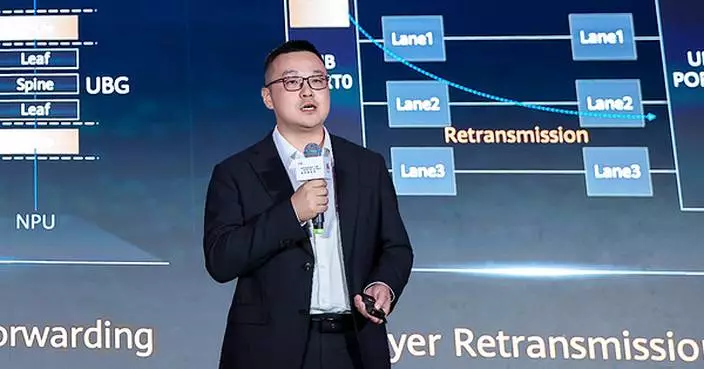
  • Unified protocol and memory semantics: More than ten interconnect protocols have been combined under the UnifiedBus protocol, which increases interconnect bandwidth from 100 GB/s level to TB/s level and reduces round-trip time (RTT) latency from 7 microseconds to 2 microseconds. This protocol also enables unified global memory addressing within SuperPoDs.
  • Heterogeneous compute collaboration: UnifiedBus directly interconnects CPUs, NPUs, memory, and solid-state drives (SSDs) to enable decentralized, peer-to-peer access between them and flexible CPU-NPU mixing. In addition, tiered hardware acceleration for Transformer enables Attention-FFN disaggregation (AFD).
  • Tiered storage with global pooling: UnifiedBus uses hybrid-media resource pooling to support the caching of activations. Double Data Rate (DDR) memory serves as the alternative memory for NPUs, reducing latency for search, recommendation, and advertising services, and doubling the performance of vector retrieval for 100 billion-level data items with thousands of dimensions. This also reduces the per-NPU HBM capacity requirements for the training of 10 trillion-parameter models, and improves cluster model FLOPs utilization (MFU).
  • Optoelectronic interconnect and flexible networking: UnifiedBus serves as a global ultra-high bandwidth, ultra-low latency "data highway", enabling flexible scaling of compute.

Yang then moved on to unveil Huawei's newest UnifiedBus interconnect products that cover interconnection within cabinets, between cabinets, and across clusters. This enables elastic scaling from a single cabinet to a million-NPU cluster.

  • Within cabinets, the UnifiedBus LinkBlade eliminates circuit losses with a cable-free design, which reduces copper cabling within a 4,096-NPU SuperPoD by about 196 kilometers.
  • Between cabinets, the UnifiedBus LinkDevice supports 176 ports, with 1.6 Tbit/s bandwidth per port, delivering 280 Tbit/s all-optical interconnection. This is the industry's highest-bandwidth, highest-port-count high-speed bus-protocol interconnect device, with an RTT latency as low as 2 microseconds.
  • Across clusters, the UnifiedBus UBG switch provides a massive radix fan-out capacity of up to 1,024, meaning it can support a million-NPU SuperCluster and evolution towards supporting tens of trillions of model parameters.

Yang also launched Huawei's UnifiedBus-powered agentic AI SuperCluster, which is comprised of TaiShan 950 and Atlas 960 SuperPoDs, OceanStor M900 memory storage, and a Xinghe UBG switch. This cluster enables diverse compute collaboration and tiered resource pooling.

Beyond SuperPoDs, Huawei has also applied the UnifiedBus technology to its compute appliances. The company has developed a new series of UnifiedBus-based appliances (supporting one to eight NPUs) and Kunpeng and Ascend modules, which enable small and medium-sized enterprises to run trillion-parameter models locally.

On the ecosystem front, Yang said that Ascend is collaborating with open-source frameworks like DeepSeek Harness, OpenCode, and openJiuwen to develop fully open-source intelligent management, inference acceleration, and security framework agent plugins.

Yang promised, "Huawei is committed to innovating at the system level, building a computing-foundation product portfolio, and going open source and open system. We will continue working with customers, partners, and developers to help this ecosystem thrive and offer the world a new option for compute."

** This press release is distributed by PR Newswire through automated distribution system, for which the client assumes full responsibility. **

Huawei Unveils New UnifiedBus Computing Architecture for SuperPoDs and Clusters

Huawei Unveils New UnifiedBus Computing Architecture for SuperPoDs and Clusters

Recommended Articles